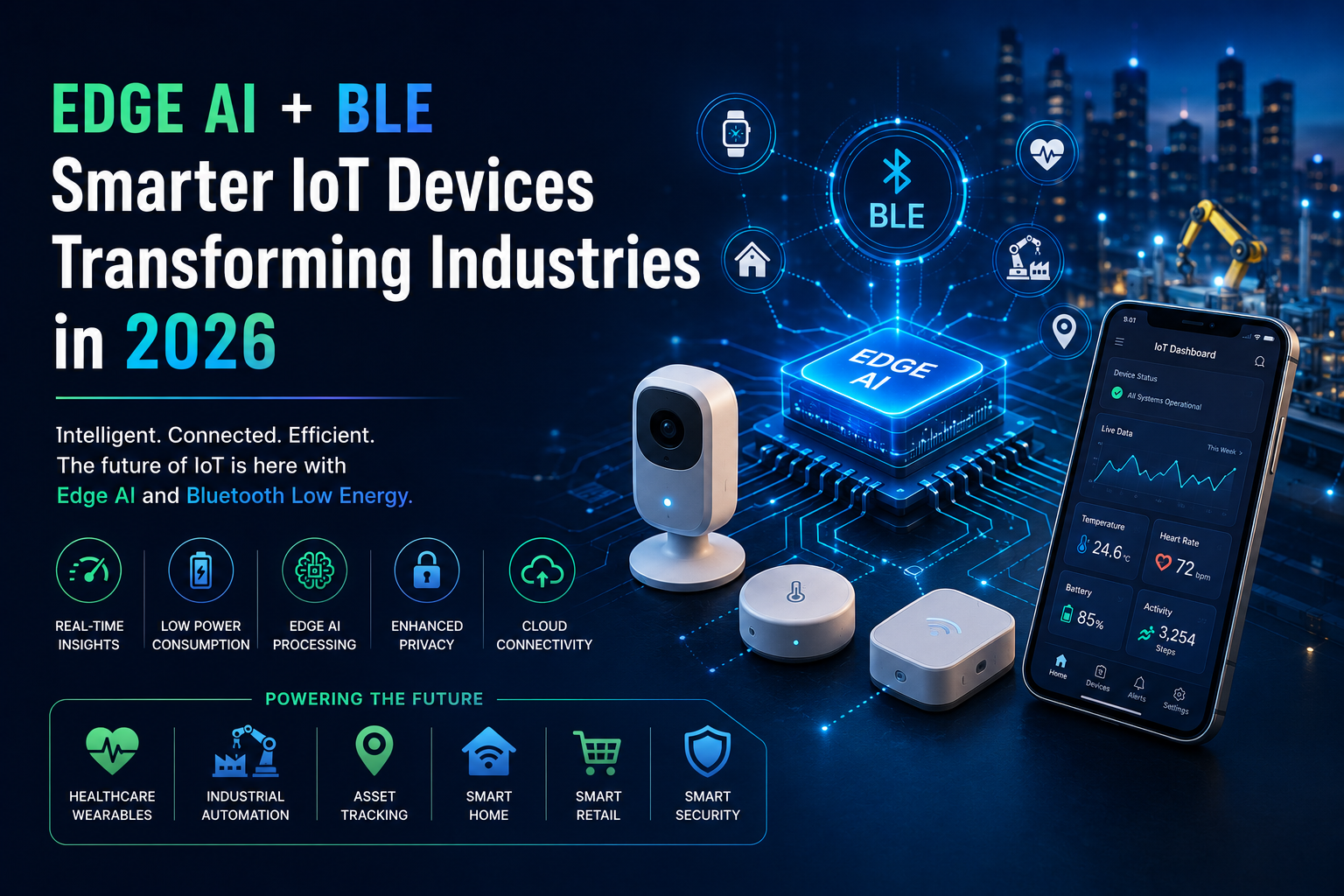
The Internet of Things is entering a more intelligent era.
Connected devices are no longer designed only to collect information and send it to the cloud. In 2026, many IoT solutions are becoming faster, smarter, and more responsive by combining Edge AI with Bluetooth Low Energy (BLE).
This combination allows devices to collect data, process important information closer to where it is generated, and communicate efficiently with mobile applications, gateways, and connected systems.
From healthcare wearables and smart homes to industrial monitoring and asset tracking, Edge AI and BLE are helping businesses build intelligent solutions with lower power consumption, faster responses, and improved real-time capabilities.
What Is Edge AI?
Edge AI refers to running artificial intelligence models directly on or near a device instead of sending all information to a remote cloud server.
For example, a smart sensor may analyze data locally and send only important results to the cloud.
This can provide several benefits:
- Faster decision-making
- Lower latency
- Reduced cloud data usage
- Improved privacy
- Better offline functionality
- More reliable real-time performance
Edge AI is especially useful when a device must respond quickly or operate in environments with limited internet connectivity.
What Is Bluetooth Low Energy?
Bluetooth Low Energy, commonly known as BLE, is a wireless communication technology designed for low-power devices.
BLE allows connected products to exchange small amounts of information while using less energy than traditional Bluetooth communication.
BLE is commonly used in:
- Fitness trackers
- Smartwatches
- Healthcare devices
- Smart locks
- Asset tracking systems
- Industrial sensors
- Smart home products
- Connected retail devices
Its low energy consumption makes BLE useful for battery-powered devices that need to operate for long periods.
Why Combine Edge AI and BLE?
Edge AI and BLE support different parts of an intelligent IoT solution.
BLE provides efficient communication between devices, mobile applications, sensors, and gateways. Edge AI helps devices analyze information and make intelligent decisions closer to the source.
Together, they can support connected solutions that are:
- Fast
- Energy-efficient
- Intelligent
- Responsive
- Scalable
- Privacy-focused
For example, a wearable health device can collect sensor information, use Edge AI to identify unusual patterns, and send an important alert to a mobile application through BLE.
The device does not always need to send every piece of raw information to the cloud.
Top Edge AI and BLE Trends in 2026
1. Smarter Healthcare Wearables
Healthcare wearables are becoming more advanced.
Modern connected devices can support:
- Heart-rate monitoring
- Activity tracking
- Sleep analysis
- Remote patient monitoring
- Medication reminders
- Health alerts
Edge AI can help analyze sensor information locally, while BLE can connect the device to a smartphone or healthcare platform.
This can support faster notifications and reduce unnecessary data transmission.
Healthcare applications should be developed with strong privacy, security, and appropriate professional oversight.
2. Predictive Maintenance in Industry
Industrial equipment can generate large amounts of sensor information.
Edge AI can analyze data from:
- Motors
- Pumps
- Machines
- Temperature sensors
- Vibration sensors
- Production equipment
The system can identify unusual patterns that may indicate a potential equipment issue.
BLE sensors can communicate with nearby gateways or mobile devices, helping businesses monitor equipment without relying on complex wired infrastructure.
Predictive maintenance may help reduce unexpected downtime and improve operational planning.
3. Intelligent Asset Tracking
Businesses need to know where important assets are located.
BLE beacons and connected tags can support:
- Equipment tracking
- Warehouse monitoring
- Inventory visibility
- Staff and asset location
- Hospital equipment management
Edge intelligence can help process location information locally and identify relevant movement patterns.
This can improve operational visibility while reducing unnecessary cloud processing.
4. Smart Home Automation
Smart home technology is becoming more connected and context-aware.
BLE-enabled devices can support:
- Smart locks
- Lighting systems
- Thermostats
- Security sensors
- Home appliances
- Energy monitoring
Edge AI can help devices respond to local conditions.
For example, a smart home system may identify normal activity patterns and automatically adjust lighting or temperature based on user preferences.
5. Connected Retail Experiences
Retail businesses are using BLE and IoT technology to improve customer experiences and store operations.
Possible applications include:
- Smart inventory tracking
- Location-based customer experiences
- Connected POS systems
- Digital shelf monitoring
- Asset management
Edge AI can help analyze store activity and identify useful operational insights in real time.
6. Low-Power AI Devices
Energy efficiency is becoming an important part of IoT product development.
Developers are building smaller AI models that can operate on devices with limited processing power and battery capacity.
These models can support:
- Sensor analysis
- Activity recognition
- Anomaly detection
- Voice commands
- Device monitoring
BLE complements these devices by providing efficient wireless communication.
Key Benefits for Businesses
Faster Responses
Local AI processing can reduce the time required to send information to a cloud server and receive a result.
This is useful for:
- Safety systems
- Healthcare alerts
- Industrial monitoring
- Real-time automation
Lower Cloud Costs
Processing selected information at the edge can reduce the amount of data sent to cloud platforms.
This may lower data transfer and cloud processing requirements.
Improved Privacy
Keeping some information closer to the device can reduce unnecessary data transmission.
However, edge processing does not automatically make a solution secure. Businesses still need encryption, access controls, secure updates, and appropriate data management.
Better Offline Performance
Edge AI can allow some device features to continue working when internet access is unavailable or unreliable.
Longer Battery Life
BLE is designed for low-power communication, making it useful for battery-operated sensors and connected products.
Building an Edge AI and BLE Solution
Developing an intelligent connected product requires both software and hardware planning.
Step 1: Define the Business Use Case
Start with a clear question:
What problem will the connected device solve?
The team should identify:
- Target users
- Device requirements
- Sensor requirements
- AI capabilities
- BLE communication needs
- Expected outcomes
Step 2: Select the Right Hardware
Hardware selection may include:
- Microcontrollers
- BLE chipsets
- Sensors
- Batteries
- Edge AI processors
- Gateways
The hardware should support the application’s performance, power, size, and cost requirements.
Step 3: Design the BLE Architecture
The BLE architecture may include:
- Device discovery
- Secure pairing
- Data services
- Device communication
- Mobile app integration
- Firmware updates
Step 4: Develop the Edge AI Model
The AI model should be optimized for the available device resources.
Developers may consider:
- Model size
- Processing requirements
- Memory usage
- Accuracy
- Power consumption
Step 5: Build the Mobile or Web Application
The connected application may provide:
- Device setup
- Real-time monitoring
- Alerts
- Data visualization
- User controls
- Device management
Step 6: Add Security
Security should be included throughout the solution.
Important measures may include:
- Encrypted BLE communication
- Secure authentication
- Device identity management
- Secure firmware updates
- Access controls
- Cloud security
Step 7: Test in Real-World Conditions
IoT devices should be tested for:
- BLE connection reliability
- Battery performance
- Communication range
- Device compatibility
- AI model accuracy
- Environmental conditions
- Security
Challenges to Consider
Edge AI and BLE offer many benefits, but development can involve challenges.
Common considerations include:
- Limited device memory
- Battery constraints
- BLE range limitations
- Hardware compatibility
- AI model optimization
- Secure device management
- Firmware updates
- Cloud integration
A successful solution requires careful planning across hardware, firmware, mobile applications, cloud services, and AI systems.
Build Intelligent IoT and BLE Solutions with IoTBLE
At IoTBLE, we help businesses turn connected product ideas into scalable and intelligent solutions.
Our services include:
- BLE application development
- IoT software development
- Edge AI integration
- Connected device development
- BLE firmware development
- Mobile app development
- IoT cloud platforms
- Smart healthcare solutions
- Industrial IoT development
- Asset tracking applications
- Smart home applications
- IoT security and testing
Whether you are building a wearable device, industrial monitoring platform, smart home product, or connected business solution, our team can help design and develop technology around your requirements.
Conclusion
The combination of Edge AI and BLE is helping IoT devices become faster, smarter, and more efficient.
By processing important information closer to the device and using low-power wireless communication, businesses can build connected products with better responsiveness, lower data usage, improved privacy, and longer battery life.
In 2026, the future of IoT is not only about connecting devices. It is about creating intelligent systems that can understand data, respond in real time, and deliver practical value.
Ready to build an intelligent connected product? Connect with IoTBLE and transform your idea into a secure, scalable, and future-ready IoT solution.
Leave a Reply