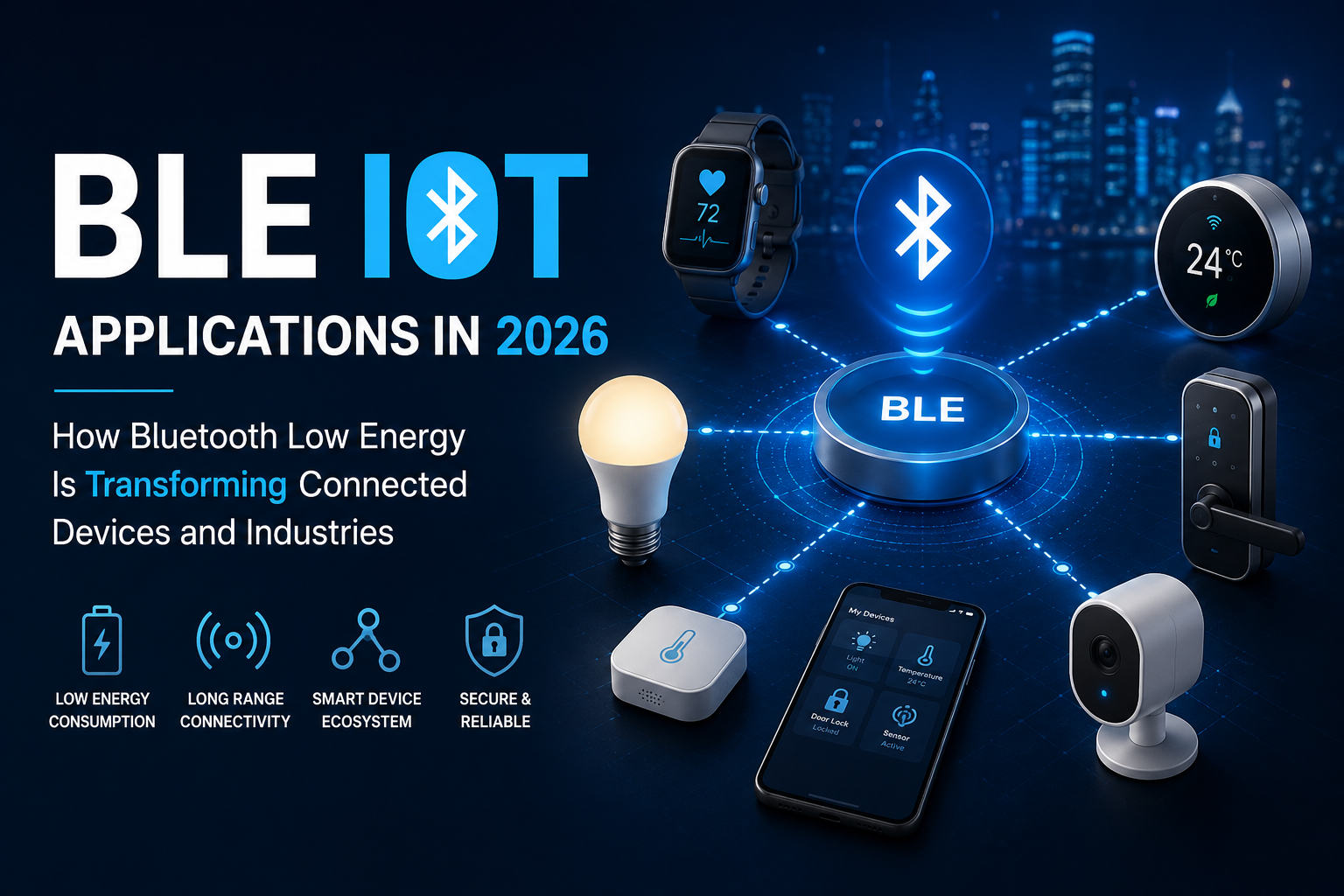
Bluetooth Low Energy (BLE) has become one of the most practical technologies for building connected products that are affordable, energy-efficient, and easy to deploy. As IoT adoption continues to grow in 2026, BLE is playing an increasingly important role in connecting sensors, mobile applications, wearables, healthcare devices, smart buildings, and industrial equipment.
For businesses looking to develop reliable IoT solutions, combining BLE with cloud platforms, mobile apps, edge computing, and AI can create powerful connected experiences.
What Is BLE IoT?
BLE IoT refers to the use of Bluetooth Low Energy technology to connect IoT devices, sensors, and applications. Unlike traditional Bluetooth, BLE is designed for low-power communication, making it particularly suitable for battery-operated devices.
A typical BLE IoT ecosystem can include:
- BLE-enabled sensors
- Smartphones and tablets
- IoT gateways
- Cloud platforms
- Mobile applications
- Web dashboards
- AI and analytics systems
A BLE device collects information such as temperature, movement, location, pressure, or device status and communicates that data to a smartphone, gateway, or other connected system.
Why BLE Is Important for IoT in 2026
The growth of smart devices has increased the demand for wireless technologies that are efficient, reliable, and cost-effective.
BLE offers several advantages:
Low Power Consumption
BLE devices can operate for long periods using small batteries. This makes BLE suitable for wearable devices, sensors, trackers, and remote monitoring systems.
Cost Efficiency
BLE hardware is generally affordable, allowing businesses to deploy large numbers of connected sensors without significantly increasing infrastructure costs.
Smartphone Compatibility
Modern smartphones support BLE, allowing mobile applications to communicate directly with compatible IoT devices without requiring specialized hardware in many use cases.
Flexible Connectivity
BLE can be used for short-range communication between sensors, mobile devices, gateways, and connected equipment.
Scalable IoT Deployments
Businesses can combine multiple BLE sensors with gateways and cloud platforms to create scalable IoT ecosystems.
Major BLE IoT Applications in 2026
1. Healthcare and Medical Devices
BLE is increasingly useful in healthcare monitoring applications. Connected devices can transmit measurements to mobile applications or healthcare platforms.
Potential applications include:
- Patient monitoring
- Fitness and wellness devices
- Medical sensors
- Medication tracking
- Hospital asset monitoring
- Remote health monitoring
BLE can help reduce the need for wired connections while providing convenient access to device data.
2. Smart Homes
BLE is also becoming an important component of smart-home ecosystems.
Connected BLE devices can include:
- Smart locks
- Motion sensors
- Temperature sensors
- Lighting controls
- Door and window sensors
- Energy-monitoring devices
Mobile applications can communicate with these devices and provide users with real-time control and monitoring.
3. Industrial IoT
Industrial businesses can use BLE sensors to monitor equipment and operational conditions.
For example, sensors can collect:
- Temperature
- Vibration
- Pressure
- Machine status
- Equipment usage
- Environmental conditions
This information can be analyzed to identify abnormal conditions and support predictive maintenance strategies.
4. Asset Tracking
BLE beacons and tags can help businesses track equipment, inventory, tools, and other assets.
A BLE-based tracking system can provide information about the approximate location of an asset and help businesses reduce asset loss and improve operational visibility.
5. Retail and Customer Engagement
Retailers can use BLE technology for proximity-based experiences.
BLE beacons can support:
- Indoor navigation
- Product information
- Customer engagement
- Store analytics
- Personalized notifications
- Location-aware experiences
When combined with mobile applications, BLE can create more interactive retail environments.
6. Wearable Technology
BLE is widely used in wearable devices because of its low energy requirements.
Examples include:
- Smartwatches
- Fitness trackers
- Sports sensors
- Health-monitoring devices
- Smart accessories
BLE enables these devices to communicate with smartphones and other connected systems while conserving battery power.
BLE IoT and Mobile Applications
Mobile applications are often an important part of a BLE IoT solution.
A typical application can:
- Scan for nearby BLE devices.
- Identify compatible devices.
- Establish a connection.
- Discover BLE services and characteristics.
- Read or receive sensor data.
- Send commands to the connected device.
- Display information to the user.
- Synchronize selected data with a cloud platform.
This combination of BLE and mobile technology allows businesses to create connected products without requiring users to interact directly with complex hardware.
BLE IoT and Cloud Connectivity
BLE itself is generally designed for local wireless communication. Cloud connectivity can be added through a smartphone, gateway, or edge device.
A common architecture looks like:
BLE Sensor → Smartphone/Gateway → Internet → Cloud Platform → Web/Mobile Dashboard
This architecture allows organizations to collect data from multiple devices and analyze it centrally.
Cloud integration can provide:
- Real-time monitoring
- Historical data
- Device management
- Remote analytics
- Alerts and notifications
- Reporting
- Data visualization
The Role of AI in BLE IoT
AI is becoming an important layer in modern IoT solutions.
Instead of simply collecting sensor data, businesses can use AI to analyze that information and identify meaningful patterns.
For example, AI can help detect:
- Unusual equipment behavior
- Potential device failures
- Abnormal sensor readings
- Usage patterns
- Energy consumption trends
The combination of BLE sensors, IoT platforms, and AI can turn raw device data into actionable business insights.
BLE IoT Security Considerations
Security should be considered from the beginning of every BLE IoT project.
Important areas include:
- Secure pairing
- Authentication
- Encryption
- Device authorization
- Secure firmware updates
- Data protection
- Access control
- Secure cloud communication
Developers should design the complete IoT ecosystem with security in mind rather than treating security as a final-stage feature.
Challenges in BLE IoT Development
Although BLE provides many benefits, IoT development can involve technical challenges.
These may include:
- Device compatibility
- Connection stability
- Background communication on mobile platforms
- Power optimization
- Large-scale device management
- Firmware integration
- Security requirements
- Cloud synchronization
- Cross-platform application development
Choosing the right BLE architecture and development approach can significantly affect the reliability of the final product.
Future of BLE IoT
The future of BLE IoT is moving toward more intelligent, automated, and interconnected systems.
Businesses are increasingly combining BLE with:
- Edge computing
- Artificial intelligence
- Cloud platforms
- Mobile applications
- Real-time analytics
- Smart sensors
- Digital twins
- Location-based technologies
This evolution will allow IoT systems to move beyond basic monitoring toward automated decision-making and intelligent device management.
How Businesses Can Build BLE IoT Solutions
Developing a successful BLE IoT product requires more than simply connecting a Bluetooth device to an application.
A complete solution may involve:
Hardware → BLE Firmware → Mobile App → IoT Gateway → Cloud → Analytics → Admin Dashboard
Working with an experienced BLE and IoT development team can help businesses manage these different components and build a solution tailored to their requirements.
Conclusion
BLE IoT is becoming an important technology for connected products in 2026. Its low power consumption, cost efficiency, smartphone compatibility, and flexibility make it suitable for applications across healthcare, industrial IoT, smart homes, retail, asset tracking, and wearable technology.
When BLE is combined with mobile applications, cloud infrastructure, and AI, businesses can create intelligent IoT ecosystems that improve monitoring, automation, and operational efficiency.
For companies planning to build a BLE-enabled IoT product, now is an excellent time to explore how connected devices can become part of their digital strategy.
Suggested SEO Keywords: BLE IoT, BLE IoT development, Bluetooth Low Energy IoT, BLE IoT applications, IoT development, BLE development, Bluetooth IoT solutions, BLE mobile app development, IoT device connectivity
Leave a Reply