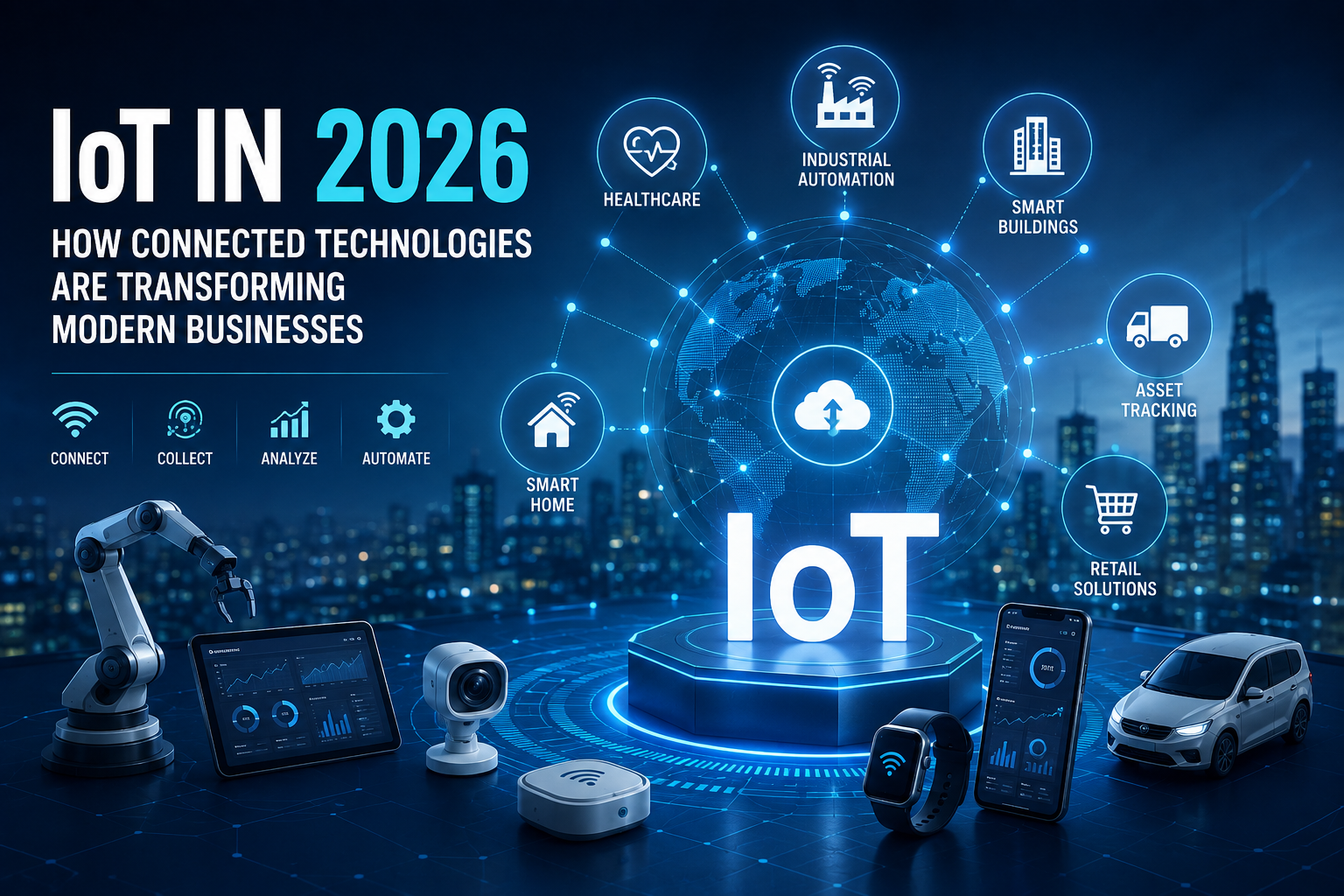
The Internet of Things (IoT) is becoming a major driver of digital transformation in 2026. Businesses across industries are connecting devices, sensors, machines, applications, and cloud platforms to collect data and automate everyday operations.
From smart homes and healthcare to industrial automation and asset tracking, IoT is helping organizations make faster decisions, improve efficiency, and deliver smarter connected experiences.
What Is IoT?
The Internet of Things refers to a network of physical devices that can collect, exchange, and process data through connected technologies.
An IoT ecosystem may include:
- Sensors and connected devices
- Mobile applications
- IoT gateways
- Cloud platforms
- APIs
- Analytics dashboards
- Artificial intelligence and machine learning systems
These components work together to collect real-world information and turn it into actionable business insights.
Why IoT Is Important in 2026
IoT has moved beyond simple device connectivity. Modern IoT solutions increasingly combine connected devices with cloud computing, artificial intelligence, automation, and real-time analytics.
Businesses are using IoT to:
- Monitor equipment remotely
- Automate repetitive processes
- Track assets and inventory
- Improve operational efficiency
- Reduce unnecessary costs
- Analyze real-time data
- Improve customer experiences
- Support predictive maintenance
Major IoT Applications in 2026
1. Industrial IoT
Industrial IoT is helping manufacturers and industrial organizations connect machinery, sensors, and production systems.
Sensors can monitor equipment conditions such as temperature, vibration, pressure, and energy consumption.
This information can help companies identify potential equipment problems before they result in costly downtime.
2. Smart Healthcare
IoT-enabled healthcare devices can collect and transmit important information from connected medical and wearable devices.
Applications include:
- Remote patient monitoring
- Wearable health devices
- Medical equipment monitoring
- Temperature monitoring
- Hospital asset tracking
IoT can improve visibility and help healthcare organizations manage connected equipment more efficiently.
3. Smart Buildings
Smart buildings use connected sensors and systems to monitor and control different aspects of a facility.
Examples include:
- Smart lighting
- Access control
- Temperature monitoring
- Occupancy detection
- Energy management
- Indoor positioning
These systems can help organizations create more efficient and connected working environments.
4. Asset Tracking
IoT technology is increasingly being used to track equipment, vehicles, inventory, and other valuable assets.
Connected tags, sensors, gateways, and cloud platforms can provide businesses with better visibility into asset location and status.
5. Retail IoT
Retail businesses can use IoT to improve inventory management, customer engagement, store operations, and equipment monitoring.
Connected devices can provide real-time information that helps retailers make better operational decisions.
The Role of BLE in IoT
Bluetooth Low Energy (BLE) is an important connectivity technology for many IoT applications.
BLE is particularly useful for battery-powered devices because it is designed for low-power wireless communication.
BLE IoT solutions can be used for:
- Asset tracking
- Wearables
- Indoor positioning
- Smart access systems
- Healthcare devices
- Retail applications
- Industrial sensors
A smartphone or gateway can collect information from BLE devices and transmit the data to an IoT platform or cloud application.
IoT and Artificial Intelligence
One of the biggest developments in modern IoT is the combination of connected devices with artificial intelligence.
IoT devices generate large amounts of data. AI and machine learning can analyze this information to identify patterns and support automated decision-making.
For example, an industrial IoT system can analyze equipment sensor data and identify unusual behavior that may indicate an upcoming failure.
This combination of IoT + AI can help businesses move from reactive operations toward predictive and automated systems.
IoT Cloud Platforms and APIs
A scalable IoT solution often requires a strong backend architecture.
Cloud platforms can store and process data collected from thousands or millions of connected devices.
APIs can connect:
IoT Devices → Gateway/Mobile App → API → Cloud Platform → Dashboard
This architecture allows businesses to monitor devices, manage data, create alerts, and integrate IoT systems with existing enterprise software.
IoT Security Challenges
As more devices become connected, security becomes increasingly important.
IoT developers should consider:
- Device authentication
- Secure communication
- Data encryption
- API security
- Access management
- Secure firmware updates
- Cloud security
- Device lifecycle management
Security should be integrated into the architecture from the beginning rather than added after development.
Challenges of IoT Development
Developing an IoT product involves more than connecting a sensor to the internet.
Common challenges include:
- Hardware and software integration
- Device compatibility
- Network reliability
- Battery optimization
- Data management
- Cloud scalability
- Security
- Firmware updates
- Mobile application integration
- Large-scale device management
A successful IoT solution requires coordination between hardware, firmware, mobile, backend, cloud, and analytics technologies.
How Businesses Can Benefit from IoT
Organizations can use IoT to create measurable improvements across their operations.
Key benefits include:
Improved Efficiency
Automated data collection can reduce manual processes and improve operational workflows.
Real-Time Monitoring
Businesses can monitor devices, equipment, and assets from centralized dashboards.
Predictive Maintenance
Sensor data can help identify equipment issues before major failures occur.
Better Decision-Making
Real-time data gives organizations greater visibility into operations.
New Business Opportunities
Connected products can enable subscription services, remote monitoring, personalized experiences, and new digital revenue models.
Why Choose IoTBLE for IoT Development?
Developing a connected product requires expertise in IoT architecture, wireless communication, mobile applications, APIs, cloud platforms, and device integration.
IoTBLE focuses on connected technology solutions that can help businesses transform ideas into scalable IoT applications.
From BLE-connected devices and smart sensors to mobile applications and cloud-connected IoT platforms, a customized development approach can help businesses build solutions around their specific requirements.
The Future of IoT
The future of IoT will increasingly involve intelligent automation, edge computing, AI-powered analytics, advanced wireless connectivity, and increasingly connected devices.
Instead of simply collecting data, next-generation IoT systems will be designed to understand data and take automated actions.
This evolution will create opportunities across industries including manufacturing, healthcare, logistics, retail, smart buildings, transportation, and consumer electronics.
Conclusion
IoT is transforming the way businesses interact with physical devices and real-world data. In 2026, connected technologies are becoming more intelligent through the integration of BLE, cloud computing, AI, automation, and real-time analytics.
For organizations planning to build connected products or modernize existing operations, a well-designed IoT architecture can provide the foundation for greater efficiency, visibility, and innovation.
The businesses that combine reliable connectivity with secure software, scalable cloud infrastructure, and intelligent data processing will be better positioned to take advantage of the next generation of IoT.
Leave a Reply