The Internet of Things was once described as a future where everything would be connected.
That future has already arrived.
Today, a wearable can communicate with a smartphone. A machine can report its own condition. A smart lock can recognize a nearby device. A healthcare sensor can continuously collect information. A business can monitor equipment without having an employee physically inspect it.
But the interesting part isn’t simply that these devices are connected.
It’s what businesses can do with the data after the connection happens.
This is where BLE and IoT development are creating a new generation of intelligent products.
BLE Is Becoming the Bridge Between Physical Products and Apps
Bluetooth Low Energy (BLE) is particularly useful for applications that need nearby wireless communication without continuously consuming large amounts of power.
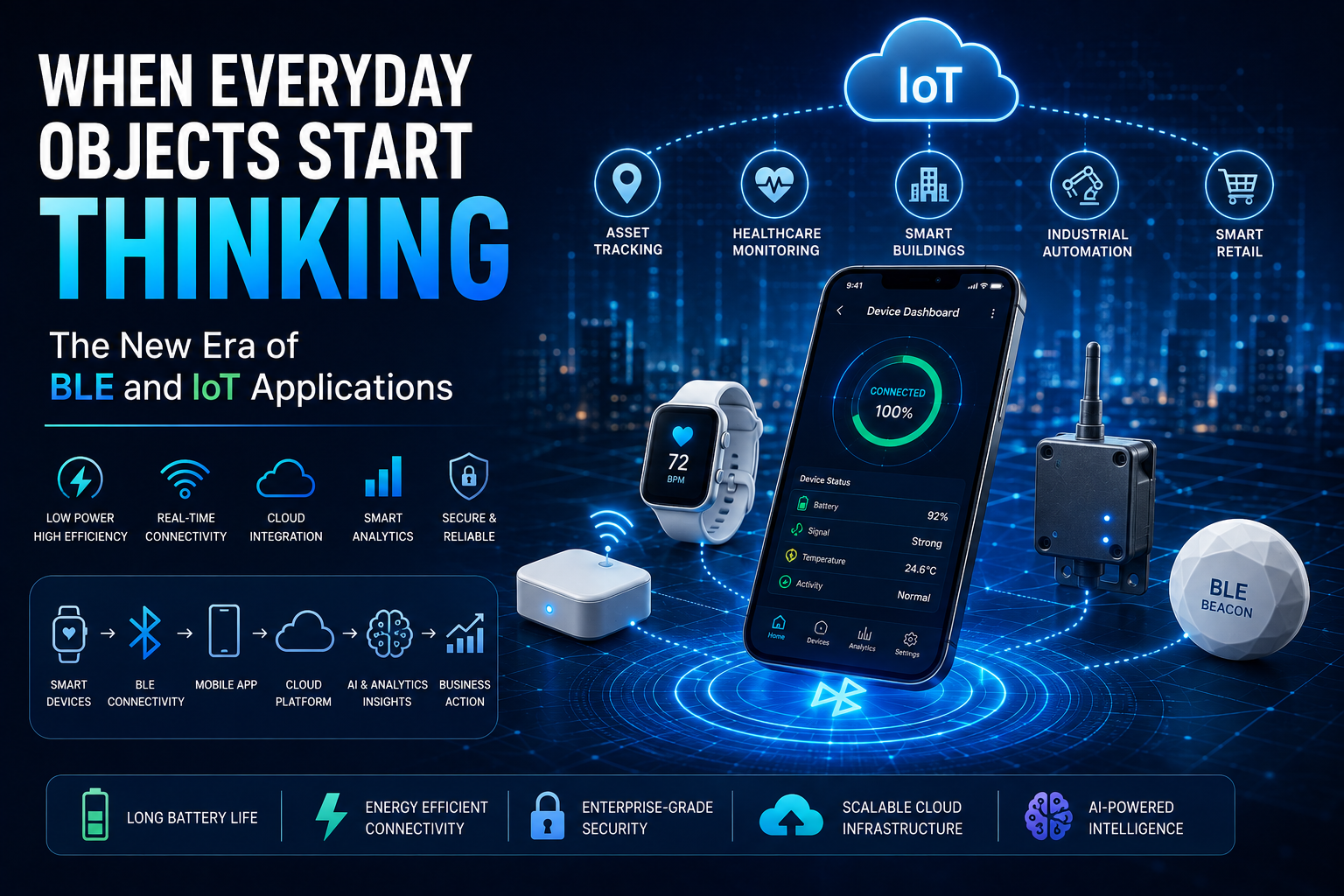
A typical BLE ecosystem can look like:
Smart Device → BLE → Smartphone → Cloud → Analytics → Business Action
This relatively simple architecture can support surprisingly sophisticated products.
BLE can be used for:
- Wearable devices
- Fitness trackers
- Smart locks
- Healthcare equipment
- Asset tracking
- Industrial sensors
- Smart retail systems
- Proximity applications
- Beacon-based experiences
- Connected consumer electronics
The smartphone often acts as the bridge between the physical device and the larger IoT ecosystem.
The Real Value of IoT Isn’t the Device
A connected sensor by itself doesn’t create much business value.
The real value comes from the information generated by that sensor.
Consider an industrial machine.
A traditional machine simply performs its job.
A connected machine can provide information about:
- Temperature
- Usage
- Operating conditions
- Performance
- Errors
- Maintenance requirements
Now imagine software analyzing that information continuously.
The business can potentially identify problems earlier, improve maintenance planning, reduce downtime, and make better operational decisions.
This is the shift from:
Connected Device → Intelligent Business System
BLE + IoT + AI: The Combination Businesses Should Watch
The next major opportunity is not BLE alone or IoT alone.
It is the combination of:
BLE + IoT + AI + Cloud + Mobile
Each technology performs a different role.
BLE
Connects nearby devices.
IoT
Moves device information into a broader connected ecosystem.
Cloud
Provides scalable storage, APIs, processing, and infrastructure.
AI
Turns large amounts of data into insights and predictions.
Mobile Apps
Give users an accessible interface for interacting with connected products.
Together, these technologies can create products that don’t simply collect information—they can help businesses understand and act on it.
From Reactive Products to Predictive Products
Traditional products usually respond after something happens.
A connected product can provide information before a problem becomes obvious.
For example, instead of waiting for equipment to fail, a connected monitoring system could detect unusual operating behavior.
Instead of asking a customer to manually enter information, a wearable could automatically send relevant data to an application.
Instead of manually checking whether an asset is available, a tracking system could provide its status digitally.
This creates a major change in product design:
Old model: Detect → Respond
Connected model: Monitor → Analyze → Predict → Respond
Why Mobile Apps Are Critical to IoT
IoT products often need a simple interface through which users can control or monitor connected devices.
That’s where mobile applications become important.
A mobile app can allow users to:
- Pair BLE devices
- Configure devices
- View real-time information
- Receive notifications
- Monitor historical data
- Change device settings
- View analytics
- Manage multiple connected devices
For many consumer IoT products, the mobile application effectively becomes the remote control for the physical world.
The Hidden Challenge: BLE Development Isn’t Just Bluetooth Pairing
Building a reliable BLE application requires more than establishing a connection.
Developers may need to deal with:
- Device discovery
- Pairing
- Services and characteristics
- Data packets
- Connection drops
- Background communication
- Reconnection logic
- Firmware compatibility
- Android and iOS differences
- Power consumption
- Data synchronization
A product may work perfectly in a controlled development environment and behave differently when hundreds or thousands of real users start connecting devices in different environments.
That is why BLE architecture and testing should be considered from the beginning.
IoT Security Cannot Be an Afterthought
More connected devices also mean more potential entry points.
IoT products should therefore consider security across the entire ecosystem.
That includes:
Device → BLE Connection → Mobile App → API → Cloud → Database
Important areas include:
- Secure authentication
- Encrypted communication
- Secure APIs
- Device authorization
- Access control
- Secure firmware updates
- Cloud security
- Data protection
- Monitoring and logging
A connected product is only as strong as its weakest component.
The Future of IoT Will Be Less Visible
One of the biggest changes coming to IoT is that users may not even notice the technology.
Imagine walking into a building and having your preferred settings automatically applied.
Imagine a machine notifying the maintenance team before a major failure.
Imagine a healthcare device continuously sharing information with an application.
Imagine a retail environment understanding customer movement without requiring manual interaction.
The technology becomes invisible.
The experience becomes the product.
What Businesses Should Ask Before Building an IoT Product
Before starting development, businesses should answer several important questions.
What problem are we solving?
Connectivity alone isn’t a business strategy.
What data does the device need to collect?
Collecting unnecessary information increases complexity.
How will the device communicate?
BLE, Wi-Fi, cellular, or a combination may be appropriate depending on the use case.
Where will the data go?
The cloud architecture needs to be planned early.
Who will use the information?
Customers, employees, administrators, machines, or automated systems may require different interfaces.
What happens when connectivity fails?
Real-world devices won’t always have perfect connectivity.
How will the ecosystem scale?
An architecture designed for 100 devices may behave very differently with 100,000 devices.
Why IoT Products Need More Than Hardware
Successful connected products are built through the combination of multiple disciplines.
A complete solution may require:
- Hardware integration
- BLE development
- Mobile application development
- Backend development
- IoT architecture
- Cloud infrastructure
- APIs
- Data analytics
- AI integration
- Security
- Device management
This is why businesses should think about the entire product ecosystem, rather than developing hardware and software as completely separate projects.
Building the Next Generation of Connected Products
IoTBLE focuses on the intersection of Bluetooth Low Energy, IoT, mobile applications, connected devices, and intelligent software.
For businesses developing connected products, the objective should be more than simply making a device communicate with a phone.
The bigger opportunity is to build an ecosystem where:
Devices generate data → Applications connect users → Cloud systems process information → AI creates intelligence → Businesses take action.
That is where connected technology becomes genuinely valuable.
Final Thoughts
The future of IoT isn’t about putting a sensor into everything.
It’s about creating meaningful connections between devices, applications, people, and data.
BLE provides an efficient way for nearby devices to communicate.
IoT creates the larger connected ecosystem.
Cloud platforms provide the infrastructure.
AI transforms data into intelligence.
And mobile applications make that intelligence accessible.
The businesses that understand how these technologies work together can move beyond building individual connected devices and start creating intelligent digital products that continuously learn, communicate, and improve.
The next generation of products won’t just be connected. They’ll be context-aware.
SEO Title
BLE and IoT Applications: How Connected Products Are Becoming Intelligent
Meta Description
Discover how BLE, IoT, AI, cloud, and mobile applications are transforming connected products and creating intelligent IoT ecosystems for modern businesses.
Primary Keywords
BLE IoT applications, BLE IoT development, IoT application development, BLE app development
Secondary Keywords
Bluetooth Low Energy IoT, BLE development company, IoT development company, connected device development, IoT mobile app development, BLE mobile app, smart device development, IoT solutions, connected products, IoT software development
Leave a Reply