The Internet of Things is moving beyond simply connecting devices to the internet.
Today, smart devices are expected to collect data, communicate with nearby equipment, respond to changing conditions, and provide useful insights in real time.
One technology helping make this possible is Bluetooth Low Energy (BLE).
By combining BLE with IoT platforms, businesses can build connected solutions that are energy-efficient, scalable, and suitable for applications ranging from smart homes to industrial environments.
What Is IoT and BLE?
IoT, or the Internet of Things, refers to a network of physical devices that collect, exchange, and process data.
BLE, or Bluetooth Low Energy, is a wireless communication technology designed for applications where low power consumption is important.
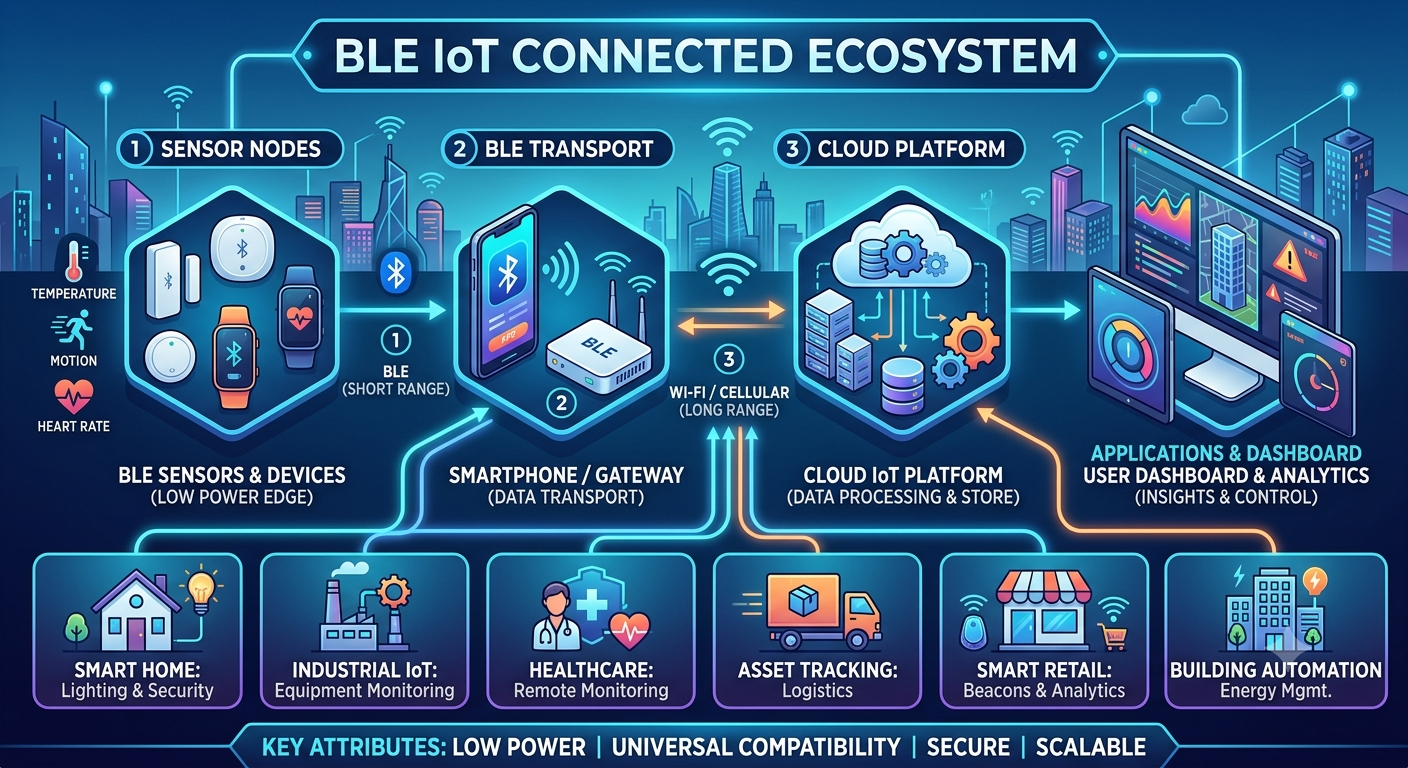
When the two technologies work together, BLE can connect nearby sensors and devices while an IoT platform handles data processing, analytics, automation, and remote management.
A simple architecture can look like:
BLE Device → Smartphone/Gateway → Cloud → IoT Platform → Dashboard
This model allows relatively small and battery-powered devices to become part of larger connected ecosystems.
Why Businesses Are Adopting BLE-Based IoT Solutions
Connected products need to balance performance, cost, battery life, and usability.
BLE can be useful because many IoT devices don’t need a constant high-bandwidth internet connection. A sensor may only need to transmit a small amount of information periodically.
This can make BLE a practical option for applications involving:
- Battery-powered sensors
- Wearable devices
- Asset tracking
- Smart equipment
- Environmental monitoring
- Healthcare devices
- Industrial sensors
1. Smart Home Applications
Smart homes are becoming increasingly connected.
BLE-enabled sensors can monitor conditions such as temperature, movement, occupancy, and device status.
For example, a smart home system could use BLE sensors to detect activity and send information to a central hub. The IoT platform can then trigger automated actions based on predefined rules.
This can support smarter:
- Lighting systems
- Security devices
- Temperature monitoring
- Door and window sensors
- Energy management
- Home automation
2. Industrial IoT
Industrial environments generate enormous amounts of operational data.
BLE sensors can collect information from equipment and transmit it to gateways for further processing.
Businesses can use connected sensors for:
- Equipment monitoring
- Asset tracking
- Temperature monitoring
- Machine status
- Warehouse monitoring
- Predictive maintenance workflows
The resulting data can be analyzed to identify unusual conditions and improve operational visibility.
3. Healthcare and Wellness Devices
BLE is particularly relevant to compact and wearable devices.
Fitness trackers, wellness products, and certain connected healthcare devices can communicate with smartphones or gateways using BLE.
A typical workflow could be:
Sensor → BLE → Mobile App → Cloud Platform → Analytics
The mobile application can act as an interface between the physical device and the wider IoT ecosystem.
For healthcare-related products, developers must also account for applicable privacy, security, regulatory, and safety requirements.
4. Asset Tracking
Businesses often need to know where equipment, inventory, or other assets are located.
BLE-based solutions can help organizations build location and tracking systems using tags, beacons, gateways, and software.
Potential use cases include:
- Warehouse equipment
- Hospital assets
- Retail inventory
- Industrial tools
- Office equipment
- Logistics operations
Combining BLE data with an IoT dashboard can provide businesses with better visibility into their physical assets.
5. Smart Retail
Retailers are increasingly using connected technology to understand their stores and improve customer experiences.
BLE devices can support applications involving proximity, asset monitoring, and location-aware experiences.
For example, BLE beacons can communicate with nearby smartphones or devices and trigger application-specific experiences.
When combined with IoT analytics, retailers can gain additional insights into physical environments and connected assets.
BLE Gateways: Connecting Devices to the Cloud
A BLE device typically doesn’t need direct internet connectivity.
Instead, a BLE gateway can collect information from nearby devices and forward it to a cloud or IoT platform.
For example:
Multiple BLE Sensors → Gateway → Internet → Cloud → Dashboard
This architecture can make it easier to deploy numerous low-power sensors across a facility.
Gateways can also provide an important bridge between short-range device communication and cloud-based applications.
The Importance of Mobile Apps
Mobile applications are another important component of many BLE IoT solutions.
A smartphone can act as a BLE central device, allowing users to:
- Discover nearby devices
- Connect to sensors
- Configure devices
- Read sensor values
- Send commands
- Update settings
- Synchronize information
This makes smartphones useful development platforms for consumer and commercial connected products.
Security in IoT and BLE
As more devices become connected, security becomes increasingly important.
A BLE IoT system should consider security throughout the entire architecture.
Important areas include:
Device Security
Devices should use appropriate authentication and secure communication mechanisms.
Data Security
Data moving between devices, gateways, applications, and cloud systems should be protected appropriately.
Access Control
Only authorized users and systems should be able to access sensitive device functionality.
Firmware Protection
Secure firmware update processes can help maintain device security throughout its lifecycle.
Security should be incorporated during architecture and development rather than added after deployment.
What Does the Future Hold for IoT and BLE?
The next generation of connected devices will focus increasingly on automation, intelligence, and efficiency.
BLE can provide efficient communication between nearby devices, while IoT platforms can provide the computing power and analytics needed to turn device data into useful business information.
We can expect continued innovation in areas such as:
- Smart manufacturing
- Connected healthcare
- Wearable technology
- Smart buildings
- Logistics
- Retail technology
- Environmental monitoring
- Industrial automation
The combination of BLE, edge computing, cloud platforms, mobile applications, and AI can create increasingly intelligent connected ecosystems.
Final Thoughts
IoT is changing how businesses interact with physical products, equipment, and environments.
BLE provides an efficient way to connect many nearby, low-power devices, while IoT platforms provide the infrastructure needed to collect, process, analyze, and act on their data.
For businesses developing smart products, the right combination of BLE hardware, firmware, mobile applications, gateways, cloud technology, and IoT analytics can create a scalable foundation for future growth.
The future of connected technology isn’t simply about having more devices.
It’s about making those devices work together intelligently.
Leave a Reply