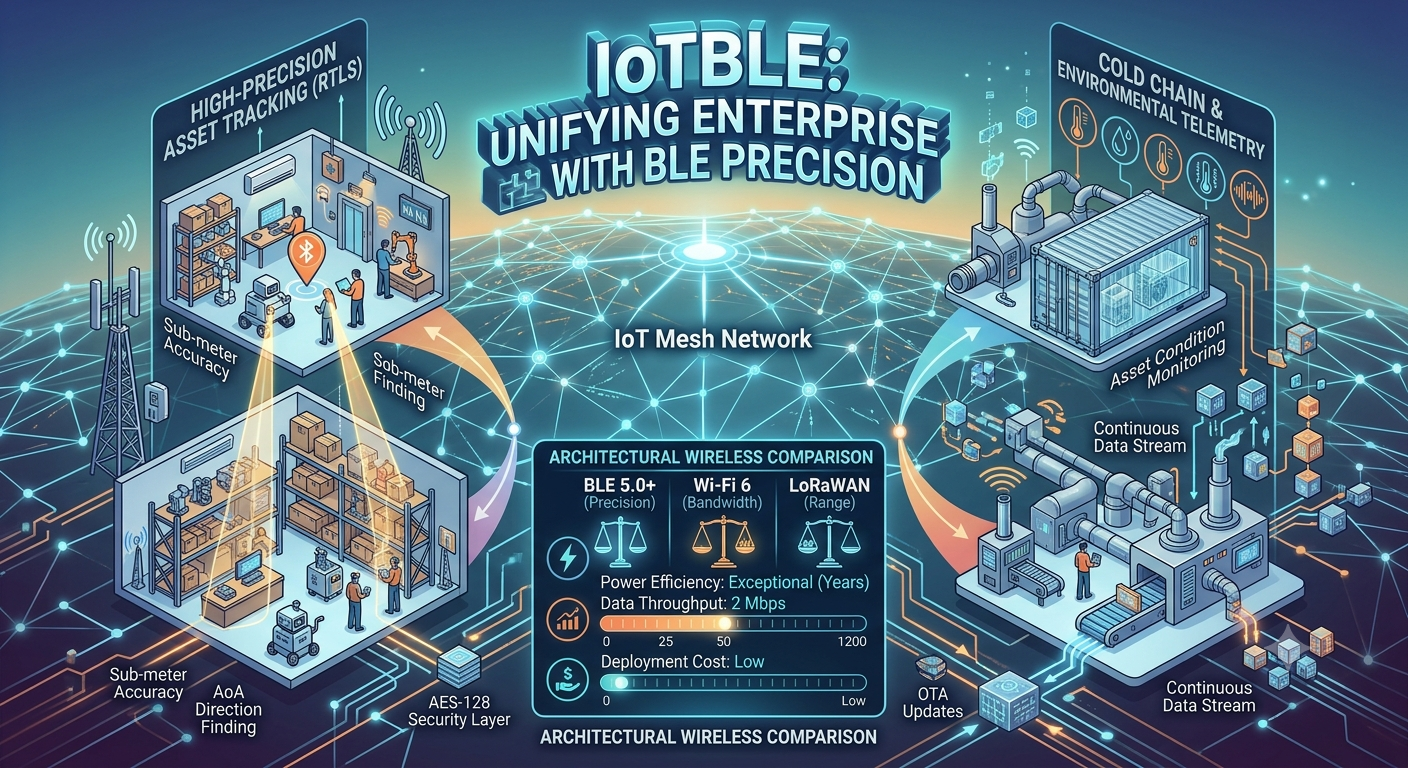
The proliferation of Internet of Things (IoT) endpoints across enterprise facilities—surpassing 18.8 billion connected devices worldwide—has shifted corporate reliance toward energy-efficient, high-precision wireless protocols. Bluetooth Low Energy (BLE) has evolved from a basic device-to-device pairing link into an essential connectivity backbone for real-time location systems (RTLS), smart buildings, and automated supply chains.
For system architects and IT leaders, deploying BLE IoT (Bluetooth Low Energy for the Internet of Things) delivers sub-meter positioning precision, scalable mesh network topologies, and multi-year battery lifecycles on low-cost sensor nodes.
Architectural Comparison: Enterprise Wireless Protocols
Selecting the right communication protocol requires balancing power requirements, bandwidth, and total cost of ownership across your operational footprint.
| Technical Parameter | BLE 5.0+ (AoA / Channel Sounding) | Wi-Fi 6 | Zigbee / Z-Wave | LoRaWAN |
| Power Efficiency | Multi-year operation on coin-cell batteries. | Requires main power or frequent charging. | Moderate power consumption. | Multi-year battery operation. |
| Data Throughput | 1.0 to 2.0 Mbps. | High-speed (Gbps range). | Low (up to 250 kbps). | Very low (< 50 kbps). |
| Location Precision | Sub-meter (via AoA & Channel Sounding). | Coarse room-level proximity. | Zone-based presence. | Regional / GPS-dependent. |
| Infrastructure Overhead | Low; leverages native mobile hardware & gateways. | High access-point cost. | Dedicated hub infrastructure. | Dedicated long-range gateways. |
Core Enterprise Deployments
1. High-Precision Indoor Asset Tracking (RTLS)
Using Angle of Arrival (AoA) antenna arrays and phase-difference algorithms, modern BLE setups deliver sub-meter tracking for tools, medical devices, and inventory. Fusing real-time RSSI and AoA telemetry prevents signal bleeding in high-density warehouses and hospital wings.
2. Cold Chain & Environmental Telemetry
BLE sensor nodes monitor ambient parameters—including temperature, humidity, and vibration—in real time. Compact form factors allow direct placement inside cold-storage transport units, transmitting telemetry to edge gateways without breaching sealed environments.
3. Decentralized Building Automation via BLE Mesh
BLE Mesh networking enables many-to-many ($m:n$) communication, allowing thousands of lighting fixtures, occupancy monitors, and HVAC controllers to relay messages across vast facilities. This self-healing architecture eliminates single points of failure and minimizes hardwired control lines.
Key Development & Security Advantages
BLE Channel Sounding & AoA Precision
Recent advancements—such as Bluetooth Channel Sounding and 3rd-generation AoA anchors—replace unstable signal-strength estimations (RSSI) with true distance-ranging and direction-finding algorithms, enabling secure digital key access and pinpoint location services.
Native Interoperability & Zero-Touch Provisioning
Unlike proprietary wireless protocols, BLE enjoys universal support across enterprise tablets, smartphones, and edge platforms. Field technicians can directly provision, inspect, and update firmware locally via Over-the-Air (OTA) channels without carrying specialized diagnostic gear.
Multi-Layer Security Architecture
Enterprise BLE IoT implementations incorporate robust security frameworks:
- AES-128 Cryptographic Encryption: Protects sensitive telemetry data over public frequency channels.
- Authenticated Pairing & Replay Protection: Prevents unauthorized node spoofing and man-in-the-middle exploits.
- Anonymous Node Addressing: Shields physical tracking tags from external surveillance and unauthorized signal scraping.
Deploying BLE IoT at Scale
Successfully transitioning BLE IoT infrastructure from proof-of-concept to production relies on connecting low-power hardware with open APIs. By integrating BLE position engines and sensor streams into your existing ERP, WMS, and cloud platforms, organizations convert ambient device signals into clear, actionable operational data.
Leave a Reply