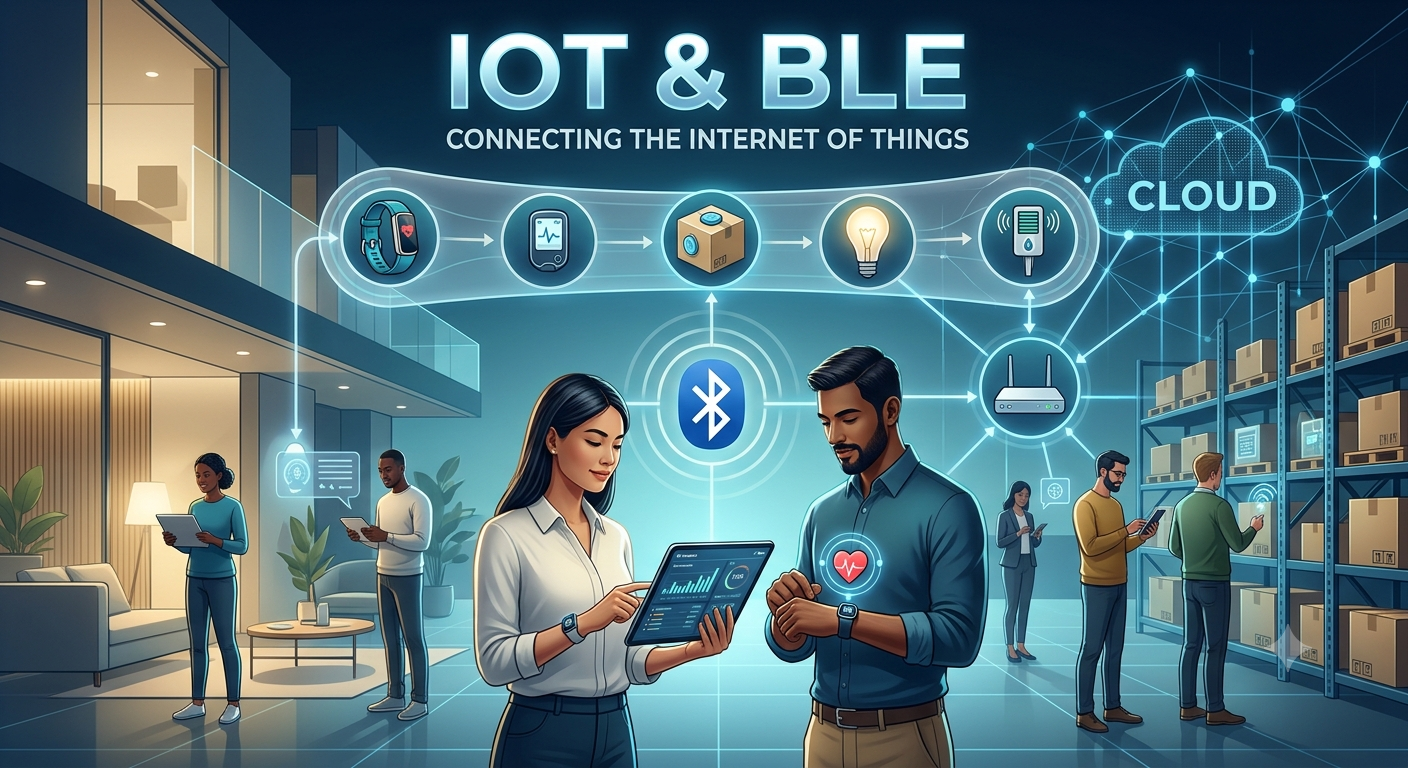
The Internet of Things (IoT) landscape thrives on efficient, low-power, and dependable connectivity. Among the communication protocols powering smart ecosystems today, Bluetooth Low Energy (BLE) stands out as a core driver for everything from wearable tech to industrial asset tracking.
This guide breaks down how IoT and BLE work together, why this pairing is essential for modern connected applications, and key architecture best practices.
What Is BLE in the Context of IoT?
Unlike Classic Bluetooth—which was designed for continuous, high-bandwidth data streams like audio streaming—Bluetooth Low Energy (BLE) is optimized for short burst transmissions with minimal power consumption.
Operating in the 2.4 GHz ISM spectrum, BLE devices can remain in sleep mode most of the time, waking up only to transmit small packets of data before sleeping again. This mechanism allows compact, battery-powered IoT devices to operate for months or even years on a single coin-cell battery.
Why Choose BLE for Your IoT Ecosystem?
- Ultra-Low Power Consumption: Minimizes maintenance costs by significantly extending battery life on remote edge nodes.
- Universal Hardware Compatibility: Natively supported by virtually all modern smartphones, tablets, laptops, and smart gateways without needing specialized receivers.
- Flexible Communication Topologies: Supports Point-to-Point (1:1), Broadcast/Beacons (1:M), and Mesh Networks (M:M).
- Low Deployment Costs: Mass adoption has made BLE microcontrollers and chips highly affordable for large-scale production.
Core BLE Network Topologies for IoT Applications
| Topology | Directionality | Common Use Case |
| Point-to-Point (1:1) | Direct device-to-device | Wearables sync with mobile apps, medical diagnostics |
| Broadcast / Beacons (1:M) | One-way transmission to nearby devices | Indoor navigation, retail promotions, proximity alerts |
| BLE Mesh (M:M) | Many-to-many interconnected nodes | Smart building lighting, automated factories, environmental grids |
Key Real-World Use Cases
1. Healthcare & Wearable Tech
BLE enables continuous monitoring for wearable heart-rate monitors, continuous glucose sensors, and smart hospital beds. Data is securely synced to a mobile gateway or cloud database with minimal power drain.
2. Asset Tracking & Logistics
In warehouses and manufacturing plants, BLE tags placed on inventory or machinery send location signals to central receivers or mesh gateways, enabling real-time asset visibility.
3. Smart Homes & Commercial Automation
With BLE Mesh, smart switches, light bulbs, and climate sensors form self-healing networks that cover entire structures without relying solely on high-power Wi-Fi routers.
Critical Best Practices for IoT BLE Development
- Optimize Connection Parameters: Adjust advertising intervals and slave latency based on your app’s needs to balance responsiveness and battery consumption.
- Prioritize Security & Pairing: Enforce AES-CCM cryptography and secure pairing methods (such as Passkey Entry or Numeric Comparison) to protect against eavesdropping and Man-in-the-Middle (MitM) attacks.
- Minimize Overhead with Custom Profiles: Standardize your GATT (Generic Attribute Profile) structures, sending only raw, compressed byte arrays instead of bloated payloads.
- Plan for OTA Updates: Build Over-the-Air (OTA) firmware update capabilities into your BLE stack to patch security vulnerabilities without physically retrieving devices.
Final Thoughts
BLE has transformed how IoT devices interact with the world around them. By combining ultra-low power consumption with multi-topology flexibility, BLE provides a scalable foundation for modern connected solutions. Implementing strong security standards and optimized GATT architecture ensures your IoT ecosystem remains robust, safe, and efficient for years to come.
Leave a Reply