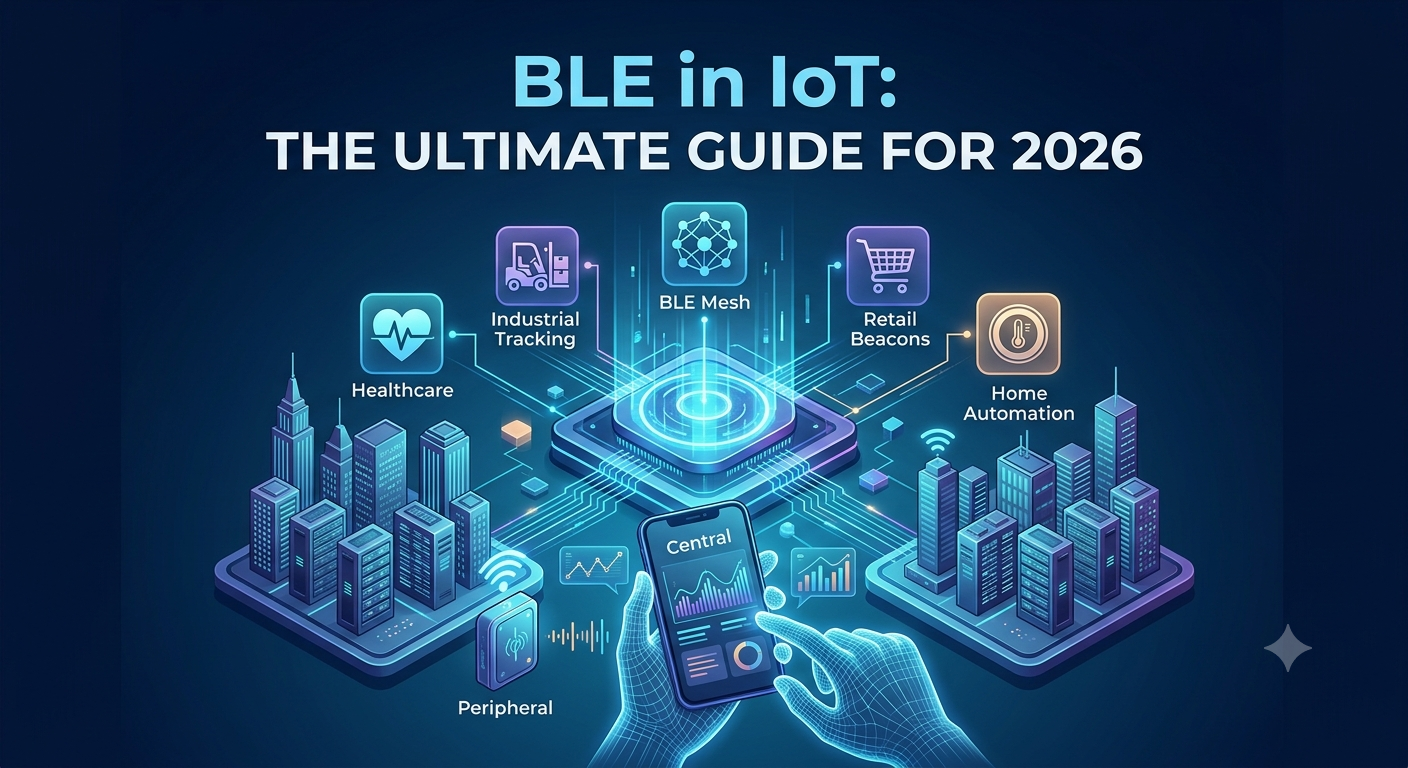
The Internet of Things (IoT) relies on seamless, low-power connectivity. While cellular, Wi-Fi, and LoRaWAN each have their place, Bluetooth Low Energy (BLE) remains the dominant standard for short-range, battery-powered IoT applications.
From smart home ecosystems and wearable medical monitors to industrial asset tracking, BLE connects billions of active devices worldwide.
What Is Bluetooth Low Energy (BLE)?
Introduced in the Bluetooth 4.0 specification, BLE is a wireless personal area network technology designed for short-range communication. Unlike Classic Bluetooth—which was built for continuous high-data streaming like audio—BLE transmits small packets of data at structured intervals.
This architectural difference allows BLE devices to operate on tiny coin-cell batteries for months or even years.
Key Benefits of BLE in IoT Architectures
- Ultra-Low Power Consumption: Devices sleep when inactive and consume minimal energy during data bursts.
- Cost Efficiency: Lower hardware costs and minimal infrastructure requirements make deployment budget-friendly.
- Universal Compatibility: Direct native support across virtually every modern smartphone, tablet, and gateway.
- Mesh Networking Capabilities: BLE Mesh enables large-scale device networks to communicate without relying on a central router.
How BLE Operates: Core Concepts
To implement BLE in an IoT setup, understanding two core operational models is essential:
[ Central Device / Client ]  <--->  [ Peripheral Device / Server ]
      (e.g., Smartphone)                  (e.g., Heart Rate Monitor)
1. Generic Access Profile (GAP)
GAP handles network discovery, advertising, and connections:
- Broadcaster / Observer: One-way data transmission (e.g., location beacons).
- Peripheral / Central: A peripheral advertises its presence, while a central device scans for and establishes a two-way connection.
2. Generic Attribute Profile (GATT)
GATT defines how data is formatted and exchanged once connected:
- Services: Collections of related characteristics (e.g., a “Battery Level” service).
- Characteristics: Individual data points containing values and descriptors (e.g., current battery percentage).
BLE Top Use Cases in 2026
- Smart Healthcare & Wearables: Continuous monitoring devices like glucose monitors and pulse oximeters sync data directly to patient smartphones.
- Industrial IoT (IIoT) & Asset Tracking: BLE beacons track equipment movement across warehouses and monitor ambient temperature in cold chains.
- Smart Homes & Buildings: Smart locks, environmental sensors, and automated lighting leverage BLE Mesh for robust, low-latency control.
- Indoor Positioning Systems (IPS): Retailers and venues use BLE beacons to deliver location-aware micro-services to visitors.
Classic Bluetooth vs. BLE: Quick Comparison
| Feature | Classic Bluetooth | Bluetooth Low Energy (BLE) |
| Primary Use Case | Continuous audio / file streaming | Short burst data transfer / IoT sensors |
| Power Consumption | High (days) | Ultra-Low (months to years) |
| Data Rate | Up to 3 Mbps | Up to 2 Mbps (BLE 5.0+) |
| Range | ~10 meters | Up to 100+ meters (line of sight) |
| Topology | Point-to-Point | Point-to-Point, Broadcast, Mesh |
Overcoming BLE Implementation Challenges
- Range Limitations: Mitigate signal degradation over distances by deploying BLE Mesh or strategic gateway placement.
- Security Vulnerabilities: Implement pairing methods like Passkey Entry or Numeric Comparison along with AES-128 encryption to safeguard data in transit.
- Data Throughput Constraints: Avoid using BLE for heavy media streaming; reserve it for sensor readings, state toggles, and status alerts.
The Road Ahead: Future Trends
As IoT systems evolve, advancements such as Bluetooth Direction Finding (AoA/AoD) for sub-meter positioning accuracy and ambient energy harvesting are pushing BLE capabilities further. Integrating BLE with unified smart home standards like Matter ensures it remains a fundamental pillar of connected tech.
Leave a Reply