Businesses are increasingly connecting physical products, sensors, machines, and devices to digital platforms.
From healthcare wearables and industrial sensors to smart buildings, asset tracking, connected retail, and consumer electronics, the combination of Bluetooth Low Energy (BLE) and IoT is creating new ways to collect data, automate processes, and monitor connected products.
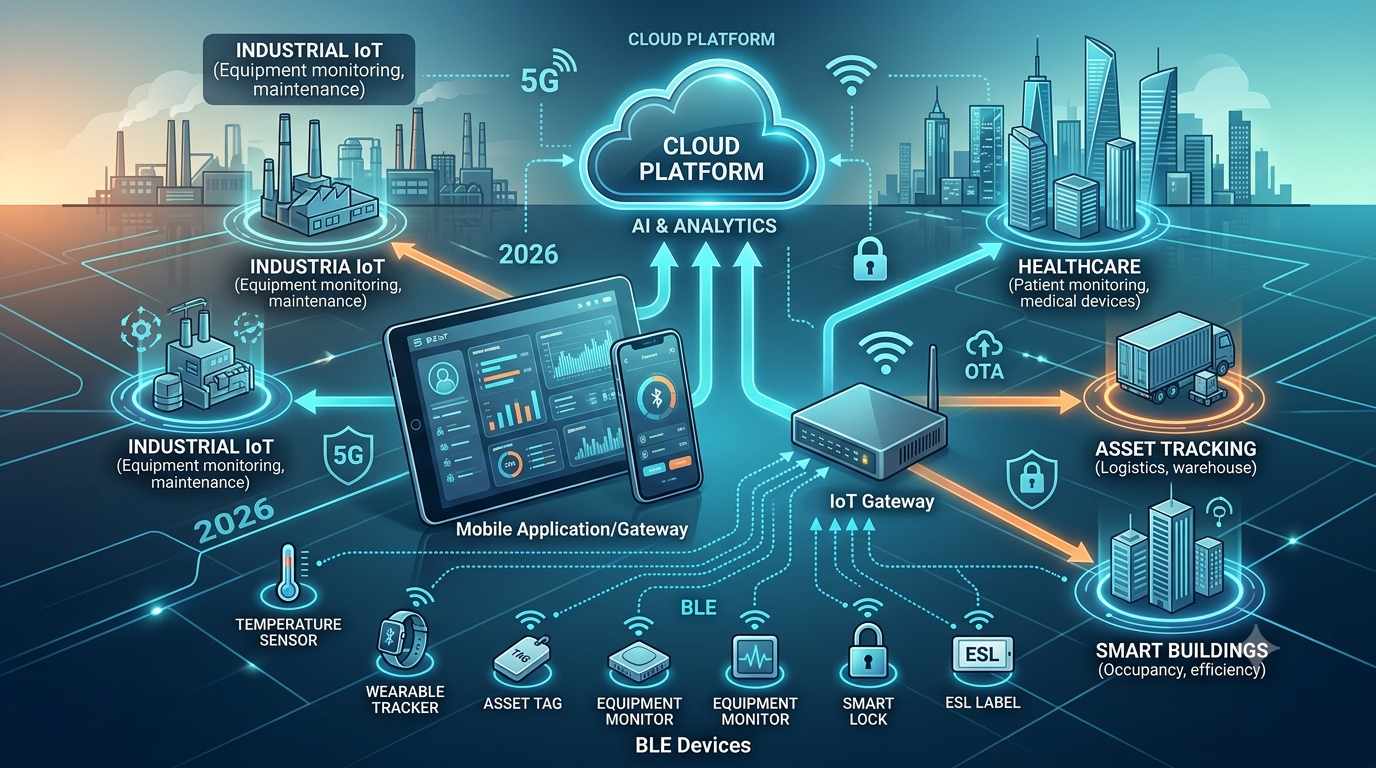
In 2026, BLE is no longer limited to simple device-to-phone communication. Modern IoT architectures can combine BLE devices with mobile applications, gateways, cloud platforms, analytics, and AI systems to create complete connected ecosystems.
Current Bluetooth industry developments are also expanding opportunities in areas such as asset tracking, smart buildings, healthcare monitoring, electronic shelf labels, and edge AI.
What Is BLE IoT?
BLE IoT refers to the use of Bluetooth Low Energy technology as part of an Internet of Things ecosystem.
A BLE-enabled device can collect information from sensors and communicate that information to another device, such as a smartphone, gateway, or embedded controller.
A typical architecture can look like:
BLE Device → Mobile App/Gateway → Cloud → Database → Analytics → Business Application
BLE is particularly useful when connected devices need low-power wireless communication and relatively small amounts of data.
Why BLE Is Important for IoT
IoT devices are often expected to operate for long periods while consuming minimal power.
BLE can be useful for applications requiring:
- Low-power communication
- Short-range connectivity
- Battery-powered devices
- Sensor data collection
- Smartphone connectivity
- Device configuration
- Wearable integration
- Proximity applications
- Asset monitoring
Its broad ecosystem support also makes BLE practical for products that need to communicate with iOS and Android applications.
How a BLE IoT System Works
A complete BLE IoT solution generally includes several layers.
1. BLE Device
The device contains a BLE-capable chipset and may include sensors for collecting information such as:
- Temperature
- Humidity
- Motion
- Pressure
- Battery level
- Proximity
- Equipment status
- Environmental conditions
The device can advertise information or establish a BLE connection with another device.
2. Mobile Application or Gateway
A smartphone or dedicated gateway can act as the bridge between BLE and the internet.
The application may:
- Discover nearby devices
- Connect to BLE peripherals
- Read characteristics
- Write commands
- Subscribe to notifications
- Monitor signal strength
- Configure devices
- Transfer data to the cloud
For larger deployments, a dedicated IoT gateway may be more appropriate.
3. Cloud Platform
The cloud layer can receive information from mobile applications or gateways.
Typical cloud services include:
- Device management
- Data storage
- Authentication
- Analytics
- Alerts
- Reporting
- APIs
- Remote monitoring
4. Business Dashboard
The final layer converts device data into useful business information.
For example:
BLE Sensor → Gateway → Cloud → Analytics → Maintenance Alert
This allows businesses to move beyond simple connectivity toward monitoring and automation.
Top BLE IoT Applications in 2026
1. Industrial IoT
Industrial businesses can use BLE sensors to monitor equipment and operational conditions.
Potential applications include:
- Equipment monitoring
- Temperature monitoring
- Asset tracking
- Machine status
- Predictive maintenance
- Environmental monitoring
- Worker safety
For example, a BLE sensor can monitor equipment conditions and send information to a gateway.
The cloud platform can then analyze the data and notify an operations team when predefined conditions occur.
2. Healthcare and Medical Devices
BLE is useful for connected healthcare products that need efficient short-range communication.
Potential applications include:
- Health monitoring devices
- Wearables
- Patient monitoring
- Medical equipment
- Fitness devices
- Environmental monitoring
A healthcare architecture might look like:
Medical Device → BLE → Mobile Gateway → Secure Cloud → Healthcare Dashboard
Healthcare applications require careful consideration of security, privacy, regulatory requirements, and data handling.
3. Asset Tracking
Businesses often need to monitor equipment, inventory, tools, and other physical assets.
BLE tags and beacons can support asset-monitoring solutions across:
- Warehouses
- Hospitals
- Retail stores
- Manufacturing facilities
- Offices
- Logistics operations
A system can associate a BLE device identifier with a physical asset and use gateways or mobile devices to detect its presence.
4. Smart Buildings
BLE and IoT can support connected-building applications such as:
- Occupancy monitoring
- Indoor navigation
- Access systems
- Smart lighting
- Environmental sensing
- Room management
- Asset tracking
Multiple sensors can provide building operators with real-time information about different areas of a facility.
5. Smart Retail
Retail businesses can use BLE for connected customer and operational experiences.
Applications may include:
- Proximity experiences
- Indoor navigation
- Smart shelves
- Asset monitoring
- Inventory-related systems
- Store analytics
- Electronic shelf labels
Bluetooth industry research identifies electronic shelf labels, asset tracking, and retail as areas where Bluetooth-enabled IoT can contribute to operational efficiency.
6. Wearable Devices
Wearables are one of the most common BLE use cases.
Examples include:
- Fitness trackers
- Smartwatches
- Health devices
- Industrial wearables
- Safety devices
- Connected accessories
A typical architecture is:
Wearable → BLE → Smartphone → Cloud
The mobile application can synchronize device information, configure settings, display measurements, and transfer data to cloud services.
7. Logistics and Supply Chain
BLE IoT can also support supply-chain monitoring.
Possible applications include:
- Shipment monitoring
- Cold-chain monitoring
- Warehouse assets
- Equipment tracking
- Temperature monitoring
- Inventory visibility
For example, a BLE temperature sensor can collect environmental measurements while a gateway transfers the information to a cloud platform.
If the temperature crosses a predefined threshold, the system can generate an alert.
BLE + Cloud Connectivity
One important point about BLE IoT architecture is that BLE itself is not normally the internet connection.
BLE provides local wireless communication.
Internet connectivity is usually provided through another device or network.
For example:
BLE Device → Smartphone → Wi-Fi/5G → Cloud
or:
BLE Device → IoT Gateway → Wi-Fi/Ethernet/Cellular → Cloud
This architecture allows low-power BLE devices to participate in larger cloud-connected IoT systems.
BLE GATT and Custom Device Communication
The Generic Attribute Profile (GATT) defines how BLE devices organize and exchange data.
A custom BLE product may use:
- Custom services
- Custom characteristics
- Read operations
- Write operations
- Notifications
- Indications
- Device configuration commands
For example:
Custom Service
→ Temperature Characteristic
→ Battery Characteristic
→ Device Status Characteristic
→ Configuration Characteristic
A well-designed GATT architecture can make communication between the device and application more predictable and maintainable.
BLE Device Provisioning and Pairing
Device onboarding is another important part of an IoT product.
A typical onboarding process can include:
New Device → Discovery → Authentication → Pairing → Configuration → Cloud Registration
Secure provisioning helps associate the physical device with the appropriate customer account or IoT platform.
This becomes increasingly important when businesses deploy thousands of connected devices.
OTA Firmware Updates
Connected products may require firmware updates after deployment.
Over-the-Air (OTA) updates can allow businesses to update device firmware without physically accessing every device.
OTA systems can support:
- Firmware upgrades
- Security fixes
- Feature updates
- Bug fixes
- Performance improvements
For production IoT deployments, OTA architecture should account for authentication, integrity verification, interrupted downloads, rollback strategies, and device compatibility.
BLE and AI: Creating Smarter IoT Systems
BLE can provide the connectivity layer while AI can provide intelligence.
A modern architecture could look like:
BLE Sensors → IoT Platform → Data Processing → AI Model → Insight → Automated Action
AI can potentially be used for:
- Predictive maintenance
- Anomaly detection
- Demand forecasting
- Equipment monitoring
- Pattern recognition
- Automated alerts
- Device optimization
Bluetooth industry analysis published in 2026 also highlights the growing relationship between Bluetooth connectivity, edge AI, and intelligent connected devices.
Security Considerations for BLE IoT
Security needs to be considered across the complete IoT ecosystem.
Important areas include:
Device Security
Connected devices should use appropriate authentication and secure communication mechanisms.
BLE Security
Depending on the product, developers may need to consider:
- Secure pairing
- Bonding
- Encryption
- Key management
- Device authentication
API Security
Cloud APIs should use appropriate:
- Authentication
- Authorization
- Encryption
- Rate limiting
- Input validation
Cloud Security
Cloud infrastructure should include appropriate controls for:
- Identity management
- Data access
- Monitoring
- Logging
- Backup
- Infrastructure security
Security should be designed into the product from the beginning rather than added after development.
BLE IoT Development Process
Building a connected IoT product usually requires coordination between hardware, firmware, mobile applications, cloud services, and testing.
Step 1: Define the Business Use Case
Start by identifying:
- What needs to be connected?
- What data needs to be collected?
- How frequently should data be transmitted?
- How long should the device operate on battery?
- Who will use the application?
- What action should happen after data is collected?
Step 2: Select Hardware
Hardware selection may include:
- BLE chipset
- Sensors
- Antenna
- Battery
- Microcontroller
- Gateway hardware
The hardware needs to match the communication, power, performance, and environmental requirements of the product.
Step 3: Design BLE Communication
The development team defines:
- GATT services
- Characteristics
- Data formats
- Commands
- Notifications
- Pairing strategy
Step 4: Develop Firmware
Firmware controls the behavior of the connected device.
It may handle:
- Sensor readings
- BLE advertising
- Connections
- Data processing
- Power management
- Device commands
- OTA updates
Step 5: Develop the Mobile Application
The mobile application can provide:
- Device discovery
- Pairing
- Configuration
- Data visualization
- Device control
- Account management
- Cloud synchronization
Native iOS and Android BLE APIs can be used depending on the project requirements.
Step 6: Build the Cloud Platform
The backend can provide:
- Device registration
- User accounts
- Data storage
- Device management
- APIs
- Analytics
- Notifications
- Reporting
Step 7: Testing
IoT testing should cover the complete ecosystem.
Testing may include:
- BLE connectivity
- Device range
- Battery consumption
- Firmware reliability
- Mobile compatibility
- Cloud synchronization
- API security
- OTA updates
- Real-world hardware testing
When Should a Business Use BLE?
BLE can be a strong choice when a product requires:
- Low-power wireless communication
- Short-range connectivity
- Smartphone interaction
- Sensor data
- Wearable connectivity
- Device configuration
- Proximity detection
- Battery-powered operation
BLE may not be appropriate as the only connectivity technology when a product requires high-bandwidth communication, long-distance direct connectivity, or continuous high-volume data transfer.
In these situations, BLE can still be combined with Wi-Fi, cellular, Ethernet, or other communication technologies.
Why Choose a BLE and IoT Development Partner?
A complete connected product can involve multiple technologies:
Hardware + Firmware + BLE + Mobile + Cloud + IoT + Security + Analytics
Because these components interact with each other, businesses should evaluate whether their development partner can handle the complete technology stack.
A BLE and IoT development team may provide:
- BLE device development
- BLE firmware integration
- iOS BLE development
- Android BLE development
- Custom GATT development
- IoT system integration
- Gateway development
- Cloud connectivity
- Sensor network development
- OTA firmware updates
- Device provisioning
- IoT dashboards
- Real-time monitoring
- BLE security
Why IoTBLE for BLE and IoT Development?
IoTBLE provides end-to-end BLE and IoT development capabilities for businesses building connected products.
The platform’s current service offering includes BLE device development, IoT system integration, smart sensor networks, gateway and cloud connectivity, custom GATT services, device provisioning, OTA firmware updates, beacon technologies, embedded firmware integration, and native iOS and Android BLE development.
This approach allows businesses to develop the different components of a connected product as one coordinated ecosystem.
Frequently Asked Questions
What is BLE IoT?
BLE IoT is the use of Bluetooth Low Energy technology within an IoT ecosystem to connect devices, sensors, applications, gateways, and cloud platforms.
Is BLE suitable for IoT applications?
Yes. BLE is particularly useful for low-power, short-range IoT applications involving sensors, wearables, asset tracking, smart devices, and mobile connectivity.
Can BLE devices connect to the cloud?
Yes, but typically through a smartphone, gateway, or another device that provides internet connectivity.
What is a BLE gateway?
A BLE gateway receives information from nearby BLE devices and transfers that information to a cloud or backend system using another network connection such as Wi-Fi, Ethernet, or cellular.
What is a custom GATT service?
A custom GATT service is a BLE data structure designed specifically for a product’s communication requirements. It can contain custom characteristics for sensor data, commands, configuration, and device status.
Can BLE IoT systems use AI?
Yes. BLE devices can provide data to an IoT platform, where AI and machine-learning systems can analyze that data for use cases such as anomaly detection, predictive maintenance, and intelligent monitoring.
How much does BLE IoT development cost?
The cost depends on hardware complexity, firmware, mobile applications, cloud infrastructure, number of devices, integrations, security requirements, and testing. A technical discovery phase is normally needed before providing a reliable estimate.
Conclusion
BLE and IoT are becoming increasingly important components of connected-product development.
The combination allows businesses to connect sensors, devices, wearables, machines, and physical assets with mobile applications and cloud platforms.
In 2026, the opportunity extends beyond simple connectivity. Businesses can combine BLE, IoT, cloud computing, real-time analytics, automation, and AI to create smarter connected products.
For companies developing a new connected device or modernizing an existing IoT product, the right architecture should consider hardware, firmware, BLE communication, mobile applications, cloud infrastructure, security, and future scalability from the beginning.
IoTBLE helps businesses build these connected ecosystems through custom BLE and IoT development, device integration, cloud connectivity, sensor networks, firmware integration, and mobile application development.
Leave a Reply