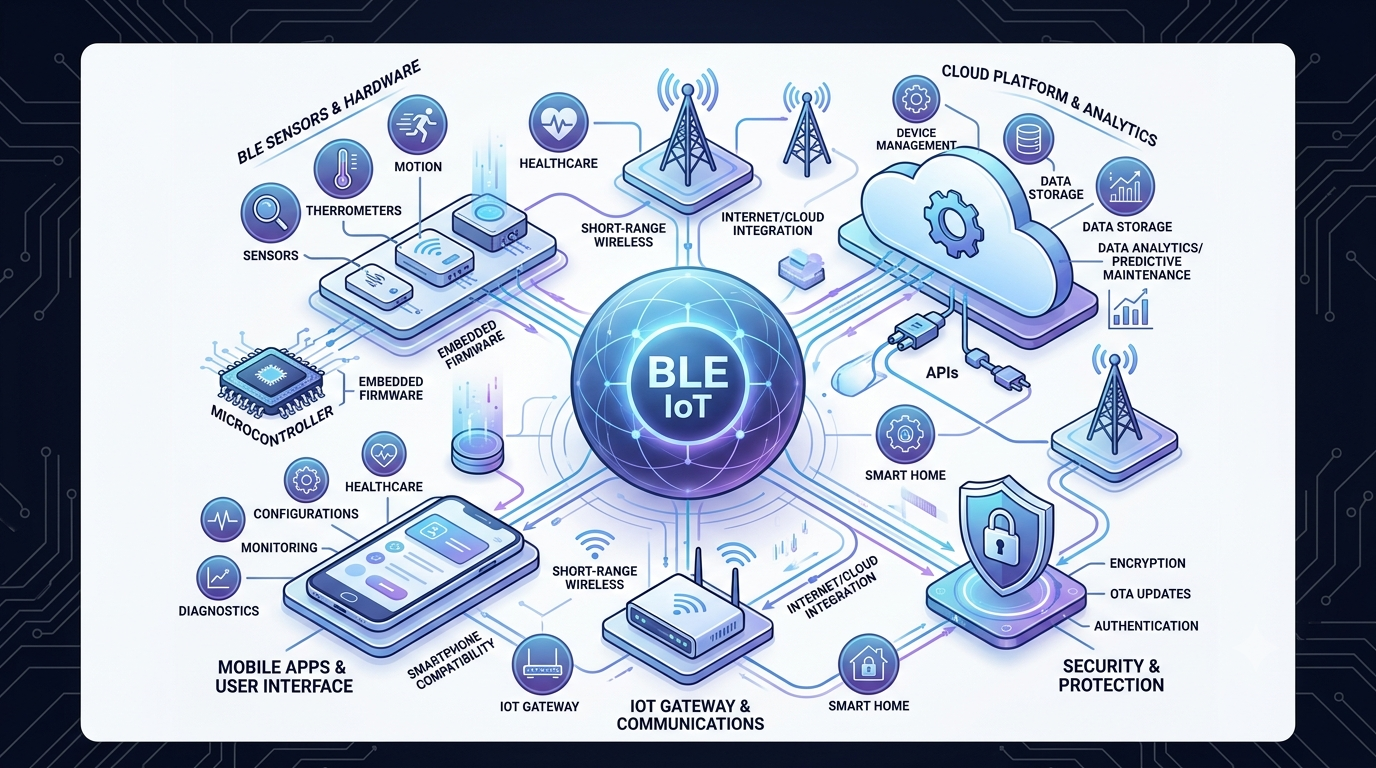
The Internet of Things (IoT) is transforming how businesses design, monitor, and manage connected products. From healthcare devices and smart buildings to industrial equipment and consumer electronics, connected technology is becoming an important part of modern product development.
One technology that continues to play an important role in IoT is Bluetooth Low Energy (BLE).
BLE enables connected devices to communicate with smartphones, tablets, gateways, sensors, and other hardware while using relatively low power. This makes it particularly useful for battery-powered IoT products that need reliable wireless connectivity.
In 2026, businesses developing connected products are increasingly combining IoT, BLE, sensors, cloud platforms, mobile applications, and data analytics into complete solutions.
What Is BLE in IoT?
Bluetooth Low Energy is a wireless communication technology designed for applications where devices need to exchange data while keeping power consumption low.
Unlike traditional Bluetooth applications that often focus on continuous data transmission, BLE is well suited to devices that periodically send or receive smaller amounts of information.
A typical BLE-enabled IoT solution can include:
- BLE sensors
- Embedded hardware
- Mobile applications
- IoT gateways
- Cloud platforms
- APIs
- Databases
- Analytics dashboards
- Device management systems
For example, a temperature sensor can collect environmental data and transmit it through BLE to a nearby gateway. The gateway can then send that information to a cloud platform where businesses can monitor the device remotely.
Why BLE Is Important for IoT Product Development
BLE provides several characteristics that make it useful for connected products.
1. Low Power Consumption
Many IoT devices operate on batteries and may need to work for months or years without frequent replacement.
BLE’s low-power communication model makes it suitable for devices such as:
- Wearable sensors
- Asset trackers
- Medical monitoring devices
- Smart locks
- Environmental sensors
- Industrial sensors
2. Smartphone Compatibility
Modern smartphones commonly support Bluetooth Low Energy.
This allows IoT products to communicate directly with mobile applications without requiring specialized hardware in every use case.
A BLE mobile application can be used to:
- Configure devices
- Read sensor data
- Update settings
- Monitor device status
- Trigger actions
- Perform diagnostics
3. Cost-Effective Connectivity
BLE can be incorporated into many compact embedded devices, making it an attractive option for businesses developing connected products at different price points.
4. Short-Range Wireless Communication
BLE is particularly useful when devices need to communicate within a relatively short range.
This can be valuable for applications such as:
- Smart home products
- Wearables
- Retail systems
- Healthcare devices
- Industrial monitoring
- Access-control systems
How an IoT + BLE Architecture Works
A typical BLE-based IoT solution can be divided into several layers.
Device Layer
This layer contains the physical IoT product.
Examples include:
- Sensors
- BLE modules
- Microcontrollers
- Battery systems
- Actuators
- Embedded firmware
The device collects information from its environment and communicates through BLE.
Mobile or Gateway Layer
A smartphone, tablet, or dedicated IoT gateway can act as an intermediary.
The gateway may collect BLE data from multiple devices and transmit it to a remote server.
Cloud Layer
The cloud platform stores and processes device information.
It can provide:
- Device management
- Data storage
- User management
- Analytics
- Alerts
- APIs
- Remote monitoring
Application Layer
The final layer is the interface used by customers, employees, administrators, or technicians.
It can be a:
- Mobile application
- Web dashboard
- Enterprise application
- Monitoring platform
Popular BLE IoT Use Cases
BLE can be applied across multiple industries.
Healthcare
BLE-enabled healthcare devices can collect information from sensors and transmit it to mobile applications or gateways.
Potential applications include:
- Patient monitoring
- Fitness tracking
- Medical equipment monitoring
- Wearable devices
- Medication-related devices
Healthcare applications require additional consideration for security, privacy, regulatory requirements, and device reliability.
Smart Home
BLE can support smart-home products such as:
- Smart locks
- Sensors
- Lighting controllers
- Temperature monitoring
- Home automation devices
A mobile application can provide users with local device configuration and control.
Retail
Retailers can use BLE-based technologies for:
- Asset tracking
- Customer engagement
- Inventory monitoring
- Store analytics
- Proximity-based experiences
Industrial IoT
Industrial environments can use BLE sensors for monitoring:
- Equipment
- Temperature
- Vibration
- Machinery
- Inventory
- Environmental conditions
BLE can be combined with gateways and cloud infrastructure to create centralized monitoring systems.
Asset Tracking
BLE beacons and tags can help businesses monitor the location or status of assets within appropriate environments.
Potential applications include:
- Equipment tracking
- Warehouse management
- Tool tracking
- Healthcare equipment
- Inventory management
BLE Beacons and IoT
BLE beacons are small wireless devices that periodically transmit identifiers or other information.
A smartphone or gateway can detect these transmissions.
Businesses can use beacon technology for:
- Indoor positioning
- Proximity detection
- Asset tracking
- Location-based experiences
- Retail applications
- Facility management
For more advanced systems, beacon data can be combined with cloud services and analytics platforms.
BLE Firmware Development
Firmware is an important part of any BLE IoT product.
The firmware controls how the embedded device communicates, collects data, manages power, and responds to commands.
A BLE firmware development project may involve:
- Microcontroller selection
- BLE module integration
- Sensor integration
- GATT service design
- Power optimization
- Connection management
- Firmware security
- OTA update functionality
- Hardware testing
- Production validation
Poor firmware architecture can result in connectivity problems, battery drain, unreliable sensor readings, and difficult device maintenance.
BLE GATT and IoT Applications
The Generic Attribute Profile (GATT) is an important part of BLE communication.
GATT organizes information into:
- Services
- Characteristics
- Descriptors
For example, an IoT temperature sensor might expose a temperature service containing a characteristic that provides the current temperature value.
A mobile application or gateway can connect to the BLE device and read or subscribe to those characteristics.
Designing a clear GATT architecture is important because it affects how mobile applications, gateways, and other devices communicate with the product.
BLE Security for IoT Devices
Security should be considered from the beginning of IoT product development.
Potential security considerations include:
- Device authentication
- Secure pairing
- Encryption
- Access control
- Secure firmware
- OTA update protection
- API security
- Cloud security
- Data protection
IoT products can create security risks if devices use weak authentication, exposed credentials, insecure firmware updates, or poorly protected APIs.
Security should therefore be considered across the complete IoT architecture rather than only at the BLE communication layer.
BLE and Cloud Integration
BLE alone does not provide remote cloud connectivity.
A common architecture uses a gateway between BLE devices and the cloud.
For example:
BLE Sensor → Gateway → Internet → Cloud → Web/Mobile Application
The gateway can collect data from nearby BLE devices and transmit it to cloud infrastructure using technologies such as Wi-Fi, Ethernet, cellular connectivity, or other networking technologies.
This architecture allows businesses to combine low-power local communication with remote monitoring.
IoT Data Analytics
Collecting sensor data is only one part of an IoT solution.
Businesses can use analytics to identify patterns and generate useful insights.
For example, industrial sensors could collect vibration information from machinery. Cloud software could analyze historical data and identify unusual changes that may require inspection.
IoT analytics can support:
- Predictive maintenance
- Performance monitoring
- Operational optimization
- Energy management
- Asset utilization
- Automated alerts
Challenges in BLE IoT Development
Although BLE offers many advantages, IoT product development still involves several technical challenges.
Connectivity
Developers need to consider connection stability, interference, range, reconnection behavior, and device density.
Battery Life
Battery-powered devices require careful optimization of advertising intervals, connection parameters, sensor usage, and firmware behavior.
Hardware Compatibility
Different chipsets, sensors, antennas, smartphones, and operating systems can introduce compatibility considerations.
Scalability
An IoT platform should be designed to support increasing numbers of connected devices without creating performance or management problems.
Security
Security needs to cover hardware, firmware, BLE communication, APIs, cloud infrastructure, and applications.
IoT + BLE Development Process
A structured development process can reduce technical risks.
Step 1: Define the Product Requirements
Identify the device’s purpose, users, sensors, connectivity requirements, power requirements, and expected environment.
Step 2: Design the Hardware
Select appropriate microcontrollers, BLE chipsets, sensors, batteries, and other components.
Step 3: Develop Firmware
Create the embedded software responsible for device operation and BLE communication.
Step 4: Develop the Mobile Application
Build Android and/or iOS applications when mobile connectivity is part of the product.
Step 5: Develop Cloud Infrastructure
Create APIs, databases, device management services, authentication, and analytics functionality.
Step 6: Integrate the Complete System
Connect the hardware, firmware, mobile application, gateway, cloud platform, and dashboard.
Step 7: Test the Product
Testing should cover:
- BLE connectivity
- Battery consumption
- Device range
- Hardware reliability
- Security
- Mobile compatibility
- Cloud performance
- Firmware updates
Step 8: Deploy and Monitor
After deployment, businesses can monitor device performance and use collected data to improve the product.
Why Businesses Choose Custom IoT Development
Off-the-shelf IoT platforms can be useful for simple applications, but businesses with specialized requirements may need custom development.
Custom IoT development can provide greater control over:
- Hardware
- Firmware
- BLE communication
- Mobile applications
- Cloud infrastructure
- APIs
- User interfaces
- Security
- Analytics
- Device management
This approach can
Leave a Reply