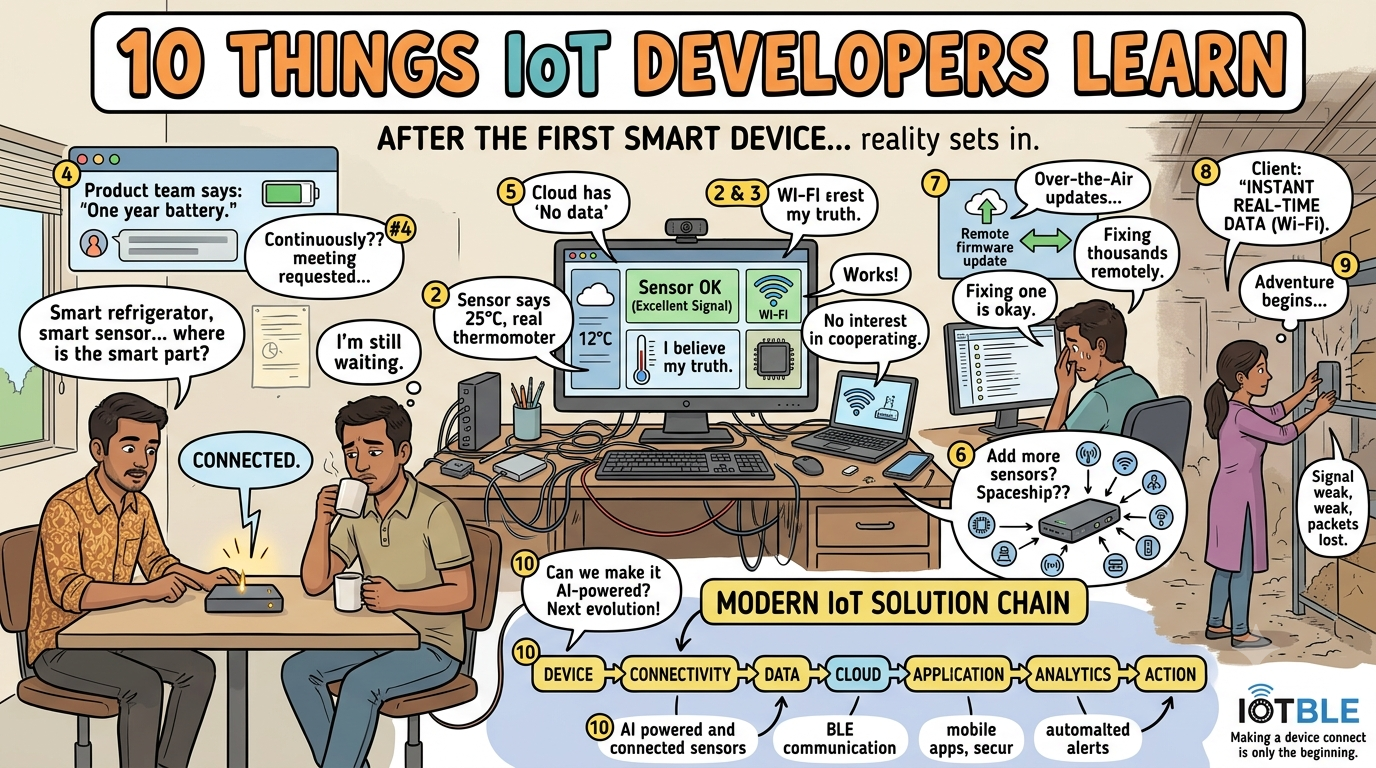
The Internet of Things sounds futuristic.
Smart sensors.
Connected devices.
Real-time monitoring.
Cloud platforms.
Automation.
Artificial intelligence.
Everything sounds intelligent.
Then you connect your first IoT device and discover something important:
The device has internet access, but apparently no interest in cooperating.
Welcome to the everyday reality of IoT development.
From sensors that suddenly stop sending data to devices that disconnect at exactly the wrong moment, IoT developers have plenty of stories.
Here are 10 things every IoT developer eventually learns.
1. “It’s a Smart Device”
Everyone loves the word smart.
Smartwatch.
Smart home.
Smart sensor.
Smart factory.
Smart refrigerator.
But sometimes the developer looks at the device and thinks:
“It is connected. I’m still waiting for the smart part.”
A connected device is only useful when its hardware, firmware, communication layer, backend, and application work together reliably.
2. The Sensor Says Everything Is Fine
Dashboard:
Temperature: 25°C
Humidity:
50%
Battery:
98%
Signal:
Excellent
Developer:
“Perfect.”
Walks into the actual room.
It’s freezing.
Checks another thermometer.
12°C.
Developer looks back at the IoT dashboard.
25°C.
The sensor:
“I believe in my truth.”
Accurate sensor data depends on hardware quality, calibration, placement, communication, and proper data processing.
3. Wi-Fi Works. The Device Doesn’t.
Developer:
“Is the Wi-Fi working?”
Team:
“Yes.”
Developer:
“Can you browse the internet?”
“Yes.”
Developer:
“Can the IoT device connect?”
No.
This is one of the classic IoT mysteries.
A network can work perfectly for a laptop while an embedded device still struggles because of configuration, authentication, firmware, signal quality, network compatibility, or power constraints.
4. The Battery Was Supposed to Last a Year
Product team:
“The battery should last 12 months.”
Developer:
“Okay.”
Product team:
“And the device should continuously monitor the sensor.”
Developer:
“Okay…”
Product team:
“And send data every second.”
Developer:
“…Let’s discuss the definition of ‘continuously.’”
Power management is one of the biggest considerations in IoT product development, particularly for battery-powered connected devices.
Reducing unnecessary communication, optimizing sleep cycles, and choosing appropriate wireless technologies can make a major difference.
5. The Cloud Has No Data
The device is online.
The sensor is working.
The application is running.
But the cloud dashboard says:
No data available.
Developer checks the device.
Fine.
Checks the network.
Fine.
Checks the API.
Fine.
Checks the cloud.
Fine.
Checks the database.
Fine.
Developer:
“Then where is the data?”
IoT debugging sometimes feels less like programming and more like detective work.
6. “Can We Add One More Sensor?”
The original product:
Temperature sensor.
Then someone says:
“Can we also measure humidity?”
Sure.
Then:
Pressure?
Okay.
Motion?
Fine.
Light?
Sure.
Air quality?
Why not?
GPS?
Developer:
“Are we building a sensor or a spaceship?”
IoT systems can combine multiple sensors, but every additional component can affect hardware design, power consumption, data processing, connectivity, and cost.
7. The Firmware Update Nobody Wanted
Everything works.
Then a bug appears.
The device is already deployed.
There are 10 devices.
Then 100.
Then 10,000.
Someone asks:
“Can we update all of them remotely?”
Developer slowly turns around.
This is why OTA (Over-the-Air) firmware updates and proper device-management strategies are important when designing scalable IoT products.
Fixing one device manually is manageable.
Fixing thousands?
That’s a different conversation.
8. The “Real-Time” Requirement
Client:
“We need real-time IoT data.”
Developer:
“How real-time?”
Client:
“Immediately.”
Developer:
“How immediately?”
Client:
“Instantly.”
Developer:
“So… milliseconds?”
Client:
“Yes.”
Developer:
“What’s the network?”
Client:
“Wi-Fi.”
Developer:
“What’s the cloud architecture?”
Client:
“We’ll decide later.”
And that’s when the real-time adventure begins.
9. The Device Works Perfectly in the Office
Testing environment:
Perfect.
Temperature:
Perfect.
Connectivity:
Perfect.
Battery:
Perfect.
Then the device is installed in a warehouse.
Suddenly:
Signal weak.
Packets lost.
Data delayed.
Device disconnected.
Developer:
“The warehouse wasn’t in the test plan?”
Real-world IoT environments can introduce interference, physical obstacles, temperature changes, distance, network congestion, and other conditions that may not appear in controlled testing.
10. The Ultimate IoT Developer Question
After everything is finally working:
Device connected.
Sensors working.
Data reaching the cloud.
Dashboard working.
Alerts working.
Mobile app working.
Everyone celebrates.
Then the client asks:
“Can we make it AI-powered?”
Developer:
“Of course.”
And the IoT project enters its next evolution.
What a Modern IoT Solution Can Include
Behind the jokes, successful IoT development requires a complete technology ecosystem.
Depending on the product, an IoT solution can include:
- Connected sensors
- BLE communication
- Wi-Fi or cellular connectivity
- Embedded firmware
- Mobile applications
- Cloud infrastructure
- APIs
- Real-time dashboards
- Device management
- OTA firmware updates
- Data analytics
- Automated alerts
- Security controls
- AI and machine learning
For BLE-based products, Bluetooth Low Energy can be used for efficient communication between devices, sensors, smartphones, gateways, and other connected systems.
Why IoT Development Is More Than Connecting a Device
Connecting a sensor to an application is only one part of an IoT project.
A production-ready IoT solution needs to consider the complete journey:
Device → Connectivity → Data → Cloud → Application → Analytics → Action
If any part of that chain fails, the “smart” product may suddenly become a very expensive blinking box.
That’s why IoT architecture, security, scalability, testing, and device management should be considered from the beginning.
Final Thoughts
IoT is making everyday products more connected, measurable, and automated.
But every IoT developer eventually learns a few universal lessons:
A connected device can still disconnect.
A smart sensor can still give strange data.
A one-year battery can still disappear surprisingly quickly.
And the phrase:
“It works perfectly here.”
Should always be followed by:
“Let’s test it somewhere else.”
At IoTBLE, the focus is on connected-device development, BLE IoT solutions, smart sensors, mobile connectivity, cloud integration, and scalable IoT applications.
Because making a device connect is only the beginning.
Making it work reliably in the real world is the real IoT challenge.
Leave a Reply