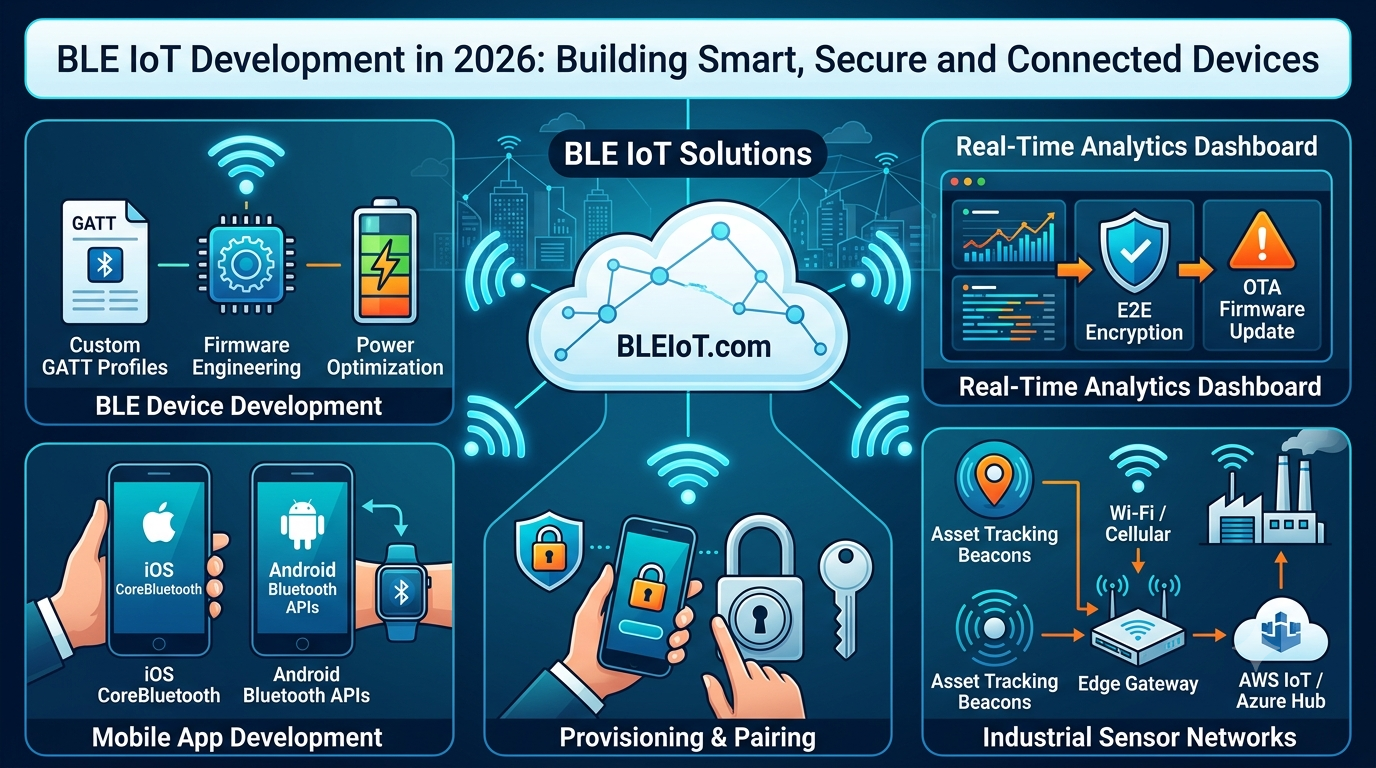
The Internet of Things (IoT) is transforming how businesses design, operate, and manage connected products. From wearable technology and medical devices to industrial sensors, smart locks, fitness trackers, and EV chargers, connected hardware is becoming an important part of modern digital ecosystems.
At the center of many of these products is Bluetooth Low Energy (BLE).
BLE enables devices to communicate wirelessly while keeping power consumption low, making it a practical connectivity technology for battery-powered products and smart sensor networks.
In 2026, businesses are increasingly looking beyond basic Bluetooth connectivity. They need complete BLE IoT solutions that combine device development, embedded firmware, mobile applications, cloud connectivity, real-time monitoring, automation, and security.
What Is BLE IoT?
BLE IoT combines Bluetooth Low Energy technology with Internet of Things platforms to connect physical devices, sensors, smartphones, gateways, and cloud systems.
A typical BLE IoT ecosystem may look like:
$$\text{BLE Device} \longrightarrow \text{Mobile App / Gateway} \longrightarrow \text{Cloud Platform} \longrightarrow \text{Dashboard} \longrightarrow \text{Business Action} \text{}$$
This architecture allows connected devices to collect information, communicate with applications, transmit data to cloud platforms, and support real-time monitoring.
For businesses developing connected products, BLE IoT development can provide the foundation for efficient and scalable device communication.
For businesses looking for complete BLE IoT services, BLE IoT Services is a relevant resource covering BLE device development, IoT system integration, smart sensor networks, and gateway and cloud connectivity.
Why Bluetooth Low Energy Is Important for IoT
Many IoT products operate on batteries and need to remain active for extended periods.
BLE is designed for low-energy wireless communication, making it suitable for products that periodically transmit sensor data or interact with smartphones and gateways.
Common BLE IoT applications include:
- Wearable devices & fitness trackers
- Medical devices & health monitors
- Smart locks & access control
- EV chargers & energy nodes
- Industrial condition sensors
- Smart home products & building management
- Asset tracking devices & beacon systems
- Connected consumer electronics
The right BLE architecture depends on factors such as power consumption, communication range, data requirements, hardware, application platforms, and scalability.
BLE Device Development
BLE device development is one of the core components of a connected product. A BLE-enabled device may contain sensors, microcontrollers, wireless modules, and embedded firmware responsible for collecting and transmitting data.
A production-ready BLE device needs more than wireless connectivity. Developers may need to address:
- BLE Protocol Implementation: Configuring low-energy duty cycles and advertising intervals.
- Power Optimization: Sleep mode execution to maximize battery lifespan.
- Connection Management: Efficient discovery, connection setup, and background reconnection algorithms.
- GATT Services: Building logical structured attributes for bi-directional data exchange.
- Firmware Updates: Safe, recoverable over-the-air binary distribution.
- Security & Hardware Compatibility: Hardware testing across varying RF conditions.
BLE Peripheral and Central Implementations
BLE devices can operate in different roles depending on the application.
BLE peripheral and central implementations allow devices to scan, advertise, connect, and communicate with other BLE devices.
- Peripheral Role: A sensor or wearable advertises its presence and exposes attributes.
- Central Role: A smartphone or gateway scans for advertising nodes and initiates connection requests.
- Dual-Role Architecture: Advanced nodes can scan and receive data from nearby tags while simultaneously acting as a peripheral to a master cloud gateway or smartphone.
Custom GATT Services
Custom GATT (Generic Attribute Profile) services define how BLE devices organize and exchange data. Custom profiles and characteristics are designed around a product’s specific data model.
┌────────────────────────────────────────────────────────┐
│             GATT Service: Sensor Hub                   │
├────────────────────────────────────────────────────────┤
│  Characteristic 1: Temperature Reading  (Read/Notify)  │
│  Characteristic 2: Battery Level        (Read)         │
│  Characteristic 3: System Status       (Read/Write)    │
│  Characteristic 4: Configuration Flags (Write)         │
└────────────────────────────────────────────────────────┘
A carefully designed GATT structure makes communication between embedded devices and applications more predictable and maintainable.
Device Provisioning and Pairing
A connected product needs a reliable onboarding experience. Device provisioning and pairing allow a new BLE device to be securely connected to a smartphone, application, user account, or IoT ecosystem.
A typical onboarding process includes:
- Discovering the unprovisioned BLE device via advertising packets.
- Establishing an encrypted, secure link.
- Authenticating device identity via cryptographic certificates or out-of-band methods.
- Associating the node with the user’s account and backend cloud profile.
- Configuring operational parameters such as upload intervals and network keys.
BLE Mobile App Development
BLE IoT products frequently require mobile applications to communicate with connected hardware. Native mobile development uses:
iOS CoreBluetooth
iOS CoreBluetooth provides the framework required for iPhone and iPad applications to communicate with BLE peripherals. iOS applications handle device discovery, state restoration, and background operations when apps are suspended.
Android Bluetooth APIs
On Android, developers work with Android Bluetooth APIs to discover and communicate with BLE devices. Android development accounts for OEM hardware variations, permission models, Doze mode restrictions, and GATT error management.
OTA Firmware Updates for BLE Devices
Connected products often need software improvements after deployment. Over-The-Air (OTA) firmware updates allow developers to update field devices without physical access.
Reliable OTA pipelines provide:
- Bug Fixes & Security Patches: Swift deployment of vulnerability patches.
- Fail-Safe Rollbacks: Preventing “bricked” hardware if power or connection drops mid-transfer.
- Encrypted Binaries: Verification of signed updates before execution.
Beacon Technologies: iBeacon and Eddystone
BLE supports proximity and location-aware applications through beacon technologies like iBeacon and Eddystone. These provide indoor positioning, asset tracking, micro-location triggers, and retail engagement without establishing explicit paired connections.
Gateway and Cloud Connectivity
BLE devices are often connected to smartphones or hardware edge gateways before data reaches the cloud. A gateway collects information from multiple BLE nodes and transmits it via Wi-Fi, Ethernet, or Cellular to cloud environments such as AWS IoT Core, Azure IoT Hub, or Google Cloud IoT.
Real-Time Data Monitoring and Smart Sensor Networks
Modern IoT platforms visualize operational data in real-time. Smart sensor networks aggregate data from temperature sensors, medical monitors, equipment nodes, and tracking devices. Centralized dashboards process this data for:
- Predictive Maintenance: Early detection of vibration or temperature anomalies.
- Resource Optimization: Automated alerts for battery replacement or device disconnects.
- Compliance Reporting: Historical logging for healthcare and industrial environments.
BLE IoT Security
Security must be integrated throughout the development lifecycle:
- Secure Pairing & Bonding: ECDH key exchange to prevent eavesdropping and Man-In-The-Middle (MITM) attacks.
- AES-128 Encryption: Protecting link-layer packet payloads.
- Identity Protection: Utilizing random resolving private addresses (RPA) to prevent untrusted tracking.
- End-to-End Encryption: Encrypting application data from the BLE device through the gateway to the cloud database.
Modern BLE Chipset Ecosystems
Selecting the appropriate chipset impacts processing power, range, and unit costs:
| Manufacturer | Chipset Family | Key Focus |
| Nordic Semiconductor | nRF52 / nRF53 / nRF54 | Low-power performance, advanced multiprotocol, rich SDK |
| Espressif Systems | ESP32-C / ESP32-S | Integrated Wi-Fi + BLE, cost-effective prototyping |
| Silicon Labs | EFR32 Series | Mesh networks, ultra-low power energy modes |
| Texas Instruments | CC26xx | Industrial-grade reliability, multi-band support |
Frequently Asked Questions
What is BLE IoT development?
BLE IoT development involves building connected products that use Bluetooth Low Energy to communicate between physical hardware, smartphones, gateways, and IoT cloud platforms.
What services are included in BLE development?
Complete BLE services include hardware chipset selection, custom GATT profile design, embedded firmware engineering, native mobile application development, OTA update systems, gateway setup, and cloud integrations.
Can BLE devices connect directly to AWS IoT?
BLE devices typically connect through an edge gateway (or mobile app) that translates BLE GATT notifications into MQTT or HTTPS payloads to stream directly to AWS IoT Core.
What is the difference between BLE central and peripheral?
A BLE peripheral advertises its presence and provides data services, while a central device scans for advertising packets and initiates connections. Some systems use dual-role setups to handle both operations simultaneously.
Can BLE work seamlessly with both iOS and Android?
Yes. BLE applications can be built for both platforms using iOS CoreBluetooth and Android Bluetooth APIs, provided platform-specific background limitations and connection parameters are accounted for in code.
Conclusion
BLE IoT development requires a unified approach connecting hardware, firmware, mobile interfaces, and cloud architectures. Designing these layers together early in the project reduces risk and creates scalable, secure connected products.
For complete BLE device development, mobile apps, and cloud integration, visit BLE IoT Services to bring your connected hardware vision to market.
Leave a Reply