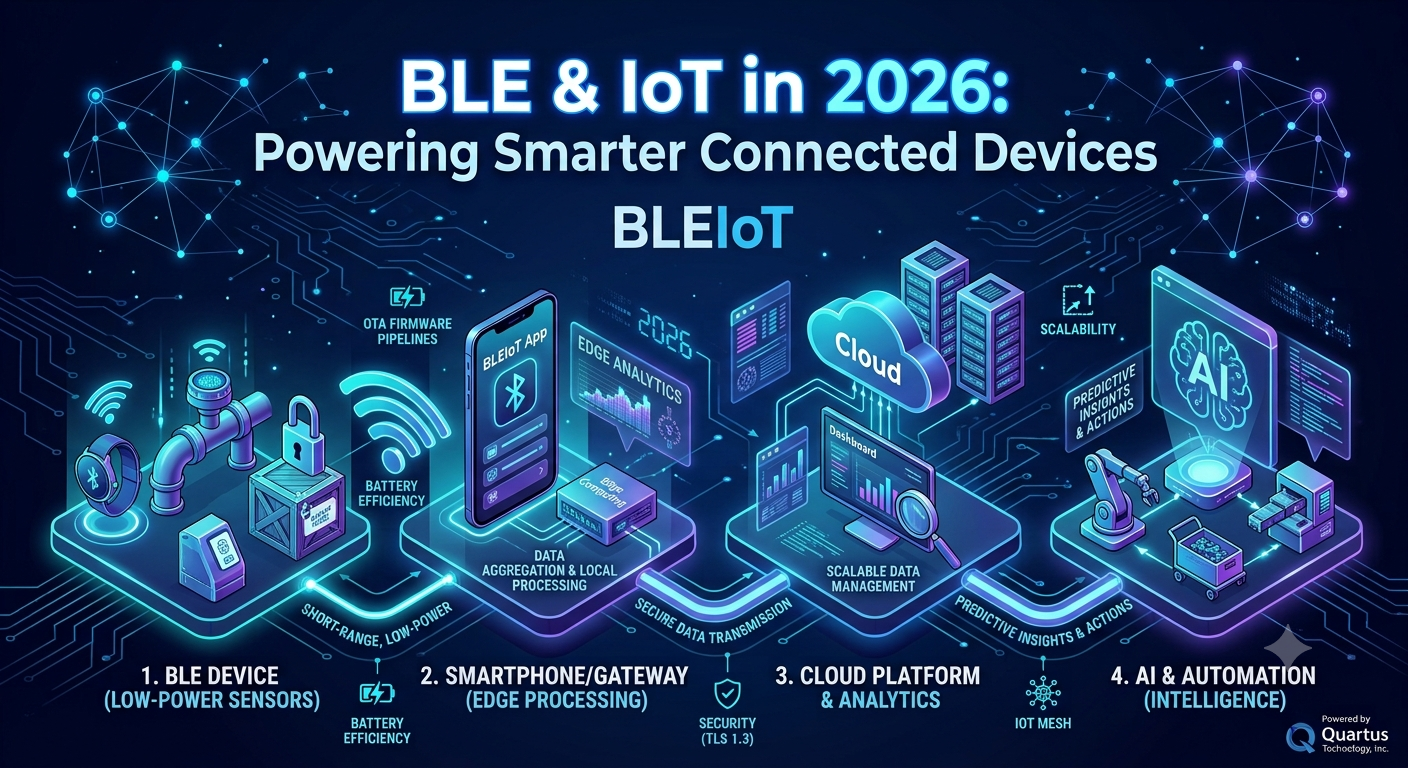
The Internet of Things is transforming how businesses build, monitor, and manage connected products. From smart wearables and healthcare devices to industrial sensors, asset trackers, smart home products, and connected equipment, organizations are increasingly looking for reliable ways to connect physical devices with mobile and cloud applications.
Bluetooth Low Energy (BLE) has become an important connectivity technology for many of these applications because it supports short-range wireless communication with relatively low power consumption.
When BLE is combined with IoT platforms and mobile applications, businesses can create connected experiences that allow users to monitor devices, collect data, configure hardware, and interact with physical products through smartphones and tablets.
This is where BLE IoT app development becomes valuable.
What Is BLE IoT App Development?
BLE IoT app development involves creating mobile or web applications that communicate with Bluetooth Low Energy devices and connect them to broader IoT systems.
A typical architecture can look like:
BLE Device → Mobile App → IoT Backend → Cloud → Analytics Dashboard
Depending on the product, the architecture may also include a dedicated gateway.
For example, a smart sensor could collect temperature information and transmit it through BLE to a mobile application. The application can then send that information to a cloud platform where businesses can store, analyze, and visualize the data.
This creates a complete connected-device ecosystem.
Why BLE Is Important for IoT Applications
Many IoT devices need to operate for long periods on batteries.
BLE can be useful for these products because it is designed for low-power wireless communication.
Common BLE IoT applications include:
- Wearable devices
- Fitness trackers
- Smart sensors
- Healthcare devices
- Industrial monitoring
- Asset tracking
- Smart locks
- Retail technology
- Smart home products
- Connected equipment
The right connectivity technology depends on the product’s range, power, bandwidth, environment, and business requirements.
How a BLE IoT App Works
A BLE IoT application usually has several layers.
1. Connected BLE Device
The physical device contains a BLE-enabled chipset and may include sensors, actuators, or other hardware.
2. BLE Communication
The mobile application discovers and communicates with the device through Bluetooth Low Energy.
3. Mobile Application
The application can provide features such as:
- Device discovery
- Pairing
- Configuration
- Data visualization
- Device control
- Notifications
- Firmware management
4. IoT Backend
The backend can store device information, user accounts, telemetry, and application data.
5. Cloud Platform
Cloud infrastructure can provide scalability, APIs, storage, analytics, and device management.
Key Features of a BLE IoT Application
A modern BLE IoT app can include a wide range of features depending on the product.
BLE Device Discovery
The application can scan for nearby compatible BLE devices and identify available devices.
Secure Device Pairing
Secure pairing and authentication help prevent unauthorized access to connected devices.
Real-Time Device Data
Applications can display sensor information and device status in near real time where appropriate.
Remote Device Control
For compatible hardware, users can send commands from the mobile application to the connected device.
Push Notifications
The application can notify users when certain device events or conditions occur.
Device Configuration
Users can configure device settings through the mobile application.
Data Synchronization
Device data can be synchronized between the mobile application and cloud backend.
Firmware Updates
Connected products may require firmware updates throughout their lifecycle. A properly designed application can support appropriate firmware-update workflows.
BLE IoT App Development for Different Industries
Healthcare
BLE-connected applications can support certain healthcare and wellness devices.
Potential use cases include:
- Wearable monitoring
- Fitness tracking
- Temperature monitoring
- Rehabilitation devices
- Connected medical equipment
Healthcare applications require careful consideration of security, privacy, reliability, and applicable regulatory requirements.
Fitness and Wearables
BLE is widely suited to short-range communication between wearable devices and smartphones.
Apps can collect information such as:
- Activity data
- Device status
- Exercise metrics
- Sensor readings
The information can then be presented through mobile dashboards.
Industrial IoT
Industrial companies can use BLE applications for connected sensors and equipment.
Potential applications include:
- Equipment monitoring
- Maintenance
- Asset tracking
- Environmental sensing
- Worker safety
- Inventory monitoring
A BLE mobile application can act as a convenient interface between field workers and connected industrial devices.
Smart Home
BLE IoT apps can provide interfaces for connected home products such as:
- Smart locks
- Sensors
- Lighting controllers
- Access systems
- Connected appliances
BLE can provide local device communication, while cloud services can enable broader application functionality where appropriate.
Retail
BLE applications can support connected retail environments through:
- Asset tracking
- Proximity experiences
- Smart shelves
- Inventory monitoring
- Indoor navigation
Retail applications can combine BLE data with analytics to create more intelligent customer and operational experiences.
BLE + Cloud: Creating Connected Applications
BLE provides local connectivity, while cloud infrastructure can provide centralized data management.
A typical system may work like this:
BLE Sensor → Mobile App → API → Cloud Database → Web Dashboard
This architecture allows businesses to separate local device communication from centralized data management.
Cloud infrastructure can support:
- Device data storage
- User management
- APIs
- Analytics
- Notifications
- Device management
- Reporting
BLE + AI for Intelligent IoT Applications
AI is creating new possibilities for connected-device applications.
BLE devices can collect sensor data, while AI can analyze that information to identify patterns and potential anomalies.
For example:
BLE Sensor → Data Collection → AI Analysis → Insight → Action
Possible applications include:
- Predictive maintenance
- Anomaly detection
- Usage analysis
- Personalized recommendations
- Equipment monitoring
- Intelligent alerts
AI should be applied where it solves a meaningful business or product problem rather than simply being added as a marketing feature.
BLE App Development for Android and iOS
Businesses developing BLE IoT products often need applications for both major mobile platforms.
Android BLE Development
Android applications can communicate with compatible BLE devices using the platform’s Bluetooth APIs.
Developers need to consider device compatibility, permissions, connection behavior, background operation, and different Android versions.
iOS BLE Development
iOS applications can use Apple’s Core Bluetooth framework to communicate with BLE peripherals.
Developers need to consider Apple’s permission requirements, background behavior, connection management, and device compatibility.
A well-designed cross-platform strategy can help businesses maintain a consistent user experience while accounting for platform-specific BLE behavior.
Challenges in BLE IoT App Development
Building a BLE application is more complex than simply connecting a phone to a Bluetooth device.
Connection Reliability
Wireless connections can be affected by distance, interference, device behavior, and environmental conditions.
Battery Consumption
Poorly designed communication patterns can increase battery consumption.
Platform Differences
Android and iOS handle Bluetooth functionality differently.
Device Compatibility
Applications may need to support multiple hardware versions and firmware configurations.
Security
Connected devices can create additional attack surfaces, making authentication and secure communication important.
Scalability
An application that works well with a few devices must be designed differently when a business plans to support thousands or millions of devices.
How to Build a BLE IoT Application
A successful BLE IoT project should start with the product requirements.
Step 1: Define the Product
Determine what the device does and what users need to accomplish through the application.
Step 2: Select BLE Hardware
Choose the appropriate BLE chipset, sensors, power architecture, and hardware components.
Step 3: Define the BLE Protocol
Design services, characteristics, commands, data formats, and communication behavior.
Step 4: Develop the Mobile Application
Build the Android and/or iOS application for device discovery, communication, configuration, and data visualization.
Step 5: Build the IoT Backend
Develop APIs, databases, authentication, device management, and cloud infrastructure.
Step 6: Add Analytics
Use dashboards and analytics to convert raw device data into useful information.
Step 7: Test the Complete System
Testing should include:
- BLE connectivity
- Device compatibility
- Battery performance
- Security
- Firmware compatibility
- Mobile application behavior
- Cloud communication
- Real-world wireless environments
Why Choose Custom BLE IoT App Development?
Off-the-shelf applications may work for simple devices, but businesses developing unique connected products often require custom functionality.
Custom BLE IoT application development can provide control over:
- BLE communication
- Mobile UX
- Device configuration
- Firmware workflows
- Cloud architecture
- APIs
- Data analytics
- Security
- User management
- Device lifecycle management
This allows the application to be designed around the actual product instead of forcing the product to fit a generic application.
The Future of BLE IoT Applications
Connected applications are becoming more intelligent and integrated.
The future of BLE IoT app development is likely to involve a combination of:
BLE + IoT + Cloud + Edge Computing + AI + Mobile Applications
BLE can provide efficient local connectivity, while cloud platforms can manage large-scale data and AI can help transform that data into useful insights.
For businesses developing connected products, this combination can create new opportunities across healthcare, fitness, industrial IoT, retail, smart homes, logistics, and consumer technology.
Final Thoughts
BLE IoT app development is becoming an important part of connected-product development.
A successful application requires much more than Bluetooth connectivity. It requires a carefully designed combination of hardware, BLE protocols, firmware, mobile development, cloud infrastructure, APIs, security, and data analytics.
Businesses planning connected products in 2026 should consider the complete ecosystem from the beginning.
With the right architecture, a BLE-enabled mobile application can become the bridge between physical devices and intelligent digital experiences.
Looking to build a BLE IoT application?
IoTBLEAppDeveloper can help businesses develop connected-device applications combining Bluetooth Low Energy, mobile apps, IoT platforms, cloud services, and intelligent data solutions.
Leave a Reply