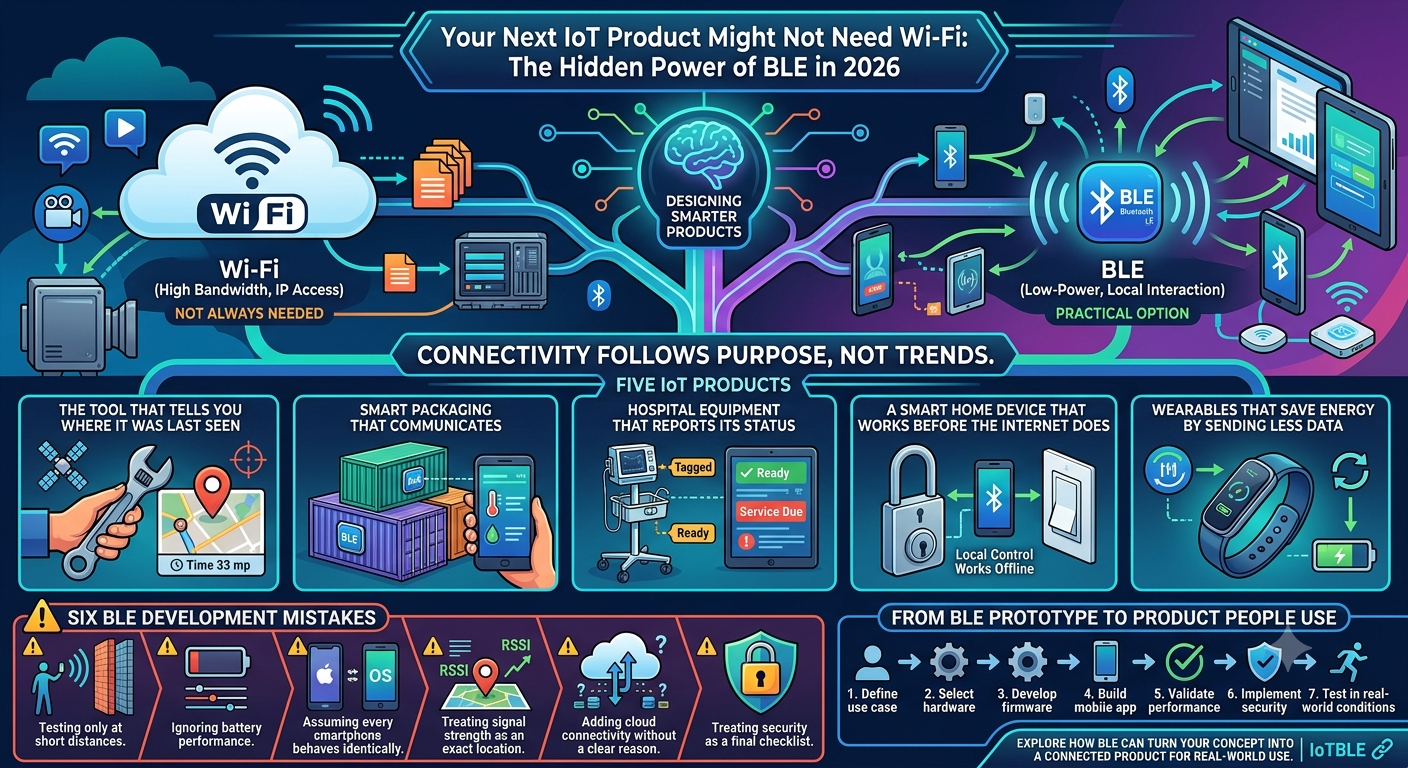
Imagine a warehouse where every valuable tool can be located, a hospital where equipment can report its status, or a factory where sensors detect problems before a machine stops working.
Now imagine achieving these capabilities without connecting every device directly to Wi-Fi.
That is where Bluetooth Low Energy (BLE) becomes interesting.
As businesses rethink how connected products should communicate, BLE is emerging as a practical option for applications that need low-power wireless connectivity, local device interaction, and efficient data exchange. In 2026, the real opportunity is not simply connecting more devices. It is designing smarter products that use the right connection for the right job.
The Big IoT Question: Does Every Device Need Wi-Fi?
Wi-Fi is useful when devices need substantial bandwidth or direct access to an IP network. However, not every IoT product needs to transmit large amounts of data continuously.
Consider a temperature sensor that records a reading every few minutes. A connected access tag that broadcasts its presence. A wearable device that synchronizes information with a smartphone.
For these products, continuous Wi-Fi connectivity may introduce unnecessary power consumption, configuration complexity, or hardware requirements.
BLE offers another approach: devices can communicate locally with compatible smartphones, gateways, or other supported systems, depending on the product architecture.
The lesson for IoT product developers is simple: connectivity should follow the product’s purpose, not the latest technology trend.
Five IoT Products That Become More Interesting With BLE
1. The Tool That Tells You Where It Was Last Seen
Imagine a maintenance company managing hundreds of specialized tools across multiple locations.
A BLE tag attached to each tool can broadcast a signal that compatible scanners or gateways detect. A tracking application can then display the last detected location or zone, along with timestamps.
This can help teams reduce time spent searching for equipment.
The development challenge: Designing useful tracking logic, gateway placement, battery-efficient advertising, and clear location-confidence indicators.
BLE proximity does not automatically provide precise GPS-like positioning. The actual accuracy depends on the hardware, environment, and positioning method.
2. Smart Packaging That Communicates
What if reusable shipping containers could help businesses monitor their handling conditions?
A BLE-enabled sensor could record temperature or other environmental measurements and share them with a nearby smartphone or gateway.
Businesses could use this approach to improve visibility into storage and transportation conditions.
The development challenge: Battery life, sensor calibration, data integrity, environmental durability, and deciding when readings should be stored locally or transmitted.
3. Hospital Equipment That Reports Its Status
Hospitals and clinics manage many mobile assets, from diagnostic equipment to portable monitoring devices.
BLE tags and receiving infrastructure can help authorized staff identify nearby equipment and improve asset visibility.
A connected system could also support maintenance reminders or equipment availability workflows.
The development challenge: Reliable coverage, secure device identity, integration with existing hospital systems, and careful handling of sensitive operational data.
4. A Smart Home Device That Works Before the Internet Does
A smart device should not always become unusable simply because the internet connection fails.
A BLE-enabled product can support local setup, configuration, and direct interaction with a compatible phone. Depending on its design, essential local functions may continue even when cloud services are unavailable.
The development challenge: Defining which features must work offline, preserving device settings, handling reconnections, and securely synchronizing data when connectivity returns.
5. Wearables That Save Energy by Sending Less Data
A wearable sensor does not necessarily need to transmit every raw measurement continuously.
Depending on the application, firmware can process or summarize selected measurements and send only the information required by the connected application.
This can reduce unnecessary communication and may improve energy efficiency.
The development challenge: Balancing measurement frequency, data accuracy, latency, battery life, and the limitations of the device’s processor.
The Real Innovation Is Not BLE Alone
A successful connected product usually combines multiple technologies rather than relying on one wireless protocol.
For example, a BLE-enabled industrial sensor might use:
- BLE for local communication and configuration.
- Embedded firmware for sensor readings, power management, and device behavior.
- A mobile application for setup, diagnostics, and nearby-device interaction.
- A gateway to relay information when remote access is required.
- Cloud software for device management, historical data, and reporting.
- AI or analytics when the collected data can support useful predictions or anomaly detection.
Not every product needs all six components. The correct architecture depends on its users, operating environment, data requirements, and budget.
Six BLE Development Mistakes That Can Ruin a Good IoT Product
A promising prototype can still fail when deployed in the real world.
Mistake 1: Testing only at short distances. Real buildings contain walls, metal surfaces, interference, and changing environmental conditions.
Mistake 2: Ignoring battery performance. Advertising intervals, connection settings, sensor activity, and firmware behavior all influence power consumption.
Mistake 3: Assuming every smartphone behaves identically. Operating-system restrictions, background execution, permissions, and Bluetooth implementations can affect application behavior.
Mistake 4: Treating signal strength as an exact location. RSSI-based proximity estimates can fluctuate and require suitable calibration and interpretation.
Mistake 5: Adding cloud connectivity without a clear reason. Remote access is valuable for some products, but local-only solutions may be simpler and more economical for others.
Mistake 6: Treating security as a final checklist. Device authentication, pairing security, firmware updates, and protection of sensitive information should be considered from the beginning.
From BLE Prototype to a Product People Can Actually Use
Building a BLE demonstration is only the first step. Commercial product development requires attention to the complete user experience.
A practical development process includes:
- Define the product’s core use case and connectivity requirements.
- Select suitable BLE hardware, sensors, and power architecture.
- Develop firmware and the required GATT services and characteristics.
- Build and test the mobile application on supported devices.
- Validate range, interference handling, reconnection, and battery performance.
- Implement suitable security controls and device-update mechanisms.
- Test the product in realistic operating conditions before deployment.
For manufacturers and startups, this process helps identify technical limitations before they become expensive production problems.
Is BLE the Right Choice for Your Next IoT Product?
BLE is worth evaluating when your product needs low-power local communication, smartphone connectivity, nearby-device discovery, or sensor-data exchange.
It may not be the best primary technology when the application requires high-bandwidth streaming, long-distance communication without gateways, or continuous direct internet access.
The strongest product architecture may combine BLE with Wi-Fi, cellular connectivity, or another suitable technology.
The objective is not to use the most technologies. It is to build a product that solves the problem reliably.
Build Beyond the Prototype With IoTBLE
A connected product becomes valuable when its hardware, firmware, connectivity, and software work together in real operating conditions.
IoTBLE can position its development services around helping businesses explore BLE-enabled product concepts, connected-device applications, firmware integration, and end-to-end IoT architectures.
Whether you are developing an asset tracker, a smart sensor, a wearable, or an industrial monitoring solution, start by identifying the problem your device needs to solve.
Then choose the technology that makes that solution practical.
Have an IoT product idea? Explore how BLE development can help turn your concept into a connected product built for real-world use.
Frequently Asked Questions
Can an IoT device work without Wi-Fi?
Yes. Depending on its requirements, a device can use BLE for local communication or another connectivity technology. Remote access may require a gateway or an additional network connection.
How far can Bluetooth Low Energy communicate?
Range varies with hardware, antenna design, transmit power, receiver sensitivity, obstacles, and interference. The practical range must be tested in the intended environment.
Can BLE devices send data to the cloud?
Yes. A smartphone or gateway can receive BLE data and forward it to cloud services when the application requires remote monitoring or centralized data management.
Is BLE suitable for industrial IoT?
It can be suitable for sensor monitoring, configuration, asset visibility, and other applications where its range, reliability, and throughput meet operational requirements.
What is the difference between a BLE prototype and a production-ready product?
A prototype demonstrates core functionality. A production-ready product additionally requires robust firmware, realistic connectivity testing, security, power optimization, manufacturing preparation, and ongoing support.
Leave a Reply