Introduction: What If Buildings Could Guide You?
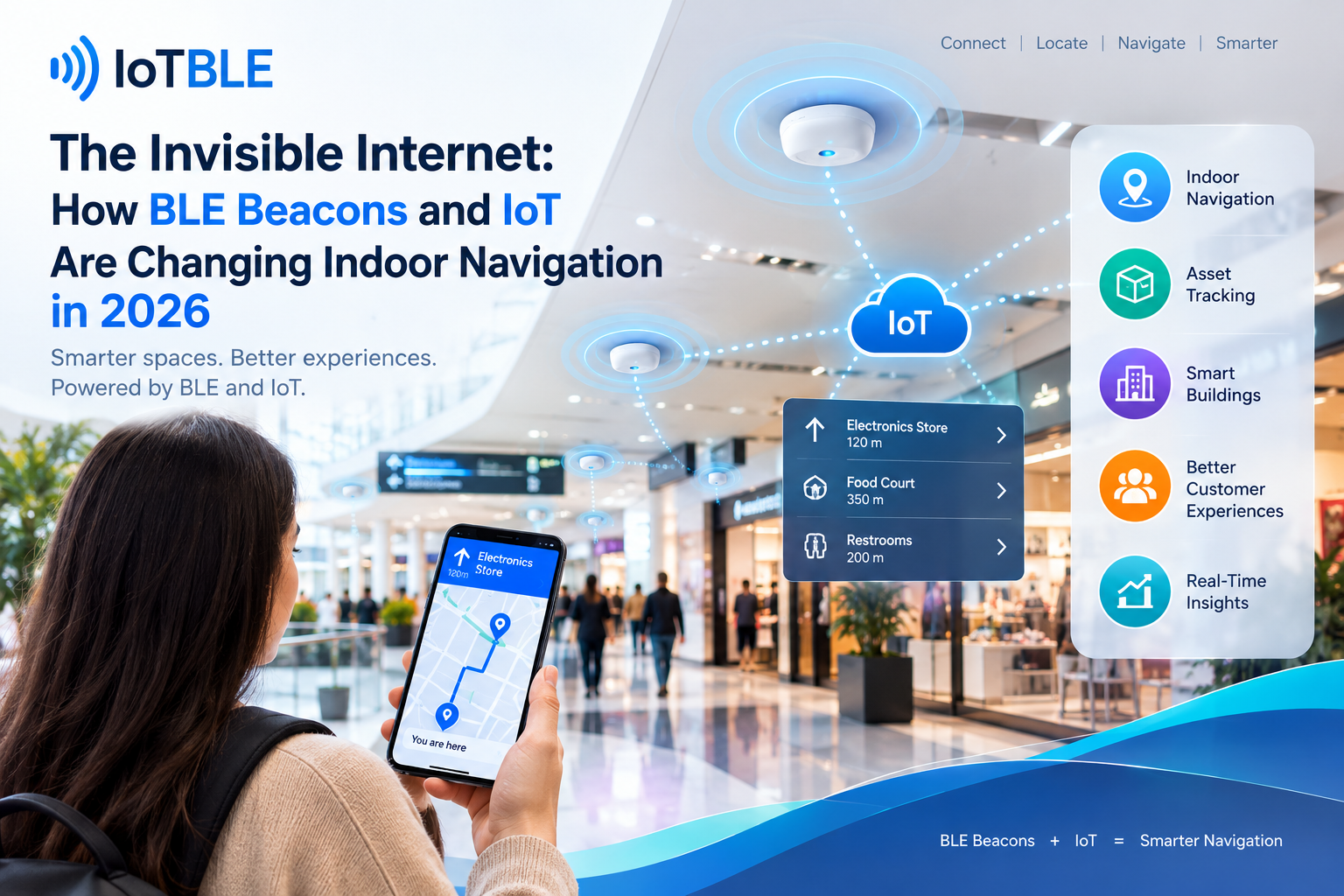
Imagine entering a hospital and finding your department without asking for directions. A warehouse worker locates a specific product in seconds. A shopper receives helpful navigation inside a large shopping center without relying on GPS.
These experiences are becoming possible through indoor positioning technologies, including Bluetooth Low Energy (BLE) beacons and the Internet of Things (IoT).
GPS works well outdoors, but its accuracy can be limited inside buildings because satellite signals struggle to penetrate walls and roofs. BLE-based systems offer another approach by using nearby wireless signals to estimate device proximity or location.
In 2026, businesses are exploring these technologies to improve navigation, asset visibility, operational efficiency, and customer experiences.
What Are BLE Beacons and How Do They Work?
BLE beacons are small wireless transmitters that periodically broadcast Bluetooth signals. Compatible smartphones, gateways, or other devices can detect these signals and use them for different applications.
A typical BLE indoor navigation system includes:
- BLE beacons: Broadcast identifiable wireless signals.
- Mobile applications: Detect beacon signals and provide directions or contextual information.
- IoT gateways: Collect information from nearby devices when required.
- Location software: Estimates proximity or position using signal measurements and system configuration.
- Management dashboards: Help businesses monitor devices, locations, and system activity.
For example, a hospital may install beacons in corridors and waiting areas. Its mobile application can use detected signals to identify nearby zones and guide visitors toward their destinations.
The accuracy depends on beacon placement, building layout, radio interference, device capabilities, and the positioning method used.
Five Industries Exploring BLE Indoor Navigation
1. Hospitals and Healthcare Facilities
Large hospitals often contain multiple departments, diagnostic laboratories, pharmacies, and specialist clinics.
BLE-based indoor navigation can help visitors find departments, elevators, reception desks, and waiting areas.
Potential benefits include:
- Easier navigation for patients and visitors.
- Location-aware information through mobile applications.
- Better orientation in large medical facilities.
- Support for locating tagged equipment when the system is designed for asset tracking.
Healthcare implementations should protect personal information and avoid assuming that proximity data alone establishes a person’s precise location.
2. Warehouses and Distribution Centers
Finding inventory and equipment in a large warehouse can consume valuable time.
BLE tags and receivers can support asset visibility by helping organizations detect tagged items in particular zones or estimate their location.
When integrated with warehouse management software, these systems can help staff find tools, track equipment movement, and improve inventory workflows.
For applications requiring centimeter-level accuracy, BLE alone may not be sufficient without specialized positioning techniques or complementary technologies.
3. Shopping Malls and Retail Stores
Retailers can use BLE beacons to support indoor maps, location-aware offers, and store discovery.
For example, a shopping center application could help visitors find a particular store or display relevant information when they approach a designated area.
Businesses should prioritize useful, permission-based notifications instead of sending excessive promotional messages.
4. Airports and Transportation Hubs
Airports, railway stations, and convention centers can be difficult to navigate because of their size and complex layouts.
BLE-based systems can support indoor maps, wayfinding, and location-aware guidance to gates, platforms, service counters, and facilities.
Reliable navigation requires careful deployment, frequent map updates, and testing across different mobile devices.
5. Smart Offices and Commercial Buildings
Connected buildings can use BLE to support room discovery, occupancy-related applications, and location-aware building services.
Combined with suitable IoT sensors and building management platforms, these systems can provide additional insights into space utilization and operational patterns.
Any monitoring solution should be designed with appropriate transparency, access controls, and privacy protections.
BLE vs. GPS: Which Is Better for Indoor Navigation?
GPS and BLE serve different purposes, and many location solutions use multiple technologies.
| Feature | BLE Beacons | GPS |
|---|---|---|
| Best environment | Indoor and nearby-device applications | Outdoor positioning |
| Infrastructure | Usually requires deployed beacons or compatible transmitters | Generally uses satellite signals |
| Indoor performance | Can work indoors with proper deployment | Often limited inside buildings |
| Typical applications | Indoor wayfinding, proximity, asset visibility | Road navigation, outdoor tracking |
| Accuracy | Depends on configuration and positioning method | Depends on signal conditions and receiver |
BLE is not automatically more accurate in every building. The right choice depends on the environment, required accuracy, infrastructure cost, and user experience.
How AI Can Make BLE and IoT Navigation Smarter
BLE provides wireless signals, while IoT systems organize and process information from connected devices. AI and analytics can add another layer of intelligence.
Potential applications include:
Navigation optimization: Analyze aggregated movement patterns to identify confusing routes or heavily congested areas.
Predictive maintenance: Use device-health data to identify beacons or gateways that may need attention.
Crowd-flow insights: Help facility managers understand general traffic patterns using appropriately aggregated data.
Context-aware assistance: Combine location estimates with maps and user-selected destinations to provide more relevant directions.
AI cannot eliminate inaccurate signals or poor infrastructure. Reliable outcomes still depend on suitable hardware, quality data, and well-tested positioning logic.
Common Challenges in BLE Indoor Positioning
Although BLE can be cost-effective and flexible, successful deployment requires careful planning.
Signal Interference
Walls, metal structures, people, and other radio sources can affect Bluetooth signal strength. Site surveys and real-world testing help determine appropriate beacon placement.
Location Accuracy
A beacon detection may indicate that a device is nearby without identifying its exact position. More advanced methods, calibration, or additional sensors may be needed for precise navigation.
Battery Life and Maintenance
Battery-powered beacons require a maintenance plan based on transmission intervals, hardware specifications, and expected operating conditions.
Device Compatibility
Mobile operating systems have Bluetooth permissions and background-operation restrictions. Applications must account for these behaviors and obtain the necessary user permissions.
Privacy and Security
Organizations should consider secure system administration, appropriate data retention, transparent location-data practices, and access controls.
How to Develop a BLE Indoor Navigation Solution
Businesses planning a BLE navigation product can follow a structured development process.
- Define the objective: Decide whether the priority is wayfinding, asset tracking, proximity notifications, or another use case.
- Survey the environment: Assess the building layout, walls, interference, and required coverage.
- Select the hardware: Choose appropriate beacons, gateways, and receivers.
- Choose a positioning method: Determine whether proximity zones, signal-strength estimates, or more advanced techniques meet the accuracy requirements.
- Develop the application: Build indoor maps, route guidance, search, and accessible navigation features.
- Integrate IoT services: Connect the system to relevant dashboards, databases, or business applications.
- Test and optimize: Validate performance in busy and quiet conditions, across supported devices.
- Plan maintenance: Establish procedures for battery replacement, map updates, monitoring, and software improvements.
A pilot deployment in one floor or department can help businesses measure accuracy and usability before expanding across an entire facility.
The Future of BLE and Indoor Location Technology
Indoor positioning is evolving alongside connected devices, digital mapping, edge computing, and smart-building platforms.
BLE can provide a practical foundation for proximity-based services, while additional sensors and positioning methods can improve location estimates where necessary.
The strongest implementations will focus on solving specific problems: helping people find their destinations, reducing time spent searching for equipment, and giving facility managers useful operational information.
Instead of adding beacons simply because the technology is available, businesses should begin with a clear goal and measurable outcomes.
Conclusion
BLE beacons and IoT are creating new possibilities for indoor navigation across healthcare, retail, logistics, transportation, and commercial buildings.
By combining wireless hardware, mobile applications, positioning software, and connected platforms, organizations can build indoor experiences that are more informative and convenient.
For companies exploring connected product development, the opportunity lies in designing a solution that balances location accuracy, affordability, reliability, and privacy.
IoTBLE insight: The future of indoor navigation isn’t just about knowing where you are. It’s about helping you decide where to go next.
Frequently Asked Questions
What is BLE indoor positioning?
BLE indoor positioning uses Bluetooth Low Energy signals from beacons or devices to estimate proximity or location within a building.
Can BLE be used for indoor navigation without GPS?
Yes. A properly designed BLE-based system can support indoor navigation without relying on GPS, although it may use maps, gateways, or other positioning technologies.
How accurate is BLE indoor positioning?
Accuracy varies significantly with hardware, beacon placement, environmental conditions, and the positioning technique. Proximity detection is generally simpler than precise coordinate-based tracking.
Do BLE beacons need Wi-Fi?
BLE beacons can broadcast Bluetooth signals without Wi-Fi. However, applications may require internet access or gateways for map downloads, remote monitoring, and cloud integration.
What businesses can benefit from BLE IoT solutions?
Hospitals, warehouses, retailers, airports, offices, museums, and other large facilities can benefit when indoor navigation or location awareness addresses a genuine operational need.
SEO title: BLE Indoor Navigation in 2026: Beacons, IoT and Smart Buildings
Meta description: Discover how BLE beacons and IoT enable indoor navigation, asset tracking, smart buildings, and location-aware applications in 2026.
Primary keyword: BLE indoor navigation
Secondary keywords: BLE beacon technology, BLE IoT solutions, indoor positioning system, Bluetooth indoor navigation, IoT asset tracking, BLE beacon development, smart building technology.
Suggested URL slug: /blogs/ble-indoor-navigation-iot-2026/
Leave a Reply