Introduction
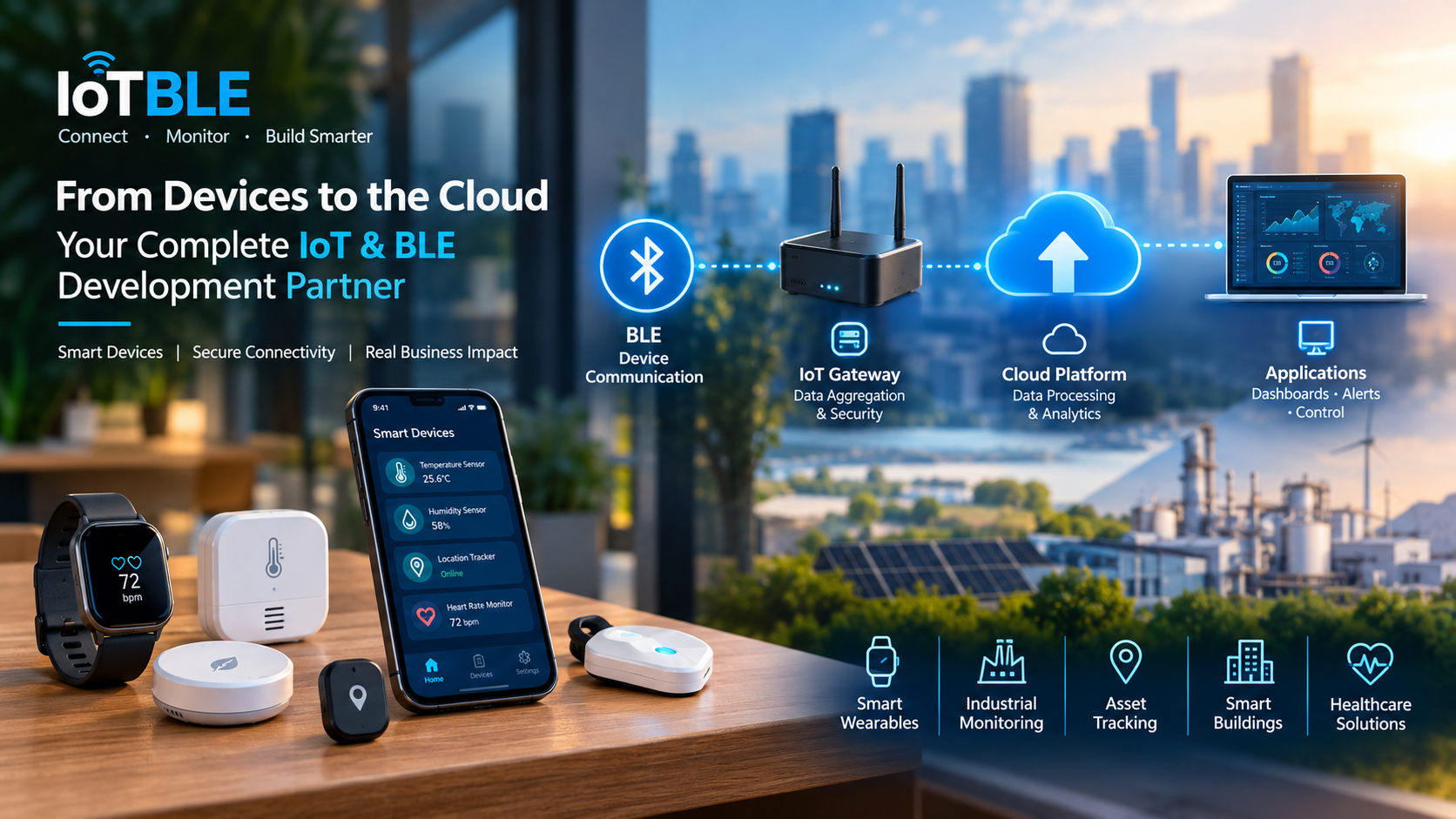
Connecting a device to a smartphone is only the beginning of a successful Internet of Things (IoT) product. The real challenge is creating a reliable system in which devices collect data, applications interpret it, and cloud platforms make that information useful.
In 2026, businesses developing connected products need more than wireless communication. They need secure device pairing, efficient data transmission, dependable firmware, mobile application connectivity, and scalable cloud infrastructure.
This is where IoT product development, Bluetooth Low Energy (BLE) integration, and cloud-connected software work together.
IoTBLE helps businesses explore connected product solutions that combine BLE device communication, IoT system integration, sensor networks, gateways, and cloud connectivity. The objective is to turn individual devices into useful, manageable, and scalable connected systems.
1. Why BLE-to-Cloud Integration Matters for IoT Products
Bluetooth Low Energy is designed for wireless communication with relatively low power consumption, making it suitable for many battery-powered connected devices.
However, BLE devices generally do not connect directly to cloud services on their own. A smartphone, dedicated gateway, or another suitable intermediary typically bridges the device to an internet-connected platform.
A complete BLE-to-cloud architecture may include:
- BLE-enabled hardware and embedded firmware.
- Secure device discovery, pairing, and communication.
- A mobile application or IoT gateway.
- Backend APIs and cloud infrastructure.
- Data storage, monitoring dashboards, and alerts.
- Device management and firmware update mechanisms.
When these components work together, businesses can develop connected products that provide useful information and support remote monitoring.
2. IoT Product Development Beyond the Prototype
A working prototype demonstrates that an idea is technically possible. A production-ready IoT product must also work reliably under real-world conditions.
Professional IoT product development services consider hardware compatibility, connectivity, power consumption, firmware behavior, software integration, and long-term maintenance.
The development process typically includes:
Requirements and feasibility: Define the product’s purpose, target users, hardware, connectivity needs, and expected operating conditions.
System architecture: Determine how devices, mobile applications, gateways, APIs, and cloud services will communicate.
Prototype development: Validate critical functionality using representative hardware and software.
Integration and testing: Test device communication, data handling, connectivity recovery, and security controls.
Deployment and maintenance: Monitor production performance, address issues, and plan updates.
This approach helps identify technical risks early and reduces the likelihood of expensive integration problems later.
3. BLE Device Development for Low-Power Connected Products
BLE is useful when a product needs to exchange relatively small amounts of data with nearby devices while managing power consumption.
Examples include smart wearables, environmental sensors, access-control devices, connected consumer products, and industrial monitoring equipment.
A well-designed BLE device development project may involve:
- BLE peripheral and central implementations.
- Custom Generic Attribute Profile (GATT) services and characteristics.
- Device discovery and connection management.
- Secure pairing and bonding.
- Embedded firmware integration.
- Signal and power optimization.
- Mobile application communication.
- Compatibility and interoperability testing.
The correct implementation depends on the hardware, Bluetooth specification, communication requirements, and expected operating environment.
4. Smart Sensor Networks for Real-Time Monitoring
Sensor networks allow businesses to collect information from multiple devices and use it to understand operational conditions.
For example, industrial sensors may monitor temperature, humidity, vibration, or equipment status. A gateway can aggregate sensor data and forward it to a cloud platform for visualization and analysis.
Smart sensor network development can help organizations:
- Monitor environmental conditions.
- Identify abnormal readings.
- Track equipment operating conditions.
- Generate alerts when thresholds are exceeded.
- Analyze historical sensor data.
- Improve visibility across distributed locations.
Reliable sensor networks require appropriate sampling intervals, data validation, connectivity planning, and a strategy for handling missing or delayed measurements.
Real-time monitoring also depends on the system architecture and connection quality; not every IoT deployment requires instantaneous cloud updates.
5. IoT Gateway and Cloud Connectivity
A gateway acts as a bridge between connected devices and broader networks or cloud services.
In a BLE-based system, a gateway can receive data from nearby BLE devices and forward it through an internet connection. Depending on the design, a compatible smartphone may also perform this bridging role.
IoT gateway development and cloud connectivity solutions can include:
- Device-to-gateway communication.
- Secure API integration.
- Data ingestion and processing.
- Cloud-based device registration.
- Remote monitoring dashboards.
- Device status and event notifications.
- Connectivity recovery and error handling.
A suitable gateway architecture can also support local processing when internet access is unavailable or immediate responses are required.
Businesses should select their cloud architecture according to expected device volume, data frequency, security requirements, operating costs, and integration needs.
6. Secure Device Provisioning and BLE Communication
Device provisioning is the process of securely registering and configuring a device so it can operate within an application or IoT ecosystem.
Poor provisioning can create onboarding difficulties, unauthorized access risks, and device-management problems.
A robust provisioning workflow should consider:
- Device identity and authentication.
- Secure pairing and bonding where appropriate.
- User or organization ownership.
- Protected configuration and credentials.
- Authorization for device commands.
- Recovery and device-transfer procedures.
BLE security mechanisms should be selected according to the threat model and supported hardware. Applications should not treat a successful Bluetooth connection as proof that a device or user is authorized.
For cloud-connected products, security must extend beyond BLE communication to APIs, firmware, cloud accounts, data storage, and administrative interfaces.
7. Over-the-Air Firmware Updates for Connected Devices
Connected products often need firmware updates to improve functionality, address vulnerabilities, or correct device behavior.
Over-the-air (OTA) firmware updates can reduce the need to access every device physically, particularly when products are deployed across multiple locations.
A reliable OTA process should include:
- Firmware authenticity and integrity verification.
- Secure update authorization.
- Compatibility checks.
- Adequate power and connectivity checks.
- Progress reporting and failure handling.
- Recovery or rollback mechanisms where supported.
- Post-update validation.
For BLE-enabled devices, firmware transfer speed and reliability depend on device capabilities, connection parameters, packet handling, and the update design.
Planning OTA functionality early can make long-term product maintenance easier and safer.
8. Industries Benefiting from BLE and IoT Integration
Healthcare and wearable technology
Connected devices can transmit measurements to mobile applications for display and further processing. Products handling sensitive health information require appropriate privacy, security, and validation practices.
Manufacturing and industrial monitoring
Sensor-based systems can provide visibility into equipment conditions, environmental measurements, and selected operational events.
Smart buildings
BLE sensors and compatible gateways can support environmental monitoring, occupancy-related applications, and connected building systems.
Logistics and asset tracking
Connected sensors and beacon technologies can assist with asset visibility and proximity detection. Accuracy depends on the chosen positioning technology and deployment conditions.
Consumer electronics
Mobile applications can help users configure, monitor, and control compatible connected products.
Each industry has different requirements for connectivity, reliability, security, and data handling, so solutions should be designed around the actual use case.
9. How IoTBLE Supports Connected Product Development
IoTBLE focuses on BLE and IoT development capabilities for businesses planning connected products and integrated device ecosystems.
Depending on project requirements, relevant capabilities include:
- BLE device communication and integration.
- IoT application development.
- Custom GATT service implementation.
- Secure device provisioning and pairing.
- Smart sensor network development.
- IoT gateway and cloud connectivity.
- Embedded firmware integration.
- OTA firmware update workflows.
- Mobile application connectivity.
- Monitoring dashboards and data integration.
Combining these elements into a coordinated architecture helps businesses plan beyond initial connectivity and consider the entire product lifecycle.
If you are developing a new connected device or upgrading an existing IoT platform, define the required hardware, communication protocols, data flow, security controls, and user experience before selecting the final architecture.
10. How to Choose the Right IoT Development Partner
Choosing an IoT development company requires evaluating the complete technology stack rather than focusing on a single component.
Before beginning a project, consider the following questions:
- Does the team understand BLE protocols and device behavior?
- Can it integrate embedded firmware with mobile and cloud software?
- Does it have experience with device provisioning and connectivity troubleshooting?
- Can it implement suitable security controls?
- Does its testing process cover real hardware and operating conditions?
- Can the architecture support future features and additional devices?
- Is maintenance and firmware update support available?
A development partner should be able to explain the technical trade-offs, identify project risks, and establish a practical implementation plan.
Conclusion
The future of connected products depends on more than adding wireless connectivity to hardware. Successful IoT solutions require coordinated device engineering, reliable BLE communication, secure provisioning, cloud integration, and ongoing maintenance.
From BLE development services to IoT gateway development, sensor networks, and cloud-connected applications, a well-planned architecture can help businesses build connected products that are easier to manage, maintain, and expand.
IoTBLE supports businesses exploring BLE and IoT development opportunities with an emphasis on device connectivity, system integration, and connected product requirements.
Planning a BLE or IoT product? Visit IoTBLE to discuss your project requirements and explore a suitable connected-device development approach.
Frequently Asked Questions
1. What is BLE-to-cloud integration?
BLE-to-cloud integration connects Bluetooth Low Energy devices to cloud platforms through an intermediary, such as a smartphone or dedicated gateway, allowing data to be transmitted, stored, and processed.
2. What are IoT product development services?
IoT product development services can include system architecture, embedded software, device connectivity, mobile applications, cloud integration, testing, and ongoing product support.
3. What is the role of an IoT gateway?
An IoT gateway connects devices or local networks with other systems and cloud platforms. It can bridge protocols, forward data, and perform selected local processing.
4. Why is BLE useful for IoT devices?
BLE is useful for many short-range applications because it supports wireless communication with relatively low power consumption. Its suitability depends on range, throughput, latency, hardware, and application requirements.
5. What is OTA firmware updating?
OTA firmware updating allows compatible devices to receive and install firmware updates remotely, subject to appropriate security, compatibility, and recovery mechanisms.
6. How can businesses secure BLE and IoT devices?
Businesses should use suitable device authentication, secure pairing, protected APIs, access controls, signed firmware updates, and ongoing security testing throughout the product lifecycle.
SEO keyword strategy
Primary keyword
- IoT product development
Secondary keywords
- BLE IoT development
- BLE development services
- IoT development company
- IoT system integration
- BLE device development
- IoT gateway development
- IoT cloud connectivity
- Smart sensor network development
- BLE-to-cloud integration
- IoT application development
Long-tail keywords
- Custom BLE and IoT product development services
- Bluetooth Low Energy integration for IoT devices
- IoT gateway and cloud integration solutions
- Secure BLE device provisioning and pairing
- Over-the-air firmware updates for IoT devices
- Connected device development for industrial monitoring
Suggested internal links
- BLE Device Development
- IoT System Integration
- Smart Sensor Networks
- Gateway and Cloud Connectivity
- BLE Application Development
Link each phrase to the corresponding IoTBLE service page when that page exists. Avoid adding links to nonexistent URLs.
Leave a Reply