Introduction
A connected product is no longer just a device that sends data to an application. Businesses increasingly need products that collect useful information, communicate efficiently, and help users make better decisions.
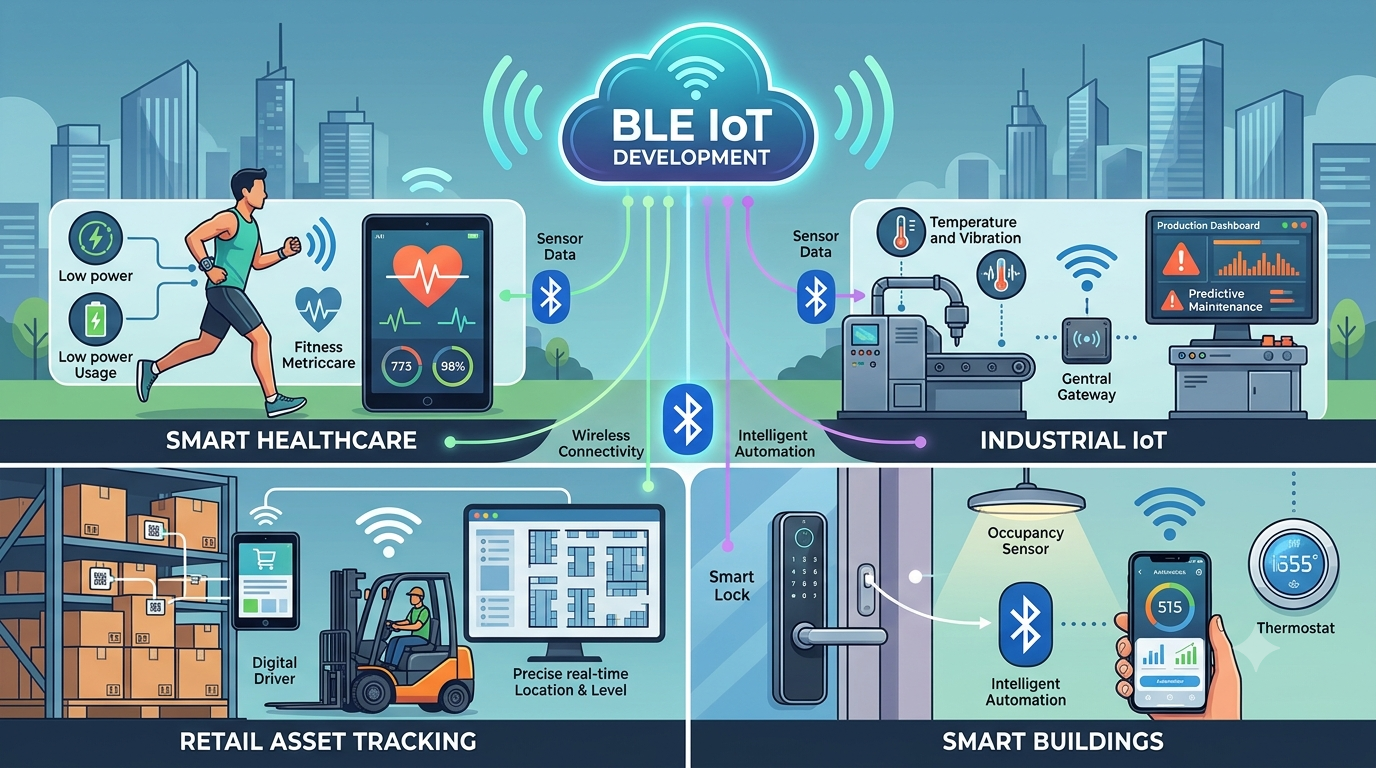
From smart wearables and industrial sensors to warehouse tracking systems and intelligent building controls, Bluetooth Low Energy (BLE) is helping businesses build practical connected experiences.
In 2026, the combination of BLE and the Internet of Things (IoT) is creating new opportunities for companies developing smart hardware, mobile applications, and connected enterprise systems.
For product manufacturers and technology businesses, investing in the right BLE IoT development strategy can improve device efficiency, simplify connectivity, and create new opportunities for digital services.
1. What Makes BLE Important for IoT Product Development?
Bluetooth Low Energy is a wireless communication technology designed for applications that need to exchange data while managing power consumption carefully.
Unlike connectivity approaches designed primarily for high-bandwidth communication, BLE is particularly useful for devices that transmit small amounts of data periodically or communicate with nearby smartphones, tablets, or gateways.
Its capabilities make it suitable for a wide range of connected products.
Key advantages include:
- Energy-efficient communication: Appropriate design and power management can help battery-powered products operate longer between charges or battery replacements.
- Smartphone compatibility: BLE allows supported devices to communicate directly with compatible mobile applications.
- Compact product design: BLE-enabled chips and modules can support small connected devices.
- Flexible integration: BLE can connect sensors and peripherals to applications, gateways, and larger IoT platforms.
- Multiple use cases: BLE supports applications ranging from asset tracking to device configuration and environmental monitoring.
Actual power consumption, range, and reliability depend on hardware, firmware, radio conditions, communication settings, and the deployment environment. These factors should be evaluated during product development.
2. Five Industries Transforming Through BLE and IoT
Smart Healthcare and Wearable Devices
Wearables and connected healthcare devices can use BLE to communicate with compatible smartphones or monitoring systems.
Potential applications include fitness trackers, wellness devices, temperature sensors, and connected medical accessories.
A typical system collects measurements from a sensor, transfers the data to a mobile application, and optionally sends approved information to a cloud platform.
Product developers must carefully address data privacy, connection reliability, and any applicable medical-device requirements.
Industrial IoT and Predictive Maintenance
Factories and industrial facilities use sensors to monitor equipment conditions and operational performance.
BLE-enabled sensors can transmit information such as temperature, vibration, or environmental readings to nearby gateways or supported devices.
When integrated with analytics software, this information can help maintenance teams identify unusual patterns and investigate equipment problems earlier.
The result can be improved operational visibility and better-informed maintenance planning.
Retail and Warehouse Asset Tracking
Businesses often lose time locating equipment, managing inventory, or identifying where reusable assets are being used.
BLE beacons and tags can help systems detect nearby assets and estimate their location within a suitably designed infrastructure.
For example, a warehouse solution may combine BLE tags, strategically placed receivers, a gateway, and inventory software to provide asset visibility.
Developers should select the tracking approach based on required accuracy, facility layout, interference, and budget.
Smart Homes and Intelligent Buildings
BLE can support smart locks, wireless switches, occupancy sensors, environmental sensors, and device commissioning.
Connected building applications can use sensor data to support lighting automation, access management, and environmental monitoring.
Where multiple devices need to communicate across a larger facility, the architecture may combine BLE with gateways, cloud platforms, or other networking technologies.
Agriculture and Environmental Monitoring
Agricultural and environmental applications can use connected sensors to monitor soil conditions, temperature, humidity, and other relevant measurements.
BLE may be appropriate for nearby sensors that communicate with a smartphone or gateway. Remote farms or wide outdoor deployments may require additional connectivity technologies.
By collecting useful measurements and presenting them in a clear dashboard, IoT applications can help operators make more informed decisions about resources and maintenance.
3. How a BLE IoT Solution Works
A reliable connected product requires more than a Bluetooth chip. Hardware, embedded software, mobile applications, connectivity, and data processing must work together.
A typical BLE IoT architecture includes the following components:
1. Sensor or connected device
The hardware collects measurements or performs an action. Examples include temperature sensors, smart locks, industrial equipment, and wearable devices.
2. BLE firmware
Embedded firmware manages Bluetooth advertising, connections, data exchange, device states, and power consumption.
3. Mobile application or gateway
A compatible mobile app or dedicated gateway receives data from the BLE device. The gateway can forward information to an internet-connected platform when required.
4. Cloud or backend platform
The backend stores and processes information, manages authorized users, and connects device data with business systems.
5. Dashboard and analytics
Users view measurements, receive alerts, monitor device status, and interact with connected products.
Not every product needs all five components. A standalone BLE accessory may work entirely through a mobile application, while a large industrial deployment may require gateways and a centralized backend.
4. Battery Life: A Critical Factor in BLE Development
One of the biggest challenges in connected product engineering is balancing functionality with energy consumption.
A device that drains its battery too quickly can increase maintenance costs, frustrate customers, and make large deployments impractical.
Effective Bluetooth Low Energy development requires power optimization throughout the design process.
Optimize communication intervals
The device should transmit data as frequently as its actual use case requires. Excessive communication can increase power consumption.
Use appropriate sleep modes
Battery-powered devices can spend much of their time in low-power states and wake when measurements or communication are required.
Reduce unnecessary processing
Efficient firmware, carefully scheduled sensor readings, and optimized data handling can reduce energy use.
Measure real-world performance
Power consumption should be measured using representative workloads, connection settings, battery characteristics, and operating conditions.
Select hardware carefully
The BLE chipset, sensors, power regulator, antenna, and other components all influence total device performance.
Developers should validate expected battery life through testing rather than relying solely on theoretical estimates.
5. Security Considerations for Connected BLE Products
As IoT devices become part of business operations, security must be included from the earliest design stages.
A vulnerable connected device may expose sensitive information or allow unauthorized users to interact with the product.
Important security practices include:
- Use appropriate BLE pairing and bonding mechanisms where required.
- Apply authentication and authorization to sensitive operations.
- Protect sensitive data during transmission and storage.
- Secure firmware updates and verify update authenticity.
- Avoid exposing unnecessary device information.
- Implement appropriate access controls in mobile apps and backend systems.
- Test reconnection behavior, pairing flows, and unauthorized access scenarios.
BLE security should be considered alongside application security, cloud security, and the physical security of the device.
A secure design must account for the complete product rather than Bluetooth communication alone.
6. BLE vs. Wi-Fi vs. Cellular: Which Technology Should You Choose?
The right communication technology depends on how much data a device needs to transfer, how far it must communicate, its power constraints, and whether it needs direct internet access.
| Requirement | BLE | Wi-Fi | Cellular |
|---|---|---|---|
| Low-power sensor communication | Often suitable | Depends on implementation | Depends on technology and usage |
| High-bandwidth data | Generally limited | Often suitable | Depends on network and service |
| Direct smartphone interaction | Strong use case | Supported | Requires separate connectivity |
| Wide-area connectivity | Usually needs a phone or gateway | Requires network coverage | Designed for wide-area networks |
| Typical applications | Wearables, beacons, nearby sensors | Cameras, connected appliances | Remote trackers, distributed assets |
These technologies are not always competitors. Many connected products combine them.
For example, a sensor may communicate with a mobile app using BLE while the app uses Wi-Fi or cellular connectivity to upload data to the cloud.
Similarly, a gateway may collect BLE sensor readings and forward them through an internet connection.
The best architecture balances cost, performance, battery life, coverage, and the intended user experience.
7. How to Choose the Right BLE IoT Development Partner
Choosing an experienced development team can help reduce integration problems and improve the reliability of a connected product.
Before selecting a BLE IoT development company, businesses should evaluate several factors.
Embedded systems expertise: Can the team develop and test firmware for the intended hardware platform?
Mobile application development: Does the team understand BLE scanning, pairing, permissions, connection management, and background-operation limitations on Android and iOS?
IoT integration experience: Can the proposed solution connect devices with gateways, backend systems, APIs, and dashboards?
Power optimization: Does the development process include current measurement and battery-life validation?
Security and testing: Are firmware, device communication, mobile applications, and cloud components tested together?
Long-term maintainability: Can the product support future firmware updates, additional devices, and evolving customer requirements?
A good development partner considers the complete product lifecycle, from early prototypes through deployment and maintenance.
8. Why BLE IoT Development Needs a Complete Product Strategy
A connected product may work perfectly in a laboratory but encounter problems after deployment.
Metal structures, radio interference, different smartphone operating systems, battery variations, and inconsistent network availability can all affect real-world performance.
A complete development strategy should therefore include:
- Requirements gathering and use-case definition.
- Hardware and communication architecture selection.
- Embedded firmware and BLE protocol implementation.
- Mobile application and backend development, where needed.
- Security, interoperability, and performance testing.
- Pilot deployment in realistic operating conditions.
- Monitoring, maintenance, and future product improvements.
This structured approach helps identify technical risks before they become expensive production problems.
9. How IoTBLE Can Support Your Connected Product Journey
Businesses developing smart devices need a practical approach to connectivity, embedded software, and application integration.
IoTBLE focuses on the BLE and IoT development space, making it relevant to organizations exploring connected products and wireless device applications.
Depending on the project’s scope, a BLE IoT solution may involve:
- BLE-enabled mobile applications.
- Connected sensor and hardware integration.
- IoT data collection and monitoring.
- Device configuration and communication.
- Cloud connectivity and application integration.
- Power optimization and product testing.
The exact development requirements should be determined by the device specifications, target users, deployment environment, and expected product lifecycle.
Whether a business is building a new connected product or upgrading an existing device, careful architecture and testing can help turn an initial concept into a dependable solution.
Conclusion
BLE and IoT are helping businesses build connected products that are more practical, energy-conscious, and useful in everyday operations.
From industrial sensors and wearable devices to smart buildings and asset tracking, the combination creates opportunities to collect data, improve visibility, and automate selected workflows.
However, successful deployment requires more than wireless connectivity. Developers must consider battery life, hardware compatibility, firmware reliability, security, mobile application behavior, and the complete system architecture.
By investing in the right BLE IoT development strategy, businesses can create connected products designed for real-world conditions and future growth.
Planning a BLE-enabled product? Explore the requirements for your hardware, firmware, mobile application, and IoT platform to identify the right development approach.
Frequently Asked Questions
1. What is BLE IoT development?
BLE IoT development involves building connected products that use Bluetooth Low Energy to exchange information between devices, sensors, smartphones, gateways, or other systems.
2. What products can be developed using BLE?
BLE can support wearables, smart locks, environmental sensors, asset tags, industrial monitoring devices, retail solutions, and many other products that require nearby wireless communication.
3. Does a BLE device need an internet connection?
No. A BLE device can communicate directly with a compatible nearby smartphone or another BLE device without internet access. Internet connectivity is needed only when the application requires remote access, cloud processing, or online data synchronization.
4. How can developers improve BLE battery life?
Developers can optimize advertising and connection intervals, use low-power sleep modes, reduce unnecessary sensor readings, select suitable hardware, and measure power consumption under realistic operating conditions.
5. Can BLE connect with cloud-based IoT platforms?
Yes. A smartphone or gateway can receive BLE data and forward it to a cloud platform through an internet connection. The exact architecture depends on the product requirements.
6. Is BLE suitable for industrial IoT?
BLE can be suitable for industrial sensing, nearby asset monitoring, device configuration, and selected automation applications. Range, interference, reliability, environmental conditions, and safety requirements should be evaluated for each deployment.
7. What is the difference between BLE and Bluetooth Classic?
BLE is designed for energy-efficient communication and many low-power connected-device applications. Bluetooth Classic is commonly used for applications such as continuous audio streaming. The appropriate option depends on the product’s data, latency, power, and interoperability requirements.
Leave a Reply