The Internet of Things (IoT) is changing how businesses monitor equipment, manage resources, track assets, and interact with connected products.
From smart homes and wearable devices to industrial monitoring systems, connected technology is becoming an important part of modern operations.
But connecting devices is only the beginning.
Businesses also need communication technologies that consume less energy, support reliable data exchange, and work efficiently across different IoT environments.
This is where Bluetooth Low Energy (BLE) becomes valuable.
Bluetooth Low Energy is designed for wireless communication with relatively low power consumption, making it suitable for devices that need to operate for extended periods without frequent battery replacement.
In 2026, BLE continues to play an important role in connected product development, sensor networks, asset tracking, and smart device ecosystems.
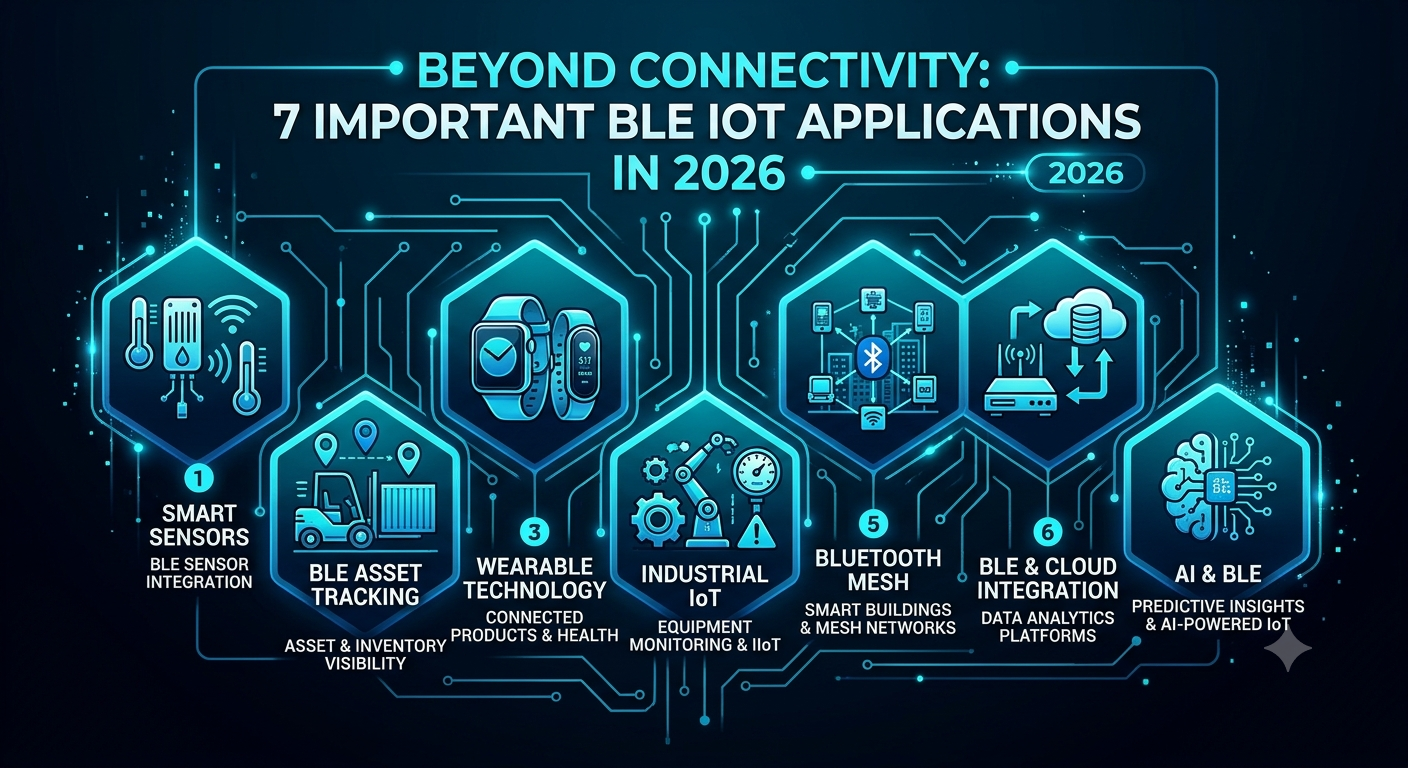
Let’s explore seven important applications and developments shaping Bluetooth Low Energy IoT solutions.
1. Smart Sensors Are Making IoT Monitoring More Efficient
Sensors are among the most important components of IoT ecosystems.
They collect information about environmental conditions, equipment performance, movement, and other physical parameters.
BLE-enabled sensors can transmit collected information to smartphones, gateways, and compatible monitoring systems.
Common applications include:
- Temperature monitoring.
- Humidity measurement.
- Motion detection.
- Environmental monitoring.
- Equipment condition monitoring.
- Occupancy detection.
For example, a warehouse can use BLE temperature sensors to monitor storage conditions. The collected information can be transferred to a gateway and displayed through a centralized dashboard.
This helps businesses improve visibility into their operations.
2. BLE Asset Tracking Is Improving Business Visibility
Managing physical assets across warehouses, offices, hospitals, and industrial facilities can be challenging.
Businesses need to know where important equipment is located and whether it is being used efficiently.
BLE beacons and compatible tracking devices can help address these challenges.
A BLE-based asset tracking solution may include:
- BLE tags attached to assets.
- Fixed BLE gateways or receivers.
- Mobile applications for monitoring.
- Cloud-based data processing.
- Location and movement dashboards.
For example, hospitals can use BLE tags to monitor the movement of medical equipment within supported facilities.
Warehouses can use connected tags to improve asset visibility and inventory workflows.
The accuracy of tracking depends on device placement, signal conditions, receiver density, and the positioning technology being used.
3. Bluetooth Low Energy Is Transforming Wearable Technology
Wearable devices have become an important part of the connected technology industry.
Smartwatches, fitness trackers, health monitoring accessories, and industrial wearables rely on efficient wireless communication.
BLE makes it possible for compatible wearable devices to exchange information with smartphones and other connected systems while conserving battery power.
Some common applications include:
- Fitness activity tracking.
- Heart-rate data transmission.
- Smart wearable notifications.
- Personal safety devices.
- Industrial worker monitoring.
- Connected accessories.
For product manufacturers, BLE integration can help develop compact and energy-efficient wearable solutions.
However, healthcare-related products must also consider appropriate device validation, privacy, and applicable regulatory requirements.
4. Industrial IoT Is Using BLE for Smarter Operations
Industrial environments often contain large numbers of machines, sensors, and monitoring devices.
Connecting these devices can improve operational visibility and support more efficient maintenance workflows.
BLE can be used for industrial applications such as:
Equipment Monitoring: Collect sensor readings from compatible machinery.
Environmental Monitoring: Track temperature, humidity, and other environmental conditions.
Asset Management: Improve visibility into tools and equipment.
Worker Safety: Support proximity-based alerts and connected safety devices.
Maintenance Operations: Provide technicians with wireless access to equipment information.
BLE is not a replacement for every industrial communication protocol. Its suitability depends on coverage, interference, latency, data throughput, and reliability requirements.
A well-designed IoT architecture can combine BLE with gateways and other industrial networking technologies.
5. Bluetooth Mesh Is Supporting Connected Building Ecosystems
Managing multiple connected devices in a building can become complicated when each device operates independently.
Bluetooth Mesh networking provides a communication approach that allows supported devices to communicate through a mesh network.
This technology can support applications such as:
- Smart lighting control.
- Building automation.
- Occupancy-based lighting.
- Connected commercial spaces.
- Sensor-based environmental monitoring.
For example, an office building can use Bluetooth Mesh-enabled lighting systems to coordinate lighting controls across different rooms and areas.
Mesh networking can help support large connected environments, although the network design must account for device capacity, message traffic, and application requirements.
6. BLE and Cloud Integration Are Creating More Connected IoT Platforms
A BLE device can collect valuable information, but businesses often need more than local device communication.
They want centralized dashboards, historical reporting, alerts, analytics, and remote monitoring.
This is where BLE-to-cloud integration becomes important.
A typical architecture may work like this:
- A BLE sensor collects information.
- A compatible smartphone or gateway receives the data.
- The gateway processes and forwards relevant information.
- A cloud platform stores and analyzes the data.
- Users access insights through a web or mobile application.
This architecture allows businesses to manage connected devices across multiple locations.
It can also support integration with business applications, monitoring platforms, and analytics systems.
7. AI and BLE Are Creating Opportunities for Intelligent IoT Applications
Artificial intelligence is introducing new opportunities for IoT product development.
BLE devices can provide data that AI-enabled platforms use to identify patterns, detect unusual conditions, and support predictive insights.
Consider these examples:
Predictive Maintenance: Analyze equipment sensor data to identify patterns associated with possible failures.
Smart Building Management: Use occupancy and environmental information to support building optimization.
Asset Utilization: Analyze tracking information to understand how frequently equipment is used.
Environmental Intelligence: Identify unusual temperature or humidity patterns.
Connected Product Analytics: Analyze device usage information to improve product functionality.
BLE itself does not provide artificial intelligence. Instead, it serves as a communication technology within a larger connected system that may include cloud computing, analytics, and AI models.
Important Considerations When Developing BLE-Based IoT Products
Building a successful BLE-enabled product requires careful planning beyond selecting a Bluetooth module.
Businesses should evaluate several technical considerations.
Power Consumption
Battery-powered IoT devices need efficient communication strategies.
Developers should optimize advertising intervals, connection intervals, transmission frequency, and device sleep modes according to application requirements.
Device Compatibility
BLE products should be tested across supported smartphones, operating systems, gateways, and Bluetooth hardware.
Compatibility testing helps identify communication and interoperability issues.
Data Security
IoT applications must protect device communication and sensitive information.
Important considerations include secure pairing, appropriate authentication, encryption, secure firmware updates, and access management.
Connectivity and Range
BLE performance depends on transmit power, antenna design, physical surroundings, interference, and receiver capabilities.
Developers should validate real-world connectivity rather than relying only on theoretical range specifications.
Firmware and Mobile Application Development
The device firmware and companion application must work together reliably.
A well-designed BLE product should support device discovery, pairing, connection management, data exchange, error handling, and firmware maintenance.
How IoTBLE Supports Modern Bluetooth and IoT Product Development
Developing a successful IoT product requires coordination between hardware, firmware, wireless communication, mobile applications, and cloud platforms.
At IoTBLE, the focus is on Bluetooth Low Energy and connected IoT development solutions that help businesses turn product concepts into practical connected technologies.
From BLE device integration and sensor connectivity to custom mobile applications and IoT platform development, the right technical architecture can help businesses create scalable connected products.
Whether you’re developing a smart sensor, wearable device, industrial monitoring solution, or connected consumer product, selecting the right BLE implementation strategy is an important step towards long-term product success.
Final Thoughts
Bluetooth Low Energy continues to be an important communication technology for modern IoT products.
Its energy-efficient wireless communication capabilities make it suitable for a wide range of applications, including asset tracking, wearable technology, smart buildings, and industrial monitoring.
However, successful IoT development requires more than wireless connectivity.
Businesses must also consider device compatibility, firmware performance, data security, gateway architecture, cloud integration, and long-term scalability.
As connected products become more intelligent in 2026, BLE will continue to provide an important foundation for building efficient and innovative IoT ecosystems.
Planning to develop a Bluetooth-enabled IoT product?
Connect with IoTBLE to explore BLE development, IoT device integration, and custom connected product solutions.
Frequently Asked Questions
1. What is Bluetooth Low Energy in IoT?
Bluetooth Low Energy is a wireless communication technology designed for devices that need to exchange information while consuming relatively little power.
2. Why is BLE important for IoT product development?
BLE supports energy-efficient wireless communication, making it suitable for battery-powered sensors, wearables, asset trackers, and connected consumer products.
3. What is the difference between Bluetooth Classic and BLE?
Bluetooth Classic is commonly used for applications such as continuous audio streaming, while BLE is designed for lower-power communication and periodic data exchange.
4. Can BLE devices connect directly to the cloud?
BLE devices generally require an intermediary, such as a smartphone or gateway, to communicate with cloud platforms over an internet connection.
5. What is Bluetooth Mesh networking?
Bluetooth Mesh is a networking technology that allows compatible devices to communicate through a mesh network, supporting applications such as smart lighting and building automation.
6. Is BLE suitable for industrial IoT applications?
Yes. BLE can support industrial sensor monitoring, asset tracking, equipment monitoring, and worker safety applications when its range, reliability, and environmental requirements are properly evaluated.
7. Can AI work with Bluetooth Low Energy devices?
Yes. BLE devices can transmit sensor data to applications and cloud platforms where AI models can analyze patterns, identify anomalies, and generate predictive insights.
Leave a Reply