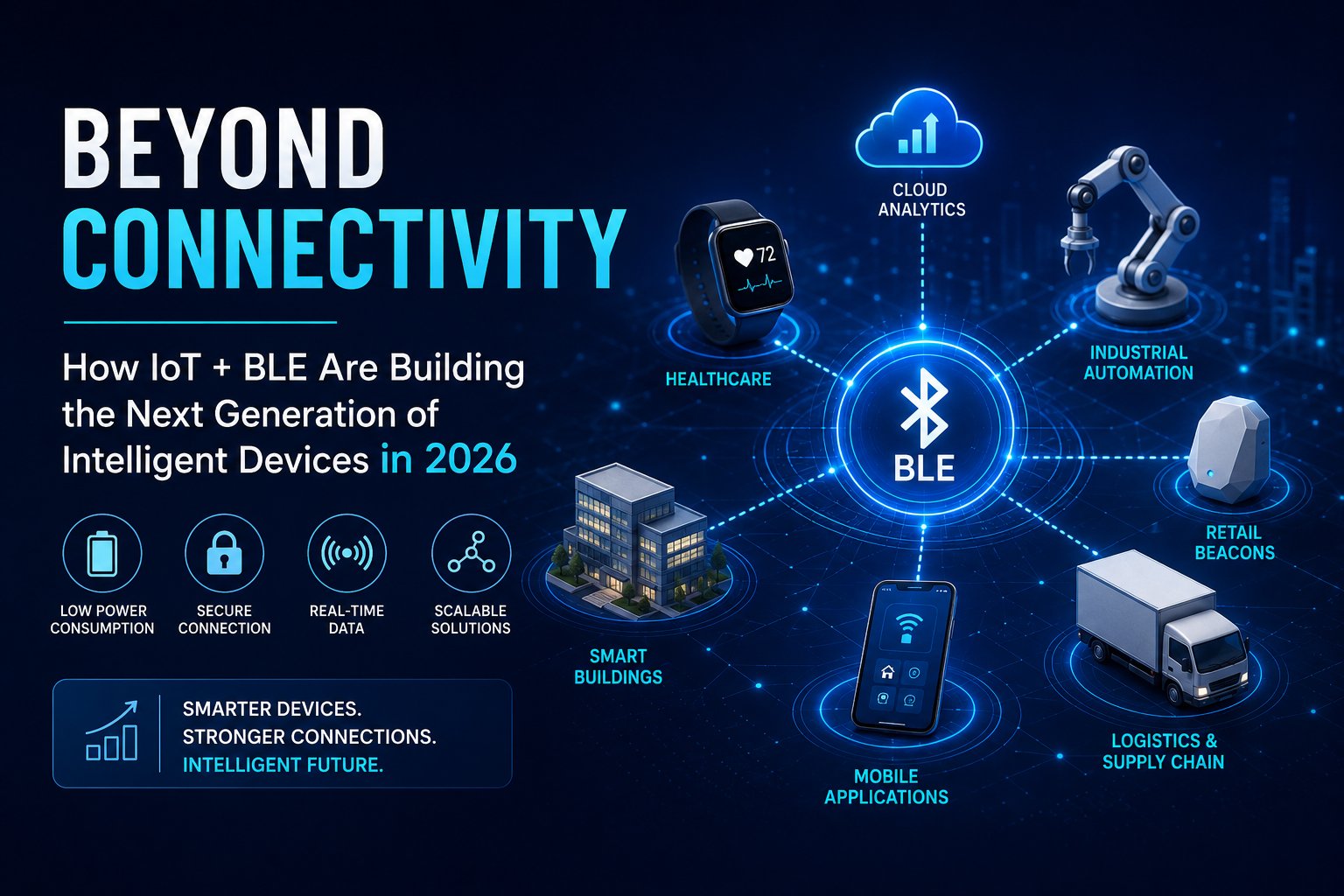
The Internet of Things (IoT) is no longer just about connecting devices—it’s about creating intelligent ecosystems that collect, analyze, and act on data in real time. At the heart of many of these ecosystems is Bluetooth Low Energy (BLE), the wireless technology enabling fast, secure, and energy-efficient communication between smart devices.
From wearable health monitors and smart factories to retail beacons and industrial sensors, IoT + BLE has become the preferred combination for businesses looking to build scalable, low-power connected solutions.
As organizations accelerate digital transformation in 2026, investing in custom IoT BLE development is becoming a competitive necessity rather than an experimental technology.
Why BLE Is Essential for Modern IoT
Unlike traditional Bluetooth, Bluetooth Low Energy is specifically designed for devices that need to transmit small amounts of data while consuming minimal power.
Its advantages include:
- Ultra-low energy consumption
- Fast device discovery
- Secure encrypted communication
- Cost-effective hardware
- Excellent mobile compatibility
- Reliable indoor positioning
- Easy integration with cloud platforms
These features make BLE the ideal wireless protocol for IoT products that must operate continuously for months—or even years—without frequent battery replacement.
Industries Being Transformed by IoT + BLE
Healthcare
Healthcare providers are adopting BLE-powered medical devices to improve patient monitoring while reducing hospital workloads.
Examples include:
- Remote patient monitoring
- Smart insulin pens
- Heart-rate monitoring wearables
- Connected blood pressure devices
- Oxygen saturation sensors
- Hospital asset tracking
Doctors receive real-time health information while patients gain continuous care outside hospitals.
Retail
Retailers use BLE beacons to deliver highly personalized customer experiences.
Applications include:
- Indoor navigation
- Personalized promotions
- Contactless checkout
- Inventory tracking
- Smart shelves
- Customer behavior analytics
BLE enables physical stores to provide digital shopping experiences comparable to eCommerce platforms.
Manufacturing
Industrial IoT relies heavily on BLE sensors for predictive maintenance and operational efficiency.
Use cases:
- Machine health monitoring
- Temperature sensing
- Equipment diagnostics
- Predictive maintenance
- Worker safety monitoring
- Asset utilization tracking
Manufacturers reduce downtime while improving production efficiency.
Smart Buildings
Modern commercial buildings integrate BLE with IoT systems to automate energy management.
Examples:
- Smart lighting
- HVAC automation
- Occupancy detection
- Digital access control
- Conference room management
- Indoor positioning
This results in lower operational costs and improved occupant experiences.
Logistics & Supply Chain
BLE-enabled IoT solutions provide real-time visibility into goods throughout the supply chain.
Applications include:
- Fleet monitoring
- Cold chain monitoring
- Warehouse automation
- Shipment tracking
- Smart pallets
- Delivery verification
Organizations gain accurate inventory visibility while reducing losses.
Emerging IoT + BLE Trends for 2026
AI-Powered Edge Computing
BLE devices increasingly process data locally before sending insights to the cloud.
Benefits include:
- Faster decisions
- Reduced latency
- Lower bandwidth costs
- Improved privacy
- Better battery efficiency
Digital Twins
IoT devices continuously feed data into digital replicas of physical assets.
Businesses use digital twins to:
- Predict failures
- Optimize maintenance
- Simulate operations
- Improve efficiency
BLE Mesh Networks
BLE Mesh enables thousands of connected devices to communicate simultaneously.
Ideal applications include:
- Smart cities
- Industrial automation
- Large commercial buildings
- Smart lighting systems
Indoor Location Intelligence
BLE is becoming the standard for indoor positioning systems.
Applications include:
- Hospital navigation
- Airport guidance
- Warehouse tracking
- Museum experiences
- Retail analytics
Sustainable IoT
Energy-efficient BLE devices help organizations meet ESG and sustainability goals through:
- Reduced battery waste
- Lower energy consumption
- Longer device lifespan
- Lower maintenance costs
Security Challenges and Best Practices
As connected devices increase, cybersecurity becomes even more critical.
Organizations should implement:
- End-to-end encryption
- Secure device authentication
- Firmware updates over-the-air (OTA)
- Identity management
- Certificate-based security
- Zero Trust architecture
- Continuous vulnerability monitoring
Security should be integrated into every stage of IoT product development—not added later.
Why Businesses Choose Custom IoT BLE Development
Off-the-shelf solutions often fail to meet complex business requirements.
Custom development offers:
- Tailored hardware integration
- Cross-platform mobile applications
- Cloud connectivity
- Real-time analytics dashboards
- Enterprise API integration
- Scalable architecture
- Advanced security implementation
Whether developing healthcare wearables, industrial sensors, retail beacons, or smart consumer products, custom IoT BLE solutions provide greater flexibility and long-term scalability.
The Future of Connected Intelligence
The next generation of connected devices will not simply transmit data—they will analyze it, learn from it, and automate decisions.
IoT combined with Bluetooth Low Energy forms the foundation of:
- AI-driven automation
- Predictive maintenance
- Smart healthcare
- Autonomous logistics
- Intelligent manufacturing
- Connected workplaces
Businesses investing today in scalable IoT BLE ecosystems will be better positioned to innovate, reduce operational costs, and deliver exceptional customer experiences in the years ahead.
Conclusion
IoT and Bluetooth Low Energy are reshaping how businesses interact with devices, customers, and data. Their combination offers the perfect balance of low power consumption, secure communication, real-time connectivity, and scalability.
As digital transformation accelerates, organizations that embrace custom IoT BLE solutions will unlock new efficiencies, smarter operations, and future-ready products. The connected future is no longer on the horizon—it is already here.
Leave a Reply