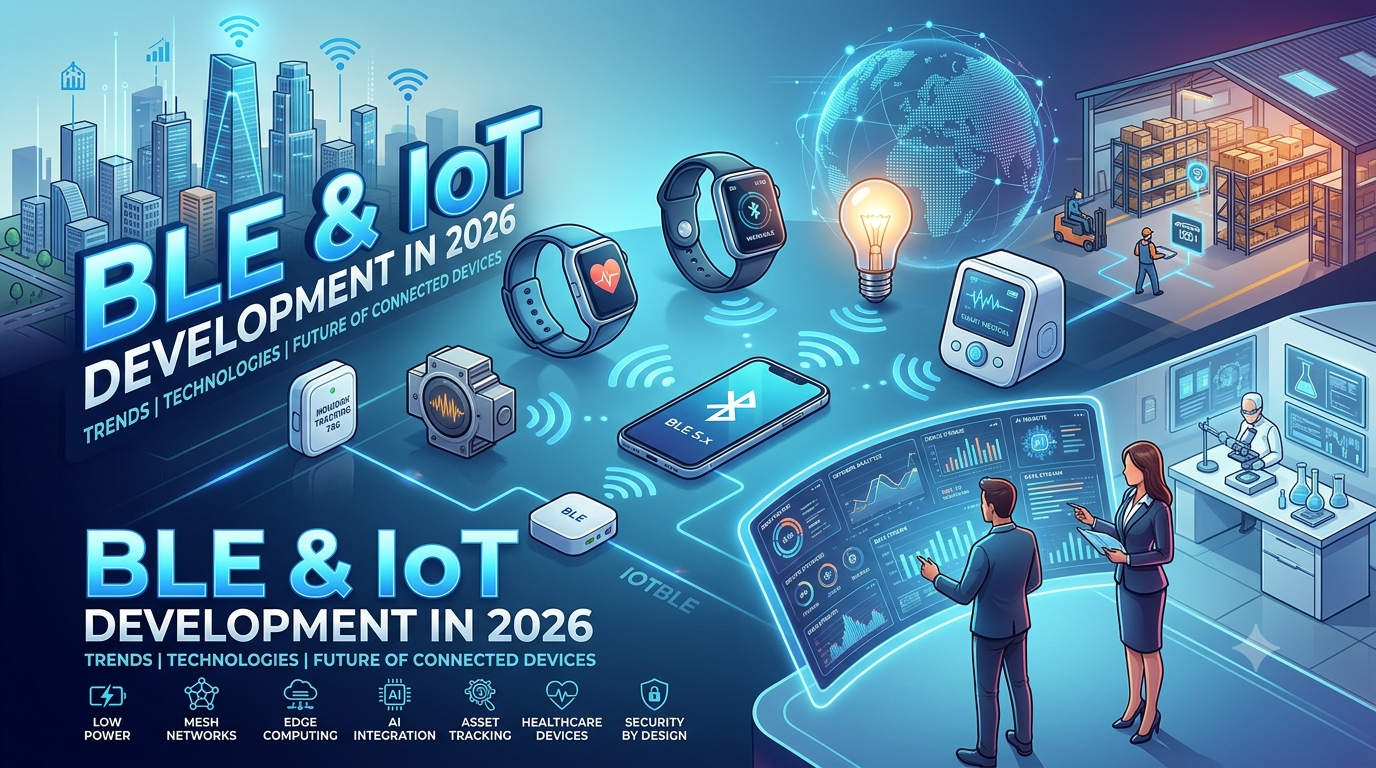
The Internet of Things is moving toward smaller, smarter, and more energy-efficient connected devices. From wearable technology and healthcare devices to industrial sensors, smart buildings, asset tracking, and connected products, businesses are looking for reliable technologies that can connect devices without consuming excessive power.
Bluetooth Low Energy (BLE) has become an important technology in this ecosystem.
In 2026, the combination of BLE and IoT is creating new opportunities for businesses developing connected products. Improvements in Bluetooth technology, edge computing, AI, cloud platforms, device security, and interoperability are making BLE-based IoT solutions more capable than ever.
For companies planning a connected product, understanding the latest BLE IoT development trends can help create solutions that are scalable, secure, and ready for future growth.
What Is BLE IoT Development?
BLE IoT development involves using Bluetooth Low Energy to connect devices, sensors, smartphones, gateways, and cloud platforms.
A typical BLE IoT ecosystem can look like:
BLE Device → Smartphone/Gateway → Internet → Cloud → Analytics/AI → Business Application
BLE is particularly useful for IoT applications where devices need:
- Low power consumption
- Wireless connectivity
- Small hardware footprints
- Smartphone compatibility
- Sensor communication
- Periodic data transmission
- Secure device communication
This makes BLE suitable for everything from consumer products to industrial IoT systems.
Why BLE Is Important for IoT in 2026
Traditional wireless technologies are not always ideal for battery-powered devices.
Many IoT products need to operate for months or even years while collecting and transmitting sensor information.
BLE addresses this requirement by providing wireless connectivity optimized for low-power applications.
Businesses can use BLE for:
- Smart sensors
- Wearables
- Healthcare devices
- Asset tracking
- Industrial monitoring
- Smart home products
- Fitness devices
- Retail technology
- Location-based services
- Connected equipment
The combination of low power consumption and broad smartphone support makes BLE an attractive technology for connected product development.
Top BLE and IoT Trends in 2026
1. Bluetooth Low Energy for Smart IoT Devices
BLE continues to be an important connectivity option for smart devices.
Developers can use BLE to connect sensors and embedded devices to smartphones, tablets, gateways, and other nearby devices.
Common applications include:
- Temperature sensors
- Motion sensors
- Fitness trackers
- Medical devices
- Smart locks
- Asset tags
- Industrial sensors
- Smart appliances
The trend is moving toward smaller devices that can collect more data while consuming less energy.
2. BLE 5.x and Advanced Bluetooth Capabilities
Modern BLE development can take advantage of features introduced across the Bluetooth 5.x family.
Depending on the hardware and use case, developers can benefit from improvements related to:
- Range
- Data throughput
- Broadcasting
- Reliability
- Device communication
- Location services
For IoT product developers, selecting the right Bluetooth specification and hardware architecture is an important part of product design.
3. Bluetooth Mesh for Large-Scale IoT
Bluetooth Mesh enables many devices to communicate within a network rather than relying on a simple one-to-one connection.
This makes it useful for environments containing large numbers of connected devices.
Potential applications include:
- Smart lighting
- Commercial buildings
- Industrial facilities
- Smart offices
- Warehouse systems
- Building automation
Instead of connecting every device directly to a central controller, mesh networking can create a distributed communication architecture.
4. BLE + Edge Computing
Edge computing is becoming increasingly important for IoT.
Instead of sending every piece of sensor data to the cloud, an edge device can process information locally.
For example:
BLE Sensor → Edge Gateway → Local Processing → Cloud
This can reduce:
- Latency
- Bandwidth requirements
- Cloud processing costs
- Dependence on constant connectivity
Edge computing is particularly useful for industrial IoT and applications where rapid responses are important.
5. AI + BLE IoT
One of the biggest opportunities in 2026 is combining AI with connected IoT devices.
BLE sensors can continuously collect information, while AI systems can analyze the data and identify patterns.
For example:
Sensor Data → BLE → Gateway → AI Model → Action
AI-powered IoT solutions can support:
- Predictive maintenance
- Anomaly detection
- Equipment monitoring
- Energy optimization
- Predictive analytics
- Health and fitness insights
- Smart automation
The value of IoT is increasingly moving from simply collecting data to understanding what the data means.
6. Matter and Connected Home Ecosystems
Interoperability has become an important issue in smart-home development.
Matter is designed to improve interoperability between supported smart-home devices and ecosystems.
BLE can also play a role in device setup and commissioning workflows within connected-device ecosystems.
For developers building smart-home products, understanding how BLE interacts with technologies such as Wi-Fi, Thread, and Matter can be important when designing the overall connectivity architecture.
7. BLE Asset Tracking
Asset tracking is another major application for BLE IoT.
BLE tags can be attached to:
- Equipment
- Tools
- Inventory
- Medical assets
- Vehicles
- Warehouse products
- Employee devices
A BLE tracking system can combine tags, gateways, mobile applications, cloud infrastructure, and analytics.
This can help businesses understand where assets are located and how they move through a facility.
8. Indoor Positioning and Location Services
GPS does not work efficiently for many indoor applications.
BLE-based technologies can help businesses develop indoor location and proximity solutions.
Applications include:
- Indoor navigation
- Retail proximity
- Warehouse tracking
- Hospital asset tracking
- Employee location
- Smart building applications
- Beacon-based marketing
BLE beacons and Bluetooth-based positioning can therefore become an important component of location-aware IoT systems.
9. BLE Healthcare and Wearable Devices
Healthcare and wearable technology continue to be important BLE applications.
BLE can connect devices such as:
- Fitness trackers
- Smartwatches
- Health monitors
- Blood pressure devices
- Glucose-related devices
- Medical sensors
- Rehabilitation equipment
The device can collect measurements and securely transmit information to a smartphone or gateway.
For healthcare applications, however, developers must pay particular attention to security, privacy, reliability, regulatory requirements, and the intended medical use of the product.
10. Low-Power Industrial IoT
Industrial environments contain thousands of sensors and connected devices.
BLE can be useful for monitoring:
- Temperature
- Humidity
- Vibration
- Equipment status
- Machine conditions
- Environmental conditions
When combined with gateways and cloud platforms, BLE sensors can become part of a larger Industrial IoT (IIoT) architecture.
Key Components of a BLE IoT Solution
A successful BLE IoT product usually contains multiple layers.
1. BLE Hardware
This is the physical device containing the Bluetooth chipset, sensors, battery, and other electronics.
2. Firmware
Firmware controls device behavior, Bluetooth communication, sensors, power management, and data collection.
3. Mobile Application
A smartphone application can communicate with BLE devices, configure them, display data, and send information to the cloud.
4. Gateway
A gateway can collect data from multiple BLE devices and forward it to the internet.
5. Cloud Platform
The cloud layer can store device information, sensor data, user information, and analytics.
6. Dashboard
A web or mobile dashboard can allow businesses to monitor connected devices and analyze their data.
7. AI and Analytics
AI and analytics can transform raw IoT data into useful insights and automated actions.
BLE IoT Development Architecture
A modern architecture may look like:
BLE Sensors
↓
BLE Gateway / Smartphone
↓
Internet Connectivity
↓
Cloud Platform
↓
Data Processing & Analytics
↓
AI / Automation
↓
Web or Mobile Dashboard
This architecture can be customized depending on the product requirements.
BLE IoT Security Considerations
Security should be considered from the beginning of product development.
Important areas include:
- Secure pairing
- Authentication
- Encryption
- Device identity
- Secure firmware updates
- Access control
- Cloud security
- API security
- Data protection
- Device lifecycle management
IoT security cannot be treated as an afterthought because compromised connected devices can potentially expose both device and user data.
How to Develop a BLE IoT Product
A structured development process can reduce technical risks.
Step 1: Define the Product
Identify the device’s purpose, users, sensors, connectivity requirements, and business objectives.
Step 2: Select Hardware
Choose an appropriate BLE chipset, sensors, battery, antenna, and supporting components.
Step 3: Develop Firmware
Build firmware for Bluetooth communication, sensor data collection, power management, and device configuration.
Step 4: Develop the Mobile App
Create Android and/or iOS applications for device discovery, pairing, configuration, and data visualization.
Step 5: Build the Cloud Backend
Develop APIs, databases, authentication, device management, and data processing systems.
Step 6: Add Analytics and AI
Use analytics or AI models to identify patterns, anomalies, and opportunities for automation.
Step 7: Test the Product
Test:
- Connectivity
- Range
- Battery performance
- Security
- Firmware stability
- Mobile compatibility
- Network conditions
- Device scalability
Step 8: Deploy and Monitor
After launch, monitor device performance and continuously improve firmware, applications, APIs, and cloud infrastructure.
Industries Using BLE IoT Technology
BLE IoT development can support a wide range of industries.
Healthcare
Connected medical and wellness devices.
Retail
Beacons, proximity experiences, inventory tracking, and smart retail systems.
Manufacturing
Machine monitoring, sensors, and predictive maintenance.
Logistics
Asset tracking and warehouse monitoring.
Smart Buildings
Lighting, occupancy, environmental monitoring, and automation.
Automotive
Connected accessories, vehicle-related devices, and proximity applications.
Fitness
Wearables, fitness sensors, and activity monitoring.
Consumer Electronics
Smart appliances, accessories, and connected products.
Why Businesses Choose Custom BLE IoT Development
Every connected product has different requirements.
A custom BLE IoT solution allows businesses to design the technology around their specific product rather than relying entirely on generic platforms.
Benefits can include:
- Custom hardware integration
- Custom BLE firmware
- Android and iOS applications
- Cloud integration
- API development
- IoT dashboards
- Device management
- AI integration
- Scalable architecture
- Custom security implementation
This approach can be especially valuable for businesses developing their own connected products.
The Future of BLE and IoT
The future of connected devices will increasingly combine BLE, AI, edge computing, cloud platforms, advanced sensors, and intelligent automation.
The next generation of IoT products will not simply connect devices. They will collect data, understand patterns, predict problems, and automatically respond to changing conditions.
BLE is well positioned for this evolution because it provides a practical connectivity layer for many low-power devices.
From smart wearables and healthcare devices to industrial sensors and asset tracking, BLE IoT development can help businesses transform physical products into intelligent connected solutions.
Build Your BLE IoT Solution With IoTBLE
Developing a successful connected product requires more than simply adding Bluetooth connectivity.
It requires the right combination of BLE hardware, firmware, mobile applications, cloud infrastructure, APIs, security, analytics, and IoT architecture.
Whether you are building a wearable, smart sensor, industrial IoT product, asset tracking solution, healthcare device, or connected consumer product, a well-planned BLE architecture can provide the foundation for long-term scalability.
IoTBLE helps businesses explore and develop BLE-powered IoT solutions designed around their specific product and connectivity requirements.
Target SEO Keywords
- BLE IoT development
- BLE IoT solutions
- Bluetooth IoT development
- BLE product development
- Bluetooth Low Energy development
- BLE application development
- BLE software development
- BLE firmware development
- IoT product development
- IoT development company
- Bluetooth IoT solutions
- BLE device development
- BLE mobile app development
- BLE gateway development
- BLE sensor development
- Bluetooth Mesh development
- BLE asset tracking
- BLE indoor positioning
- BLE healthcare devices
- BLE wearable development
- industrial BLE IoT
- AI IoT development
- edge IoT development
- connected device development
- IoT product development 2026
- BLE IoT trends 2026
Leave a Reply