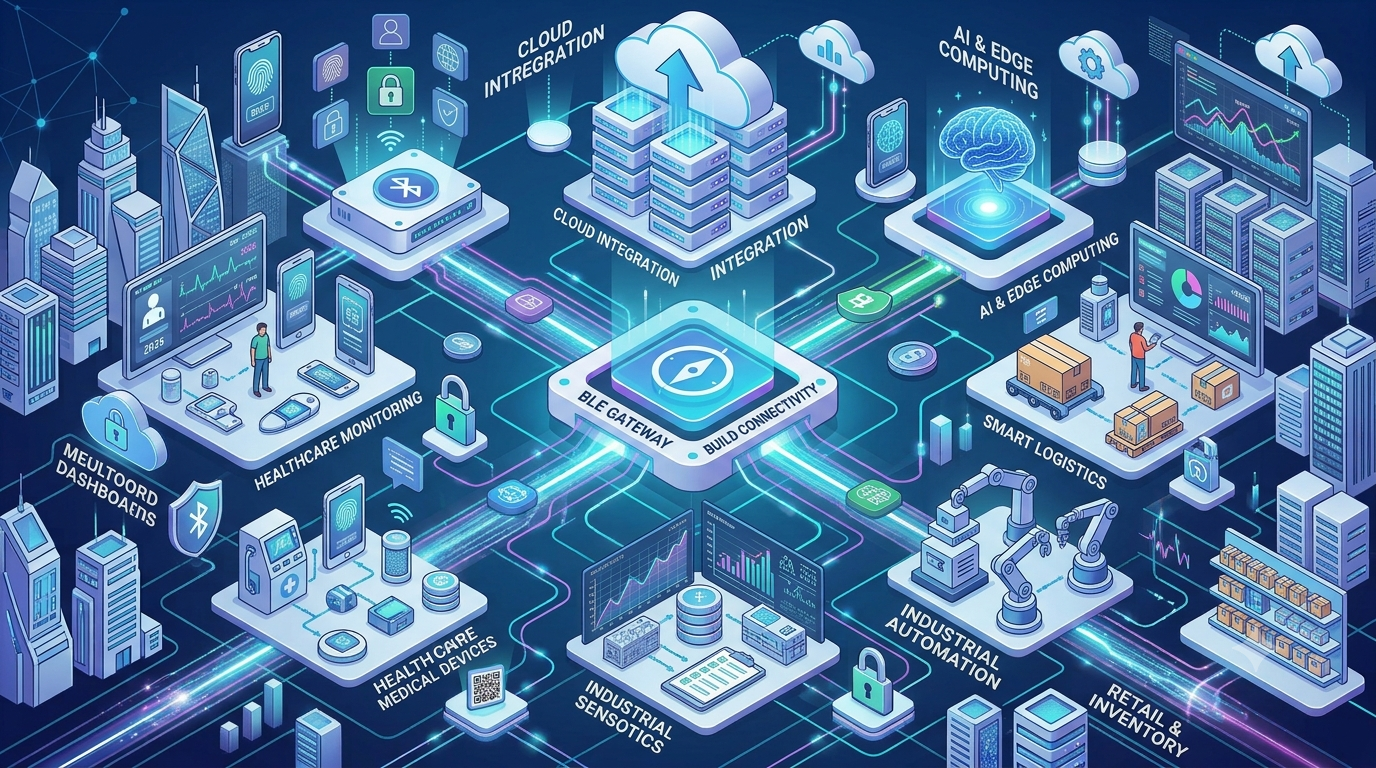
Bluetooth Low Energy (BLE) has become an important connectivity technology for smart devices, sensors, wearables, industrial equipment, healthcare devices, and asset monitoring systems.
But a BLE device does not always need to communicate directly with the cloud.
In many IoT applications, a BLE IoT gateway acts as the bridge between nearby Bluetooth devices and a remote cloud platform. This architecture can make it possible to collect information from multiple BLE devices, process data locally, and send relevant information to centralized applications.
As businesses move from individual connected devices toward larger IoT ecosystems, understanding the role of BLE gateways is becoming increasingly important.
What Is a BLE IoT Gateway?
A BLE IoT gateway is a hardware or software-enabled system that receives data from BLE devices and forwards it to another network or platform.
A basic architecture can look like:
BLE Sensor → BLE Gateway → Internet → Cloud Platform → Dashboard
The gateway can communicate with multiple BLE devices within its coverage area while using technologies such as Wi-Fi, Ethernet, cellular connectivity, or other networking methods to communicate with backend systems.
This makes the gateway an important link between short-range Bluetooth communication and wider IoT infrastructure.
Why Do IoT Systems Need BLE Gateways?
BLE is designed primarily for short-range wireless communication.
Cloud platforms, on the other hand, generally require an internet or network connection.
A gateway can connect these two environments.
For example:
Temperature Sensor
↓ BLE
Gateway
↓ Wi-Fi / Ethernet / Cellular
Cloud Platform
↓
Web Dashboard
This allows businesses to collect information from devices without requiring every BLE sensor to have its own internet connection.
How Does a BLE Gateway Work?
A typical BLE gateway performs several functions.
1. Device Discovery
The gateway scans for nearby BLE devices and identifies available signals.
2. Data Collection
It receives information from sensors, beacons, tags, or other Bluetooth-enabled products.
3. Data Processing
Depending on the architecture, the gateway may filter, transform, aggregate, or validate information locally.
4. Network Communication
The gateway sends relevant data to the cloud or another backend system.
5. Device Management
Advanced gateways can support remote configuration, diagnostics, software updates, and device monitoring.
This creates a complete communication pathway between physical devices and business applications.
BLE Gateway vs Direct-to-Cloud Devices
Not every IoT product needs a gateway.
Some devices can connect directly to Wi-Fi or cellular networks.
However, BLE gateway architecture can be useful when many low-power Bluetooth devices operate within the same physical environment.
| BLE Gateway Architecture | Direct Internet Connectivity |
|---|---|
| Multiple BLE devices can share a gateway | Devices generally need their own network connection |
| Can support low-power BLE sensors | May require higher device power consumption |
| Centralized local communication | Each device communicates independently |
| Useful for indoor environments | Useful where direct connectivity is practical |
| Gateway infrastructure is required | Gateway may not be required |
The right architecture depends on device requirements, deployment environment, power constraints, connectivity availability, and business objectives.
Where Are BLE IoT Gateways Used?
BLE gateway technology can support many industries.
Healthcare
Hospitals can use BLE-enabled devices and gateways to collect information from connected equipment.
Potential applications include:
- Medical equipment monitoring
- Asset visibility
- Temperature monitoring
- Patient-related devices
- Environmental sensors
Healthcare deployments require particularly careful consideration of privacy, security, and regulatory requirements.
Warehousing
BLE gateways can receive signals from tagged assets, equipment, pallets, or containers.
The collected data can then be integrated with warehouse management platforms.
Manufacturing
Factories can use BLE sensors to monitor equipment, environmental conditions, and operational assets.
Gateways can collect data from multiple devices and forward it to industrial or cloud platforms.
Retail
Retail environments can use BLE devices for inventory visibility, equipment monitoring, and other proximity-based applications.
Smart Buildings
BLE sensors can monitor environmental conditions such as:
- Temperature
- Humidity
- Occupancy-related signals
- Equipment status
- Room conditions
The gateway can collect information from different areas of a building and send it to a centralized management platform.
BLE Gateways and Edge Computing
One of the important developments in IoT architecture is the growing use of edge computing.
Instead of sending every piece of sensor data directly to the cloud, a gateway can perform selected processing locally.
For example:
BLE Sensors → Gateway → Local Processing → Cloud
The gateway could potentially:
- Filter unnecessary data
- Detect predefined events
- Aggregate sensor readings
- Trigger local alerts
- Buffer information during connectivity interruptions
- Forward only relevant information
This can reduce unnecessary network traffic and support applications where immediate local processing is useful.
BLE Gateway Connectivity Options
A gateway may use different technologies to communicate with backend systems.
Wi-Fi
Suitable for environments with reliable wireless network coverage.
Ethernet
Useful for fixed installations where wired network connectivity is available.
Cellular
Can be useful for remote or mobile deployments where wired or Wi-Fi infrastructure is unavailable.
Ethernet + Cellular Backup
Some commercial IoT deployments can use multiple network options for improved connectivity resilience.
The choice depends on deployment conditions and reliability requirements.
MQTT and BLE IoT
MQTT is commonly used in IoT architectures because it follows a lightweight publish-and-subscribe communication model.
A simplified architecture could look like:
BLE Device → Gateway → MQTT Broker → Cloud Application
The gateway publishes device information, while authorized applications can subscribe to relevant data streams.
MQTT can be useful for applications involving large numbers of connected devices, but the appropriate communication protocol depends on the overall system architecture.
Designing a Scalable BLE Gateway
A gateway that supports ten devices may have very different requirements from one expected to support thousands.
During development, businesses should consider:
- Number of BLE devices
- Scanning frequency
- Data volume
- Network availability
- Processing requirements
- Memory
- Storage
- Power requirements
- Security
- Remote management
- Firmware updates
Planning for future device growth can help prevent architectural limitations later.
Security Considerations for BLE Gateways
A gateway sits between connected devices and backend infrastructure, making security particularly important.
A secure BLE IoT architecture can include:
Device Authentication
Verify that connected devices are authorized.
Secure Communication
Protect information exchanged between devices, gateways, and backend systems.
API Security
Use appropriate authentication and authorization for cloud communication.
Secure Gateway Access
Restrict administrative access to authorized users.
Firmware Protection
Implement secure mechanisms for gateway software and firmware updates.
Network Segmentation
Where appropriate, isolate IoT infrastructure from other business systems.
Security requirements should be evaluated according to the device, industry, data, and deployment environment.
Remote Gateway Management
Large IoT deployments may involve hundreds or thousands of gateways.
Physically accessing every gateway for configuration or maintenance can be difficult.
A remote management platform can potentially support:
- Gateway health monitoring
- Configuration management
- Software updates
- Device status
- Error reporting
- Connectivity monitoring
- Remote diagnostics
This can significantly simplify the management of distributed IoT infrastructure.
What Happens When Internet Connectivity Is Lost?
IoT systems should account for network interruptions.
A well-designed gateway may temporarily store data locally and forward it when connectivity is restored.
This can be useful for applications where temporary internet outages should not result in complete data loss.
The appropriate buffering strategy depends on:
- Data importance
- Available storage
- Network reliability
- Required data freshness
- Application requirements
AI and BLE Gateway Architecture
AI can add another layer of intelligence to BLE IoT systems.
For example, a gateway or cloud platform could analyze sensor information to identify patterns or unusual behavior.
Potential applications include:
- Equipment anomaly detection
- Predictive maintenance
- Energy optimization
- Environmental monitoring
- Asset utilization analysis
- Automated alerts
A practical architecture might look like:
BLE Sensors → Gateway → IoT Platform → AI Analytics → Business Dashboard
AI should be introduced where it addresses a specific business requirement rather than simply being added as a technology feature.
Steps to Develop a Custom BLE IoT Gateway
Businesses planning a custom gateway can follow a structured development process.
Step 1: Define the Use Case
Identify the devices, environment, data, and business objective.
Step 2: Select BLE Hardware
Choose the appropriate Bluetooth chipset, module, antenna, and supporting components.
Step 3: Develop Gateway Firmware
Implement BLE scanning, device communication, processing, storage, and networking functionality.
Step 4: Add Cloud Connectivity
Connect the gateway with the required IoT platform using suitable protocols and APIs.
Step 5: Build Device Management
Create tools for configuration, monitoring, diagnostics, and updates.
Step 6: Implement Security
Secure device communication, authentication, access, firmware, and cloud connectivity.
Step 7: Test in Real Environments
Test range, interference, network interruptions, device density, power consumption, and reliability.
Step 8: Prepare for Deployment
Optimize the solution for manufacturing, installation, monitoring, and long-term maintenance.
Why Businesses Choose Custom BLE IoT Development
Off-the-shelf gateways can be useful for standard applications, but some businesses require specialized functionality.
Custom BLE gateway development can provide greater control over:
- Hardware configuration
- BLE device compatibility
- Data processing
- Cloud integration
- Security
- User management
- Remote updates
- Industry-specific workflows
For a company developing its own connected product ecosystem, a custom gateway can become an important part of the overall product architecture.
How BLEIoT Can Help
BLEIoT focuses on Bluetooth Low Energy and IoT development for businesses building connected products and wireless ecosystems.
Depending on project requirements, development can cover:
- BLE IoT development
- BLE gateway development
- Bluetooth device integration
- BLE firmware development
- IoT application development
- Mobile BLE applications
- Cloud IoT integration
- Sensor connectivity
- Smart device development
- Connected product engineering
- Custom Bluetooth solutions
The development approach can be adapted to the product’s hardware, connectivity, software, and business requirements.
Final Thoughts
BLE IoT gateways provide an important connection between low-power Bluetooth devices and larger digital platforms.
They can collect data from multiple BLE devices, perform local processing, connect to cloud systems, and support remote device management.
For businesses developing smart buildings, healthcare solutions, industrial systems, warehouse technology, asset monitoring platforms, or connected consumer products, gateway architecture can provide a practical way to build a scalable IoT ecosystem.
The future of IoT is not simply about connecting more devices.
It is about creating reliable connections between devices, data, software, and business operations.
SEO Keywords
- BLE IoT gateway
- BLE gateway development
- Bluetooth IoT gateway
- BLE IoT development
- Bluetooth Low Energy IoT
- custom BLE gateway
- IoT gateway development
- BLE device integration
- Bluetooth gateway development
- BLE firmware development
- IoT device connectivity
- Bluetooth IoT solutions
- smart device development
- connected product development
- BLE development company
Meta Title
BLE IoT Gateways in 2026: Development & Connectivity Guide | BLEIoT
Meta Description
Learn how BLE IoT gateways connect Bluetooth devices to cloud platforms and explore gateway architecture, edge computing, security, AI, and custom BLE development.
Suggested URL Slug
/blogs/ble-iot-gateway-development-connect-bluetooth-devices-cloud/
Leave a Reply