Introduction
What if a business could monitor a physical product, understand its current condition, and identify potential problems through a digital representation of that product?
This is the idea behind digital twins. By combining sensor data, Bluetooth Low Energy (BLE), IoT platforms, and analytics, businesses can create digital views of physical assets and use them to make more informed decisions.
In 2026, connected product development is moving beyond simply collecting sensor readings. Businesses increasingly need solutions that transform device data into useful information, support remote monitoring, and improve operational visibility.
BLE IoT technology can play an important role in this process, especially when products require low-power wireless communication between sensors, smartphones, and gateways.
For manufacturers, product designers, and technology companies, understanding this combination can open new opportunities for building intelligent connected solutions.
What Is a Digital Twin in BLE IoT?
A digital twin is a digital representation of a physical asset, process, or system that is updated using relevant information from the real world.
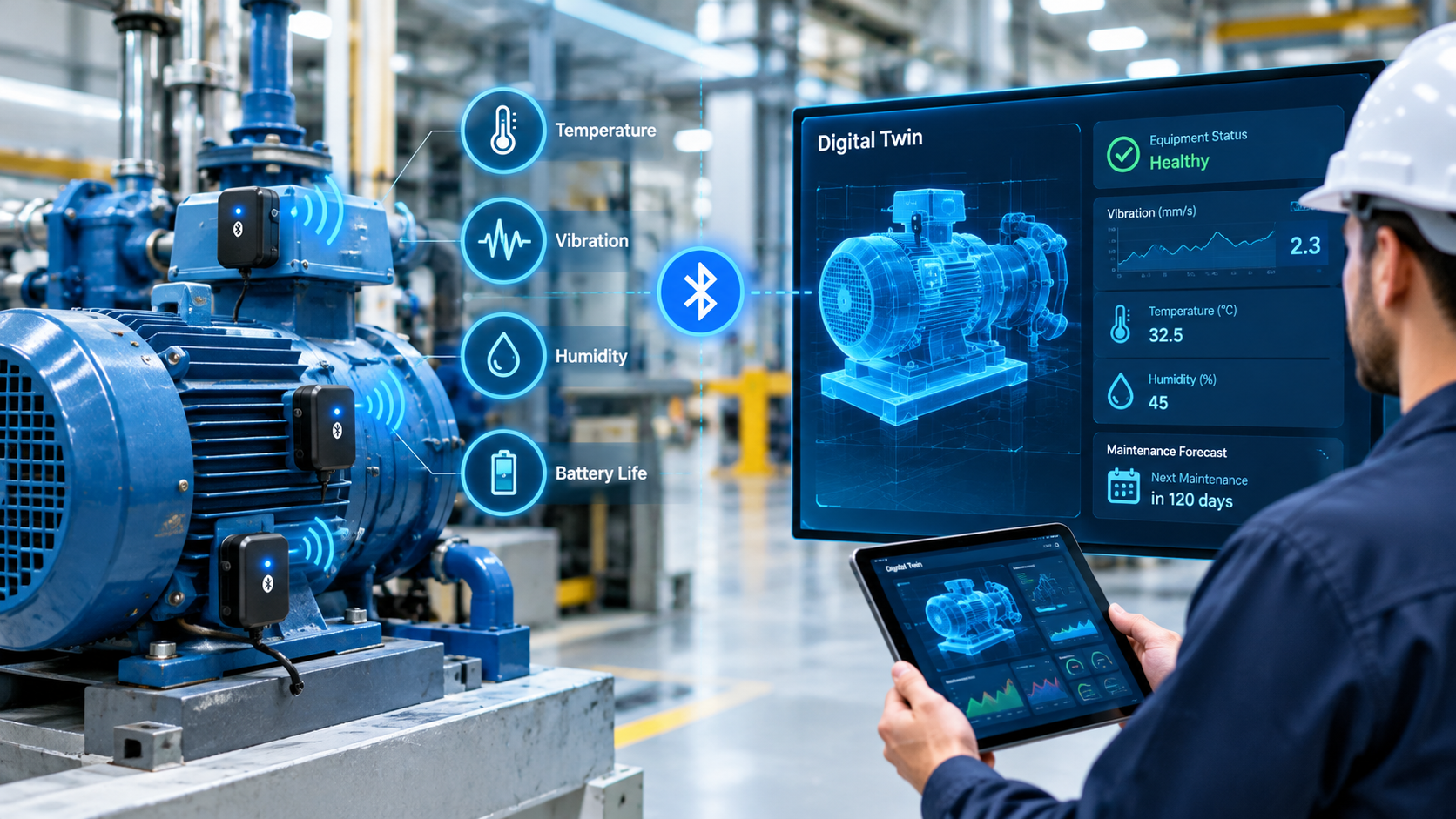
In a BLE IoT implementation, sensors can collect data from a physical device and transmit it to a compatible receiver. A smartphone, gateway, or embedded system can then forward the data to a platform that updates the digital representation.
For example, a digital twin for an industrial motor might display its temperature, operating status, vibration measurements, and maintenance history.
A typical system may include:
- Physical equipment: The machine, product, or asset being monitored.
- BLE sensors: Components that measure and transmit relevant data.
- Connectivity layer: A smartphone, gateway, or other compatible receiver.
- IoT platform: Software that stores, processes, and organizes incoming data.
- Digital twin interface: A dashboard displaying the asset’s current and historical condition.
- Analytics engine: Rules or predictive models that identify trends and potential issues.
A digital twin does not automatically predict every failure or mirror every physical behavior. Its usefulness depends on sensor quality, data availability, model accuracy, and the way the system is designed.
Why BLE Is Useful for Digital Twin Applications
Bluetooth Low Energy is designed for wireless communication with relatively low power consumption, making it useful for many battery-powered sensors and connected devices.
Its advantages include the following.
1. Lower-Power Sensor Connectivity
Battery-powered devices often need to operate for extended periods without frequent maintenance.
BLE can support periodic sensor readings and short data exchanges, helping developers optimize power consumption through suitable advertising intervals, connection settings, and sleep modes.
Actual battery life depends on hardware, firmware, transmission frequency, and operating conditions.
2. Smartphone-Based Device Access
Many smartphones support BLE, allowing a mobile application to discover compatible devices, read measurements, configure settings, and display device status.
This can simplify product onboarding and local monitoring without requiring a dedicated receiver for every use case.
3. Flexible IoT Architecture
BLE can operate as part of a larger system that includes cloud services, analytics platforms, and enterprise software.
For example, a gateway can collect readings from multiple nearby sensors and transmit selected information to a remote digital twin platform.
4. Cost-Conscious Product Design
For suitable applications, BLE-enabled hardware can provide a practical connectivity option for connected products.
However, the overall project cost depends on sensor selection, hardware design, certification, application development, backend infrastructure, and production volume.
6 Real-World Applications of Digital Twins and BLE IoT
1. Manufacturing Equipment Monitoring
Manufacturers can use sensors to collect temperature, vibration, and operating information from machinery.
The corresponding digital twin can present current readings alongside historical measurements, maintenance records, and equipment status.
Maintenance teams can use this information to investigate abnormal patterns and prioritize inspections.
Example: A production facility monitors several motors through BLE sensors and a nearby gateway. When vibration measurements exceed a configured threshold, the system flags the equipment for inspection.
2. Smart Buildings and Facility Management
Building operators need visibility into environmental conditions, equipment status, and energy-related performance.
BLE sensors can collect temperature, humidity, and occupancy-related information where suitable. A digital twin of the building can organize these readings by room, floor, or equipment zone.
When integrated with appropriate building management systems, this information can help facility teams identify inefficient operating conditions and coordinate maintenance.
3. Healthcare Equipment Management
Hospitals and healthcare facilities use many devices that require monitoring, maintenance, and inventory management.
BLE connectivity can support compatible equipment-status sensors and asset tracking systems.
A digital representation of an asset can show its reported condition, location information when supported by the deployment, service history, and maintenance schedule.
Healthcare implementations must account for privacy, cybersecurity, applicable regulatory requirements, and the limitations of any monitoring technology.
4. Warehouse and Logistics Operations
Warehouses often manage large numbers of tools, containers, and reusable assets.
BLE tags and receivers can help collect asset-identification and proximity information. An IoT platform can use these observations to maintain a digital inventory view.
This can improve asset visibility and reduce time spent searching for equipment.
Location accuracy depends on receiver placement, signal conditions, and the positioning technology used. A standard BLE beacon does not guarantee precise indoor coordinates.
5. Smart Agriculture
Agricultural operators can use connected sensors to monitor conditions in greenhouses, storage areas, and other controlled environments.
Measurements such as temperature, humidity, and soil moisture can be incorporated into a digital representation of a growing area or storage facility.
A gateway can forward readings to a remote dashboard, helping users review environmental trends and respond when readings move outside configured ranges.
For remote outdoor locations, BLE should be evaluated against alternative communication technologies based on range, infrastructure, and power requirements.
6. Consumer Products and Connected Appliances
Connected consumer products can use BLE to communicate with mobile applications and share operational information.
A digital twin can provide users or support teams with a structured view of device configuration, usage information, and maintenance events.
For product manufacturers, this architecture can support troubleshooting, service planning, and better visibility into connected product performance.
How to Build a BLE IoT Digital Twin Solution
Developing a useful digital twin requires careful planning across hardware, software, and data integration.
Step 1: Identify the Asset and Business Goal
Start by defining the problem the solution should address.
Does the business need equipment monitoring, inventory visibility, maintenance planning, environmental tracking, or product diagnostics?
The answer determines which measurements must be collected and how frequently they should be updated.
Step 2: Select Suitable Sensors and BLE Hardware
Choose sensors based on measurement accuracy, operating environment, power consumption, and expected service life.
The BLE module or microcontroller must support the required communication behavior and provide sufficient processing capability for the intended application.
Step 3: Design the Firmware and Data Model
Firmware should handle sensor readings, communication, error conditions, and power management.
Developers can use Bluetooth GATT services and characteristics to organize device data. The application should also define how measurements, timestamps, device identifiers, and status information are represented.
Step 4: Develop the Gateway or Mobile Application
If the device needs remote monitoring, a smartphone or gateway may collect the BLE data and forward it to the IoT platform.
The appropriate architecture depends on whether the solution requires local access, continuous operation, multiple-device support, or unattended data collection.
Step 5: Build the Digital Twin Platform
The platform should connect incoming data to the correct asset and present useful information through dashboards, reports, and alerts.
Depending on the use case, it may also include asset history, maintenance schedules, device configuration, and integration with enterprise systems.
Step 6: Add Analytics and Predictive Capabilities
Once sufficient reliable data is available, analytics can identify patterns and unusual readings.
Predictive maintenance requires suitable historical data, validated models, and ongoing evaluation. A basic threshold alert should not be presented as a guaranteed prediction of equipment failure.
Step 7: Test Security and Real-World Performance
Test the complete solution under realistic operating conditions, including wireless interference, connection interruptions, sensor errors, and gateway outages.
Use appropriate authentication, access controls, secure data transmission, and protected firmware update mechanisms.
Testing should also confirm that digital twin information remains consistent with the latest valid device data.
BLE vs. Wi-Fi vs. Cellular for Digital Twin Connectivity
| Factor | BLE | Wi-Fi | Cellular |
|---|---|---|---|
| Typical role | Local sensor connectivity | Local network and IP connectivity | Wide-area connectivity |
| Power considerations | Often suitable for low-power sensors | Can require more power | Depends on radio technology and transmission behavior |
| Infrastructure | Smartphone or compatible receiver | Wi-Fi network or access point | Cellular coverage and service |
| Data transfer | Small to moderate data exchanges | Suitable for high data volumes | Suitable for remote data transmission |
| Common applications | Wearables, tags, sensors | Gateways, cameras, connected appliances | Remote assets and mobile equipment |
These technologies are not necessarily competitors. A connected product may use BLE to collect sensor readings and Wi-Fi or cellular connectivity to deliver information to its digital twin platform.
Common Challenges in BLE IoT Digital Twin Development
Data Accuracy and Reliability
Incorrect sensor readings can make a digital twin misleading. Sensor calibration, data validation, timestamps, and fault handling are essential.
Connectivity Gaps
BLE communication is intended for suitable local wireless links, not unlimited geographic coverage. Remote monitoring may require gateways and another network connection.
Battery Optimization
Frequent transmissions and continuous sensor sampling can shorten battery life. Developers need to balance update frequency against power consumption and business requirements.
Integration Complexity
Digital twins often combine information from sensors, applications, databases, and enterprise systems. Consistent device identifiers and well-defined data formats help simplify integration.
Security and Device Management
Connected devices need appropriate access controls, secure configuration, and a reliable process for firmware updates and lifecycle management.
Scaling Beyond the Prototype
A solution that works with a few sensors may require a different operational approach when deployed across hundreds of assets. Device provisioning, observability, data retention, and support processes should be planned early.
The Future of BLE IoT and Digital Twins
Several developments are shaping connected product engineering.
Edge computing: Processing data closer to the source can reduce unnecessary data transfers and support faster local responses.
AI-assisted analytics: Suitable models can help identify unusual sensor patterns, estimate equipment condition, and prioritize maintenance tasks.
Improved asset visibility: BLE-based identification and positioning solutions can help organizations understand where assets are observed and how they move through a facility.
Interoperable platforms: Better integration between device data, cloud services, and business applications can make connected solutions more useful across departments.
Lifecycle monitoring: Manufacturers can build systems that support products from deployment through maintenance and eventual replacement.
These capabilities are not automatic benefits of BLE itself. They require suitable hardware, software, data architecture, and testing.
Why Choose an Experienced BLE IoT Development Partner?
Building a digital twin requires more than connecting a sensor to a mobile application.
A development team may need to coordinate embedded firmware, BLE communication, mobile software, gateway integration, cloud infrastructure, data visualization, and analytics.
An experienced partner can help evaluate requirements, select a suitable architecture, create a prototype, and prepare the solution for deploymen
Leave a Reply