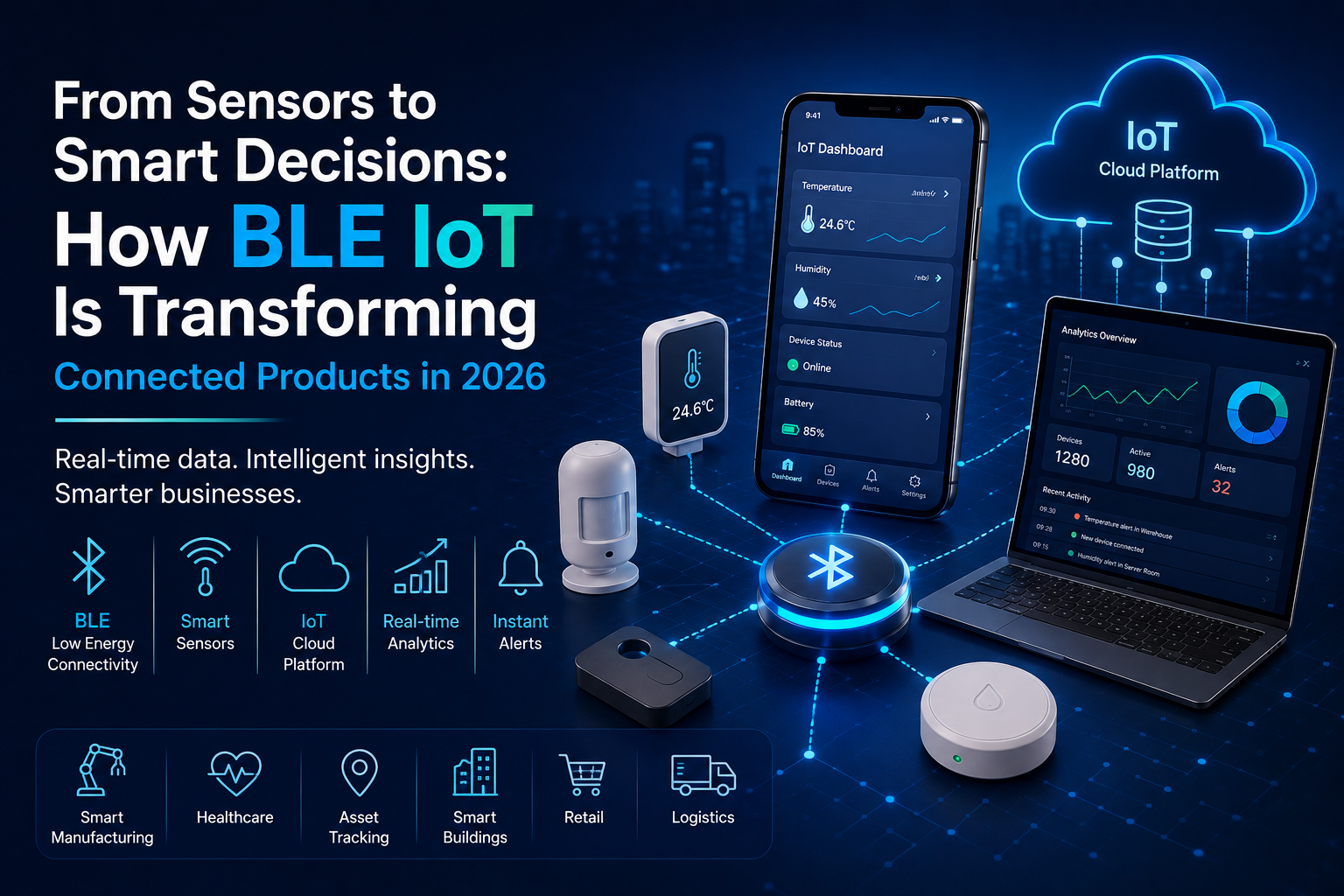
From Sensors to Smart Decisions: How BLE IoT Is Transforming Connected Products in 2026
Introduction: Connected Devices Are Becoming Intelligent
The Internet of Things has changed how businesses collect information from the physical world.
Sensors can measure temperature. Wearables can track activity. Smart devices can monitor equipment. Connected products can communicate with mobile applications and cloud platforms.
But collecting data is only the first step.
The real value comes from turning device data into useful insights and meaningful actions.
This is where Bluetooth Low Energy (BLE) and the Internet of Things (IoT) work together.
BLE helps devices communicate efficiently while consuming very little power. IoT platforms help businesses collect, manage, and analyze information from connected devices. When combined with cloud technology, mobile applications, analytics, and artificial intelligence, BLE IoT can transform simple devices into intelligent connected products.
At IoTBLE, we help businesses develop secure, scalable, and user-friendly BLE and IoT solutions—from device connectivity and mobile applications to cloud platforms and intelligent dashboards.
What Is BLE IoT?
BLE IoT refers to connected solutions that use Bluetooth Low Energy to exchange information between devices, mobile applications, gateways, and IoT platforms.
A typical BLE IoT ecosystem may include:
BLE Device → Mobile App or Gateway → Cloud Platform → Dashboard → Business Action
For example, a smart environmental sensor may:
- Measure temperature and humidity.
- Send the information through BLE.
- Connect with a nearby mobile device or IoT gateway.
- Transfer the data to a cloud platform.
- Display real-time information on a dashboard.
- Send an alert when conditions move outside a defined range.
This process allows businesses to monitor physical environments and respond more quickly.
Why Bluetooth Low Energy Is Ideal for Connected Products
Connected devices often need to be small, affordable, and battery-efficient.
BLE is designed to support these requirements.
Low Energy Consumption
BLE devices can remain in low-power modes and communicate only when required.
This can help extend battery life and reduce the need for frequent maintenance.
Fast Device Communication
BLE can support quick communication between nearby devices.
This is useful for applications that require:
- Device discovery
- Sensor data transfer
- Status updates
- Proximity detection
- Real-time alerts
Smartphone Compatibility
Modern smartphones and tablets commonly support BLE.
A mobile app can act as a convenient interface for:
- Connecting devices
- Viewing sensor information
- Managing device settings
- Sending commands
- Receiving notifications
Compact and Cost-Effective Hardware
BLE technology can be integrated into small connected products, making it suitable for wearables, sensors, smart devices, and enterprise IoT solutions.
How BLE IoT Turns Data into Business Value
A connected device may generate thousands of data points, but raw information alone does not automatically improve business performance.
A complete BLE IoT solution can transform data into useful outcomes.
Data Collection
BLE sensors collect information from physical environments, equipment, products, or users.
Data Transfer
The information is transferred to a mobile application or gateway.
Cloud Processing
Cloud systems store, organize, and process device information.
Analytics
Analytics tools identify trends, patterns, and unusual activity.
Intelligent Alerts
The system can notify users when specific conditions occur.
Business Decisions
Teams use the insights to improve operations, reduce risks, or create better customer experiences.
The result is a connected system that supports faster and more informed decision-making.
Real-World BLE IoT Applications
1. Smart Manufacturing
Manufacturing businesses can use BLE sensors to monitor equipment and production environments.
Potential applications include:
- Machine-status monitoring
- Equipment utilization
- Temperature tracking
- Vibration monitoring
- Worker safety
- Asset visibility
Connected data can help teams identify operational issues earlier.
2. Predictive Maintenance
Unexpected equipment failures can cause delays and increase operational costs.
BLE sensors can collect information such as:
- Vibration
- Temperature
- Operating time
- Equipment movement
Analytics or AI systems can identify unusual patterns and help maintenance teams investigate potential issues before a major failure occurs.
3. Connected Healthcare Devices
BLE can support communication between medical or wellness devices and mobile applications.
Possible applications include:
- Connected monitoring devices
- Wearable health technology
- Smart medical equipment
- Patient-support applications
- Healthcare asset tracking
Healthcare solutions require appropriate privacy, security, regulatory, and clinical considerations.
4. Smart Warehouses
Warehouses can use BLE-enabled tags and sensors to improve operational visibility.
Use cases may include:
- Asset tracking
- Inventory monitoring
- Equipment location
- Worker safety
- Environmental monitoring
BLE can help connect physical warehouse operations with digital management systems.
5. Retail and Customer Experiences
BLE technology can connect physical retail environments with mobile experiences.
Businesses may use BLE for:
- Proximity-based engagement
- Smart product information
- In-store navigation
- Connected inventory
- Customer interaction
6. Smart Buildings
BLE sensors can help monitor and manage building environments.
Potential applications include:
- Room occupancy
- Lighting automation
- Environmental monitoring
- Equipment tracking
- Smart access systems
- Energy-management support
BLE Beacons and Proximity Technology
BLE beacons are small devices that broadcast signals to nearby smartphones or compatible receivers.
Applications can use these signals to understand proximity to a specific location or object.
BLE beacons may support:
- Indoor navigation
- Visitor experiences
- Smart retail
- Event applications
- Museum guides
- Workplace automation
- Location-aware notifications
The technology can connect physical spaces with relevant digital information.
The Role of Mobile Apps in BLE IoT
A BLE device often needs a simple and reliable user interface.
Mobile applications can provide that interface.
A custom BLE mobile application may allow users to:
- Discover nearby devices
- Connect and disconnect devices
- View real-time information
- Configure device settings
- Receive alerts
- Synchronize data
- Update device information
A well-designed application should handle connection changes, permissions, device compatibility, background activity, and data synchronization.
Cloud Platforms for BLE IoT
Cloud technology allows connected-device information to be accessed beyond the device’s local environment.
A cloud platform can support:
- Device management
- User accounts
- Data storage
- Real-time monitoring
- Notifications
- Analytics
- Remote dashboards
- API integrations
Cloud-based systems can also help businesses scale from a small pilot project to larger connected-device deployments.
AI-Powered BLE IoT Solutions
AI can help businesses understand large amounts of connected-device information.
For example, an AI system may analyze data from BLE sensors and identify:
- Unusual equipment behavior
- Changing environmental conditions
- Device-performance patterns
- Potential maintenance requirements
- Operational trends
AI can support:
- Predictive maintenance
- Anomaly detection
- Smart alerts
- Automated recommendations
- Demand forecasting
- Operational optimization
BLE connects the physical world to digital systems, while AI helps turn connected data into useful intelligence.
Important Challenges in BLE IoT Development
Developing a connected product requires more than establishing a Bluetooth connection.
Device Compatibility
Different smartphones, operating systems, hardware components, and BLE versions may behave differently.
Connection Reliability
Applications must manage:
- Signal interruptions
- Device movement
- Connection loss
- Automatic reconnection
- Data synchronization
Battery Optimization
Developers need to balance communication frequency with energy consumption.
Data Management
Connected products may generate large volumes of information. The system must organize, process, and retain data efficiently.
Security
Connected devices should include appropriate security measures such as:
- Secure pairing
- Authentication
- Encryption
- Access controls
- Secure APIs
- Protected firmware updates
Scalability
A prototype with a few devices may require significant architectural changes before supporting thousands of connected devices.
How IoTBLE Develops Connected Products
At IoTBLE, we look at the complete connected ecosystem.
Our development process includes:
1. Product Discovery
We understand the business goal, device requirements, target users, and expected outcomes.
2. BLE and IoT Architecture
We define how devices, mobile applications, gateways, cloud services, and dashboards will communicate.
3. Device Integration
We support BLE communication and integration between hardware and software systems.
4. Mobile Application Development
We develop mobile applications that provide reliable device connectivity and user-friendly experiences.
5. Cloud and Dashboard Development
We build cloud platforms and dashboards for device management, data visibility, and business insights.
6. Testing and Optimization
We test device communication, performance, security, battery usage, compatibility, and reliability.
7. Deployment and Growth
We help businesses prepare connected products for real-world users and future expansion.
IoTBLE Development Services
Our services can include:
- BLE Application Development
- BLE Mobile App Development
- IoT Application Development
- Custom IoT Software Development
- BLE Device Integration
- BLE Beacon Development
- IoT Dashboard Development
- Cloud IoT Integration
- Connected Product Development
- IoT API Development
- AI-Powered IoT Solutions
- Smart Device Application Development
- IoT Consulting and Architecture
The Future of BLE IoT
Connected products are becoming smaller, smarter, and more integrated.
In the coming years, BLE IoT technology will continue to support:
- Intelligent healthcare devices
- Smart factories
- Connected logistics
- Advanced wearables
- Smart homes and buildings
- Real-time asset monitoring
- AI-powered automation
- Sustainable energy management
The future will not be defined only by the number of connected devices.
It will be defined by how effectively businesses use connected data to improve products, operations, and customer experiences.
Conclusion
BLE IoT connects physical devices with mobile applications, cloud platforms, analytics, and intelligent business systems.
Bluetooth Low Energy provides efficient communication for battery-powered devices. IoT platforms help manage connected information. Cloud technology enables scalable access, while AI can transform device data into useful insights.
Together, these technologies can create smarter products and more responsive business operations.
At IoTBLE, we help businesses move from connected-device ideas to practical, secure, and scalable solutions.
The Internet of Things has changed how businesses collect information from the physical world.
Sensors can measure temperature. Wearables can track activity. Smart devices can monitor equipment. Connected products can communicate with mobile applications and cloud platforms.
But collecting data is only the first step.
The real value comes from turning device data into useful insights and meaningful actions.
This is where Bluetooth Low Energy (BLE) and the Internet of Things (IoT) work together.
BLE helps devices communicate efficiently while consuming very little power. IoT platforms help businesses collect, manage, and analyze information from connected devices. When combined with cloud technology, mobile applications, analytics, and artificial intelligence, BLE IoT can transform simple devices into intelligent connected products.
At IoTBLE, we help businesses develop secure, scalable, and user-friendly BLE and IoT solutions—from device connectivity and mobile applications to cloud platforms and intelligent dashboards.
What Is BLE IoT?
BLE IoT refers to connected solutions that use Bluetooth Low Energy to exchange information between devices, mobile applications, gateways, and IoT platforms.
A typical BLE IoT ecosystem may include:
BLE Device → Mobile App or Gateway → Cloud Platform → Dashboard → Business Action
For example, a smart environmental sensor may:
- Measure temperature and humidity.
- Send the information through BLE.
- Connect with a nearby mobile device or IoT gateway.
- Transfer the data to a cloud platform.
- Display real-time information on a dashboard.
- Send an alert when conditions move outside a defined range.
This process allows businesses to monitor physical environments and respond more quickly.
Why Bluetooth Low Energy Is Ideal for Connected Products
Connected devices often need to be small, affordable, and battery-efficient.
BLE is designed to support these requirements.
Low Energy Consumption
BLE devices can remain in low-power modes and communicate only when required.
This can help extend battery life and reduce the need for frequent maintenance.
Fast Device Communication
BLE can support quick communication between nearby devices.
This is useful for applications that require:
- Device discovery
- Sensor data transfer
- Status updates
- Proximity detection
- Real-time alerts
Smartphone Compatibility
Modern smartphones and tablets commonly support BLE.
A mobile app can act as a convenient interface for:
- Connecting devices
- Viewing sensor information
- Managing device settings
- Sending commands
- Receiving notifications
Compact and Cost-Effective Hardware
BLE technology can be integrated into small connected products, making it suitable for wearables, sensors, smart devices, and enterprise IoT solutions.
How BLE IoT Turns Data into Business Value
A connected device may generate thousands of data points, but raw information alone does not automatically improve business performance.
A complete BLE IoT solution can transform data into useful outcomes.
Data Collection
BLE sensors collect information from physical environments, equipment, products, or users.
Data Transfer
The information is transferred to a mobile application or gateway.
Cloud Processing
Cloud systems store, organize, and process device information.
Analytics
Analytics tools identify trends, patterns, and unusual activity.
Intelligent Alerts
The system can notify users when specific conditions occur.
Business Decisions
Teams use the insights to improve operations, reduce risks, or create better customer experiences.
The result is a connected system that supports faster and more informed decision-making.
Real-World BLE IoT Applications
1. Smart Manufacturing
Manufacturing businesses can use BLE sensors to monitor equipment and production environments.
Potential applications include:
- Machine-status monitoring
- Equipment utilization
- Temperature tracking
- Vibration monitoring
- Worker safety
- Asset visibility
Connected data can help teams identify operational issues earlier.
2. Predictive Maintenance
Unexpected equipment failures can cause delays and increase operational costs.
BLE sensors can collect information such as:
- Vibration
- Temperature
- Operating time
- Equipment movement
Analytics or AI systems can identify unusual patterns and help maintenance teams investigate potential issues before a major failure occurs.
3. Connected Healthcare Devices
BLE can support communication between medical or wellness devices and mobile applications.
Possible applications include:
- Connected monitoring devices
- Wearable health technology
- Smart medical equipment
- Patient-support applications
- Healthcare asset tracking
Healthcare solutions require appropriate privacy, security, regulatory, and clinical considerations.
4. Smart Warehouses
Warehouses can use BLE-enabled tags and sensors to improve operational visibility.
Use cases may include:
- Asset tracking
- Inventory monitoring
- Equipment location
- Worker safety
- Environmental monitoring
BLE can help connect physical warehouse operations with digital management systems.
5. Retail and Customer Experiences
BLE technology can connect physical retail environments with mobile experiences.
Businesses may use BLE for:
- Proximity-based engagement
- Smart product information
- In-store navigation
- Connected inventory
- Customer interaction
6. Smart Buildings
BLE sensors can help monitor and manage building environments.
Potential applications include:
- Room occupancy
- Lighting automation
- Environmental monitoring
- Equipment tracking
- Smart access systems
- Energy-management support
BLE Beacons and Proximity Technology
BLE beacons are small devices that broadcast signals to nearby smartphones or compatible receivers.
Applications can use these signals to understand proximity to a specific location or object.
BLE beacons may support:
- Indoor navigation
- Visitor experiences
- Smart retail
- Event applications
- Museum guides
- Workplace automation
- Location-aware notifications
The technology can connect physical spaces with relevant digital information.
The Role of Mobile Apps in BLE IoT
A BLE device often needs a simple and reliable user interface.
Mobile applications can provide that interface.
A custom BLE mobile application may allow users to:
- Discover nearby devices
- Connect and disconnect devices
- View real-time information
- Configure device settings
- Receive alerts
- Synchronize data
- Update device information
A well-designed application should handle connection changes, permissions, device compatibility, background activity, and data synchronization.
Cloud Platforms for BLE IoT
Cloud technology allows connected-device information to be accessed beyond the device’s local environment.
A cloud platform can support:
- Device management
- User accounts
- Data storage
- Real-time monitoring
- Notifications
- Analytics
- Remote dashboards
- API integrations
Cloud-based systems can also help businesses scale from a small pilot project to larger connected-device deployments.
AI-Powered BLE IoT Solutions
AI can help businesses understand large amounts of connected-device information.
For example, an AI system may analyze data from BLE sensors and identify:
- Unusual equipment behavior
- Changing environmental conditions
- Device-performance patterns
- Potential maintenance requirements
- Operational trends
AI can support:
- Predictive maintenance
- Anomaly detection
- Smart alerts
- Automated recommendations
- Demand forecasting
- Operational optimization
BLE connects the physical world to digital systems, while AI helps turn connected data into useful intelligence.
Important Challenges in BLE IoT Development
Developing a connected product requires more than establishing a Bluetooth connection.
Device Compatibility
Different smartphones, operating systems, hardware components, and BLE versions may behave differently.
Connection Reliability
Applications must manage:
- Signal interruptions
- Device movement
- Connection loss
- Automatic reconnection
- Data synchronization
Battery Optimization
Developers need to balance communication frequency with energy consumption.
Data Management
Connected products may generate large volumes of information. The system must organize, process, and retain data efficiently.
Security
Connected devices should include appropriate security measures such as:
- Secure pairing
- Authentication
- Encryption
- Access controls
- Secure APIs
- Protected firmware updates
Scalability
A prototype with a few devices may require significant architectural changes before supporting thousands of connected devices.
How IoTBLE Develops Connected Products
At IoTBLE, we look at the complete connected ecosystem.
Our development process includes:
1. Product Discovery
We understand the business goal, device requirements, target users, and expected outcomes.
2. BLE and IoT Architecture
We define how devices, mobile applications, gateways, cloud services, and dashboards will communicate.
3. Device Integration
We support BLE communication and integration between hardware and software systems.
4. Mobile Application Development
We develop mobile applications that provide reliable device connectivity and user-friendly experiences.
5. Cloud and Dashboard Development
We build cloud platforms and dashboards for device management, data visibility, and business insights.
6. Testing and Optimization
We test device communication, performance, security, battery usage, compatibility, and reliability.
7. Deployment and Growth
We help businesses prepare connected products for real-world users and future expansion.
IoTBLE Development Services
Our services can include:
- BLE Application Development
- BLE Mobile App Development
- IoT Application Development
- Custom IoT Software Development
- BLE Device Integration
- BLE Beacon Development
- IoT Dashboard Development
- Cloud IoT Integration
- Connected Product Development
- IoT API Development
- AI-Powered IoT Solutions
- Smart Device Application Development
- IoT Consulting and Architecture
The Future of BLE IoT
Connected products are becoming smaller, smarter, and more integrated.
In the coming years, BLE IoT technology will continue to support:
- Intelligent healthcare devices
- Smart factories
- Connected logistics
- Advanced wearables
- Smart homes and buildings
- Real-time asset monitoring
- AI-powered automation
- Sustainable energy management
The future will not be defined only by the number of connected devices.
It will be defined by how effectively businesses use connected data to improve products, operations, and customer experiences.
Conclusion
BLE IoT connects physical devices with mobile applications, cloud platforms, analytics, and intelligent business systems.
Bluetooth Low Energy provides efficient communication for battery-powered devices. IoT platforms help manage connected information. Cloud technology enables scalable access, while AI can transform device data into useful insights.
Together, these technologies can create smarter products and more responsive business operations.
At IoTBLE, we help businesses move from connected-device ideas to practical, secure, and scalable solutions.
Have an idea for a BLE-enabled IoT product? Connect with IoTBLE to build a smart, reliable, and future-ready connected solution.
Leave a Reply