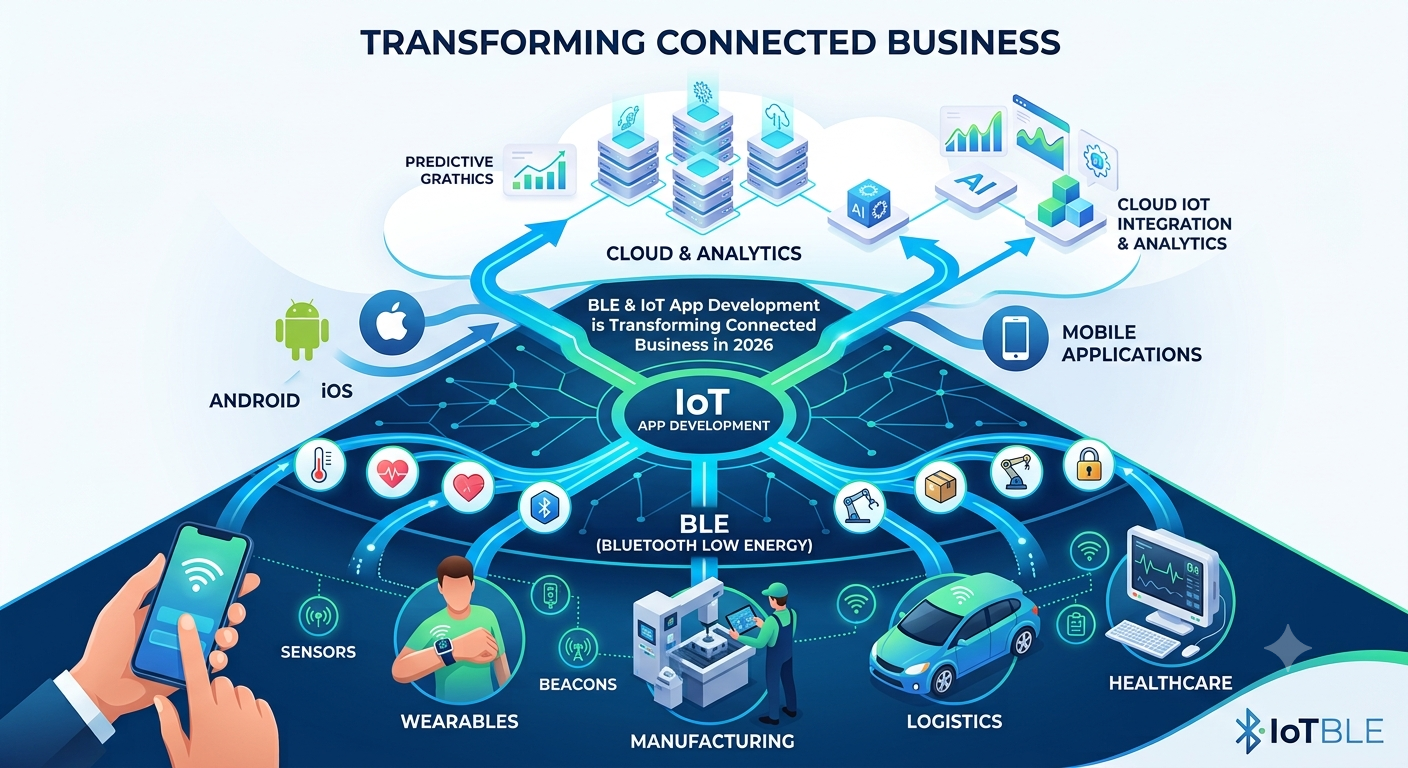
The Internet of Things is moving beyond simple connected devices.
In 2026, businesses are building connected ecosystems that combine Bluetooth Low Energy (BLE), mobile applications, cloud platforms, sensors, edge computing, and real-time analytics.
From healthcare and logistics to retail, manufacturing, fitness, hospitality, and smart buildings, connected devices are creating new ways for businesses to collect data, automate processes, and interact with customers.
One technology playing an important role in these solutions is Bluetooth Low Energy (BLE).
BLE provides a power-efficient communication layer that can connect smartphones, sensors, wearables, beacons, industrial devices, and other connected hardware.
When BLE is combined with IoT application development, businesses can create scalable systems that connect physical devices with mobile and cloud software.
What Is BLE IoT App Development?
BLE IoT app development involves creating software that communicates with Bluetooth Low Energy devices and connects their data to an application or broader IoT platform.
A typical architecture can look like:
BLE Device → Mobile App → API → Cloud Platform → Database → Dashboard
Depending on the use case, the architecture may also include:
- IoT gateways
- Sensors
- Wearables
- Beacons
- Edge devices
- Cloud infrastructure
- Analytics platforms
- Machine learning systems
- Enterprise applications
The mobile application can act as a bridge between BLE hardware and cloud-based services.
Why BLE Is Important for IoT Applications
BLE was designed for applications where low power consumption and short-range wireless communication are important.
This makes it useful for connected devices that need to operate for long periods without frequent battery replacement.
BLE can be used for applications involving:
- Sensors
- Fitness devices
- Medical devices
- Smart locks
- Asset tracking
- Beacons
- Wearables
- Industrial equipment
- Retail devices
- Smart home products
For businesses developing connected products, BLE can provide a practical communication layer between devices and applications.
BLE vs Traditional Bluetooth
Bluetooth technology has evolved significantly.
Traditional Bluetooth is commonly associated with continuous data connections such as audio streaming.
BLE, on the other hand, was designed around low-power communication and short data exchanges.
This makes BLE particularly useful for IoT applications where a device may need to periodically send sensor readings or receive commands without maintaining a high-bandwidth connection continuously.
For example:
Temperature Sensor → BLE → Smartphone → Cloud
The sensor can send temperature information to the mobile application, which then forwards the data to a cloud platform.
How a BLE IoT System Works
A BLE-based IoT solution generally involves several components.
1. BLE Hardware
The hardware collects information or performs an action.
Examples include:
- Temperature sensors
- Motion sensors
- Heart-rate devices
- Smart locks
- Asset trackers
- Industrial sensors
2. Mobile Application
The mobile application discovers and communicates with BLE devices.
It may:
- Scan for nearby devices
- Connect to devices
- Read characteristics
- Write commands
- Monitor notifications
- Display sensor data
- Synchronize information with the cloud
3. Backend API
The backend receives and processes information from the mobile application.
It can handle:
- Authentication
- Device management
- Data processing
- User management
- Business logic
- Notifications
4. Cloud Platform
The cloud infrastructure provides scalable storage and processing.
It can also support:
- Real-time monitoring
- Analytics
- Device management
- Automated workflows
- Machine learning
- Reporting
5. Business Dashboard
A web dashboard can give businesses visibility into their connected devices.
For example, a logistics company could monitor the status and location of connected assets from a centralized dashboard.
BLE IoT Applications Across Industries
BLE and IoT are being used across many industries.
Healthcare
BLE-enabled medical and wellness devices can collect information and transmit it to mobile applications.
Potential applications include:
- Patient monitoring
- Fitness tracking
- Medical sensors
- Wearable devices
- Equipment monitoring
Healthcare applications require additional consideration for privacy, security, regulatory requirements, and data handling.
Retail
Retailers can use BLE technology for:
- Indoor positioning
- Beacons
- Customer engagement
- Asset tracking
- Inventory systems
- Smart shelves
BLE can connect physical retail environments with mobile and cloud software.
Manufacturing
Manufacturing companies can use connected sensors to monitor equipment and operational conditions.
Potential applications include:
- Machine monitoring
- Predictive maintenance
- Temperature monitoring
- Equipment tracking
- Production analytics
Sensor data can be processed to identify unusual patterns and operational problems.
Logistics
BLE IoT solutions can help businesses monitor assets and equipment.
Applications can include:
- Asset tracking
- Cold-chain monitoring
- Warehouse management
- Equipment monitoring
- Shipment condition monitoring
BLE sensors can provide data that is then processed by an IoT platform.
Fitness and Wearables
BLE is widely suited to connected fitness products.
Applications can connect:
- Smartwatches
- Fitness trackers
- Heart-rate sensors
- Cycling equipment
- Gym equipment
- Sports sensors
The mobile application can collect data and synchronize it with cloud services.
Smart Buildings
BLE IoT systems can also support smart building applications.
Examples include:
- Smart access
- Occupancy monitoring
- Indoor positioning
- Environmental sensors
- Energy monitoring
- Building automation
BLE IoT and Mobile App Development
Mobile applications are particularly important in BLE ecosystems because smartphones already contain BLE capabilities.
A BLE-enabled mobile application can act as the communication layer between physical devices and cloud infrastructure.
For example:
BLE Sensor
↓
Android / iOS Application
↓
Secure API
↓
IoT Cloud
↓
Business Dashboard
This architecture allows companies to combine hardware with modern mobile and cloud technologies.
Android BLE App Development
Android applications can communicate with BLE peripherals using the platform’s Bluetooth APIs.
Developers need to consider:
- Device discovery
- Bluetooth permissions
- Connection management
- GATT services
- Characteristics
- Notifications
- Background behavior
- Connection reliability
- Android version differences
Testing across different Android devices is also important because manufacturers can implement platform features differently.
iOS BLE App Development
iOS provides Core Bluetooth APIs for communicating with BLE peripherals.
An iOS BLE application may perform tasks such as:
- Discovering peripherals
- Connecting to devices
- Discovering services
- Reading characteristics
- Writing characteristics
- Receiving notifications
Developers also need to consider Apple’s permission requirements and background execution behavior.
BLE GATT Architecture
The Generic Attribute Profile (GATT) is a key concept in BLE development.
GATT organizes BLE communication around:
Services → Characteristics → Descriptors
A BLE device may expose multiple services, with each service containing characteristics representing specific pieces of information or functionality.
For example, a wearable could expose:
Heart Rate Service
→ Heart Rate Measurement
→ Body Sensor Location
A BLE application can discover these services and communicate with the appropriate characteristics.
Understanding GATT is fundamental for developers building custom BLE applications.
BLE IoT Security
Security should be considered from the beginning of BLE IoT development.
Connected systems may involve multiple security boundaries:
Device → Bluetooth → Mobile App → API → Cloud → Dashboard
Each layer needs appropriate protection.
Security considerations can include:
- Device authentication
- Secure pairing
- Encryption
- API authentication
- Access control
- Secure cloud storage
- Credential management
- Secure firmware updates
- Data protection
- Monitoring and logging
Developers should also consider what happens if a device is lost, stolen, cloned, or compromised.
BLE Device Authentication
A connected system should determine how devices are authenticated before allowing sensitive operations.
Depending on the application, authentication can involve:
- Device identifiers
- Cryptographic keys
- Secure pairing
- Application-level authentication
- Certificates
- Backend verification
The appropriate approach depends on the hardware and overall architecture.
BLE IoT Cloud Integration
Cloud integration can turn a simple Bluetooth device into part of a larger connected platform.
For example:
Sensor
↓
BLE
↓
Mobile Gateway
↓
Cloud API
↓
IoT Platform
↓
Analytics
↓
Business Application
Once data reaches the cloud, businesses can build dashboards, reports, alerts, automation workflows, and analytics.
Real-Time IoT Monitoring
Many IoT applications require real-time or near-real-time visibility.
A monitoring platform can display:
- Device status
- Sensor values
- Battery level
- Connectivity
- Alerts
- Historical readings
- Device locations
- Maintenance information
Businesses can use these dashboards to monitor large numbers of connected devices.
BLE IoT and Edge Computing
Not every piece of IoT data needs to travel directly to the cloud.
Edge processing can allow data to be analyzed closer to the device.
For example:
BLE Sensor → Edge Gateway → Local Processing → Cloud
This can help reduce unnecessary data transmission and support applications that require faster local responses.
The appropriate architecture depends on latency, connectivity, processing, and business requirements.
BLE IoT Data Analytics
Connected devices generate large volumes of data.
IoT applications can transform this data into useful business information.
For example, a manufacturing application could analyze:
- Temperature
- Vibration
- Operating hours
- Energy consumption
- Error events
Analytics can then help businesses identify patterns and investigate abnormal equipment behavior.
AI and BLE IoT
The combination of AI, IoT, and BLE creates additional opportunities.
AI models can analyze sensor data to identify patterns or anomalies.
For example:
BLE Sensors
↓
IoT Platform
↓
Historical Data
↓
AI Model
↓
Prediction / Alert
Potential applications include predictive maintenance, anomaly detection, personalized fitness insights, and automated monitoring.
AI should be implemented according to the reliability, data-quality, privacy, and business requirements of the specific application.
Challenges in BLE IoT App Development
Developing a connected application involves more than connecting a Bluetooth device.
Common challenges include:
Device Compatibility
Different smartphones and BLE devices may behave differently.
Connection Reliability
BLE connections can be interrupted because of distance, interference, operating-system behavior, or device power management.
Background Processing
Mobile operating systems place restrictions on background activity.
Battery Consumption
Applications need to balance connectivity requirements with device battery life.
Security
Both wireless communication and cloud infrastructure need protection.
Scalability
A prototype supporting ten devices may require a very different architecture when supporting thousands or millions of devices.
Hardware Integration
Software teams need to understand the hardware’s BLE services, characteristics, firmware behavior, and communication protocol.
How to Build a Scalable BLE IoT Application
A scalable BLE IoT project can follow a structured development process.
Step 1: Define the Use Case
Start by identifying the business problem.
What should the connected device actually accomplish?
Step 2: Select the Hardware
Choose sensors, BLE modules, gateways, or other hardware based on the application’s requirements.
Step 3: Define the BLE Protocol
Document:
- Services
- Characteristics
- Data formats
- Commands
- Notifications
- Authentication
Step 4: Design the Mobile Application
Define how Android and iOS applications will discover and communicate with the devices.
Step 5: Develop the Backend
Build secure APIs and services for device management and data processing.
Step 6: Integrate Cloud Infrastructure
Design storage, monitoring, analytics, and scalability.
Step 7: Implement Security
Security should be incorporated throughout the architecture.
Step 8: Test With Real Hardware
BLE applications should be tested with actual devices rather than relying only on simulators.
Step 9: Deploy and Monitor
After launch, monitor device connectivity, API performance, errors, and system health.
Why Businesses Need Professional BLE IoT Development
BLE IoT projects sit at the intersection of several technologies.
A successful project may require expertise in:
- Bluetooth Low Energy
- Android development
- iOS development
- Embedded systems
- IoT architecture
- Cloud computing
- API development
- Databases
- Cybersecurity
- Data analytics
Working across these technologies requires careful coordination between hardware and software teams.
How IoTBLE Can Help
At IoTBLE, we focus on developing connected solutions that combine BLE, IoT, mobile applications, APIs, cloud platforms, and business software.
Our development capabilities can include:
- BLE app development
- Bluetooth Low Energy application development
- Android BLE development
- iOS BLE development
- BLE device integration
- IoT application development
- IoT dashboard development
- BLE gateway integration
- Sensor integration
- Cloud IoT integration
- BLE API development
- Wearable application development
- Smart device applications
- Industrial IoT applications
- Connected product development
Every connected product has different hardware, communication, security, and scalability requirements.
The architecture should therefore be designed around the actual device and business use case.
Future of BLE and IoT App Development
The future of connected applications is moving toward increasingly intelligent and integrated systems.
Several technologies are expected to remain important:
- BLE
- IoT platforms
- Edge computing
- AI
- Cloud computing
- Wearables
- Smart sensors
- Real-time analytics
- Digital twins
- Connected enterprise systems
BLE can continue to serve as an important short-range communication technology within these ecosystems.
The bigger opportunity comes from connecting BLE devices to software platforms that can turn raw device data into useful business information.
Final Thoughts
BLE and IoT app development can help businesses connect physical products with modern digital platforms.
From wearable devices and healthcare sensors to industrial equipment, retail systems, logistics assets, and smart buildings, BLE can provide an efficient communication layer for many connected applications.
However, successful IoT development requires more than Bluetooth connectivity.
The complete system needs to consider:
Hardware → BLE → Mobile → API → Cloud → Security → Analytics → Business Application
A well-designed architecture can make the difference between a simple connected-device prototype and a scalable IoT product.
If you are planning a BLE IoT application, connected device platform, or Bluetooth-enabled mobile app, IoTBLE can help transform your concept into a production-ready connected solution.
Leave a Reply