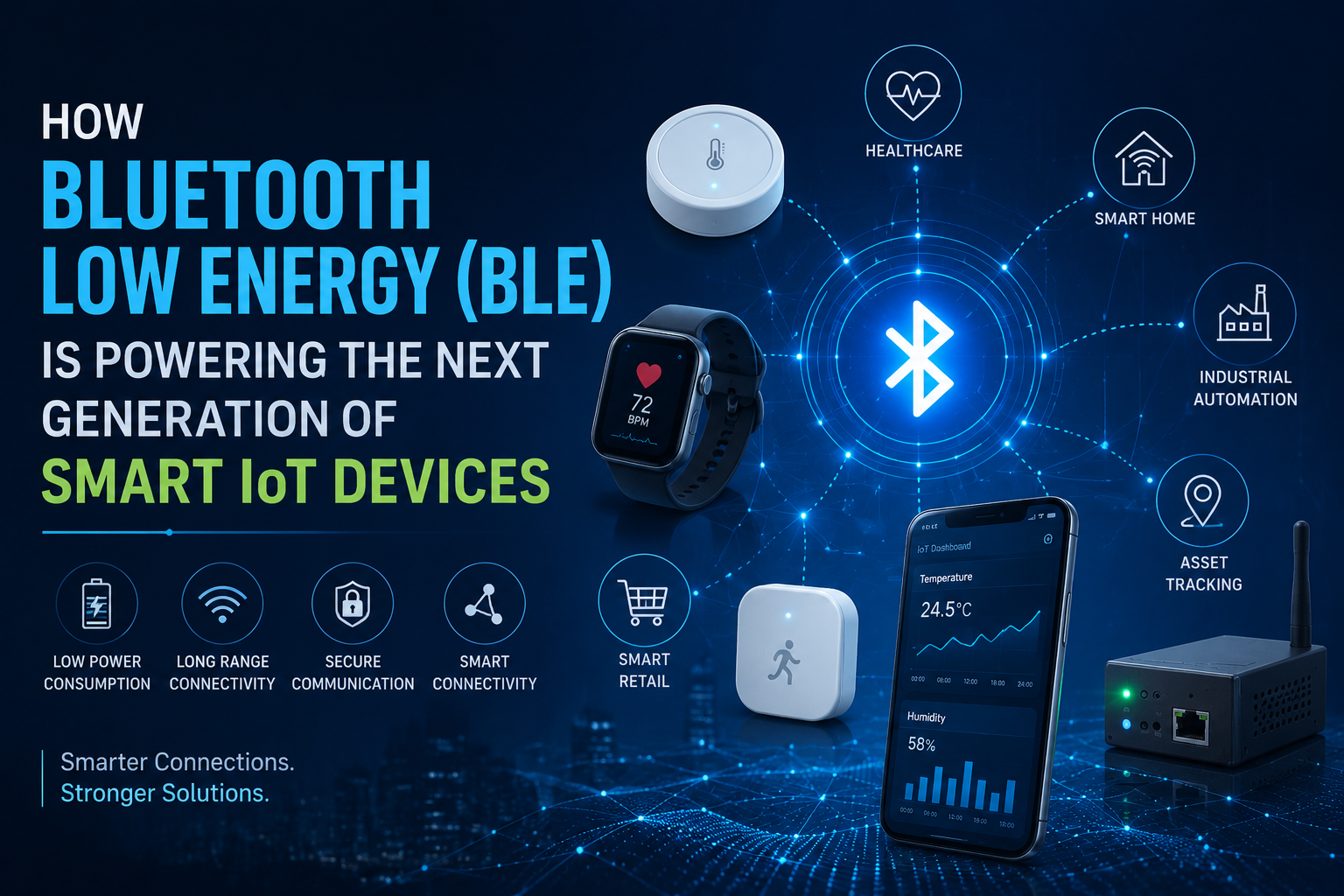
The Internet of Things is changing how people interact with technology.
From smartwatches and fitness trackers to connected healthcare devices, smart homes, industrial sensors, and asset-tracking systems, IoT technology is helping devices collect data, communicate, and respond in real time.
However, every connected device needs a reliable way to communicate.
For many IoT applications, traditional Bluetooth or Wi-Fi may consume more power than necessary. This is where Bluetooth Low Energy (BLE) plays an important role.
BLE allows devices to exchange information while using very little power. This makes it an ideal wireless technology for IoT products that need long battery life, reliable connectivity, and efficient data communication.
At IoTBLE, we develop intelligent BLE and IoT solutions that help businesses turn connected-device ideas into practical, scalable products.
What Is Bluetooth Low Energy?
Bluetooth Low Energy, commonly known as BLE, is a wireless communication technology designed to use significantly less power than traditional Bluetooth.
BLE is especially useful for devices that:
- Run on small batteries
- Need to operate for months or years
- Send small amounts of data
- Communicate with smartphones or gateways
- Require fast and efficient connections
- Need low-cost wireless connectivity
BLE does not mean “low performance.”
Instead, it is designed to use energy efficiently. A BLE device can remain in a low-power state for most of the time and become active only when it needs to send or receive information.
This helps extend battery life without sacrificing essential connectivity.
Why BLE Is Important for IoT
IoT devices are often expected to work continuously with minimal maintenance.
Imagine a temperature sensor installed inside a warehouse. Replacing its battery every few weeks would be inconvenient and expensive. A low-power communication technology can help the device operate for much longer.
BLE supports this requirement by reducing unnecessary energy consumption.
Some of the main benefits include:
1. Low Power Consumption
BLE is designed for energy-efficient communication.
Many BLE devices can operate for long periods using small batteries, depending on factors such as connection frequency, data size, transmission power, and device configuration.
This makes BLE useful for wearables, sensors, medical devices, smart tags, and battery-powered IoT products.
2. Fast Connections
BLE devices can establish connections quickly.
Fast communication is valuable when devices need to exchange small pieces of information without remaining connected continuously.
For example, a fitness tracker may periodically send activity data to a mobile application without using unnecessary battery power.
3. Smartphone Compatibility
Most modern smartphones support Bluetooth Low Energy.
This allows businesses to create IoT solutions where a mobile application acts as a control panel, data viewer, or gateway.
Users can connect to compatible BLE devices without purchasing additional hardware in many use cases.
4. Cost-Effective Connectivity
BLE hardware can be integrated into many types of connected products.
Its energy efficiency and broad device support can help businesses develop practical IoT solutions without depending on high-power communication technologies for every use case.
5. Flexible IoT Applications
BLE can support many industries and product categories.
It is commonly used in:
- Healthcare
- Fitness
- Smart homes
- Retail
- Manufacturing
- Logistics
- Hospitality
- Asset tracking
- Industrial monitoring
How BLE Works in an IoT System
A typical BLE IoT solution includes several components.
The BLE Device
The device may contain sensors, a microcontroller, a BLE chip, and a power source.
It collects information such as:
- Temperature
- Motion
- Heart rate
- Location data
- Humidity
- Equipment status
- Battery level
The Mobile App or Gateway
A smartphone, tablet, gateway, or other connected system receives information from the BLE device.
The application may display data, send commands, or transfer information to a cloud platform.
The Cloud Platform
Cloud infrastructure can store device information and support analytics, alerts, reporting, and remote monitoring.
The Business Dashboard
A web dashboard may allow administrators to view device activity, monitor performance, manage users, and analyze trends.
Together, these components create a connected IoT ecosystem.
Real-World BLE IoT Use Cases
Smart Healthcare Devices
BLE is used in connected healthcare products such as:
- Heart-rate monitors
- Blood pressure devices
- Glucose monitoring systems
- Wearable health trackers
- Remote patient monitoring solutions
A BLE-enabled device can send health information to a mobile application, where users or healthcare professionals can review the data.
Security and privacy should be considered carefully when developing healthcare solutions.
Fitness and Wearable Technology
Fitness bands and smartwatches often use BLE to communicate with mobile applications.
The devices can track:
- Steps
- Exercise activity
- Sleep patterns
- Heart rate
- Calories
- Movement
BLE helps these products maintain wireless connectivity while supporting long battery life.
Smart Home Systems
BLE can connect smartphones with smart locks, lighting systems, sensors, appliances, and other home devices.
A user may unlock a door, control a light, or receive an alert through a mobile application.
Industrial IoT
Manufacturing and industrial organizations can use BLE sensors to monitor equipment and operating conditions.
Connected systems may track:
- Machine temperature
- Vibration
- Equipment activity
- Environmental conditions
- Maintenance requirements
This information can support predictive maintenance and help reduce unexpected equipment downtime.
Asset Tracking
BLE beacons and tags can help organizations monitor the movement and location of equipment.
Possible applications include:
- Warehouse inventory
- Hospital equipment
- Retail assets
- Tools and machinery
- Office equipment
Smart Retail
Retail businesses can use BLE technology for:
- Proximity-based customer experiences
- Digital promotions
- Indoor navigation
- Smart inventory systems
- Connected point-of-sale solutions
BLE vs. Wi-Fi: Which Is Better for IoT?
BLE and Wi-Fi are designed for different requirements.
BLE is often a strong choice when a device needs:
- Low power consumption
- Small data transfers
- Long battery life
- Smartphone connectivity
- Short-range communication
Wi-Fi may be more suitable when an application needs:
- Higher data transfer speeds
- Continuous internet connectivity
- Large data transfers
- Longer-range network access through existing infrastructure
The right technology depends on the product’s requirements.
Some IoT solutions may use both BLE and Wi-Fi. For example, a sensor may communicate through BLE to a local gateway, while the gateway uses Wi-Fi or cellular connectivity to send information to the cloud.
Key Challenges in BLE IoT Development
Although BLE offers many advantages, developing a reliable connected product requires careful planning.
Device Compatibility
Different smartphones, operating systems, and hardware versions may behave differently.
BLE applications should be tested across relevant devices.
Connection Stability
The system should handle disconnections, reconnections, background activity, and changes in signal strength.
Battery Optimization
Poor device configuration can reduce battery life.
Developers must optimize advertising intervals, connection settings, data transmission, and device activity.
Security
IoT devices can collect sensitive information or control physical systems.
Security may include:
- Secure pairing
- Authentication
- Data encryption
- Access controls
- Secure firmware updates
Scalability
A prototype may work with a few devices but require additional planning to support thousands of connected products.
Cloud architecture, device management, data storage, and monitoring should be designed for future growth.
How IoTBLE Builds Connected Solutions
At IoTBLE, we help businesses develop BLE-powered products from concept to deployment.
Our development process includes:
1. IoT Product Discovery
We understand the product idea, target users, device requirements, business goals, and technical challenges.
2. BLE Architecture Planning
We define how devices, mobile applications, gateways, cloud platforms, and dashboards will communicate.
3. Mobile App Development
We create Android and iOS applications that can connect with BLE devices and provide clear, user-friendly experiences.
4. Device Integration
Our team works with BLE hardware, sensors, embedded systems, and connected devices.
5. Cloud and Dashboard Development
We build cloud-connected systems for data storage, analytics, device management, reporting, and remote monitoring.
6. Testing and Optimization
We test connectivity, battery performance, device compatibility, security, and real-world behavior.
7. Ongoing Support
Connected products may require updates, monitoring, new features, and long-term maintenance.
The Future of BLE and IoT
BLE technology continues to evolve as connected products become more intelligent.
Future BLE IoT solutions may include:
- More advanced sensor networks
- Improved indoor positioning
- Smarter healthcare monitoring
- AI-powered device analytics
- More connected industrial systems
- Energy-efficient smart buildings
- Large-scale asset tracking
- Better interoperability between devices
As AI and IoT become more closely connected, devices will do more than collect information.
They will help identify patterns, predict issues, automate actions, and support faster decision-making.
Build Your BLE IoT Solution with IoTBLE
Bluetooth Low Energy is helping businesses create connected products that are efficient, practical, and designed for long-term use.
Whether you are building a wearable device, smart healthcare product, industrial monitoring platform, connected sensor, asset-tracking system, or custom IoT application, the right technology architecture can make a major difference.
At IoTBLE, we combine BLE development, IoT engineering, mobile applications, cloud technology, and intelligent software to build scalable connected solutions.
Have an IoT idea? Let’s connect it to the future.
Contact IoTBLE to discuss your BLE and IoT development requirements.
Leave a Reply