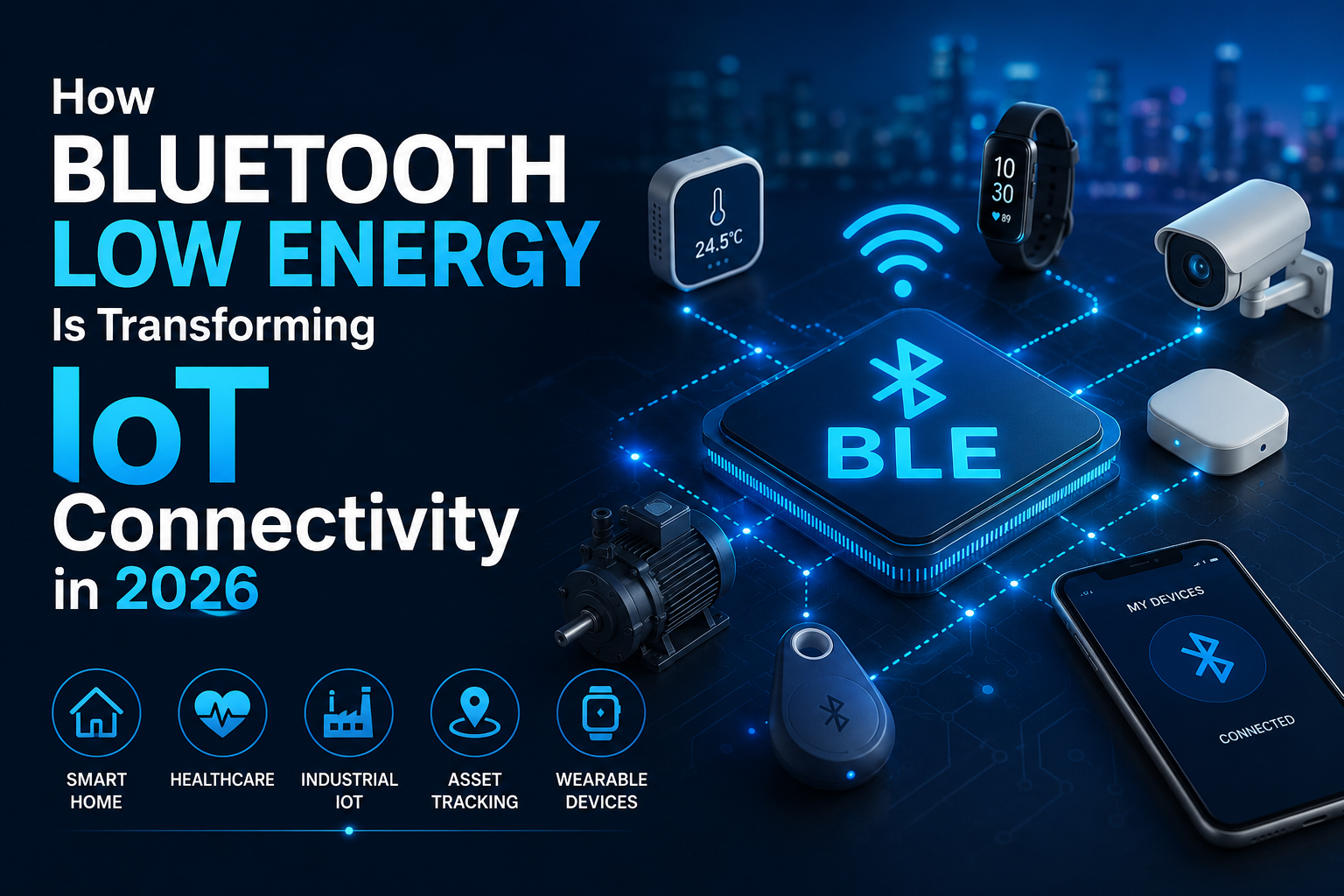
The Internet of Things (IoT) is moving toward smaller, smarter, and more energy-efficient connected devices. From wearable sensors and smart home products to industrial equipment and asset-tracking systems, IoT devices need reliable wireless communication without constantly consuming battery power.
This is where Bluetooth Low Energy (BLE) has become an important connectivity technology.
BLE was designed for low-power wireless communication and is particularly suitable for applications that exchange relatively small amounts of data. Its broad availability across smartphones, tablets, computers, and embedded devices makes it an attractive option for connecting IoT products with mobile applications and cloud-based platforms.
What Is BLE in IoT?
Bluetooth Low Energy is a wireless communication technology optimized for devices that need to operate efficiently on limited power.
Unlike traditional Bluetooth applications that often focus on continuous data transmission such as audio, BLE is well suited to sensors, trackers, wearables, controllers, and other IoT devices that periodically transmit data.
A typical BLE-enabled IoT ecosystem can include:
- BLE sensors
- Microcontrollers
- Mobile applications
- IoT gateways
- Cloud platforms
- Analytics dashboards
- Backend APIs
For example, a temperature sensor can collect environmental data, transmit it through BLE to a smartphone or gateway, and then send that information to a cloud platform for monitoring and analysis.
Why BLE Is Important for IoT
IoT developers have to balance several factors when selecting a connectivity technology, including power consumption, range, data requirements, device cost, and network architecture. Bluetooth technology offers different options depending on these requirements, while BLE is particularly attractive for low-power applications.
1. Low Power Consumption
Battery life is one of the biggest challenges in IoT development.
Many IoT sensors are installed in locations where replacing batteries frequently is inconvenient or expensive. BLE’s low-energy design helps devices communicate while minimizing power consumption.
This makes BLE useful for:
- Fitness trackers
- Environmental sensors
- Smart locks
- Asset trackers
- Wearable devices
- Industrial sensors
- Healthcare monitoring devices
2. Smartphone Compatibility
One of BLE’s biggest advantages is its compatibility with modern smartphones.
Android provides built-in BLE APIs that allow applications to discover nearby devices, access services, and exchange information with BLE peripherals.
This enables a common architecture:
BLE Device → Mobile App → Cloud Platform
For IoT companies, this can eliminate the need for a dedicated hardware controller in many consumer applications.
3. Cost-Effective Connectivity
IoT products often need to be affordable enough for large-scale deployment.
BLE can provide wireless connectivity without requiring every sensor to have a cellular connection or high-power Wi-Fi radio. This can make it suitable for applications where devices primarily communicate with a nearby smartphone, gateway, or hub.
4. Flexible IoT Architectures
BLE can be used in different IoT architectures depending on the product requirements.
A simple solution may connect one sensor directly to a smartphone.
A larger deployment can use multiple BLE devices communicating through gateways or mesh-based networks.
This flexibility allows BLE to support applications ranging from personal devices to larger connected environments.
Major BLE IoT Applications
BLE is being used across a wide range of IoT applications.
Smart Home
Smart home products can use BLE for:
- Smart locks
- Temperature sensors
- Motion sensors
- Lighting controls
- Door sensors
- Smart appliances
For example, a smartphone can communicate with a BLE smart lock when the user approaches the door.
Healthcare and Medical Devices
Healthcare devices frequently need to transmit small amounts of sensor data while operating on limited battery power.
Potential applications include:
- Patient monitoring
- Temperature monitoring
- Fitness and wellness devices
- Medical sensors
- Rehabilitation equipment
- Wearable monitoring devices
Security and privacy should receive particular attention when BLE is used for sensitive information. Android’s documentation specifically recommends application-layer security when applications handle sensitive BLE data.
Industrial IoT
Industrial environments can contain thousands of sensors and connected devices.
BLE can support applications such as:
- Equipment monitoring
- Machine sensors
- Temperature monitoring
- Asset identification
- Predictive maintenance
- Worker safety systems
BLE can also work alongside other connectivity technologies rather than replacing them completely.
For example:
BLE → Gateway → Wi-Fi/Ethernet → Cloud
This architecture allows low-power sensors to communicate locally while the gateway handles internet connectivity.
Asset Tracking
BLE beacons and tags can help organizations monitor the location or proximity of assets.
Possible applications include:
- Warehouse equipment
- Medical equipment
- Retail inventory
- Tools
- Industrial assets
- Logistics containers
For applications requiring highly precise positioning, BLE may be combined with other positioning technologies depending on the required accuracy.
Wearable Technology
Wearables are one of the most recognizable BLE IoT applications.
Smartwatches, fitness trackers, sensors, and other wearable devices can exchange information with smartphones while operating with limited battery capacity.
BLE vs Wi-Fi for IoT
BLE and Wi-Fi are not direct replacements for one another.
| Feature | BLE | Wi-Fi |
|---|---|---|
| Power consumption | Very low | Generally higher |
| Typical use | Sensors and peripherals | High-bandwidth connectivity |
| Smartphone support | Excellent | Excellent |
| Data requirements | Small/intermittent data | Higher data volumes |
| Battery-powered sensors | Excellent | Often less suitable |
| Internet connectivity | Usually through gateway/device | Direct |
| Best for | Low-power IoT | Data-intensive IoT |
The right choice depends on the application’s range, bandwidth, power, topology, and cost requirements.
The Role of BLE Gateways
A BLE gateway can act as the bridge between local BLE devices and internet-based systems.
A common architecture looks like this:
BLE Sensors → BLE Gateway → Internet → Cloud → Dashboard
The gateway can collect data from multiple devices and forward it to a backend platform.
This approach is particularly useful in:
- Smart buildings
- Warehouses
- Manufacturing facilities
- Retail environments
- Healthcare facilities
- Agriculture
BLE Mesh and Larger IoT Deployments
For larger environments, BLE-based mesh networking can extend the communication model beyond simple one-to-one connections.
BLE mesh technology has been researched for applications requiring low-power, multi-device communication and can be relevant to IoT environments where many devices need to interact.
However, developers should select the network architecture based on actual requirements rather than assuming mesh is always the best solution.
Security Considerations for BLE IoT
Connectivity alone is not enough for a production-ready IoT product.
Security should be considered throughout the system, including:
- Device authentication
- Secure pairing
- Encryption
- Secure firmware updates
- API security
- Cloud security
- Access control
- Data privacy
Recent research continues to examine authentication and reliability challenges in BLE-based IoT systems, showing why security should be incorporated during product architecture rather than added later.
BLE and the Future of IoT
The future of IoT is increasingly focused on low-power, intelligent, and highly distributed devices.
Research into technologies such as ambient IoT is exploring devices that can operate with extremely low maintenance requirements by harvesting energy from sources such as light, motion, heat, or radio waves.
BLE can play an important role in this broader ecosystem because IoT devices increasingly need efficient short-range communication.
At the same time, BLE does not have to work alone. Modern IoT systems can combine BLE with Wi-Fi, cellular, LoRaWAN, UWB, Thread, and other technologies depending on the application’s requirements.
Conclusion
Bluetooth Low Energy has become an important connectivity option for modern IoT products because it combines low-power communication, broad device compatibility, flexible architectures, and support for a wide range of sensors and connected devices.
From smart homes and healthcare to industrial IoT, asset tracking, and wearable technology, BLE can provide an efficient communication layer between physical devices and digital applications.
For businesses developing connected products, the key is not simply choosing BLE, but designing the complete ecosystem—including hardware, firmware, BLE communication, mobile applications, gateways, APIs, cloud infrastructure, and security—around the product’s specific requirements.
A well-designed BLE IoT architecture can help businesses build connected products that are efficient, scalable, and ready for the next generation of IoT.
Leave a Reply