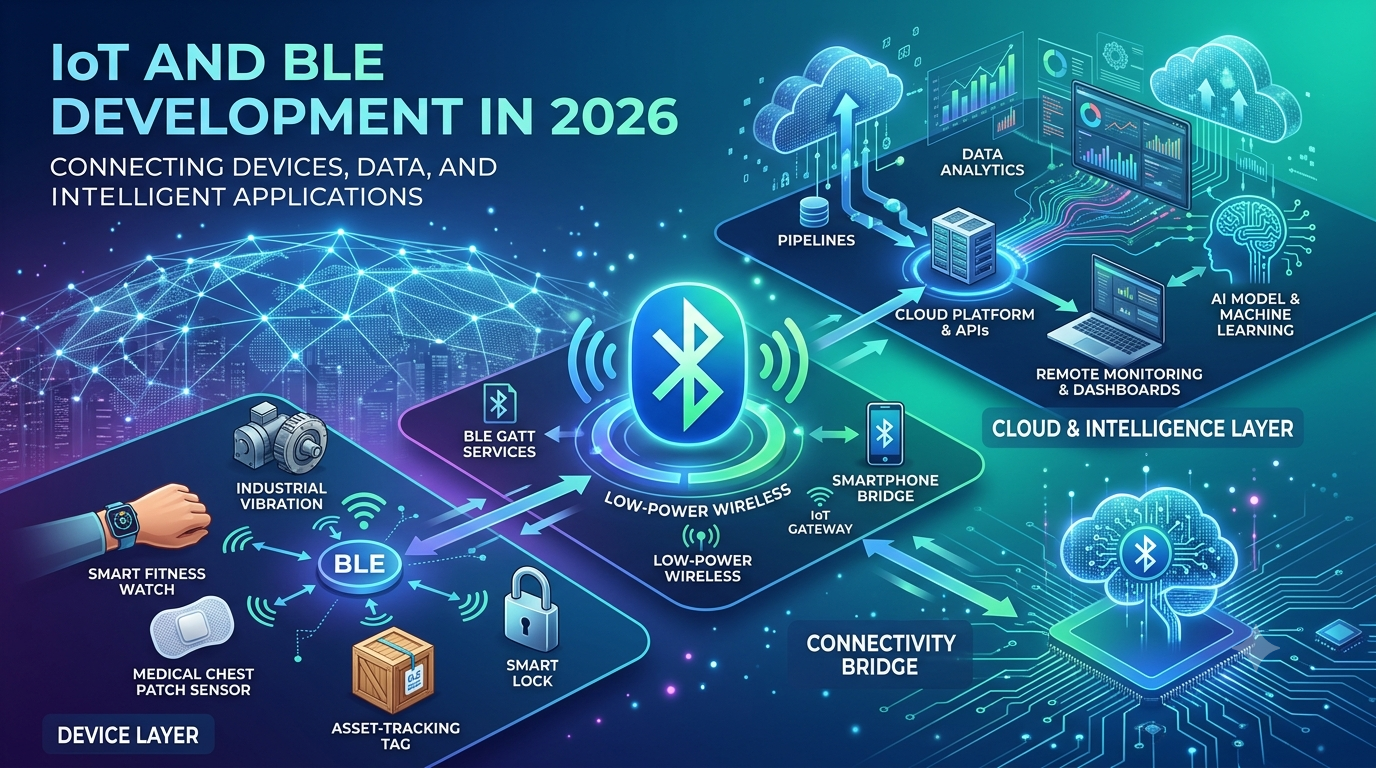
The Internet of Things is moving beyond simple connected devices. In 2026, businesses are building intelligent ecosystems where sensors, Bluetooth devices, mobile applications, gateways, cloud platforms, and analytics systems work together.
For many of these products, Bluetooth Low Energy (BLE) provides an efficient way to connect nearby devices while IoT technology enables data to move beyond the local environment.
This combination is helping businesses develop smarter wearables, industrial sensors, healthcare devices, asset-tracking systems, smart-home products, and connected consumer applications.
What Is IoT BLE Development?
IoT BLE development combines Bluetooth Low Energy connectivity with Internet of Things architecture.
A typical solution can connect:
BLE Device → Mobile App/Gateway → Internet → Cloud → Dashboard
The BLE layer manages nearby device communication, while the IoT infrastructure can handle data processing, storage, monitoring, automation, and remote management.
This makes BLE particularly useful for connected products that need:
- Low-power communication
- Smartphone connectivity
- Sensor data collection
- Device configuration
- Real-time monitoring
- Cloud connectivity
- Remote management
Why BLE Is Important for IoT Products
IoT devices often operate on batteries and may need to remain active for long periods.
BLE is designed for low-power wireless communication, making it suitable for many battery-powered connected products.
Examples include:
- Fitness trackers
- Smartwatches
- Healthcare sensors
- Temperature sensors
- Smart locks
- Asset trackers
- Industrial sensors
- Smart-home devices
- Connected equipment
Instead of continuously transmitting large amounts of information, a BLE device can communicate specific data when required.
How an IoT BLE Architecture Works
A connected product may include several technical layers.
1. Connected Device
The device contains sensors, a BLE chipset, firmware, and other hardware components.
It collects information such as:
- Temperature
- Motion
- Heart rate
- Battery status
- Location-related information
- Device status
2. BLE Communication
The device communicates with a nearby smartphone, tablet, gateway, or another BLE-enabled system.
BLE services and characteristics define how information is exchanged.
3. Mobile Application
A mobile application can act as the user interface for the connected device.
It can provide features such as:
- Device discovery
- Pairing
- Configuration
- Data visualization
- Notifications
- Firmware updates
- User accounts
4. IoT Gateway
For some applications, a gateway can collect information from multiple BLE devices and forward it to the cloud.
This can be useful in industrial, healthcare, retail, and smart-building environments.
5. Cloud Platform
The cloud can receive and store device data while providing APIs, dashboards, analytics, and remote device management.
The overall architecture can therefore connect thousands of devices to a centralized platform.
BLE GATT and IoT Applications
The Generic Attribute Profile (GATT) is an important part of BLE application development.
GATT organizes data through services and characteristics.
For example, a smart sensor might have:
Device Service
- Battery Level
- Device Status
- Firmware Version
Sensor Service
- Temperature
- Humidity
- Motion
The application can read or receive updates from these characteristics depending on the product’s requirements.
A carefully designed GATT structure helps different components communicate consistently.
BLE-to-Cloud Connectivity
BLE devices normally communicate over a short range.
IoT architecture can extend that connectivity by using a smartphone or gateway as the bridge to the internet.
For example:
BLE Sensor → Smartphone → API → Cloud Database → Web Dashboard
This approach allows data generated by a nearby sensor to become available remotely.
Businesses can then monitor devices, generate reports, trigger alerts, and analyze historical information.
IoT BLE Applications Across Industries
Healthcare and Medical Devices
Connected healthcare products can use BLE to transfer measurements from sensors to mobile applications and cloud systems.
Potential applications include:
- Patient monitoring
- Wearable health devices
- Fitness sensors
- Medical equipment
- Remote data collection
Healthcare projects require additional attention to security, privacy, testing, and applicable regulations.
Industrial IoT
BLE-enabled sensors can collect information from equipment and environments.
Businesses can use IoT dashboards to monitor:
- Equipment status
- Temperature
- Vibration
- Battery levels
- Maintenance indicators
- Operational conditions
This can help organizations create more connected monitoring systems.
Smart Home
Smart-home products can use BLE for device setup, local communication, and configuration.
Examples include:
- Smart locks
- Sensors
- Lighting controllers
- Home-monitoring devices
- Smart appliances
BLE can also complement other connectivity technologies within a broader smart-home architecture.
Wearables
Wearable products often require efficient communication with smartphones.
BLE can transfer information such as:
- Activity data
- Heart rate
- Workout statistics
- Device status
- Notifications
The mobile application can then synchronize selected information with cloud services.
Asset Tracking
BLE tags and sensors can be used to identify and monitor assets.
A typical system could include:
BLE Tag → Gateway → Cloud → Tracking Dashboard
This architecture can help organizations monitor equipment, inventory, and other physical assets.
BLE Beacons and IoT
BLE beacon technology can provide another layer of connectivity.
Beacon-based systems can be used for:
- Indoor positioning
- Proximity experiences
- Asset identification
- Location-aware applications
- Retail experiences
- Navigation
When combined with IoT infrastructure, beacon information can be collected, processed, and analyzed centrally.
OTA Updates for Connected Devices
Connected products need to evolve after deployment.
An over-the-air (OTA) update system can allow compatible devices to receive new firmware remotely.
Updates may be required for:
- Bug fixes
- Security improvements
- Performance improvements
- New features
- Compatibility changes
A reliable OTA implementation should include secure firmware delivery, version management, validation, and recovery mechanisms.
Security in IoT BLE Development
Security should be considered throughout the product lifecycle.
A connected solution may need protection at several levels:
Device → BLE Communication → Mobile App → API → Cloud
Important considerations can include:
- Secure authentication
- Device pairing
- Encryption
- Access control
- API security
- Secure firmware updates
- Data protection
- Monitoring
The appropriate security architecture depends on the product, industry, data, and regulatory requirements.
AI and IoT BLE
The next generation of connected products can combine IoT data with artificial intelligence.
For example, sensor data can be processed to identify patterns and generate useful insights.
An architecture might look like:
BLE Sensors → IoT Platform → Data Processing → AI Model → Business Insights
Potential applications include:
- Predictive maintenance
- Anomaly detection
- Usage analysis
- Smart recommendations
- Automated alerts
- Equipment monitoring
The value of AI comes from applying it to meaningful device data rather than simply adding AI as a feature.
Building a Scalable IoT BLE Solution
Before development begins, businesses should define:
Device Requirements
What information does the device collect?
Connectivity Requirements
Does it communicate directly with a phone, gateway, or both?
Mobile Requirements
Does the product need an iOS or Android application?
Cloud Requirements
Does the business need remote monitoring and centralized data?
Security Requirements
What information needs protection?
Scalability Requirements
How many devices and users should the system support?
Answering these questions early can help create a more reliable architecture.
Why Choose IoTBLE for Connected Product Development?
IoTBLE focuses on technologies that bring together IoT, Bluetooth Low Energy, connected devices, mobile applications, and cloud systems.
A complete IoT BLE development approach can cover multiple layers of a connected product, including:
- BLE device connectivity
- IoT application development
- Mobile applications
- BLE GATT implementation
- Sensor integration
- Gateway communication
- Cloud connectivity
- Real-time monitoring
- Device management
- OTA updates
This end-to-end approach is useful for companies developing connected products that need to move from an initial prototype toward a scalable commercial solution.
Frequently Asked Questions
What is IoT BLE?
IoT BLE refers to using Bluetooth Low Energy as part of an Internet of Things system to connect devices, sensors, mobile applications, gateways, and cloud platforms.
What devices can use BLE?
BLE can be used with wearables, sensors, smart locks, healthcare devices, fitness equipment, industrial products, asset trackers, and many other connected devices.
Can BLE devices connect to the internet?
BLE itself is primarily a local wireless communication technology. A smartphone, gateway, or another connected device can act as a bridge between BLE devices and the internet.
What is a BLE gateway?
A BLE gateway collects data from BLE devices and can forward that information to a cloud or IoT platform through an internet connection.
Can IoT BLE systems use AI?
Yes. IoT data can be processed using AI and machine-learning technologies for applications such as anomaly detection, predictive maintenance, analytics, and automation.
How much does IoT BLE development cost?
The cost depends on the hardware, firmware, BLE functionality, mobile applications, cloud architecture, integrations, security requirements, testing, and overall project scope.
Final Thoughts
The combination of IoT and BLE development gives businesses a practical foundation for building connected products.
BLE can provide efficient local communication, while IoT infrastructure can connect devices to cloud platforms, dashboards, analytics, and intelligent applications.
From wearables and healthcare devices to industrial sensors, smart-home products, and asset-tracking systems, connected technology is creating new opportunities across industries.
The key is to design the entire ecosystem—from device and firmware to BLE communication, mobile applications, cloud infrastructure, and security—as one connected solution.
Connected devices create the data. IoT turns that data into a connected business.
Leave a Reply