The Internet of Things is moving beyond simple device connectivity. In 2026, businesses are building connected products that can sense, communicate, analyze, automate, and respond in real time.
From industrial sensors and wearables to smart locks, medical devices, fitness trackers, EV chargers, and smart-building systems, Bluetooth Low Energy (BLE) has become an important connectivity technology for battery-powered IoT products.
The latest Bluetooth ecosystem is also expanding into areas such as precise ranging, higher data throughput, edge AI, ultra-low-power devices, and Ambient IoT applications. Bluetooth SIG’s 2026 updates highlight developments including Channel Sounding, Bluetooth Core 6.3 enhancements, and work toward higher-throughput Bluetooth LE.
What Is IoT BLE Development?
IoT BLE development combines Bluetooth Low Energy connectivity with sensors, embedded firmware, mobile applications, gateways, cloud platforms, and data analytics.
A typical architecture can look like:
BLE Device → Mobile App / Gateway → Cloud Platform → Data Processing → Dashboard → Automation
This architecture allows physical devices to communicate with software systems while maintaining the low-power characteristics required by many IoT applications.
Why BLE Is Important for IoT
BLE is particularly useful for IoT products that need wireless communication while operating with limited battery capacity.
Common advantages include:
- Low power consumption
- Wireless device connectivity
- Smartphone compatibility
- Compact hardware designs
- Secure communication capabilities
- Support for sensors and peripherals
- Proximity and location-aware applications
- Flexible device-to-app communication
Bluetooth SIG describes Bluetooth LE as a low-power technology suited to Ambient IoT applications, including energy-constrained connected devices.
IoT BLE Architecture: From Device to Cloud
Building a successful connected product requires more than adding a BLE module.
The complete technology stack can include several layers.
1. BLE Hardware
The hardware layer may include:
- Sensors
- BLE SoCs
- Microcontrollers
- Battery systems
- Actuators
- Displays
- Industrial equipment
- Medical components
Hardware selection affects power consumption, performance, connectivity, security, and overall product cost.
2. Embedded Firmware
Firmware controls how the device communicates and behaves.
A BLE IoT product may require firmware for:
- Advertising
- Scanning
- Connections
- GATT services
- Sensor data collection
- Power management
- Device configuration
- Security
- OTA updates
Firmware and mobile applications should be designed together so that communication remains reliable throughout the product lifecycle.
3. Mobile Application
Many BLE products use smartphones as a bridge between the physical device and cloud services.
Native iOS and Android development can provide access to platform-specific Bluetooth APIs, including CoreBluetooth on iOS and Android Bluetooth APIs.
A mobile application can handle:
- Device discovery
- Pairing
- Provisioning
- Configuration
- Data visualization
- User authentication
- Device control
- Cloud synchronization
4. Gateway Connectivity
Some IoT deployments cannot rely on smartphones as the communication bridge.
A dedicated gateway can collect information from multiple BLE devices and transmit it to a cloud platform.
This architecture can be useful for:
- Industrial facilities
- Smart buildings
- Retail environments
- Warehouses
- Healthcare environments
- Large sensor networks
5. Cloud Infrastructure
Cloud systems can store, process, visualize, and analyze data collected from connected devices.
Common cloud platforms for IoT development include:
- AWS IoT
- Microsoft Azure IoT
- Google Cloud
A secure edge-to-cloud architecture can provide centralized monitoring and device management.
Custom GATT Services for IoT Products
The Generic Attribute Profile (GATT) defines how BLE devices organize and exchange data.
Custom GATT services can be designed around the specific requirements of an IoT product.
For example, an industrial sensor could have characteristics for:
- Temperature
- Pressure
- Vibration
- Battery level
- Device status
- Error conditions
A custom GATT architecture can make communication between the embedded device and application more structured and predictable.
Secure BLE Pairing and Device Provisioning
Security should be considered from the beginning of IoT BLE development.
Connected devices may exchange sensitive business, operational, or personal information.
A secure implementation can include:
- Authentication
- Secure pairing
- Encryption
- Key management
- Device identity
- Access control
- Secure provisioning
- Protected firmware updates
Device provisioning is especially important when hundreds or thousands of devices need to be deployed.
The objective is to make first-time setup secure while keeping the user experience simple.
OTA Firmware Updates
IoT products often remain in the field for years.
Requiring technicians to physically update every device can become expensive and impractical.
Over-the-air firmware updates can allow manufacturers to distribute firmware improvements remotely.
OTA updates can be used for:
- Security patches
- Bug fixes
- Performance improvements
- New functionality
- Device optimization
A production-grade OTA system should consider authentication, integrity verification, recovery mechanisms, interrupted transfers, and device compatibility.
BLE and Edge AI
One of the emerging directions in 2026 is the combination of BLE connectivity and edge AI.
Bluetooth SIG highlights the growing relationship between Bluetooth connectivity and edge AI, particularly for wearables, industrial applications, smart buildings, and other intelligent connected products.
Instead of sending every piece of raw data to the cloud, an IoT device or edge gateway can potentially process information locally.
For example:
Sensor → BLE → Edge Processing → AI Model → Decision → Action
This can help applications that require faster responses, lower latency, or reduced cloud communication.
Bluetooth Channel Sounding and IoT
Bluetooth Channel Sounding is another important development for location-aware IoT applications.
The technology is designed to enable more accurate distance measurement between Bluetooth devices. Bluetooth SIG identifies applications such as asset tracking, location awareness, and other proximity-based experiences.
Potential IoT use cases include:
- Asset tracking
- Indoor positioning
- Smart access systems
- Location-aware automation
- Proximity-based experiences
- Industrial monitoring
As the technology develops, developers can explore new IoT applications that require greater awareness of device distance.
Higher Data Throughput for BLE
Bluetooth technology is also evolving toward higher data throughput.
Bluetooth SIG’s High Data Throughput work is targeting speeds of up to 7.5 Mbps compared with today’s 2 Mbps maximum for Bluetooth LE, while retaining the technology’s low-power focus.
Higher throughput could expand the types of applications that can use Bluetooth LE, particularly where connected devices need to transfer larger amounts of data.
IoT BLE Use Cases
Smart Wearables
BLE can connect smartwatches, fitness trackers, smart rings, and other wearable devices with smartphones and cloud platforms.
Healthcare Devices
Connected medical and wellness devices can collect measurements and securely transmit data to applications and backend systems.
For regulated medical products, development also requires appropriate regulatory and quality considerations.
Industrial IoT
BLE sensor networks can monitor:
- Temperature
- Pressure
- Vibration
- Equipment status
- Asset location
- Environmental conditions
Smart Buildings
BLE-enabled sensors can support:
- Occupancy monitoring
- Smart access
- Environmental monitoring
- Energy management
- Building automation
Retail and Electronic Shelf Labels
Bluetooth connectivity can support connected retail devices such as electronic shelf labels, asset tags, and other smart-store technologies.
Smart Locks
BLE enables smartphones and other authorized devices to communicate with connected locks for access-control applications.
EV and Charging Infrastructure
Connected charging systems can use BLE alongside other communication technologies for configuration, monitoring, and user interaction.
Challenges in IoT BLE Development
Building a reliable BLE IoT product requires careful engineering.
Battery Life
More sensors, wireless communication, and processing can increase power consumption.
Developers need to optimize:
- Advertising intervals
- Connection intervals
- Sleep modes
- Sensor sampling
- Data transmission
- Firmware processing
Device Compatibility
iOS and Android handle Bluetooth differently, and Android devices can vary by manufacturer and operating-system version.
Testing across real devices is therefore important.
Connectivity Reliability
BLE communication can be affected by:
- Physical obstacles
- Radio interference
- Distance
- Device density
- Antenna design
- Environmental conditions
Security
Connected devices can become entry points into larger systems if security is poorly designed.
Security should therefore be integrated across firmware, BLE communication, mobile applications, APIs, cloud infrastructure, and device management.
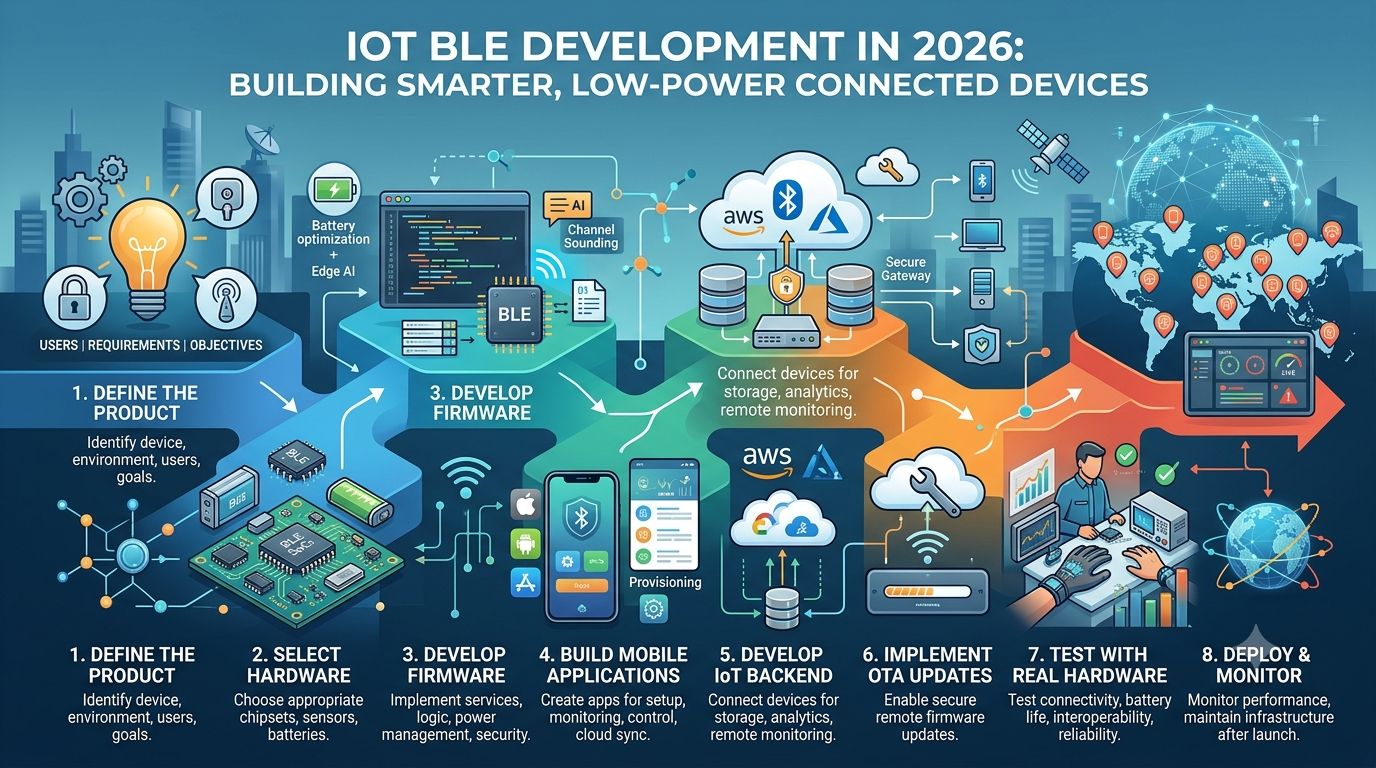
How to Build an IoT BLE Product
A structured development process can include:
Step 1: Define the Product
Identify the device, users, sensors, environment, connectivity requirements, and business objectives.
Step 2: Select Hardware
Choose appropriate BLE chipsets, sensors, microcontrollers, batteries, and communication components.
Step 3: Develop Firmware
Implement BLE services, device logic, power management, security, and sensor communication.
Step 4: Build Mobile Applications
Develop iOS and Android applications for provisioning, configuration, monitoring, and control.
Step 5: Develop the IoT Backend
Connect devices to cloud services for data storage, analytics, remote monitoring, and device management.
Step 6: Implement OTA Updates
Create a secure mechanism for remotely updating deployed devices.
Step 7: Test With Real Hardware
Test connectivity, battery life, device interoperability, firmware reliability, mobile compatibility, and real-world operating conditions.
Step 8: Deploy and Monitor
After launch, continue monitoring device performance and maintaining firmware, applications, APIs, and cloud infrastructure.
Why Choose an IoT BLE Development Partner?
IoT product development crosses several technical disciplines.
A capable development team may need expertise in:
- BLE protocol development
- Embedded firmware
- Custom GATT services
- iOS CoreBluetooth
- Android Bluetooth APIs
- BLE hardware integration
- IoT gateways
- Cloud infrastructure
- OTA firmware updates
- Security
- QA with physical devices
- Production support
IoT BLE Services highlights these areas as part of its end-to-end BLE and IoT development capabilities, including BLE device development, IoT system integration, sensor networks, gateway and cloud connectivity, provisioning, OTA updates, and embedded firmware integration.
The Future of IoT BLE Development
BLE is moving beyond simple device-to-phone connectivity.
The combination of BLE + sensors + edge computing + AI + cloud platforms is creating new possibilities for intelligent connected products.
Current Bluetooth developments point toward:
- More accurate ranging
- Higher data throughput
- Lower-power IoT
- Edge AI
- Ambient IoT
- Smarter sensor networks
- Location-aware devices
- More intelligent connected products
Bluetooth SIG’s current development roadmap also includes work aimed at IP-based communication and other capabilities that could support evolving IoT architectures.
Conclusion
IoT BLE development in 2026 is becoming more sophisticated as businesses demand connected products that are secure, power-efficient, scalable, and intelligent.
A successful IoT product requires more than Bluetooth connectivity. It needs coordinated hardware, embedded firmware, BLE protocols, mobile applications, gateways, cloud infrastructure, security, analytics, and ongoing device management.
Whether you’re developing a wearable, industrial sensor, smart lock, healthcare device, fitness tracker, EV charger, or enterprise IoT platform, a well-designed BLE architecture can provide the foundation for reliable connected experiences.
Build Your Connected IoT Product
Looking for IoT BLE development services for your next connected product?
IoT BLE Services can help with BLE device development, custom GATT services, embedded firmware, mobile BLE applications, IoT system integration, gateways, cloud connectivity, secure provisioning, OTA updates, and real-time device monitoring.
Leave a Reply