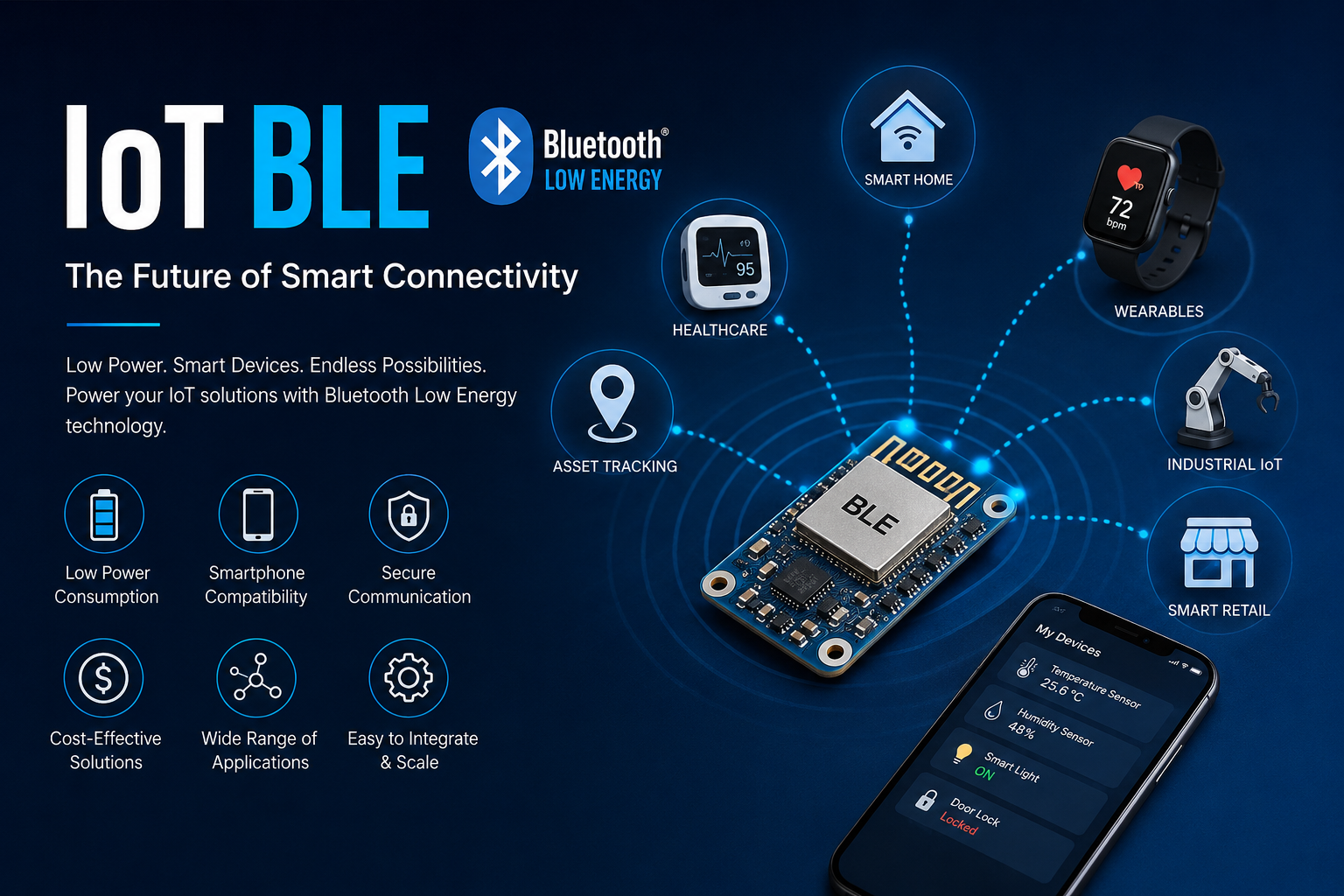
The Internet of Things (IoT) is changing the way businesses and consumers interact with technology. From smart homes and healthcare devices to industrial automation and wearable technology, connected devices are becoming an essential part of everyday life.
Among various wireless communication technologies, Bluetooth Low Energy (BLE) has become one of the most popular solutions for IoT applications because of its low power consumption, reliable communication, and smartphone compatibility. BLE is increasingly used as a foundation for modern IoT ecosystems where devices need efficient and secure data exchange.
What Is IoT BLE?
IoT BLE (Internet of Things Bluetooth Low Energy) is a technology combination where BLE-enabled devices communicate with smartphones, gateways, and cloud platforms to exchange real-time data.
Unlike traditional Bluetooth, BLE is designed for devices that require:
- Long battery life
- Low energy consumption
- Secure wireless communication
- Small data transmission
- Cost-effective connectivity
BLE allows IoT devices such as sensors, smart watches, medical devices, and industrial equipment to connect seamlessly without requiring complex networking infrastructure.
How Does BLE Work in IoT Applications?
A typical IoT BLE system includes:
1. BLE Device or Sensor
The IoT device collects information from sensors such as:
- Temperature sensors
- Motion sensors
- Health monitoring sensors
- Location trackers
- Smart meters
2. Mobile Application
A smartphone application acts as a bridge between BLE devices and users.
The mobile app can:
- Connect with BLE hardware
- Display real-time information
- Control connected devices
- Send data to cloud platforms
3. Cloud Platform
Cloud systems store and analyze collected data to provide:
- Remote monitoring
- Analytics
- Automated alerts
- Business insights
Benefits of Using BLE in IoT Development
1. Low Power Consumption
The biggest advantage of BLE is its energy efficiency. IoT devices powered by small batteries can operate for months or even years without frequent charging.
This makes BLE ideal for:
- Wearables
- Healthcare devices
- Smart sensors
- Asset tracking solutions
2. Cost-Effective Connectivity
BLE hardware components are affordable and available in many embedded platforms, making IoT development more accessible for startups and enterprises.
3. Smartphone Compatibility
Almost every modern smartphone supports Bluetooth Low Energy, allowing businesses to create IoT solutions without requiring dedicated hardware controllers.
4. Secure Data Communication
Modern BLE solutions support:
- Device authentication
- Secure pairing
- Data encryption
- Protected communication channels
Security is becoming increasingly important as IoT deployments expand across industries.
Top Applications of IoT BLE Technology
1. Smart Healthcare Devices
BLE is widely used in healthcare solutions for:
- Remote patient monitoring
- Smart medical equipment
- Fitness tracking devices
- Health monitoring wearables
Doctors and healthcare providers can collect real-time patient data through connected devices.
2. Wearable Technology
Smart watches and fitness trackers use BLE to communicate with smartphones.
Applications include:
- Heart rate monitoring
- Activity tracking
- Sleep analysis
- GPS synchronization
3. Smart Home Automation
BLE enables smart home devices such as:
- Smart locks
- Smart lighting
- Security sensors
- Temperature controllers
Users can control devices directly through mobile applications.
4. Industrial IoT (IIoT)
Industries use BLE-based IoT solutions for:
- Equipment monitoring
- Predictive maintenance
- Asset tracking
- Factory automation
BLE helps organizations collect operational data and improve efficiency.
5. Retail and Smart POS Systems
BLE technology is helping retailers build smarter customer experiences through:
- Smart inventory tracking
- Customer engagement solutions
- Connected POS devices
- Beacon-based marketing
IoT BLE Development Process
A successful BLE IoT solution requires expertise in multiple areas:
Hardware Integration
Developers connect BLE modules with:
- Sensors
- Microcontrollers
- Embedded systems
BLE Communication Development
This includes:
- GATT services
- BLE profiles
- Data communication protocols
- Device pairing
Mobile App Development
Applications are developed for:
- Android
- iOS
- Cross-platform frameworks
Cloud Integration
IoT platforms enable:
- Data storage
- Device management
- Analytics dashboards
- Remote control
IoT BLE Trends in 2026
The future of BLE-based IoT is moving toward smarter, more intelligent connected ecosystems.
Key trends include:
AI-Powered IoT Devices
AI integration helps devices analyze data locally and make faster decisions.
BLE Mesh Networks
BLE Mesh enables multiple devices to communicate across larger environments such as factories, offices, and retail spaces.
Advanced Location Tracking
BLE-based positioning and proximity technologies are improving indoor navigation and asset tracking.
Improved Security
Future BLE solutions will focus on stronger authentication and encrypted communication.
Why Businesses Need IoT BLE Development Services
Companies investing in IoT BLE development can create:
✔ Smart connected products
✔ Better customer experiences
✔ Real-time monitoring systems
✔ Automated business processes
✔ Data-driven decision-making
A professional IoT BLE development partner helps businesses design scalable solutions that connect hardware, mobile applications, and cloud platforms.
Conclusion
IoT BLE technology is becoming a powerful connectivity solution for businesses looking to build smart and efficient products. Its combination of low energy consumption, affordability, security, and smartphone compatibility makes BLE an ideal choice for modern IoT applications.
From healthcare and wearables to industrial automation and smart retail, BLE-powered IoT solutions are creating the next generation of connected experiences.
Businesses looking to develop innovative IoT products can leverage expert IoT BLE development services to transform ideas into reliable, scalable, and future-ready solutions.
Leave a Reply