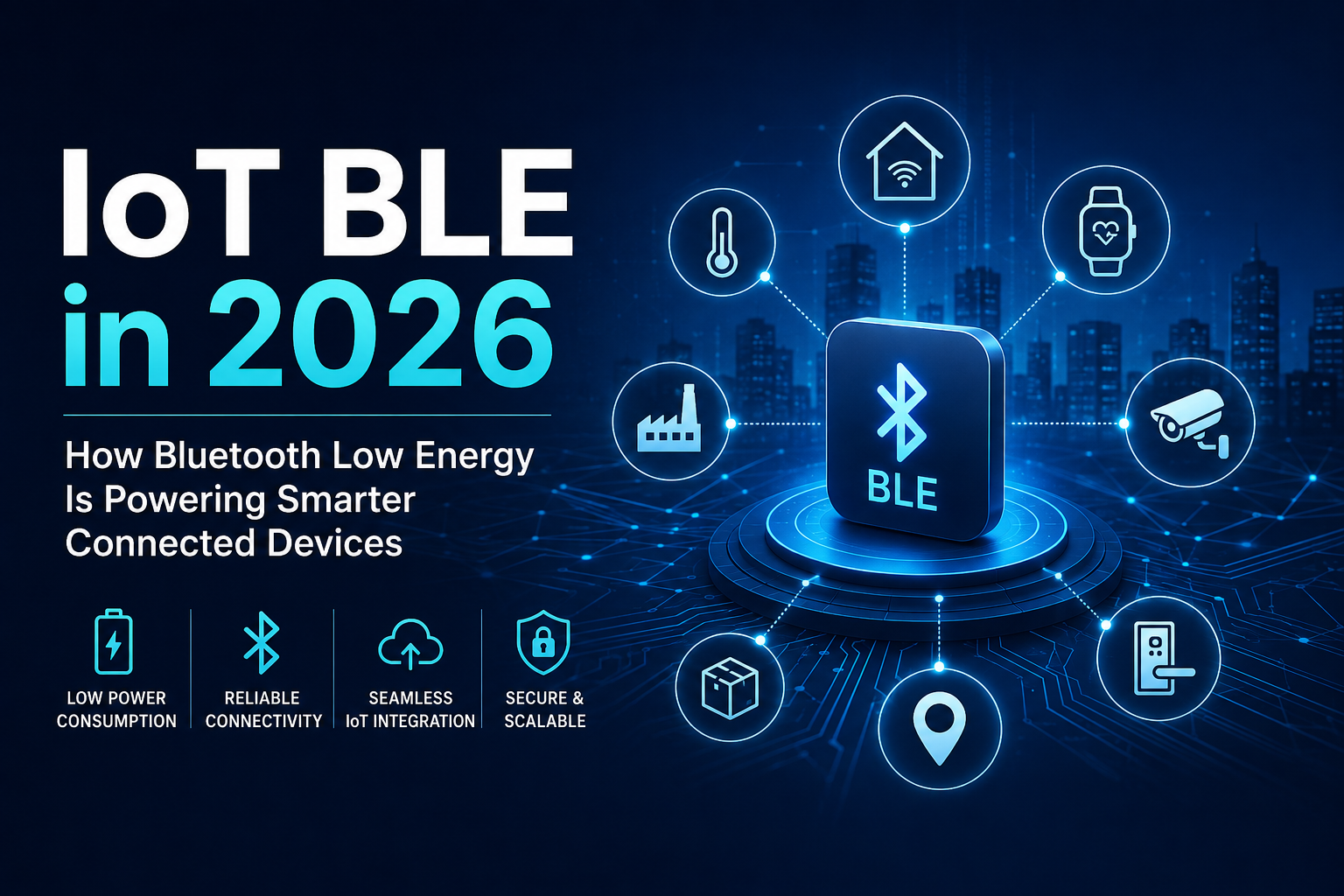
The Internet of Things (IoT) is rapidly changing how businesses and consumers interact with connected devices. From smart homes and healthcare equipment to industrial monitoring and retail solutions, organizations need reliable, secure, and energy-efficient connectivity.
One technology playing a major role in this transformation is Bluetooth Low Energy (BLE).
In 2026, BLE is no longer limited to simple wireless accessories. Combined with IoT platforms, cloud services, mobile applications, sensors, and edge computing, BLE is becoming an important building block for modern connected solutions.
What Is IoT BLE?
IoT BLE refers to the integration of Bluetooth Low Energy technology with Internet of Things devices and systems.
BLE enables sensors, machines, wearables, beacons, and other devices to communicate wirelessly while consuming relatively little power. IoT platforms can then collect, process, analyze, and visualize the data generated by these devices.
A typical IoT BLE ecosystem may include:
- BLE sensors
- Smartphones or tablets
- BLE gateways
- IoT cloud platforms
- Mobile applications
- Web dashboards
- Databases and analytics systems
- AI-powered monitoring and automation
This combination allows businesses to create connected solutions without depending on high-power wireless technologies for every device.
Why BLE Is Important for IoT in 2026
IoT deployments often involve hundreds or thousands of connected devices. Many of these devices operate on batteries and may need to work for months or years without frequent maintenance.
BLE offers several advantages for these environments.
1. Low Power Consumption
BLE was designed for low-energy communication. This makes it suitable for battery-powered sensors, wearable devices, asset trackers, and monitoring equipment.
Longer battery life can reduce maintenance requirements and operating costs for large IoT deployments.
2. Cost-Effective Connectivity
BLE hardware is widely available and can be integrated into many types of devices. This makes it practical for startups as well as enterprise IoT deployments.
3. Smartphone Compatibility
Modern smartphones and tablets generally support BLE, allowing mobile applications to communicate directly with compatible IoT devices.
This can eliminate the need for dedicated hardware in certain use cases.
4. Flexible IoT Architecture
BLE devices can communicate with smartphones, gateways, embedded systems, and other compatible infrastructure.
A BLE gateway can collect data from multiple nearby sensors and transfer that information to an IoT backend using Wi-Fi, Ethernet, cellular connectivity, or another network technology.
How an IoT BLE System Works
A basic IoT BLE architecture can be divided into several stages.
Step 1: Sensors Collect Data
BLE-enabled sensors measure information such as:
- Temperature
- Humidity
- Motion
- Location
- Pressure
- Proximity
- Equipment status
- Energy consumption
Step 2: BLE Transfers the Data
The sensor transmits information using Bluetooth Low Energy.
Depending on the application, the data may be received by a smartphone, tablet, embedded controller, or BLE gateway.
Step 3: Gateway or Mobile Device Processes Data
A gateway or mobile application can process the BLE data and forward relevant information to an IoT platform.
Step 4: Cloud Platform Stores and Analyzes Information
The IoT backend can store sensor information and provide dashboards, alerts, analytics, and automation.
Step 5: Businesses Take Action
Organizations can use the collected data to monitor assets, identify problems, automate processes, and make better operational decisions.
Major IoT BLE Applications
BLE and IoT are being used across a wide range of industries.
Smart Homes
BLE sensors can monitor temperature, motion, doors, windows, lighting, and other household conditions.
When integrated with an IoT platform, these sensors can contribute to automated smart-home experiences.
Healthcare and Wearables
BLE is widely used for connecting wearable and monitoring devices with smartphones and healthcare systems.
Applications can include fitness tracking, patient monitoring, medical device connectivity, and wellness platforms.
Industrial IoT
Factories can use BLE sensors to monitor equipment conditions, temperature, vibration, and asset movement.
Real-time data can help organizations identify maintenance requirements before equipment failures occur.
Retail
Retail businesses can use BLE beacons and sensors for proximity-based experiences, indoor navigation, customer engagement, and asset monitoring.
BLE can also help retailers understand movement patterns within physical locations.
Logistics and Asset Tracking
BLE tags can be attached to equipment, containers, inventory, or other valuable assets.
Gateways positioned throughout facilities can collect information from these tags and send it to centralized systems.
Smart Buildings
BLE-enabled sensors can support occupancy monitoring, environmental monitoring, access systems, and energy-management solutions.
BLE Beacons and IoT
BLE beacons are small wireless devices that periodically transmit signals that nearby compatible devices can detect.
When integrated into an IoT ecosystem, beacons can support:
- Indoor positioning
- Asset tracking
- Proximity marketing
- Navigation
- Location-based automation
- Employee and equipment tracking
- Smart-building applications
Beacons are particularly useful when businesses need location-aware IoT experiences.
BLE Mesh for Large IoT Deployments
Traditional BLE communication is generally designed around direct connections or broadcasts. Bluetooth Mesh can extend the possibilities for larger networks of connected devices.
Mesh networking allows compatible devices to participate in a network where information can move between nodes.
This can be useful for applications such as:
- Smart lighting
- Building automation
- Industrial monitoring
- Large sensor networks
- Commercial facilities
For organizations deploying many connected devices across large physical spaces, BLE Mesh can provide another architectural option.
IoT BLE and Edge Computing
Edge computing is becoming increasingly important as IoT deployments generate larger amounts of data.
Instead of sending every piece of sensor information directly to the cloud, edge devices can process some information locally.
For example, an industrial BLE gateway could analyze sensor readings locally and send only important events to the cloud.
This approach can help reduce:
- Network traffic
- Cloud processing requirements
- Response times
- Dependence on continuous cloud connectivity
Security Considerations for IoT BLE
Security should be considered from the beginning of an IoT BLE project.
Developers should pay attention to:
- BLE pairing and authentication
- Encryption
- Device identity
- Secure firmware updates
- Access control
- API security
- Cloud authentication
- Data protection
- Device lifecycle management
A secure IoT architecture should protect the device, communication layer, gateway, application, and backend infrastructure.
Challenges of IoT BLE Development
Despite its advantages, BLE IoT development can involve several technical challenges.
Device Compatibility
Different BLE devices may implement profiles and characteristics differently. Developers need to understand the hardware specifications and communication protocols involved.
Connection Management
Mobile and embedded applications need to properly handle scanning, pairing, connections, disconnections, reconnection attempts, and background behavior.
Large-Scale Deployment
A solution that works with ten devices may require a different architecture when deployed across thousands of devices.
Data Management
IoT systems can generate large amounts of sensor data. Businesses need an efficient approach to storing, processing, and analyzing this information.
Security
Security must be addressed across the complete ecosystem rather than only at the BLE communication layer.
The Future of IoT BLE
The combination of BLE, IoT, edge computing, cloud platforms, and AI is creating new opportunities for connected-device development.
Future IoT BLE solutions are likely to focus increasingly on:
- Intelligent automation
- Real-time monitoring
- Predictive maintenance
- Indoor positioning
- Smart healthcare
- Connected retail
- Industrial asset tracking
- Energy optimization
- AI-powered analytics
As organizations continue to digitize physical environments, BLE can provide an efficient connectivity layer between sensors and intelligent IoT applications.
Conclusion
IoT BLE is becoming an important technology for building connected, energy-efficient, and scalable solutions in 2026.
Its combination of low power consumption, smartphone compatibility, flexible connectivity, and broad hardware support makes BLE suitable for applications ranging from smart homes and wearables to industrial IoT, healthcare, retail, and asset tracking.
Businesses looking to develop connected products should consider BLE as part of a broader IoT architecture that includes secure device communication, gateways, cloud infrastructure, mobile applications, and intelligent data processing.
For companies planning a new IoT BLE solution, choosing the right architecture and development approach from the beginning can make the difference between a prototype and a scalable production-ready platform.
Leave a Reply