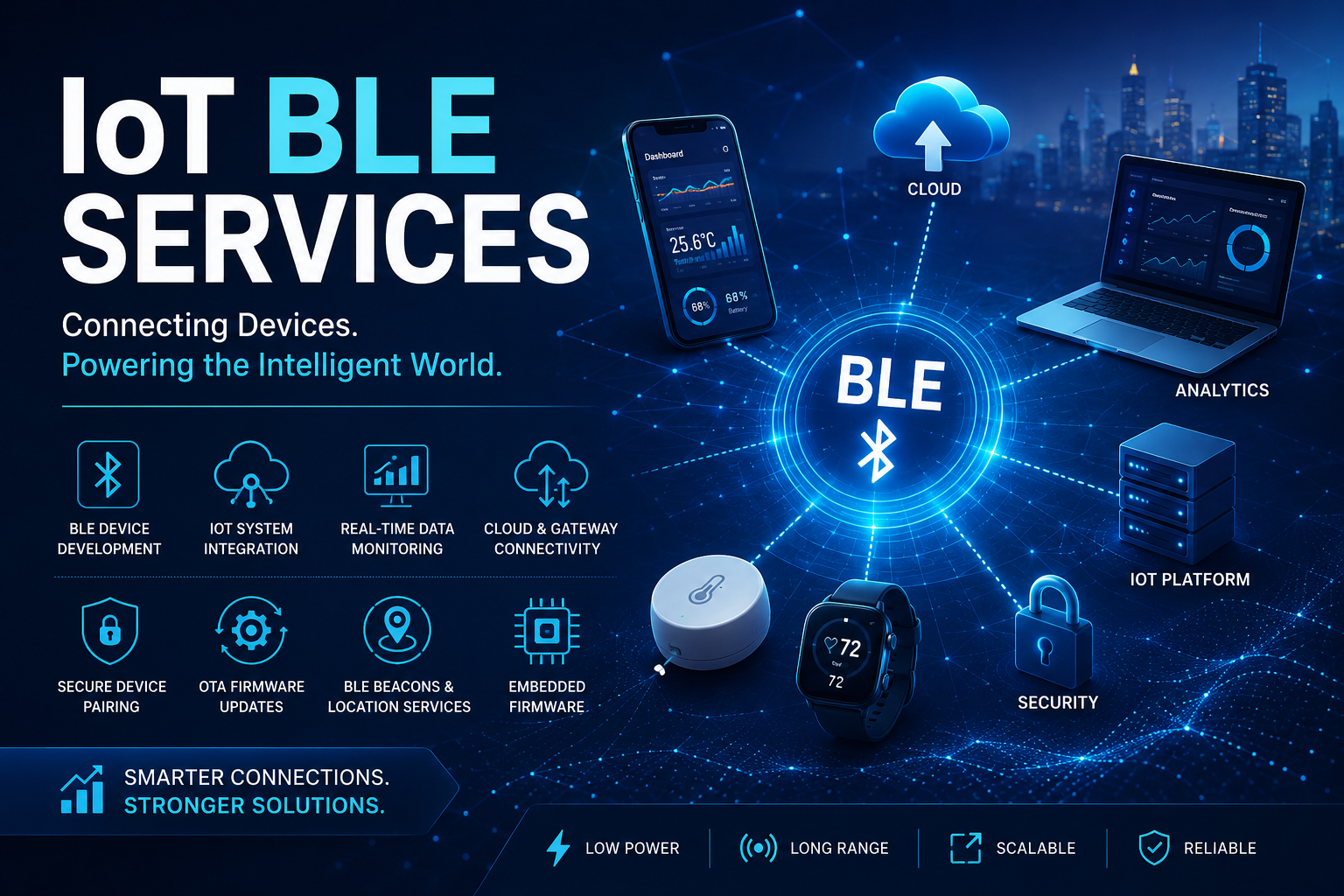
The Internet of Things is moving from simple connected devices to intelligent ecosystems that can collect data, communicate securely, and respond to real-time events. At the center of many of these connected experiences is Bluetooth Low Energy (BLE).
From smart sensors and wearables to industrial equipment, healthcare devices, asset trackers, and smart buildings, businesses are using BLE IoT solutions to connect physical devices with mobile applications, gateways, cloud platforms, and analytics systems.
But building a successful connected product requires more than simply adding Bluetooth connectivity.
A production-ready IoT ecosystem needs reliable BLE device development, IoT system integration, secure device pairing, embedded firmware, cloud connectivity, real-time data monitoring, and scalable device management.
This is where professional IoT BLE services become important.
What Are IoT BLE Services?
IoT BLE services are development and integration services that connect Bluetooth Low Energy devices with mobile applications, gateways, cloud platforms, and IoT systems.
A typical BLE IoT architecture can include:
BLE Device → Mobile App/Gateway → Internet → Cloud Platform → Database → Analytics → Business Application
BLE provides the low-power wireless communication layer, while IoT infrastructure manages connectivity, data processing, monitoring, automation, and cloud-based intelligence.
For businesses developing connected products, combining BLE with IoT can create secure, scalable, and energy-efficient connected experiences.
Why BLE Is Important for IoT
Bluetooth Low Energy was designed for applications that need wireless communication while keeping power consumption low.
This makes BLE particularly useful for battery-powered IoT devices.
Common BLE IoT applications include:
- Wearable devices
- Fitness trackers
- Medical devices
- Smart sensors
- Asset tracking systems
- Industrial monitoring
- Smart locks
- Smart home devices
- Retail technology
- Location and proximity systems
- EV charging solutions
- Connected equipment
- Environmental monitoring
A BLE device can collect information from sensors and communicate with a smartphone, tablet, gateway, or other connected system.
The data can then be processed and stored in an IoT cloud environment.
How BLE IoT Architecture Works
A modern BLE IoT solution typically consists of several interconnected layers.
1. BLE Device
The physical device contains sensors, a BLE chipset, firmware, and other hardware components.
Depending on the application, it may measure:
- Temperature
- Humidity
- Motion
- Pressure
- Location
- Heart rate
- Equipment status
- Battery level
- Environmental conditions
2. BLE Communication
The device communicates using Bluetooth Low Energy.
BLE supports both peripheral and central roles.
A BLE peripheral generally advertises its presence and provides services that another device can connect to.
A central device, such as a smartphone or gateway, can scan for BLE peripherals and establish communication.
3. Mobile Application
A mobile application can act as the communication bridge between the BLE device and the cloud.
For example:
BLE Sensor → iOS/Android App → Cloud API
Mobile BLE development commonly involves technologies such as iOS CoreBluetooth and Android Bluetooth APIs.
4. IoT Gateway
In some deployments, a dedicated IoT gateway collects data from multiple BLE devices and forwards it to the cloud.
This architecture is particularly useful for industrial, commercial, and large-scale deployments.
5. Cloud Platform
The cloud provides infrastructure for:
- Data storage
- Device management
- Authentication
- Analytics
- Monitoring
- API integration
- Automation
- Remote management
BLE IoT solutions can be integrated with platforms such as:
- AWS IoT
- Microsoft Azure IoT
- Google Cloud
6. Analytics and Applications
The final layer turns connected-device data into useful business information.
Organizations can use dashboards and analytics systems to monitor devices, identify patterns, generate alerts, and automate business processes.
BLE Device Development for IoT Products
Successful BLE IoT products start with reliable device development.
BLE device development can involve:
- BLE peripheral implementation
- BLE central implementation
- GATT service development
- GATT characteristic design
- Advertising configuration
- Connection management
- Power optimization
- Security implementation
- Firmware development
- Device provisioning
- OTA firmware updates
- Hardware and software testing
The BLE architecture should be designed around the actual product requirements.
A wearable device, for example, may prioritize extremely low power consumption.
An industrial sensor may prioritize range, reliability, data availability, and long-term field operation.
Custom GATT Services
Generic Attribute Profile, commonly known as GATT, defines how BLE devices expose services and characteristics.
For custom IoT products, developers can create custom GATT services based on the application’s data model.
For example, an industrial sensor might expose characteristics for:
- Temperature
- Pressure
- Device status
- Battery level
- Error codes
- Configuration settings
A mobile application or gateway can then read, write, subscribe to, or monitor these characteristics.
Proper GATT architecture is important because a poorly designed data model can create unnecessary complexity as the product scales.
BLE Device Pairing and Provisioning
Device onboarding is another critical component of a BLE IoT solution.
A typical onboarding process may include:
Device Discovery → Authentication → Pairing → Configuration → Cloud Registration → Device Activation
Secure provisioning helps associate a physical device with a particular customer, account, location, or IoT environment.
For enterprise deployments, device identity and authentication should be carefully designed from the beginning.
OTA Firmware Updates
Connected devices may remain in the field for years.
Updating firmware manually can be expensive and difficult, especially when thousands of devices are deployed across different locations.
Over-the-air firmware updates, or OTA updates, allow manufacturers to update device software remotely.
A robust OTA system should consider:
- Secure firmware packages
- Version management
- Update validation
- Interrupted connections
- Rollback mechanisms
- Battery limitations
- Device authentication
OTA capability can significantly improve long-term device maintainability.
Smart Sensor Networks
One of the strongest use cases for BLE IoT is the development of smart sensor networks.
Instead of collecting information manually, organizations can deploy connected sensors that continuously monitor physical environments.
For example:
Sensors → BLE → Gateway → Cloud → Dashboard → Alert
A smart sensor network can support applications such as:
- Equipment monitoring
- Environmental monitoring
- Warehouse monitoring
- Industrial automation
- Asset tracking
- Smart buildings
- Healthcare monitoring
Real-time data can help organizations make faster operational decisions.
Gateway and Cloud Connectivity
BLE works well for short-range communication, but many IoT applications require data to travel beyond the local BLE environment.
This is where gateway and cloud connectivity becomes important.
A gateway can communicate with nearby BLE devices and then send information to a cloud platform through Wi-Fi, Ethernet, cellular connectivity, or another network technology.
This creates an architecture such as:
BLE Devices → IoT Gateway → Cloud → API → Business Application
This approach allows organizations to manage large numbers of devices without requiring every BLE device to have direct internet connectivity.
Real-Time Data Monitoring
IoT becomes valuable when device data can be converted into actionable information.
Real-time data monitoring allows businesses to see the current state of connected devices.
A monitoring dashboard might display:
- Device connectivity
- Battery status
- Sensor readings
- Temperature
- Location
- Equipment status
- Alerts
- Historical trends
For example, if a sensor detects an abnormal temperature, the IoT platform could trigger an alert before the situation becomes a major operational problem.
BLE Beacons and Location-Aware IoT
BLE beacon technologies can also support proximity and location-aware applications.
Beacon-based systems can be used for:
- Indoor positioning
- Asset discovery
- Proximity notifications
- Retail experiences
- Visitor management
- Smart building applications
- Location-aware mobile applications
Beacon technologies such as iBeacon and Eddystone can become part of a larger BLE and IoT ecosystem.
BLE + IoT + AI
The next evolution of connected systems is the combination of BLE, IoT, cloud computing, and artificial intelligence.
A connected architecture could look like:
BLE Sensors
↓
IoT Gateway
↓
Cloud Platform
↓
Real-Time Data
↓
AI/ML Processing
↓
Prediction or Decision
↓
Automated Action
For example, sensors installed on industrial equipment could continuously collect operational data.
An AI system could analyze that information and identify unusual patterns.
The system could then notify an operator or trigger an automated workflow.
This moves IoT from simple monitoring toward intelligent automation.
IoT BLE Solutions Across Industries
IoT BLE technology can be applied across many industries.
Healthcare
BLE-enabled medical and healthcare devices can communicate with mobile applications and cloud platforms to support remote monitoring and connected healthcare experiences.
Manufacturing
Industrial sensors can monitor machinery, environmental conditions, equipment performance, and operational parameters.
Retail
BLE beacons and connected devices can support proximity experiences, asset tracking, inventory systems, and customer engagement.
Logistics
BLE trackers and sensors can provide information about assets, shipments, storage conditions, and equipment.
Fitness and Wearables
BLE provides an efficient communication layer for fitness trackers, smart devices, health sensors, and wearable applications.
Smart Buildings
Connected sensors can monitor temperature, occupancy, environmental conditions, equipment, and energy-related information.
What Makes a Scalable BLE IoT Solution?
Building a prototype is different from building an enterprise-ready IoT ecosystem.
A scalable solution should consider:
Security
Device authentication, encryption, secure pairing, access control, and secure cloud communication should be part of the architecture.
Reliability
Connected devices must continue operating under real-world conditions, including unstable connectivity and varying environmental conditions.
Power Efficiency
Battery-powered BLE devices require careful optimization of advertising intervals, connection parameters, data transmission, and firmware behavior.
Scalability
The architecture should support growth from a few prototype devices to potentially thousands or millions of connected devices.
Data Management
IoT systems generate significant amounts of data. Data storage, processing, retention, and analytics should be planned early.
Device Management
Organizations need tools to monitor, configure, update, and troubleshoot connected devices throughout their lifecycle.
Why Choose Custom IoT Solutions?
Every connected product has different requirements.
An off-the-shelf solution may work for simple applications, but complex products often require custom development.
A custom IoT solution can integrate:
- BLE hardware
- Embedded firmware
- Mobile applications
- Web applications
- IoT gateways
- Cloud platforms
- APIs
- Databases
- Analytics
- AI/ML
- Device management
This creates a complete technology ecosystem around the business requirement rather than forcing the product into a predefined platform.
How QuartusTech Supports BLE and IoT Development
QuartusTech provides end-to-end IoT BLE services, covering connected-device development, BLE integration, mobile applications, cloud connectivity, IoT integration, and real-time data systems.
Its BLE and IoT capabilities include:
- BLE peripheral and central development
- Custom GATT services
- BLE device provisioning and pairing
- OTA firmware updates
- BLE beacon technologies
- Embedded firmware integration
- iOS CoreBluetooth development
- Android Bluetooth API integration
- AWS IoT integration
- Azure IoT integration
- Google Cloud integration
- IoT gateway development
- Real-time data monitoring
- Custom IoT solutions
This end-to-end approach allows businesses to connect devices, applications, cloud platforms, and data into a unified IoT ecosystem.
Frequently Asked Questions About IoT BLE Services
What are IoT BLE services?
IoT BLE services are development and integration services that connect Bluetooth Low Energy devices with mobile applications, gateways, cloud platforms, and IoT systems.
Is BLE suitable for IoT?
Yes. BLE is particularly useful for battery-powered IoT devices because it provides low-power wireless communication and can connect sensors and devices with smartphones, gateways, and other systems.
What is BLE IoT integration?
BLE IoT integration connects BLE-enabled devices with an IoT ecosystem that may include mobile applications, gateways, cloud platforms, APIs, databases, dashboards, and analytics.
Can BLE devices connect to AWS IoT?
Yes. BLE devices can communicate with gateways or mobile applications that forward data to AWS IoT and other cloud-based IoT platforms.
What is BLE device provisioning?
BLE device provisioning is the process of securely onboarding and configuring a BLE device so it can communicate with an application, gateway, or cloud environment.
Why are OTA firmware updates important?
OTA firmware updates allow manufacturers to update connected devices remotely without physically accessing each device, making large IoT deployments easier to maintain.
What industries use BLE IoT solutions?
BLE IoT solutions are used across healthcare, manufacturing, logistics, retail, fitness, smart buildings, automotive, industrial monitoring, asset tracking, and connected consumer products.
The Future of BLE and IoT
The future of connected technology is moving toward systems where devices don’t simply communicate—they continuously generate data, understand their environment, and participate in intelligent workflows.
The combination of:
BLE + IoT + Cloud + Mobile + AI + Analytics
can create connected ecosystems capable of real-time monitoring, predictive insights, automation, and smarter decision-making.
For companies building connected products in 2026 and beyond, the right BLE and IoT architecture can become a significant competitive advantage.
Build Your Next BLE IoT Solution
Whether you are developing a wearable, medical device, industrial sensor, smart lock, fitness tracker, asset tracker, EV charger, or enterprise IoT platform, the technology needs to work as one connected ecosystem.
From BLE device development and embedded firmware to mobile apps, IoT gateways, cloud integration, OTA updates, and real-time monitoring, every layer needs to work together.
QuartusTech can help businesses design and develop scalable IoT BLE solutions tailored to their product and business requirements.
Ready to build your connected product?
Explore professional IoT BLE services and turn your connected-device idea into a scalable IoT solution.
Leave a Reply