The Internet of Things is changing how businesses interact with physical products, equipment, machines, and environments.
Connected devices can now collect information, communicate with other systems, send data to the cloud, and trigger automated actions with minimal human intervention.
But building a successful IoT product involves much more than connecting a sensor to the internet.
A complete IoT product development strategy may involve hardware, embedded software, connectivity, mobile applications, cloud infrastructure, APIs, data analytics, cybersecurity, and artificial intelligence.
For businesses planning a connected product in 2026, understanding how these technologies work together is essential.
What Is IoT Product Development?
IoT product development is the process of creating connected physical products that can collect, transmit, process, and use data.
An IoT product can include several interconnected components:
- Sensors
- Microcontrollers
- Embedded systems
- Wireless connectivity
- Gateways
- Mobile applications
- Cloud platforms
- APIs
- Web dashboards
- Data analytics
- AI and automation
For example, a smart industrial sensor can collect machine information, send it to an IoT gateway, transmit the data to the cloud, and display equipment conditions through a web dashboard.
The system can also generate an alert when a specific condition is detected.
How Does an IoT System Work?
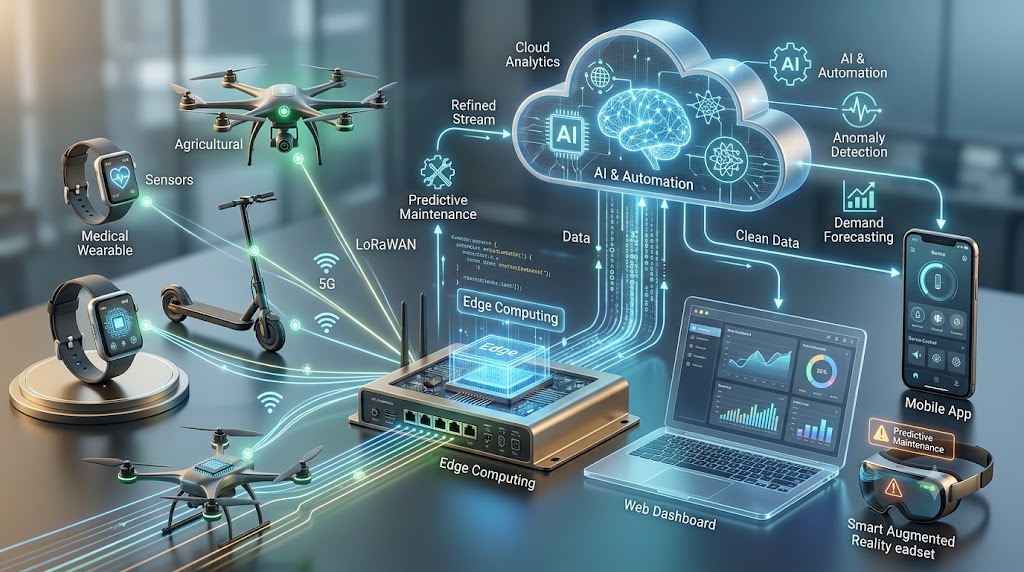
A typical IoT architecture can be represented as:
Physical Device → Sensors → Connectivity → Gateway/Network → Cloud → Analytics → Application
Each layer performs a different function.
1. Sensors and Devices
Sensors collect information from the physical environment.
Depending on the product, they may measure:
- Temperature
- Humidity
- Motion
- Pressure
- Location
- Light
- Vibration
- Proximity
- Battery level
- Equipment status
The selected sensors depend on what the IoT product needs to monitor.
2. Embedded Software
Embedded software controls the device and determines how it interacts with sensors and communication modules.
Firmware can manage:
- Sensor readings
- Data processing
- Device states
- Power consumption
- Connectivity
- Device configuration
- Security
- Firmware updates
Efficient firmware is particularly important for battery-powered IoT products.
3. Connectivity
IoT products can use different connectivity technologies depending on their environment and requirements.
Common options include:
- Wi-Fi
- Bluetooth Low Energy
- Cellular
- Zigbee
- Thread
- LoRaWAN
- Ethernet
- NFC
The right technology depends on factors such as range, power consumption, bandwidth, network availability, device density, and deployment environment.
Edge Computing in IoT
Not every piece of IoT data needs to be sent directly to the cloud.
Edge computing allows some data processing to happen closer to the device.
For example, an industrial IoT system may analyze sensor readings locally and send only important events to the cloud.
This can provide advantages such as:
- Lower latency
- Reduced bandwidth usage
- Faster local responses
- Better resilience when connectivity is interrupted
- More efficient data processing
Edge and cloud computing can therefore work together rather than being treated as competing approaches.
The Role of IoT Gateways
An IoT gateway acts as an intermediary between connected devices and cloud infrastructure.
A gateway can:
- Collect data from multiple devices
- Translate between communication protocols
- Perform local processing
- Authenticate devices
- Filter data
- Forward information to cloud services
Gateways can be particularly useful when numerous sensors need to communicate with a centralized platform.
For example:
BLE Sensors → IoT Gateway → Cloud Platform → Business Dashboard
This architecture can allow many low-power devices to communicate without requiring every individual sensor to have direct internet connectivity.
IoT Cloud Platforms
The cloud provides the infrastructure required to manage and process large amounts of device data.
An IoT cloud platform can support:
- Device registration
- Device monitoring
- Data storage
- API management
- User management
- Analytics
- Alerts
- Remote configuration
- Device lifecycle management
Cloud architecture should be designed according to the expected number of devices and the volume and frequency of data being generated.
IoT Mobile Applications
Mobile applications can become an important interface between users and connected products.
An IoT mobile application can allow users to:
- Configure devices
- View sensor information
- Receive alerts
- Monitor equipment
- Control connected devices
- Manage accounts
- Review historical data
- Update settings
For consumer products, the mobile app may be the primary user interface.
For industrial applications, it may provide field technicians with real-time equipment information.
IoT Web Dashboards
A web dashboard can provide organizations with centralized visibility into their connected-device ecosystem.
A dashboard might display:
- Total connected devices
- Online and offline devices
- Sensor readings
- Device locations
- Battery levels
- Alerts
- Historical trends
- Equipment performance
- Maintenance information
Instead of reviewing individual devices manually, users can access data from a centralized interface.
IoT and Artificial Intelligence
IoT produces data.
AI can help businesses extract useful information from that data.
This creates opportunities for AI-powered IoT solutions.
Predictive Maintenance
Machine sensor data can be analyzed to identify patterns associated with equipment problems.
Businesses can use these insights to investigate potential maintenance issues before equipment failure occurs.
Anomaly Detection
AI systems can identify unusual patterns in sensor data.
For example, an unexpected temperature, vibration, or pressure pattern could trigger an alert.
Demand Forecasting
IoT data combined with historical information can support forecasting for inventory, energy usage, production, or other business processes.
Intelligent Automation
IoT systems can trigger automated actions based on real-time information.
For example:
Sensor detects condition → IoT platform processes data → Rule/AI model evaluates event → System triggers action
This creates a more intelligent connected environment.
IoT Use Cases Across Industries
IoT product development is not limited to smart-home devices.
Industrial IoT
Manufacturers can use connected sensors to monitor machines, production environments, and equipment.
Applications include:
- Machine monitoring
- Predictive maintenance
- Production analytics
- Equipment tracking
- Energy monitoring
Smart Buildings
IoT systems can monitor building environments and connected infrastructure.
Potential applications include:
- Temperature monitoring
- Occupancy detection
- Energy management
- Lighting automation
- Equipment monitoring
- Environmental monitoring
Healthcare
Connected healthcare devices can collect information and provide data to authorized applications and systems.
Potential applications include:
- Remote monitoring
- Wearable devices
- Medical equipment monitoring
- Patient-support systems
- Connected health products
Healthcare IoT projects require particularly careful consideration of privacy, security, regulatory requirements, and data handling.
Logistics
IoT can help organizations monitor assets, vehicles, shipments, and environmental conditions.
Applications may include:
- Fleet monitoring
- Asset tracking
- Shipment monitoring
- Temperature monitoring
- Location tracking
Agriculture
Connected sensors can monitor environmental conditions and help farmers understand field conditions.
Potential applications include:
- Soil monitoring
- Weather data
- Irrigation management
- Equipment monitoring
- Crop-condition analysis
Retail
Retail businesses can use IoT to connect physical stores with digital systems.
Examples include:
- Inventory monitoring
- Smart shelves
- Asset tracking
- Customer experience systems
- Environmental monitoring
IoT Development Challenges
Building an IoT product requires solving several technical challenges.
Hardware Selection
The hardware must match the product’s operating environment and technical requirements.
Factors may include:
- Sensor accuracy
- Battery life
- Processing requirements
- Connectivity
- Physical size
- Environmental conditions
- Production cost
Connectivity Reliability
IoT devices may operate in locations with unstable connectivity.
The system should therefore consider what happens when the connection is temporarily unavailable.
Depending on the application, devices may need local storage, retry mechanisms, or edge processing.
Battery Optimization
Battery-powered products require careful power management.
Developers may optimize:
- Sensor sampling
- Communication intervals
- Sleep modes
- Data transmission
- Firmware operations
The goal is to provide the required functionality while minimizing unnecessary energy consumption.
Data Management
Large IoT deployments can generate substantial amounts of data.
The architecture should define:
- What data needs to be collected
- How frequently it should be collected
- Where it should be stored
- How long it should be retained
- Which data needs real-time processing
Collecting unnecessary data can increase infrastructure costs without providing additional business value.
IoT Security
Security should be designed into the IoT ecosystem from the beginning.
An IoT security strategy can include:
Device Authentication
Devices should be securely identified before communicating with the platform.
Encrypted Communication
Sensitive data should be protected while moving between devices, gateways, applications, and cloud services.
Secure Firmware Updates
Connected products may require remote firmware updates throughout their lifecycle.
Update mechanisms should be designed to prevent unauthorized software from being installed.
API Security
Cloud APIs should use appropriate authentication, authorization, rate limiting, and monitoring mechanisms.
Access Control
Different users should receive access according to their roles and responsibilities.
Device Lifecycle Management
Security should continue throughout the device lifecycle, including provisioning, operation, updates, replacement, and retirement.
IoT Product Development Process
A structured development process can help reduce technical and business risks.
Step 1: Define the Business Problem
Before selecting technologies, identify the actual problem the IoT product needs to solve.
Ask:
- What needs to be monitored?
- Who will use the system?
- What data is required?
- How frequently should data be collected?
- What action should happen after an event?
Step 2: Build a Proof of Concept
A proof of concept can help validate the basic technology.
For example, developers may test:
- Sensor communication
- Connectivity
- Data collection
- Gateway communication
- Cloud integration
Step 3: Design the IoT Architecture
The complete architecture can then be planned across:
- Hardware
- Firmware
- Connectivity
- Gateway
- Cloud
- APIs
- Mobile applications
- Web dashboards
- Security
Step 4: Develop the MVP
An IoT MVP should focus on the core functionality required to validate the product.
It does not necessarily need every feature planned for the final product.
Step 5: Test in Real Environments
IoT products should be tested in conditions similar to their actual deployment environment.
Testing can cover:
- Connectivity
- Battery life
- Hardware reliability
- Data accuracy
- Security
- Performance
- Environmental conditions
Step 6: Scale the Platform
After validation, the system can be prepared for larger deployments.
This may require improvements to:
- Cloud infrastructure
- Database architecture
- Device management
- Monitoring
- APIs
- Data processing
How to Choose an IoT Development Company
Choosing the right development partner is important because IoT projects often require expertise across multiple technology layers.
Businesses should evaluate:
IoT Experience
Look for experience developing connected products rather than only conventional web applications.
Hardware and Firmware Capabilities
If the project includes physical devices, understand whether the development team can work with embedded systems and hardware integration.
Connectivity Expertise
The team should understand the communication technology required by the project.
Cloud Development
IoT platforms need reliable backend and cloud infrastructure.
Mobile and Web Development
If users need applications or dashboards, these capabilities should also be considered.
Security
Ask how device, network, application, and cloud security will be addressed.
Post-Launch Support
Connected products often require firmware updates, cloud improvements, monitoring, and ongoing maintenance.
The Future of IoT Development
IoT is moving from simple device connectivity toward intelligent connected ecosystems.
The combination of IoT, edge computing, cloud platforms, AI, and automation can create systems capable of collecting information, interpreting events, and responding automatically.
Future IoT products may increasingly use:
- AI-powered analytics
- Edge AI
- Digital twins
- Real-time monitoring
- Autonomous automation
- Advanced asset tracking
- Connected industrial systems
- Smart infrastructure
The important shift is from simply asking whether a device is connected to asking what useful action can be taken from the data it produces.
Conclusion
Successful IoT product development requires a complete view of the technology ecosystem.
Hardware, firmware, connectivity, gateways, cloud platforms, applications, analytics, security, and device management all need to work together.
Businesses developing connected products should begin with a clear use case and then select the architecture and technologies that support that goal.
Whether the product is an industrial sensor, smart building solution, connected healthcare device, asset tracker, agricultural monitoring system, or consumer IoT product, careful planning can create a foundation for reliable and scalable deployment.
Build Your IoT Product With IoTBLE
IoTBLE helps businesses explore connected-product development across IoT, BLE, embedded systems, mobile applications, cloud platforms, gateways, dashboards, and intelligent data solutions.
If you are planning an IoT product or need to connect existing hardware with software and cloud infrastructure, a well-designed IoT architecture can turn device data into a practical business solution.
Leave a Reply