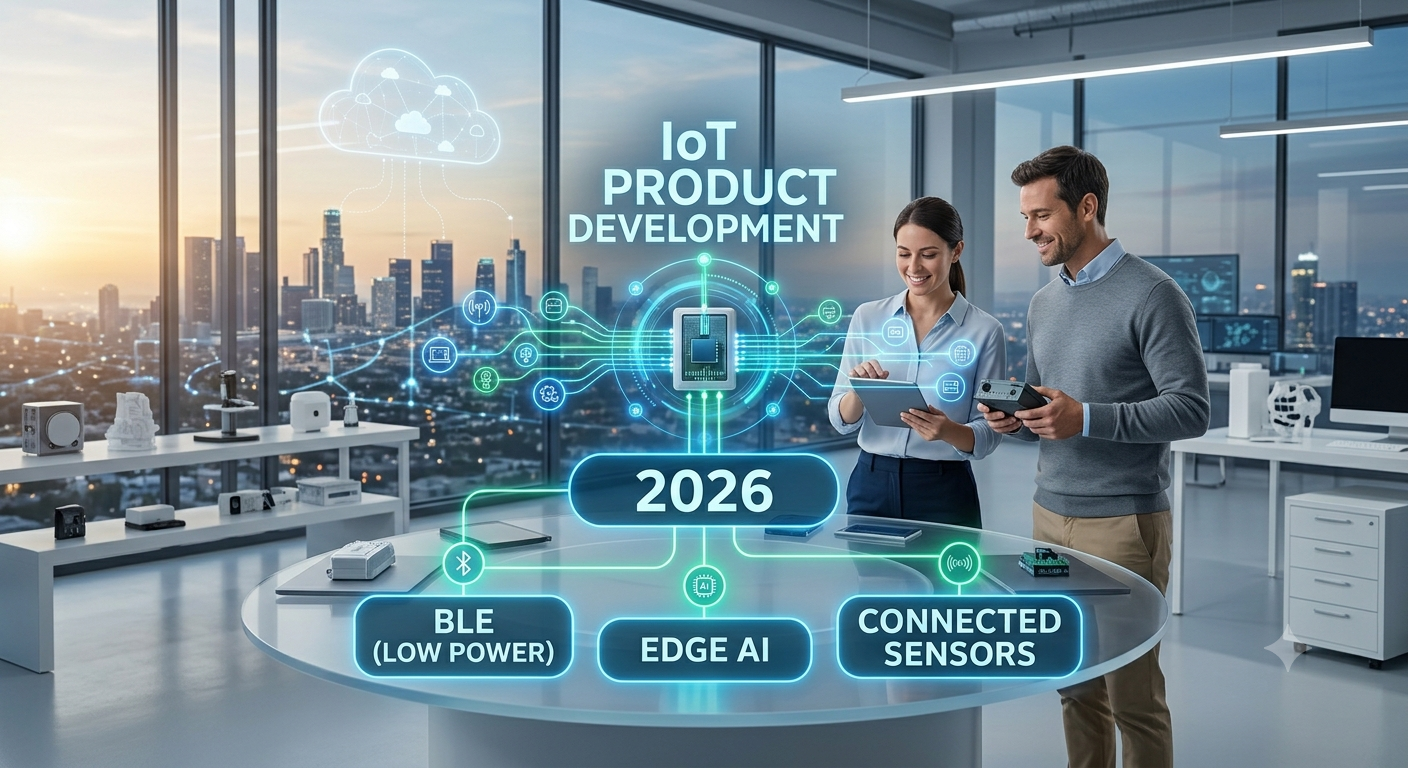
SEO Title: Smart IoT Product Development in 2026: BLE, AI & Connected Devices
Meta Description: Discover how IoT and Bluetooth Low Energy development help businesses build smart connected products with real-time monitoring, automation, and efficient data management.
Suggested URL Slug: /smart-iot-product-development-2026/
Primary Keyword: IoT product development
Secondary Keywords: IoT development services, BLE IoT solutions, Bluetooth Low Energy development, connected device development, IoT sensor integration, smart device development, industrial IoT solutions, IoT application development
Introduction
Connected technology is changing how businesses design products, monitor operations, and deliver customer experiences. From smart home devices and wearable technology to industrial sensors and asset-tracking systems, the Internet of Things (IoT) is helping organizations connect physical products with digital platforms.
In 2026, businesses are looking beyond basic device connectivity. They want connected products that collect useful data, communicate efficiently, automate routine tasks, and support smarter decisions. Technologies such as Bluetooth Low Energy (BLE), edge computing, cloud platforms, and artificial intelligence (AI) are helping make these solutions possible.
For companies planning a new connected product, choosing the right IoT architecture is essential. The right combination of sensors, firmware, wireless communication, mobile applications, and backend infrastructure can help create a product that is reliable, scalable, and ready for future improvements.
What Is IoT Product Development?
IoT product development is the process of designing and building connected devices that collect, transmit, process, and use data. An IoT solution typically combines hardware, embedded software, wireless connectivity, applications, and cloud-based services.
A typical IoT ecosystem includes:
- Sensors and connected hardware: Collect environmental, operational, or device information.
- Embedded firmware: Controls device behavior and manages communication.
- BLE or other wireless protocols: Transfer data between devices, smartphones, gateways, or networks.
- Mobile and web applications: Allow users to configure devices and monitor information.
- Cloud platforms and APIs: Store, process, and exchange data across systems.
- Analytics and AI: Identify patterns, generate alerts, and support automation.
A successful IoT development strategy connects these components into a complete system rather than treating the device as an isolated product.
Why Bluetooth Low Energy Is Important for IoT Solutions
Bluetooth Low Energy is widely used in connected products that need short-range wireless communication with limited power consumption. It is particularly useful for battery-operated sensors, wearables, proximity devices, and products that communicate with smartphones or nearby gateways.
1. Lower Power Consumption
Many IoT products operate in locations where frequent battery replacement is inconvenient or expensive. BLE supports low-power communication patterns that can help reduce energy consumption when devices are designed with appropriate advertising intervals, connection settings, and sleep modes.
This makes BLE a practical option for applications such as environmental sensors, wearable devices, equipment monitors, and smart tags.
2. Smartphone Connectivity
BLE allows compatible connected devices to communicate directly with smartphones and tablets. This can simplify device setup, configuration, diagnostics, and data access without requiring a dedicated display or complex user interface on the hardware.
For example, a manufacturer can build a BLE-enabled sensor that sends readings to a mobile application, where users can view measurements and configure device settings.
3. Flexible Device Integration
BLE can connect sensors, controllers, gateways, and applications within a larger IoT architecture. Depending on the product requirements, the mobile device or gateway can forward collected information to a cloud platform for remote access and analysis.
4. New Opportunities for Location and Sensing
BLE-based solutions can support proximity detection, asset visibility, and indoor location applications. Bluetooth direction-finding capabilities and newer distance-measurement features can support more advanced use cases when compatible hardware and suitable deployment conditions are available.
Actual range, location accuracy, and battery life depend on the hardware, environment, radio design, and software configuration.
Top IoT Development Trends Businesses Should Watch in 2026
1. Edge AI for Faster Decisions
Traditional IoT systems often send collected data to the cloud for processing. Edge computing allows some processing to happen directly on a device, gateway, or nearby computer.
When combined with suitable AI models, edge processing can help identify unusual equipment behavior, classify sensor readings, and trigger responses without sending every raw measurement to the cloud.
Business benefit: Faster responses, reduced unnecessary data transmission, and improved operation in environments with intermittent internet access.
2. Predictive Maintenance With Connected Sensors
Unexpected equipment failures can interrupt production and increase maintenance costs. IoT sensors can monitor parameters such as temperature, vibration, pressure, and operating hours.
Analytics systems can use these measurements to identify unusual patterns and help maintenance teams investigate potential problems before a breakdown occurs.
Predictive maintenance is not a guarantee that every failure will be detected. Its effectiveness depends on sensor quality, data availability, equipment conditions, and model validation.
3. Smart Asset Tracking
Businesses managing tools, inventory, equipment, or reusable containers need better visibility into where assets are located and how they are being used.
BLE beacons and tags can transmit identification or sensor data to compatible receivers. Gateways and software platforms can then organize that information into searchable dashboards and alerts.
Potential applications include:
- Warehouse inventory visibility
- Equipment and tool tracking
- Retail inventory monitoring
- Hospital equipment management
- Logistics and supply-chain monitoring
4. Connected Healthcare and Wearables
IoT technology supports connected healthcare products that collect activity, environmental, or device-status information. BLE can help wearable devices and medical-adjacent products communicate with smartphones or dedicated gateways.
Products intended for clinical use may also require specialized validation, privacy protections, regulatory compliance, and careful handling of health-related data.
5. Smart Buildings and Energy Management
Connected occupancy, temperature, lighting, and environmental sensors can help building operators understand how spaces are being used.
When connected to suitable control systems, this information can support automated lighting, more informed energy management, and maintenance alerts. BLE can be useful for sensor connectivity and retrofit projects where minimizing new wiring is important.
6. Low-Maintenance and Ambient IoT Devices
Ambient IoT explores devices that obtain some or all of their operating energy from environmental sources, such as light, motion, or radio-frequency energy.
This approach could enable new types of smart labels and low-maintenance sensors. However, battery-free operation is not suitable for every use case; available energy, transmission frequency, processing needs, and deployment conditions must be evaluated carefully.
How to Choose the Right Connectivity for an IoT Product
BLE is powerful, but it is not the right choice for every connected device. The communication technology should match the product’s range, data volume, power budget, and network requirements.
| Technology | Best suited for | Main consideration |
|---|---|---|
| Bluetooth Low Energy | Wearables, sensors, smartphone-connected products | Short-range communication and low power |
| Wi-Fi | Connected appliances, cameras, higher-bandwidth devices | Higher power requirements and network availability |
| Thread | Compatible smart-home devices and mesh networks | Requires a suitable Thread ecosystem |
| LoRaWAN | Long-range, low-data-rate sensor networks | Low throughput and gateway/network planning |
| Cellular IoT | Remote devices requiring wide-area connectivity | Coverage, subscription costs, and power budget |
Some products combine multiple technologies. For example, a BLE sensor may communicate with a gateway that uses Wi-Fi or cellular connectivity to send data to a cloud platform.
The best architecture depends on real-world operating conditions—not simply on which protocol is most popular.
Key Challenges in IoT Product Development
Building a working prototype is only one part of launching a successful connected product. Businesses must also consider reliability, security, integration, and long-term support.
Device Security and Data Privacy
IoT products should use appropriate authentication, encrypted communication where supported, secure key management, and controlled access to device settings and data.
Security must be considered across the complete system, including firmware, mobile applications, APIs, gateways, and cloud infrastructure.
Battery-Life Optimization
Battery performance depends on more than the wireless protocol. Firmware efficiency, sensor sampling frequency, radio activity, processor usage, battery chemistry, and environmental conditions all affect actual runtime.
Developers should measure power consumption on representative hardware under realistic operating conditions.
Cross-Platform Compatibility
When a product connects to Android and iOS applications, teams must account for operating-system differences, background communication restrictions, permissions, pairing behavior, and reconnection scenarios.
Testing across supported devices and operating-system versions helps reduce connectivity problems after launch.
Scalability and Integration
An IoT solution may begin with a small prototype but eventually need to support thousands of devices. The architecture should consider device provisioning, firmware updates, monitoring, API performance, data retention, and cloud costs from the beginning.
A Practical IoT Product Development Process
A structured development process helps businesses reduce technical risk and make informed investment decisions.
Step 1: Define the use case. Identify the problem, intended users, operating environment, and measurable business outcomes.
Step 2: Select the hardware and connectivity. Evaluate sensors, microcontrollers, BLE modules, gateways, power requirements, and communication range.
Step 3: Develop firmware and device logic. Implement sensing, data handling, connectivity, error recovery, and power management.
Step 4: Build the application and backend. Create the mobile or web interface, APIs, device management tools, and cloud infrastructure where required.
Step 5: Test the complete system. Validate connectivity, battery performance, security, reliability, usability, and operation under expected environmental conditions.
Step 6: Prepare for deployment and maintenance. Plan secure provisioning, monitoring, firmware updates, troubleshooting, and future feature releases.
How IoTBLE Development Services Can Help
Businesses developing connected products often need expertise across several technical disciplines. IoT and BLE development can involve embedded firmware, wireless communication, mobile application development, cloud integration, APIs, and data analytics.
A capable development partner can help define requirements, evaluate connectivity options, build prototypes, integrate software components, and test the product before deployment.
For companies developing a new smart device or upgrading an existing product, a well-planned IoT product development strategy can help turn a technical concept into a practical, maintainable connected solution.
At IoTBLE, focus on communicating the specific capabilities your team offers—such as BLE integration, connected-device software, mobile applications, sensor integration, or cloud connectivity—so prospective customers can understand how your services fit their project.
Frequently Asked Questions
1. What is BLE in IoT?
BLE, or Bluetooth Low Energy, is a wireless communication technology designed to support low-power data exchange. It is commonly used in sensors, wearables, smart tags, and connected products that communicate with smartphones or nearby gateways.
2. What are the benefits of IoT product development?
IoT product development can help businesses monitor assets, collect operational data, automate processes, improve visibility, and build new digital services around connected products.
3. Can BLE devices connect directly to the cloud?
BLE devices generally communicate with a nearby smartphone, gateway, or other compatible receiver. That intermediary can forward data to the cloud. Some products combine BLE with additional connectivity technologies to meet their specific requirements.
4. Is BLE suitable for industrial IoT?
BLE can be suitable for industrial sensors, asset tracking, equipment monitoring, and selected control applications. Engineers should evaluate interference, coverage, reliability, latency, environmental conditions, and safety requirements before selecting it.
5. How much does IoT product development cost?
Costs depend on hardware complexity, firmware requirements, mobile and cloud functionality, integrations, testing, security, and production scale. A defined scope and technical feasibility assessment help establish a more realistic estimate.
6. What is the difference between IoT and BLE?
IoT refers to the broader ecosystem of connected devices, software, networks, and data services. BLE is one wireless technology that can be used to connect components within an IoT solution.
Conclusion
IoT product development is evolving beyond basic connectivity toward intelligent, secure, and energy-conscious connected experiences. BLE remains a useful option for products requiring low-power communication, smartphone compatibility, sensor integration, and proximity-based functionality.
By combining the right connectivity technology with reliable firmware, intuitive applications, secure data handling, and scalable infrastructure, businesses can develop connected products that address real operational needs.
Planning a connected product? Explore how IoT and BLE development can support your product requirements, from early feasibility and prototyping to software integration and deployment.
Leave a Reply