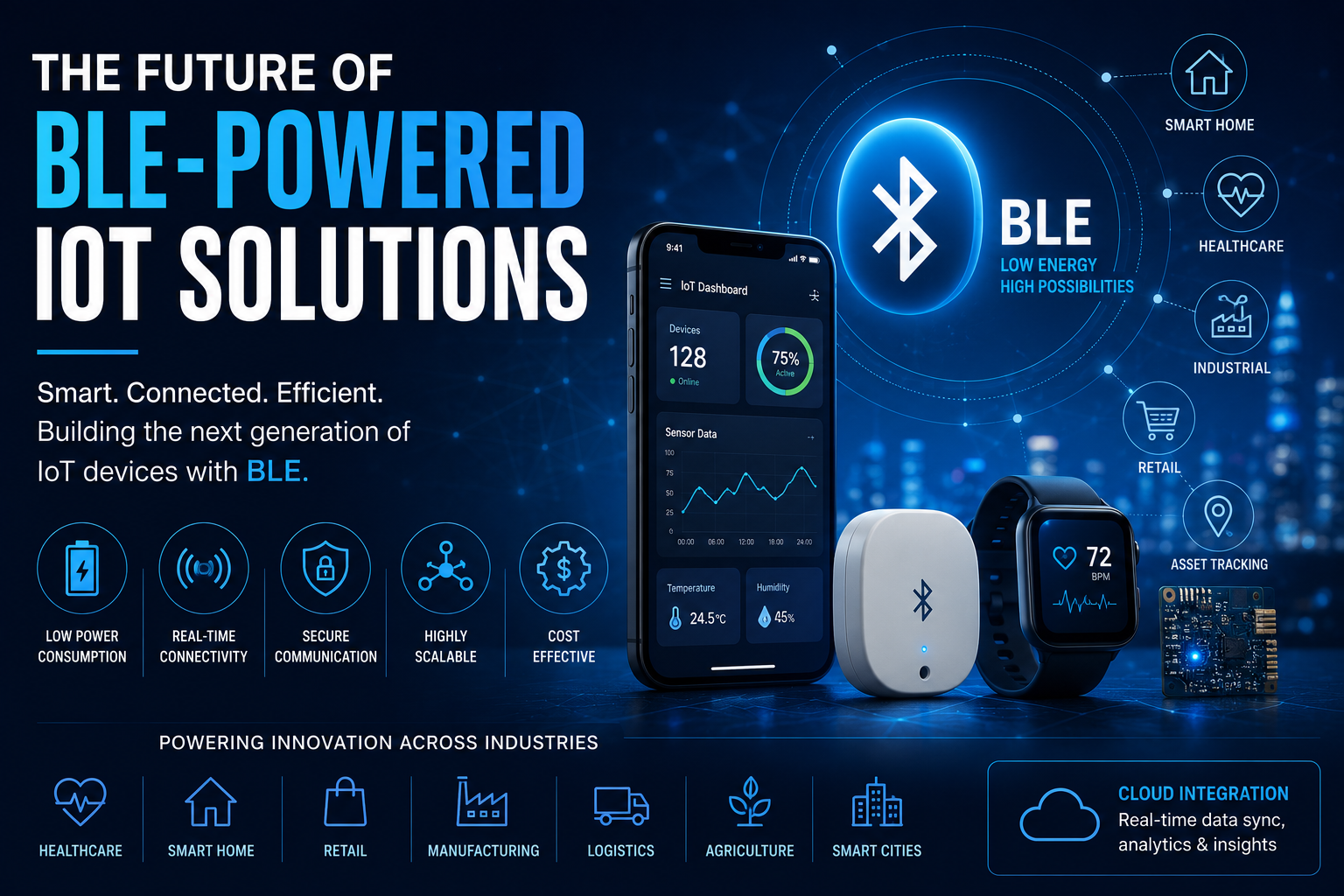
The Internet of Things (IoT) is rapidly transforming industries by connecting devices, collecting real-time data, and enabling intelligent automation. At the heart of many successful IoT ecosystems is Bluetooth Low Energy (BLE)—a wireless technology that delivers reliable, energy-efficient communication for connected devices.
From smart homes and healthcare wearables to industrial automation and asset tracking, BLE has become the preferred connectivity solution for businesses building scalable IoT products.
At IoTBLE, we specialize in developing custom BLE-enabled IoT solutions that help businesses innovate faster, improve operational efficiency, and deliver seamless connected experiences.
What Is Bluetooth Low Energy (BLE)?
Bluetooth Low Energy (BLE) is a wireless communication technology designed for devices that require low power consumption while maintaining reliable data transmission.
Unlike traditional Bluetooth, BLE is optimized for:
- Minimal battery usage
- Fast device discovery
- Secure communication
- Long battery life
- Low-cost hardware implementation
These capabilities make BLE ideal for IoT applications where devices operate continuously for months or even years on a single battery.
Why BLE Is Essential for IoT
Modern IoT devices need reliable connectivity without draining battery power.
BLE provides:
- Ultra-low energy consumption
- Fast pairing and communication
- Secure encrypted connections
- Cross-platform compatibility
- Cost-effective deployment
- Scalable device networks
As businesses continue adopting connected technologies, BLE remains one of the most efficient wireless standards available.
Key Benefits of BLE IoT Solutions
1. Low Power Consumption
BLE devices consume significantly less energy than traditional wireless technologies, allowing sensors and wearable devices to operate for extended periods without frequent battery replacements.
2. Real-Time Connectivity
BLE enables instant communication between smartphones, gateways, sensors, and embedded devices, making real-time monitoring possible across industries.
3. High Scalability
Whether connecting a few smart devices or thousands of IoT sensors, BLE supports scalable deployments that grow with business needs.
4. Enhanced Security
Modern BLE protocols include:
- AES encryption
- Secure pairing
- Authentication
- Privacy protection
- Secure key exchange
These features help safeguard sensitive business and customer data.
5. Cost-Effective Development
BLE modules are affordable, widely available, and supported by major hardware manufacturers, reducing overall development costs.
Industries Using BLE IoT Solutions
Healthcare
Healthcare organizations use BLE for:
- Patient monitoring
- Wearable medical devices
- Smart insulin pens
- Connected blood pressure monitors
- Hospital asset tracking
Smart Homes
BLE powers:
- Smart lighting
- Door locks
- Thermostats
- Motion sensors
- Security systems
- Home automation hubs
Retail
Retail businesses use BLE for:
- Indoor navigation
- Customer engagement
- Proximity marketing
- Smart shelves
- Inventory tracking
- Digital coupons
Manufacturing
Industrial BLE applications include:
- Predictive maintenance
- Equipment monitoring
- Worker safety
- Factory automation
- Environmental sensors
Logistics & Supply Chain
BLE improves supply chain visibility through:
- Asset tracking
- Warehouse automation
- Cold chain monitoring
- Fleet management
- Inventory optimization
Essential Features of a BLE IoT Platform
A modern BLE IoT solution should include:
- Device provisioning
- Secure BLE communication
- Cloud synchronization
- Mobile applications
- OTA (Over-the-Air) firmware updates
- Device monitoring
- Real-time alerts
- Analytics dashboards
- API integrations
- Multi-device management
BLE vs Wi-Fi for IoT
| Feature | BLE | Wi-Fi |
|---|---|---|
| Power Consumption | Very Low | High |
| Battery Life | Excellent | Moderate |
| Range | Short to Medium | Long |
| Cost | Low | Moderate |
| Data Transfer | Small Packets | High Bandwidth |
| IoT Suitability | Excellent | Good |
BLE is the preferred choice for battery-powered IoT devices, while Wi-Fi is better suited for applications requiring high-speed data transfer.
AI Meets BLE IoT
Artificial Intelligence is making BLE-powered IoT systems more intelligent by enabling:
- Predictive maintenance
- Smart anomaly detection
- Energy optimization
- Behavior analysis
- Automated alerts
- Predictive analytics
- Personalized user experiences
The combination of AI and BLE creates connected systems that not only collect data but also generate actionable insights.
Security Best Practices for BLE IoT
To ensure secure IoT deployments:
- Enable BLE encryption
- Use secure pairing methods
- Implement device authentication
- Protect firmware updates
- Monitor connected devices
- Rotate encryption keys
- Secure cloud APIs
- Perform regular security testing
Security should be integrated throughout the entire product lifecycle.
Why Choose IoTBLE?
At IoTBLE, we build intelligent Bluetooth Low Energy solutions tailored to modern business needs.
Our expertise includes:
- BLE Firmware Development
- IoT Mobile App Development
- Custom Embedded Software
- Smart Device Development
- BLE Sensor Integration
- Wearable Device Solutions
- Industrial IoT Platforms
- Cloud IoT Integration
- OTA Firmware Update Systems
- BLE Gateway Development
We help startups and enterprises create secure, scalable, and future-ready IoT products that deliver real business value.
The Future of BLE in IoT
As connected devices become more intelligent, BLE will continue playing a critical role in powering next-generation IoT ecosystems.
Emerging innovations include:
- AI-powered edge devices
- Smart healthcare ecosystems
- Connected factories
- Digital twins
- Smart cities
- Autonomous logistics
- Energy-efficient wearable technology
- Intelligent environmental monitoring
Businesses investing in BLE today are preparing for a more connected, automated, and data-driven future.
Conclusion
Bluetooth Low Energy has become the foundation of modern IoT innovation. Its low power consumption, secure communication, and flexibility make it ideal for building scalable connected products across industries.
Whether you’re developing a wearable device, smart home product, industrial sensor network, or enterprise IoT platform, BLE offers the performance and efficiency needed to succeed.
Ready to build your next BLE-powered IoT solution? Partner with IoTBLE to develop secure, scalable, and intelligent connected products that accelerate digital transformation.
FAQs
Q1. What is BLE in IoT?
BLE (Bluetooth Low Energy) is a wireless communication technology designed for low-power IoT devices that require efficient, secure, and reliable connectivity.
Q2. Why is BLE preferred for IoT devices?
BLE offers low power consumption, long battery life, secure communication, and cost-effective implementation, making it ideal for connected devices.
Q3. Which industries use BLE IoT solutions?
Healthcare, retail, manufacturing, logistics, smart homes, hospitality, agriculture, and industrial automation all benefit from BLE-powered IoT solutions.
Q4. Can BLE integrate with cloud platforms?
Yes. BLE devices can connect to cloud services through mobile apps, gateways, or edge devices for real-time monitoring and analytics.
Leave a Reply