Introduction: What If Your IoT Devices Could Think Locally?
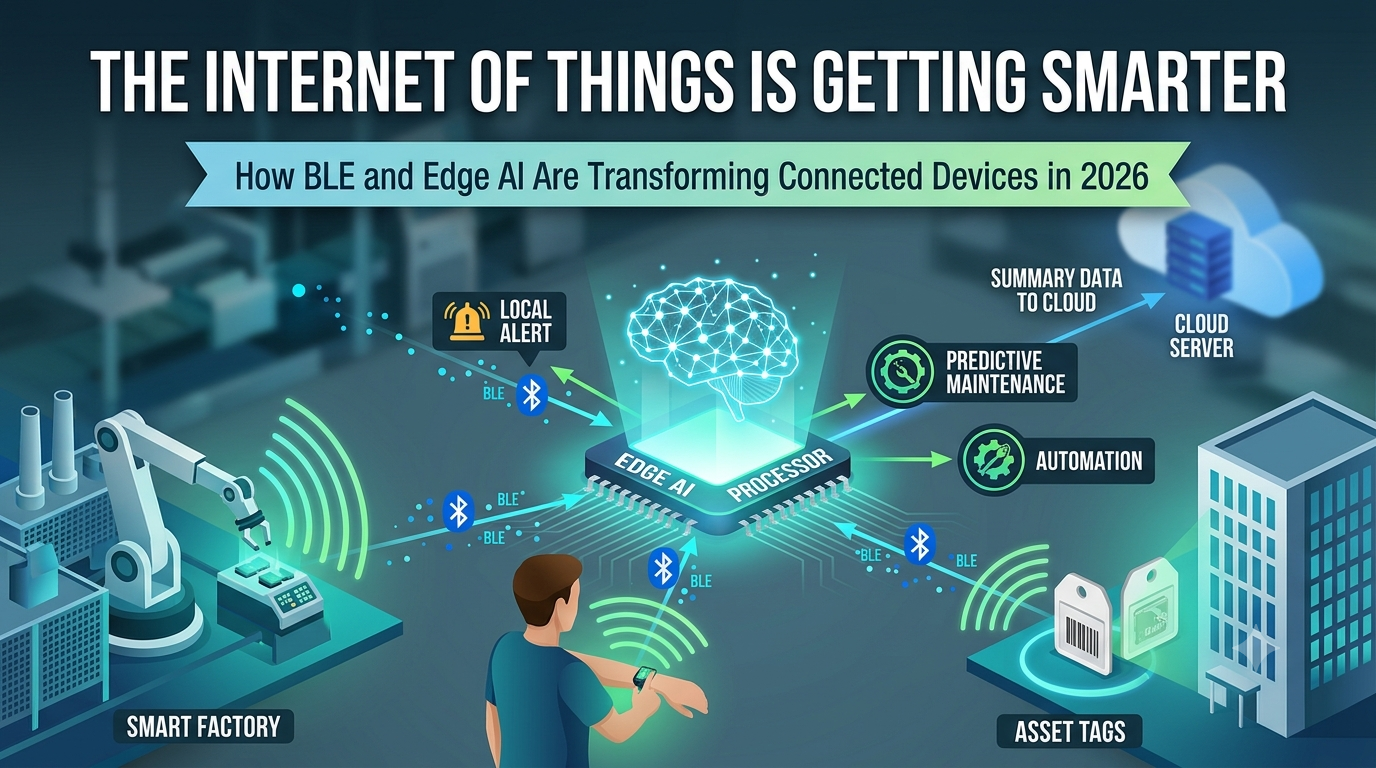
Imagine a factory sensor that detects an unusual machine vibration and immediately alerts a technician. A smart building that adjusts its environment based on occupancy. A wearable device that identifies an unusual pattern without continuously sending raw data to the cloud.
These applications represent an important direction for the Internet of Things (IoT): combining efficient wireless connectivity with intelligent processing.
Bluetooth Low Energy (BLE) enables compatible devices to communicate while supporting power-conscious designs. Edge AI allows suitable devices or nearby computing systems to analyze information closer to where it is collected.
Together, these technologies can help businesses build connected products that respond more quickly, reduce unnecessary data transfers, and support smarter automation.
In 2026, the opportunity is not simply to connect more devices. It is to make connected systems more useful, responsive, and efficient.
What Is BLE-Powered Edge AI?
BLE-powered edge AI combines Bluetooth Low Energy communication with artificial intelligence processing performed on a device, gateway, smartphone, or other nearby computing system.
A typical architecture includes four components:
- Sensors and connected devices: Collect temperature, movement, vibration, location-related signals, or other measurements.
- BLE connectivity: Transfers selected data between compatible devices and receivers.
- Edge processing: Analyzes information locally using rules, lightweight machine-learning models, or other algorithms.
- Applications and cloud platforms: Display results, manage devices, generate reports, and coordinate wider operations when required.
Not every BLE device needs to run an AI model itself. A small battery-powered sensor might transmit measurements to a nearby gateway that performs the analysis.
This distinction matters because processing requirements, battery capacity, memory, and hardware capabilities vary considerably across IoT products.
Why This Technology Combination Matters in 2026
Traditional IoT architectures often send collected information to remote servers for processing. That approach remains useful, but it is not always ideal when applications need rapid responses, intermittent connectivity, or reduced data transmission.
Combining BLE with edge processing can address several practical challenges.
1. Faster Responses
Local processing can reduce dependence on round trips to a remote cloud service.
For example, a gateway monitoring industrial equipment could detect a predefined vibration threshold and trigger an immediate local alert.
The actual response time depends on the hardware, communication interval, processing workload, and application design.
2. More Efficient Data Transfers
Instead of transmitting every raw measurement continuously, a device or gateway can process readings and send summaries, events, or anomalies.
This can reduce network traffic and cloud processing requirements when the application permits selective reporting.
3. Better Support for Intermittent Connectivity
Some industrial sites, remote facilities, and mobile environments experience unreliable internet access.
Local processing allows certain monitoring and automation functions to continue while cloud connectivity is unavailable. Data can be synchronized later if the system has suitable storage and recovery mechanisms.
4. Greater Control Over Sensitive Data
Processing information locally can reduce the amount of raw data sent to external services.
However, edge processing does not automatically guarantee privacy. Device security, access controls, encryption, data retention, and software updates remain essential.
Five Real-World Applications of BLE and Edge Intelligence
1. Predictive Maintenance for Industrial Equipment
Unexpected equipment failure can interrupt production and increase maintenance costs.
BLE-enabled sensors can collect measurements such as vibration and temperature. A nearby gateway can analyze the data to identify abnormal patterns and notify maintenance personnel.
Example: A factory monitors selected motors and flags unusual vibration patterns for inspection before a problem causes a major disruption.
This approach can support condition monitoring, although reliable predictive maintenance requires appropriate sensors, sufficient data, and validated detection models.
2. Smart Buildings That Respond to Occupancy
Commercial buildings can use compatible BLE sensors and occupancy-related systems to understand how rooms and facilities are being used.
Edge processing can help coordinate lighting, ventilation, or room-level automation according to predefined rules and sensor inputs.
Example: A meeting room automation system uses occupancy information to manage lighting and report underused spaces.
The system must be designed around privacy expectations, sensor accuracy, and the building’s existing control infrastructure.
3. Intelligent Asset Tracking
Warehouses, hospitals, and manufacturing facilities often need better visibility into tools, equipment, and reusable inventory.
BLE tags or beacons can transmit identifiers that compatible receivers detect. Gateways can process sightings and provide information about an asset’s last detected area.
Edge analytics can help identify unexpected movement or assets that have not appeared at required checkpoints.
BLE beacon detection does not necessarily provide precise positioning. Accuracy depends on receiver placement, environmental conditions, signal characteristics, and the positioning method.
4. Wearables and Personal Devices
Wearable products can combine BLE connectivity with local processing to monitor activity, recognize selected patterns, or transfer measurements to a smartphone.
A device might process some information locally and send only relevant summaries to a mobile application.
For health-related applications, accuracy, clinical validation, data protection, and applicable regulatory requirements must be considered separately from wireless connectivity.
5. Smart Retail and Connected Products
Retailers can use BLE-connected sensors and devices for electronic shelf labels, equipment monitoring, inventory workflows, and proximity-based experiences.
Edge systems can process local events and communicate selected updates to a central platform.
For example, a gateway may collect data from multiple connected devices and flag missing inventory updates before synchronizing with a retail management system.
The result is a more responsive system without requiring every device to maintain its own direct cloud connection.
BLE vs. Wi-Fi vs. Zigbee: Which Is Right for Your IoT Product?
Choosing a connectivity technology depends on the product’s requirements rather than a single universal winner.
| Requirement | BLE | Wi-Fi | Zigbee |
|---|---|---|---|
| Typical strengths | Low-power peripheral connectivity | Higher-bandwidth networking | Low-power mesh networking |
| Common applications | Wearables, sensors, beacons | Cameras, appliances, gateways | Smart lighting, building controls |
| Device communication | Direct connections and supported broadcast modes | Infrastructure-based networking | Mesh-based networking |
| Internet access | Often through a phone or gateway | Can connect through a router | Typically through a compatible gateway |
| Key consideration | Range and connection behavior | Power consumption and network capacity | Mesh design and interoperability |
BLE, Wi-Fi, and Zigbee have different capabilities and trade-offs. A connected product may even combine them—for example, BLE for sensor communication and Wi-Fi for gateway-to-cloud connectivity.
The Technical Challenges Developers Must Solve
Combining BLE with intelligent processing creates opportunities, but successful products require careful engineering.
Battery management: Advertising intervals, connection parameters, processing frequency, and peripheral selection affect power consumption.
Wireless reliability: Interference, physical obstructions, device density, and receiver placement can affect communication.
Edge hardware limitations: Smaller devices may lack the memory, processing power, or energy budget needed for complex AI models.
Data quality: Inaccurate sensors, missing measurements, and inconsistent sampling can reduce the usefulness of analytics.
Security: Secure pairing, authentication, encryption, firmware updates, and access management must be considered throughout the product lifecycle.
Device management: Commercial deployments need reliable provisioning, diagnostics, updates, monitoring, and recovery procedures.
The best architecture balances intelligence, battery life, responsiveness, connectivity, and development cost.
How to Build a BLE and Edge AI IoT Product
A practical development process starts with the use case and works toward the right combination of hardware and software.
Step 1: Define the Problem
Determine what the device must measure, what decisions need to be made, and how the solution will improve an existing workflow.
Step 2: Select the Hardware
Choose sensors, a BLE-capable microcontroller, power components, and suitable edge hardware based on performance and environmental requirements.
Step 3: Develop Firmware
Implement sensor acquisition, wireless communication, power management, error handling, and secure device behavior.
Step 4: Design the Data Processing Layer
Decide whether analysis should run on the device, a smartphone, a gateway, or the cloud. Use the simplest approach that meets the product’s requirements.
Step 5: Develop the Application
Build the mobile or web interface for device setup, monitoring, notifications, reporting, and configuration.
Step 6: Test in Real Conditions
Evaluate communication range, battery life, processing accuracy, security, recovery from network interruptions, and performance at the expected device scale.
Step 7: Prepare for Deployment
Plan firmware updates, device provisioning, analytics, customer support, and long-term maintenance before rolling out the product.
How IoTBLE Fits Into the Connected Technology Landscape
The next generation of connected products will depend on more than wireless communication alone. Hardware, firmware, mobile applications, gateways, analytics, and cloud services must work together reliably.
For businesses exploring BLE and IoT development, the starting point should be a clearly defined operational or customer problem.
Whether the goal is smarter asset monitoring, a connected wearable, industrial sensing, or an energy-conscious device, selecting the right architecture early can help avoid unnecessary complexity later.
IoTBLE focuses on the intersection of Bluetooth Low Energy and connected-device technology, where practical integration decisions help turn prototypes into usable products.
Frequently Asked Questions
Can BLE work with edge AI?
Yes. BLE can transfer sensor data to a compatible smartphone, gateway, or processing device that runs AI models or other analytics locally. Some capable devices can also perform limited inference directly.
Does BLE IoT require cloud connectivity?
No. Many BLE applications can operate locally. Cloud connectivity is needed only for features such as remote access, centralized analytics, or internet-based synchronization.
Can edge AI improve IoT battery life?
It can, depending on the design. Local processing may reduce wireless data transfers, but AI computation also consumes energy. Battery life must be evaluated for the complete device and workload.
Is BLE suitable for industrial IoT?
BLE can be suitable for sensor monitoring, asset identification, configuration, and selected industrial workflows. Suitability depends on range, interference, environmental conditions, reliability requirements, and the wider system architecture.
What is the difference between BLE and IoT?
BLE is a wireless communication technology. IoT describes a broader ecosystem of connected physical devices, software, and data services. BLE is one of several connectivity options used in IoT systems.
Conclusion: The Future of IoT Is Connected and Context-Aware
The next step in IoT development is not simply adding connectivity to physical products. It is building systems that collect useful information, process it intelligently, and respond in ways that improve real-world operations.
BLE offers a practical communication option for many low-power devices, while edge intelligence can help applications respond locally and manage data more efficiently.
For businesses developing connected products in 2026, the opportunity lies in combining these capabilities with sound hardware design, secure firmware, reliable applications, and realistic testing.
Exploring your next connected-device project? Visit IoTBLE to learn more about BLE and IoT technology and the possibilities for smarter connected products.
Leave a Reply