Introduction
The next generation of smart products will not be defined only by their hardware. Their real value will come from how effectively they communicate, share information, and respond to changing conditions.
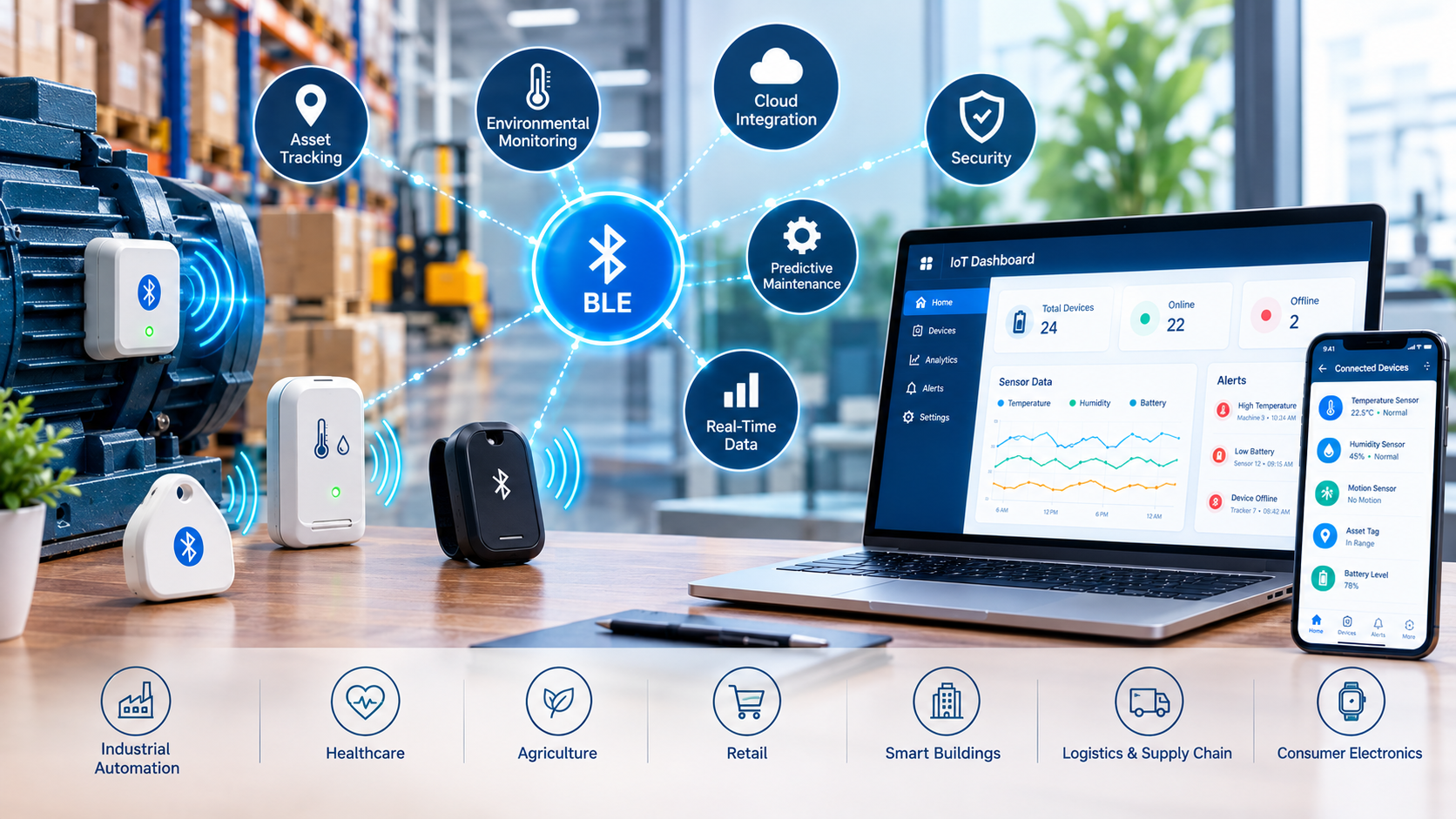
From connected industrial equipment to smart consumer devices, businesses are combining the Internet of Things (IoT) with Bluetooth Low Energy (BLE) to create products that are more efficient, responsive, and easier to manage.
Imagine a sensor that detects a change in equipment temperature, transmits the reading to a nearby gateway, and triggers an alert in a monitoring application. This simple workflow can help a maintenance team identify a potential issue before it disrupts operations.
That is the practical opportunity behind IoT product development, BLE integration, and connected device engineering.
In 2026, companies developing smart products need more than wireless connectivity. They need a complete technology ecosystem that connects hardware, firmware, mobile applications, cloud infrastructure, and business intelligence.
What Makes IoT and BLE a Powerful Combination?
The Internet of Things connects physical objects to digital systems, allowing devices to collect and exchange information. Bluetooth Low Energy provides a wireless communication option for compatible devices that need efficient, short-range data exchange.
When combined, these technologies can support connected products across industries.
A typical IoT and BLE solution may include:
- Smart sensors: Capture measurements such as temperature, motion, humidity, and vibration.
- BLE connectivity: Transfers data between compatible devices and nearby receivers.
- Embedded firmware: Controls device behavior, communication, and power management.
- Mobile applications: Allow users to configure devices and view information.
- IoT gateways: Forward information from local devices to remote systems.
- Cloud platforms: Store, process, and analyze device data.
- Monitoring dashboards: Present device status, trends, and alerts.
Not every project requires every component. The right architecture depends on the product’s communication range, battery requirements, data volume, security needs, and operating environment.
7 Innovative Applications of IoT and BLE in 2026
1. Intelligent Asset Monitoring
Businesses often lose time locating tools, equipment, and inventory across warehouses, factories, and commercial facilities.
BLE beacons and compatible asset tags can help identify nearby assets and monitor their presence in designated areas.
An IoT asset tracking platform can combine device signals with gateway data to provide operational visibility.
Potential applications include:
- Equipment location and proximity monitoring.
- Asset utilization reporting.
- Movement alerts between designated zones.
- Inventory visibility.
- Maintenance workflow integration.
The achievable location accuracy depends on the deployment design. BLE signals alone do not guarantee precise indoor positioning.
2. Smart Agriculture and Environmental Sensing
Agricultural businesses need reliable information about growing conditions, water availability, and environmental changes.
Connected sensors can collect soil moisture, temperature, humidity, and other measurements. BLE can transfer readings locally to a compatible gateway or mobile device, while an IoT platform can organize the data for analysis.
For example, a farm monitoring system could notify an operator when soil moisture falls below a configured threshold.
A well-designed solution can help farmers make more informed irrigation decisions, although the results depend on sensor quality, placement, connectivity, and local conditions.
3. Industrial Equipment Health Monitoring
Unexpected equipment failures can increase maintenance costs and interrupt production.
IoT sensors can monitor operating conditions such as temperature and vibration. BLE-enabled devices may transmit selected measurements to nearby receivers for processing and analysis.
The monitoring application can then flag abnormal readings and help maintenance teams prioritize inspections.
Industrial implementations should consider radio interference, metal enclosures, environmental conditions, device durability, and the consequences of delayed or missing data.
4. Connected Healthcare and Wearable Devices
Wearable technology and compatible medical monitoring products use wireless connectivity to exchange information with mobile applications and other systems.
BLE can support communication between sensors and smartphones, while additional software can present readings, device status, and notifications.
Depending on the product, development may involve embedded firmware, mobile app development, secure data transfer, cloud integration, and device management.
Healthcare applications require careful attention to privacy, accuracy, reliability, and applicable medical-device regulations. A general-purpose wearable should not be assumed to provide clinically validated measurements.
5. Smart Buildings and Energy Management
Commercial buildings contain lighting systems, environmental sensors, occupancy devices, and equipment that may benefit from better monitoring.
IoT and BLE solutions can support selected building automation tasks, including wireless sensor configuration, room-level environmental monitoring, and equipment identification.
Connected dashboards can help facility managers view readings and identify unusual conditions.
For larger deployments, developers should evaluate device density, gateway placement, interoperability, and integration with existing building management systems.
6. Smart Retail and Customer Experiences
Retail businesses can use connected sensors and BLE beacons to support proximity-based experiences and operational analytics.
For example, a store application could provide location-aware information when a customer with the appropriate application and permissions enters a monitored area.
IoT solutions can also support equipment monitoring, environmental sensing, and inventory visibility.
Businesses should design these experiences with privacy and consent in mind. BLE infrastructure does not automatically identify individual shoppers or guarantee that every nearby smartphone will detect a beacon.
7. Connected Consumer Electronics
Smart locks, fitness accessories, connected appliances, and other consumer products often rely on communication between hardware and mobile applications.
BLE can simplify initial setup, local control, configuration, and status monitoring.
However, a successful connected product requires more than pairing. It should also handle connection failures, firmware compatibility, device recovery, and security updates.
Developers must consider the complete user experience, from first-time setup to long-term maintenance.
IoT and BLE Development: The Technology Stack Explained
A reliable connected product combines multiple engineering disciplines.
| Technology layer | Primary purpose |
|---|---|
| Hardware and sensors | Capture physical measurements and interact with the environment |
| Embedded firmware | Control device operation and communication |
| BLE communication | Exchange data with compatible nearby devices |
| Mobile application | Configure, control, and monitor devices |
| IoT gateway | Connect local devices to broader networks |
| Cloud backend | Store information and manage connected devices |
| Analytics dashboard | Present trends, alerts, and operational insights |
| Security infrastructure | Protect devices, data, and authorized access |
Choosing technologies independently can create integration problems. The hardware, firmware, connectivity architecture, and application software should be designed together.
BLE vs. Wi-Fi for IoT Products
Choosing a wireless protocol is one of the earliest technical decisions in connected product development.
| Factor | Bluetooth Low Energy | Wi-Fi |
|---|---|---|
| Power consumption | Designed for low-energy operation | Often requires more power |
| Typical role | Nearby device communication | Network connectivity and higher data throughput |
| Internet access | Usually requires a phone or gateway intermediary | Can connect directly through a suitable network |
| Common applications | Wearables, sensors, beacons | Cameras, connected appliances, high-data devices |
| Design priorities | Battery life and local connectivity | Bandwidth and network integration |
Neither technology is universally superior. BLE can be suitable for battery-powered sensors, while Wi-Fi may be preferable when devices need higher throughput or direct network access.
Some IoT architectures use BLE for local communication and Wi-Fi or cellular connectivity for backhaul.
Five Challenges in IoT and BLE Product Development
1. Battery Life Optimization
A connected device may need to operate for months or years without a battery replacement.
Power consumption depends on advertising intervals, connection parameters, sensor sampling, transmission frequency, processing workload, and hardware selection.
Engineers should measure actual current consumption and validate battery-life estimates under realistic operating conditions.
2. Reliable Wireless Communication
Wireless performance can change because of distance, physical obstructions, interference, antenna design, and the number of active devices.
Testing should reflect the intended deployment environment rather than relying exclusively on laboratory results.
3. Device Security
Connected products can introduce risks if devices accept unauthorized connections or use insecure firmware updates.
Security planning should include appropriate authentication, protected communication, secure provisioning, access control, and a process for managing vulnerabilities throughout the product lifecycle.
4. Cross-Platform Compatibility
Products that communicate with smartphones must account for differences in operating systems, hardware, permissions, and background execution behavior.
Compatibility testing should cover pairing, reconnection, data transfer, error handling, and supported device configurations.
5. Scaling from Prototype to Production
A prototype may work well with a handful of devices but encounter challenges when deployed across hundreds or thousands of units.
Production-ready IoT platforms need reliable device registration, monitoring, firmware version management, data handling, and operational support.
Planning for scalability early can reduce costly redesigns later.
How to Develop an IoT and BLE Product Successfully
A structured development process helps businesses move from concept to a reliable connected product.
Step 1: Define the use case.
Determine what the product should measure, control, communicate, or automate.
Step 2: Select hardware and connectivity.
Choose suitable sensors, BLE chipsets, antennas, batteries, and gateway options.
Step 3: Develop embedded firmware.
Implement device logic, communication services, power management, and recovery behavior.
Step 4: Build the mobile or web application.
Create interfaces for device configuration, monitoring, and user interaction.
Step 5: Integrate cloud infrastructure.
Add device management, data storage, analytics, and notifications where required.
Step 6: Test performance and security.
Evaluate connectivity, battery life, environmental conditions, device compatibility, and security controls.
Step 7: Prepare for deployment and maintenance.
Establish monitoring, firmware updates, technical support, and a process for resolving production issues.
This end-to-end approach helps ensure that connectivity, hardware, and software work together as a coherent product.
Why Choose IoTBLE for Connected Device Development?
Businesses creating smart products need a development approach that connects physical hardware with dependable software.
An experienced IoT and BLE development partner can support projects involving Bluetooth Low Energy integration, sensor connectivity, embedded firmware, mobile application development, IoT gateways, cloud integration, and device monitoring platforms.
When evaluating a development partner, businesses should review experience with relevant hardware, wireless communication requirements, integration challenges, security testing, and long-term maintenance.
The objective is to create a connected product that solves a real business problem while meeting its requirements for power consumption, reliability, usability, and cost.
Frequently Asked Questions
What is IoT BLE development?
IoT BLE development involves creating connected products that use Bluetooth Low Energy to exchange data between compatible sensors, embedded devices, mobile applications, gateways, and software platforms.
Can BLE devices connect to the internet?
BLE devices generally communicate with nearby compatible devices rather than directly accessing the internet. A smartphone or gateway can forward their information to an internet-connected platform.
Which industries benefit from IoT and BLE solutions?
Manufacturing, healthcare, agriculture, retail, logistics, building management, and consumer electronics can benefit from appropriately designed connected-device solutions.
How much does IoT product development cost?
Costs vary according to hardware complexity, firmware development, mobile applications, cloud infrastructure, testing, certifications, and production requirements. A clearly defined scope helps establish a realistic estimate.
Is BLE suitable for battery-powered IoT devices?
Yes. BLE is designed for low-energy wireless communication and can be suitable for battery-powered sensors and accessories. Actual battery life depends on hardware, configuration, workload, and operating conditions.
What is the difference between BLE and an IoT platform?
BLE provides wireless communication between compatible devices. An IoT platform typically manages connected devices, processes data, stores information, generates alerts, and provides monitoring or analytics capabilities.
Conclusion
The combination of IoT and Bluetooth Low Energy is helping businesses create smarter products, improve operational visibility, and connect physical devices with digital services.
From asset tracking and environmental sensing to industrial monitoring and consumer electronics, the opportunities extend across industries. However, successful implementation depends on thoughtful hardware selection, efficient firmware, reliable connectivity, secure data handling, and well-integrated software.
Businesses planning their next connected product should treat IoT development as an end-to-end engineering challenge rather than simply adding wireless connectivity.
Building a connected product in 2026? Explore IoT and BLE development with IoTBLE and identify the right combination of hardware, connectivity, and software for your project.
SEO Metadata
SEO Title: IoT and BLE Development in 2026: Connected Product Solutions
Meta Description: Discover IoT and BLE development solutions for smart sensors, asset tracking, industrial monitoring, connected devices, and Bluetooth Low Energy integration.
Suggested URL Slug: /blogs/iot-ble-development-connected-products-2026/
Primary Keyword: IoT BLE development
Secondary Keywords:
- IoT product development
- Bluetooth Low Energy integration
- BLE development services
- Connected device development
- IoT software development
- BLE firmware development
- Smart sensor development
- IoT mobile app development
- Industrial IoT solutions
- Bluetooth IoT connectivity
Suggested Internal Links:
- IoT Product Development
- BLE Development Services
- Bluetooth Application Development
- Embedded Software Development
- IoT Mobile App Development
Suggested Image Alt Text: IoT and BLE connected sensors communicating with a smart device monitoring platform
Recommended Schema: BlogPosting, BreadcrumbList, and Organization. Implement FAQPage structured data only where appropriate for the website and current search engine guidelines.
Leave a Reply