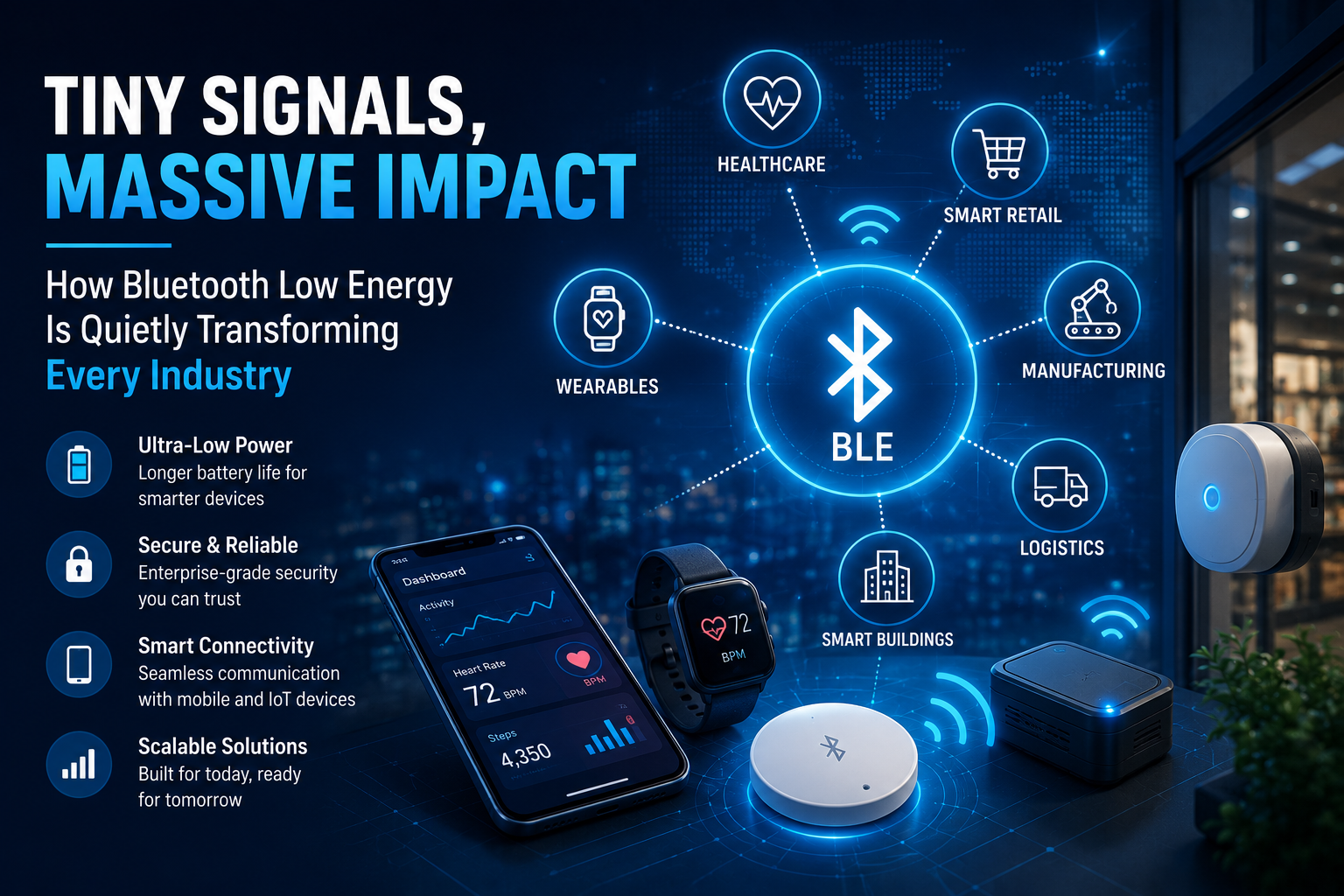
When people think about the Internet of Things (IoT), they often imagine smart homes, wearable devices, or connected factories. But behind many of these innovations is a technology that rarely gets the spotlight—Bluetooth Low Energy (BLE).
BLE has become the invisible communication layer connecting billions of devices while consuming only a fraction of the power required by traditional wireless technologies.
From healthcare and retail to industrial automation and smart cities, BLE is enabling businesses to build faster, smarter, and more energy-efficient IoT ecosystems.
In this article, we’ll explore why Bluetooth Low Energy is becoming the preferred connectivity solution for modern IoT applications and how it’s shaping the future of connected technology.
What Is Bluetooth Low Energy (BLE)?
Bluetooth Low Energy is a wireless communication technology designed for devices that need to transmit small amounts of data while consuming minimal power.
Unlike classic Bluetooth, BLE focuses on:
- Ultra-low power consumption
- Fast device discovery
- Secure communication
- Reliable short-range connectivity
- Low implementation cost
- Long battery life
This makes BLE perfect for battery-powered devices that need to operate continuously for months—or even years—without frequent charging.
Why BLE Matters in IoT
Every connected device has one common challenge:
Power efficiency.
IoT devices often operate in environments where charging or replacing batteries regularly isn’t practical.
BLE solves this problem by offering:
- Extremely low energy consumption
- Fast communication
- Stable connections
- Low hardware costs
- Broad compatibility with smartphones and tablets
This combination has made BLE one of the most widely adopted IoT communication technologies worldwide.
Industries Being Transformed by BLE
Healthcare
Healthcare organizations increasingly rely on BLE-enabled devices for real-time patient monitoring.
Applications include:
- Heart rate monitors
- Glucose sensors
- Blood pressure devices
- Smart inhalers
- Remote patient monitoring
- Medical asset tracking
BLE allows medical professionals to receive accurate patient data while ensuring long battery life for wearable devices.
Smart Retail
Retail businesses are using BLE Beacons to create personalized shopping experiences.
Examples include:
- Indoor navigation
- Product recommendations
- Digital coupons
- Customer engagement
- Contactless checkout
- Smart inventory tracking
Customers receive relevant information based on their location inside the store.
Manufacturing
Factories are becoming smarter with BLE-powered industrial solutions.
Use cases include:
- Equipment monitoring
- Worker safety
- Predictive maintenance
- Machine diagnostics
- Tool tracking
- Production optimization
BLE sensors continuously collect operational data without consuming excessive power.
Logistics & Supply Chain
BLE enables complete visibility across logistics operations.
Applications include:
- Asset tracking
- Warehouse automation
- Cold chain monitoring
- Fleet equipment tracking
- Package location
- Inventory management
Businesses gain real-time insights while reducing operational costs.
Smart Buildings
Modern commercial buildings use BLE for:
- Smart lighting
- Access control
- Energy management
- Occupancy detection
- Indoor positioning
- Meeting room automation
These systems improve both security and operational efficiency.
BLE vs Wi-Fi vs Zigbee
| Feature | BLE | Wi-Fi | Zigbee |
|---|---|---|---|
| Battery Life | Excellent | Moderate | Excellent |
| Power Consumption | Very Low | High | Low |
| Range | Short-Medium | Long | Medium |
| Data Speed | Moderate | High | Low |
| Smartphone Support | Native | Native | Limited |
| IoT Suitability | Excellent | Good | Excellent |
BLE strikes the perfect balance between power efficiency, affordability, and ease of deployment.
Why Businesses Prefer BLE
Organizations choose Bluetooth Low Energy because it offers:
- Lower infrastructure costs
- Longer battery life
- Easy mobile integration
- Strong security features
- Faster deployment
- Reliable communication
- Scalable device management
These benefits make BLE ideal for startups as well as large enterprises.
Emerging BLE Trends
The future of BLE extends far beyond wearable devices.
Emerging innovations include:
BLE Mesh Networks
Thousands of connected devices communicate seamlessly across large facilities.
Smart Cities
BLE sensors improve:
- Parking management
- Public transportation
- Street lighting
- Environmental monitoring
- Waste management
Digital Healthcare
Continuous patient monitoring is becoming standard through BLE-enabled medical devices.
AI + BLE
Artificial Intelligence analyzes data collected from BLE devices to predict failures, optimize operations, and automate business decisions.
Precision Indoor Positioning
BLE-based positioning systems provide highly accurate indoor navigation for hospitals, airports, shopping malls, and warehouses.
Security in BLE Applications
Security is essential for connected devices.
Modern BLE implementations support:
- Device authentication
- Data encryption
- Secure pairing
- Privacy protection
- Access control
- Firmware updates
Following security best practices ensures connected systems remain reliable and protected.
Choosing the Right BLE Development Partner
Successful BLE projects require expertise in:
- Embedded firmware
- Mobile application development
- Cloud integration
- IoT architecture
- Security implementation
- Device testing
- Performance optimization
A skilled development team ensures reliable communication, scalability, and long-term success.
Why IoTBLE?
At IoTBLE, we specialize in building intelligent Bluetooth Low Energy solutions for businesses across industries.
Our services include:
- Custom BLE Application Development
- IoT Device Integration
- BLE Firmware Development
- Beacon Solutions
- Wearable Device Connectivity
- Smart Healthcare Applications
- Industrial IoT Development
- BLE Mobile Apps (Android & iOS)
- Cloud Integration
- End-to-End IoT Consulting
Whether you’re developing a smart medical device, industrial sensor, retail beacon system, or connected consumer product, our experts help transform your ideas into scalable IoT solutions.
Final Thoughts
Bluetooth Low Energy is no longer just another wireless technology.
It has become the backbone of modern IoT innovation—connecting billions of devices while delivering exceptional battery efficiency, security, and performance.
As businesses continue embracing digital transformation, BLE will remain a critical technology powering smart industries, connected healthcare, intelligent retail, logistics automation, and future-ready cities.
The smallest wireless signals are creating the biggest technological revolution.
Frequently Asked Questions (FAQ)
What is Bluetooth Low Energy (BLE)?
Bluetooth Low Energy (BLE) is a wireless communication technology designed for low-power devices, enabling efficient data exchange while maximizing battery life.
Why is BLE ideal for IoT?
BLE provides low energy consumption, secure communication, native smartphone compatibility, and reliable connectivity, making it ideal for IoT devices.
Which industries use BLE technology?
Healthcare, retail, manufacturing, logistics, smart buildings, fitness, automotive, and smart city projects all rely on BLE solutions.
Does BLE support secure communication?
Yes. BLE supports encryption, secure pairing, authentication, and privacy features to protect connected devices and user data.
Leave a Reply