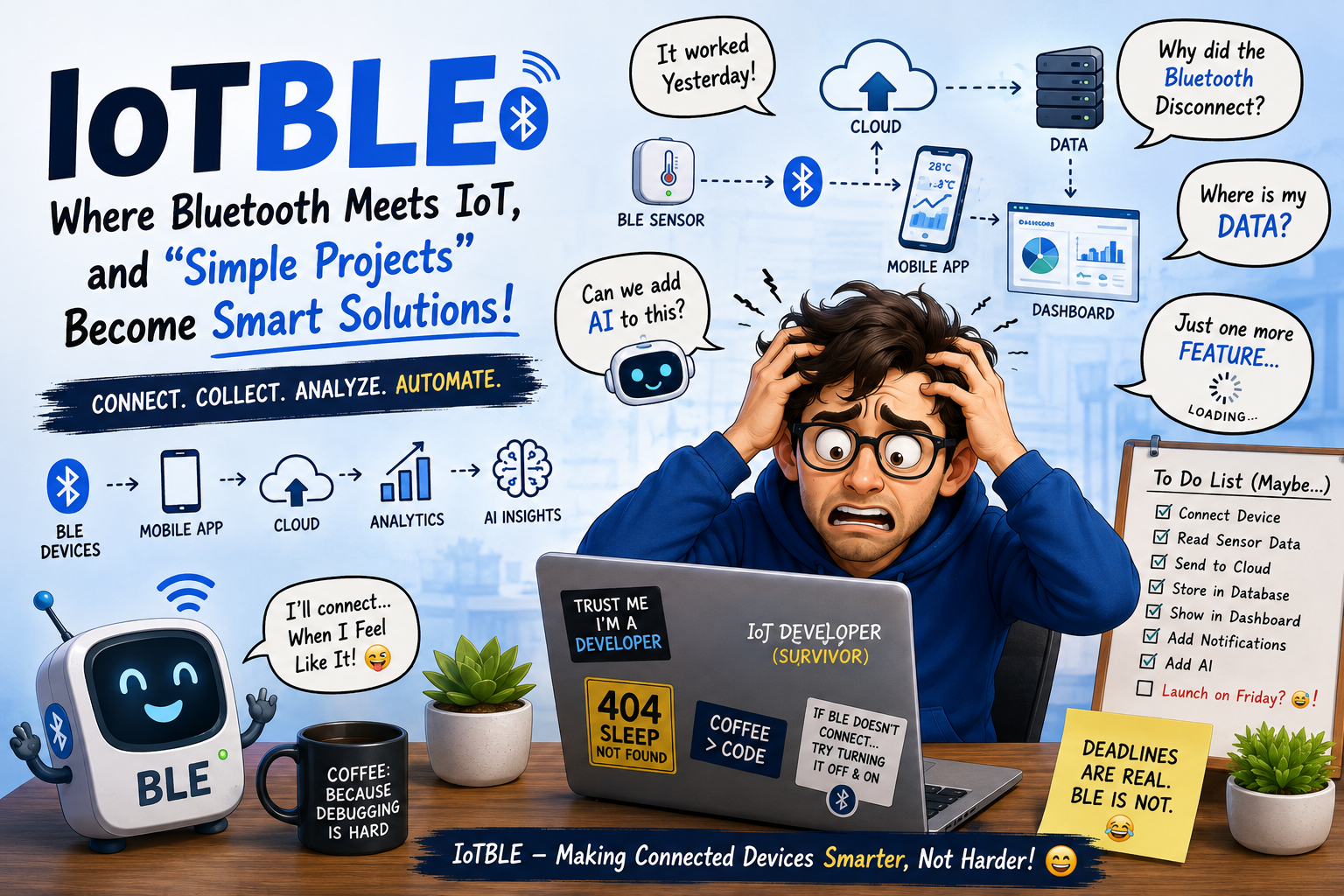
Introduction: “It’s Just a Small IoT Project” 😂
Every IoT project starts innocently.
The client says:
“We just need to connect one small sensor to a mobile app.”
The developer smiles.
“Sure.”
Then comes the second sentence:
“It should use Bluetooth.”
Okay. BLE development.
Then:
“The data should go to the cloud.”
Okay. IoT development.
Then:
“Can we add an admin dashboard?”
Okay.
“Can users get notifications?”
Sure.
“Can AI analyze the data?”
Absolutely.
“Can it work on iPhone and Android?”
Of course.
“And can we launch next Friday?”
…
Welcome to IoT development. 😂
What Is BLE IoT Anyway?
In simple terms, BLE IoT combines Bluetooth Low Energy with connected devices, mobile applications, gateways, cloud platforms, and data systems.
A typical architecture looks like:
Sensor 📡
↓
BLE 🔵
↓
Mobile App 📱
↓
Cloud ☁️
↓
Database 🗄️
↓
AI 🤖
↓
Dashboard 📊
The customer sees:
“The temperature is 28°C.”
The developer sees:
“Why did the BLE connection disappear exactly when the temperature reached 28°C?” 😂
The BLE Connection: A Love Story 💔
BLE developers know this relationship very well.
Developer:
“Connect to device.”
BLE device:
“No.”
Developer:
“Please?”
BLE device:
“Maybe.”
Developer:
“Scan again.”
BLE device:
“I don’t exist.”
Developer:
“Restart Bluetooth.”
BLE device:
“Fine. I’ll connect now.”
😂
Bluetooth Low Energy is incredibly useful, but sometimes it feels like the device has its own personality.
And apparently, its personality is:
“I will connect when I feel like it.”
“It Worked Yesterday”
These are probably the most dangerous words in software development.
“It worked yesterday.”
Yesterday:
✅ Device connected
✅ Data arrived
✅ App worked
✅ Cloud received everything
Today:
❌ Device won’t connect
Developer:
“What changed?”
Everyone:
“Nothing.”
😂
Something definitely changed.
It always does.
The Famous “Just Add One Sensor”
Client:
“Can we add another sensor?”
Developer:
“Sure.”
Then:
“And another one?”
Okay.
“And maybe five more?”
Fine.
“Actually, we have 10,000 devices.”
Developer:
👁️👄👁️
That’s when a small BLE application suddenly becomes a large-scale IoT platform.
Now you need to think about:
- Device management
- Cloud architecture
- Data storage
- Scalability
- Authentication
- Security
- Firmware updates
- Monitoring
- Analytics
- API design
Congratulations.
Your “simple project” has become an IoT ecosystem. 😂
BLE vs Wi-Fi: The Family Argument
BLE:
“I use very little power.”
Wi-Fi:
“But I have more bandwidth.”
BLE:
“I can run on tiny batteries.”
Wi-Fi:
“I can connect directly to the internet.”
BLE:
“Your battery is crying.”
Wi-Fi:
“At least I don’t need a gateway.”
BLE:
“At least I don’t drain the battery.”
😂
The truth?
Neither is automatically better.
The right technology depends on:
- Range
- Power consumption
- Data volume
- Connectivity
- Hardware
- Cost
- Application requirements
Sometimes the smartest architecture uses both.
When the Smartphone Becomes the IoT Gateway
One of the coolest things about BLE is that a smartphone can act as the bridge between the physical device and the internet.
For example:
BLE Sensor
↓
Android/iOS App
↓
Internet
↓
Cloud
Simple, right?
Well…
Then the developer gets questions like:
“Will it work when the app is closed?”
😐
“What if Bluetooth is turned off?”
😐
“What if the user walks 100 meters away?”
😐
“What if the phone battery dies?”
😐
“What if the user has an iPhone?”
😐
“What if they have Android?”
😐
And suddenly that simple diagram has become a 50-page technical discussion.
😂
GATT: The Word That Makes BLE Developers Nod
If you’re new to BLE development, you may hear:
GATT
No, it isn’t someone’s name.
GATT stands for Generic Attribute Profile.
BLE devices organize information using:
- Services
- Characteristics
- Descriptors
A developer might say:
“The device exposes a custom service with three characteristics.”
A normal person:
“…English please?”
😂
Basically, GATT defines how BLE devices organize and exchange information.
It’s one of the foundations of serious BLE application development.
The Mysterious BLE Device
Every BLE developer eventually encounters The Device.
It has:
- No documentation
- Strange UUIDs
- Random disconnects
- One mysterious characteristic
- Firmware from 2019
And the client says:
“Can you connect it to our app?”
Developer:
“Do you have the protocol documentation?”
Client:
“No.”
“SDK?”
“No.”
“Firmware documentation?”
“No.”
“Technical contact?”
“Maybe.”
😂
And that’s how detective work begins.
IoT Data: From Tiny Sensor to Giant Database
A sensor sends one small value.
For example:
Temperature = 28°C
Seems harmless.
Now imagine:
10,000 devices.
Each device sends data every 10 seconds.
Suddenly you’re dealing with a huge amount of IoT data.
Now you need:
- Data ingestion
- APIs
- Databases
- Data retention
- Cloud infrastructure
- Analytics
- Monitoring
- Security
The sensor may be tiny.
The backend definitely isn’t.
😂
Then Someone Says: “Let’s Add AI”
Everything is going smoothly.
Sensors work.
BLE works.
Cloud works.
Dashboard works.
Then someone says:
“Can we add AI?”
Of course.
Now AI needs to analyze:
- Sensor readings
- Historical data
- Device behavior
- Anomalies
- Trends
Suddenly:
BLE + IoT + Cloud + AI
is on the project roadmap.
The developer opens another coffee.
☕😂
AI + IoT: Actually Pretty Useful
Jokes aside, combining AI with IoT can be extremely useful.
Imagine a machine with BLE-connected sensors.
The system collects:
Temperature
Vibration
Pressure
Operating Time
The IoT platform processes the information.
AI can then look for unusual patterns.
Instead of simply telling a business:
“The machine temperature increased.”
The system could potentially identify:
“This machine is behaving differently from its historical pattern.”
That’s where AI-powered IoT becomes interesting.
The Dashboard Everyone Wants
Every IoT project eventually needs a dashboard.
And the dashboard usually starts with:
“Just show the sensor data.”
Then:
“Can we add graphs?”
Sure.
“Filters?”
Okay.
“Export to Excel?”
Fine.
“Real-time updates?”
Yep.
“User permissions?”
Sure.
“Can we have dark mode?”
😂
Eventually the dashboard has:
17 charts
8 filters
12 buttons
and nobody knows which button does what.
The lesson?
Good IoT dashboards should simplify data, not overwhelm users with it.
The “Real-Time” Problem
Client:
“We need real-time data.”
Developer:
“How real-time?”
Client:
“Instant.”
Developer:
“How many milliseconds?”
Client:
“Just… instant.”
😂
“Real-time” can mean different things depending on the application.
A temperature dashboard may update every few seconds.
A safety system might require much faster response.
A business analytics dashboard may only need updates every few minutes.
The technical architecture should match the actual business requirement.
When the Internet Disappears
Everything is connected.
Everything is beautiful.
Then…
Wi-Fi: Gone.
Cloud:
“I’m unavailable.”
IoT Gateway:
“What should I do?”
Sensor:
“I have data.”
Developer:
“Please store it locally.”
This is why good IoT systems need to consider:
- Offline operation
- Local caching
- Retry mechanisms
- Data synchronization
- Connection recovery
Because in the real world:
Internet outages happen.
IoT Security: The Serious Part
Okay, jokes aside.
IoT security is extremely important.
A connected device can become an entry point into a larger system.
A proper BLE IoT architecture should consider:
- BLE security
- Device authentication
- Secure APIs
- Encryption
- Cloud security
- Access control
- Secure firmware
- Data protection
The goal is simple:
Connect everything without giving everyone access to everything.
BLE Firmware Updates: “Can We Update the Device Remotely?”
Client:
“Can we update the device software without touching the device?”
Developer:
“Yes, through OTA firmware updates.”
Client:
“Great!”
Developer:
“We just need to design the update process carefully.”
Because firmware updates can involve:
- File transfer
- BLE communication
- Version management
- Validation
- Rollback
- Battery considerations
- Connection stability
In other words:
It’s not quite the same as updating Instagram. 😂
IoT Development Is Basically Connecting Everything
At the end of the day, IoT is about connecting the physical world with digital systems.
Something happens physically:
Sensor detects something
↓
BLE communicates it
↓
Mobile app or gateway receives it
↓
Cloud stores it
↓
Analytics understands it
↓
AI interprets it
↓
Business system responds
That’s powerful.
And also slightly terrifying when you realize how many things can go wrong.
😂
Where BLE IoT Is Being Used
BLE and IoT can support applications across many industries.
🏭 Manufacturing
Machine monitoring, equipment tracking, predictive maintenance.
🏥 Healthcare
Connected devices, wearables, monitoring systems.
🚚 Logistics
Asset tracking, environmental monitoring, cold-chain applications.
🛒 Retail
Beacons, smart stores, customer engagement, asset monitoring.
🏢 Smart Buildings
Occupancy, access, environmental sensing, asset tracking.
🌾 Agriculture
Environmental monitoring and connected sensors.
⌚ Wearables
Fitness devices, smart accessories, connected health products.
🏠 Smart Products
Connected appliances, sensors, and consumer devices.
The IoT Developer’s Daily Checklist 😂
☑ Is Bluetooth enabled?
☑ Is the device advertising?
☑ Did the phone discover it?
☑ Did it connect?
☑ Did the service appear?
☑ Did the characteristic respond?
☑ Did the gateway receive the data?
☑ Did the API receive the data?
☑ Did the database save it?
☑ Did the dashboard update?
☑ Why is the dashboard showing yesterday’s data?
☑ Who changed the firmware?
☑ Why is the device offline?
☑ Coffee?
☑ Definitely coffee. ☕
What Makes a Good BLE IoT Solution?
A good IoT solution isn’t simply about connecting a device.
It needs to be:
Reliable
Devices should communicate consistently.
Secure
Data and devices need appropriate protection.
Scalable
The architecture should support future growth.
Efficient
Battery and bandwidth should be used intelligently.
User-Friendly
Complex technology should remain invisible to users.
Maintainable
The system should be manageable after launch.
Data-Driven
Collected information should create actual business value.
The Future of BLE IoT
The future of connected technology isn’t simply:
More Devices.
It’s:
Smarter Devices.
The next generation of BLE IoT systems will increasingly combine:
BLE
Edge Computing
Cloud
AI
Automation
Real-Time Analytics
This means devices won’t just collect information.
They will increasingly help businesses understand and act on that information.
Why IoTBLE?
Building a successful connected product requires more than knowing how to connect a BLE device.
It can involve:
Hardware → Firmware → BLE → Mobile → IoT → Cloud → AI → Analytics
IoTBLE focuses on this connected technology ecosystem.
Solutions can include:
- BLE IoT applications
- BLE mobile applications
- IoT application development
- BLE device integration
- IoT gateway solutions
- Sensor applications
- Wearable technology
- Asset tracking
- Smart-device solutions
- Cloud-connected IoT platforms
- AI-powered IoT applications
The goal is simple:
Make connected technology actually useful.
Final Thoughts 😂
IoT sounds simple.
Until you build it.
BLE sounds simple.
Until the device refuses to connect.
Cloud sounds simple.
Until 10,000 devices start sending data.
AI sounds simple.
Until someone asks:
“Why did the AI make that decision?”
😂
But that’s exactly what makes IoT development exciting.
The real challenge isn’t simply connecting devices.
It’s creating a reliable ecosystem where devices, software, cloud platforms, AI, and people work together.
So the next time someone says:
“It’s just a small BLE IoT project.”
Smile.
Open your laptop.
And order another coffee. ☕😂
IoTBLE — Where Bluetooth meets IoT, and “simple projects” become smart connected solutions.
- BLE IoT solutions
- BLE IoT applications
- Bluetooth Low Energy IoT
- IoT BLE
- BLE development
- IoT development
- BLE app development
- BLE IoT development
- Bluetooth IoT
- connected devices
Commercial keywords:
- BLE IoT development company
- BLE IoT development services
- BLE application development company
- IoT development company
- BLE IoT solutions provider
- custom BLE IoT solutions
- BLE developers
- What is BLE IoT?
- How does BLE work with IoT?
- What are BLE IoT applications?
- Is BLE suitable for IoT?
- Can BLE devices connect to the cloud?
- Can a smartphone act as a BLE gateway?
- What is BLE used for in IoT?
- What is the difference between BLE and IoT?
- Can AI be used with BLE IoT?
- What are the challenges of BLE IoT development?
Suggested CTA:
👉 Have a “simple” BLE IoT idea? Let IoTBLE turn it into a connected solution.
Leave a Reply