PCI Developers Navbar

Category: dolor

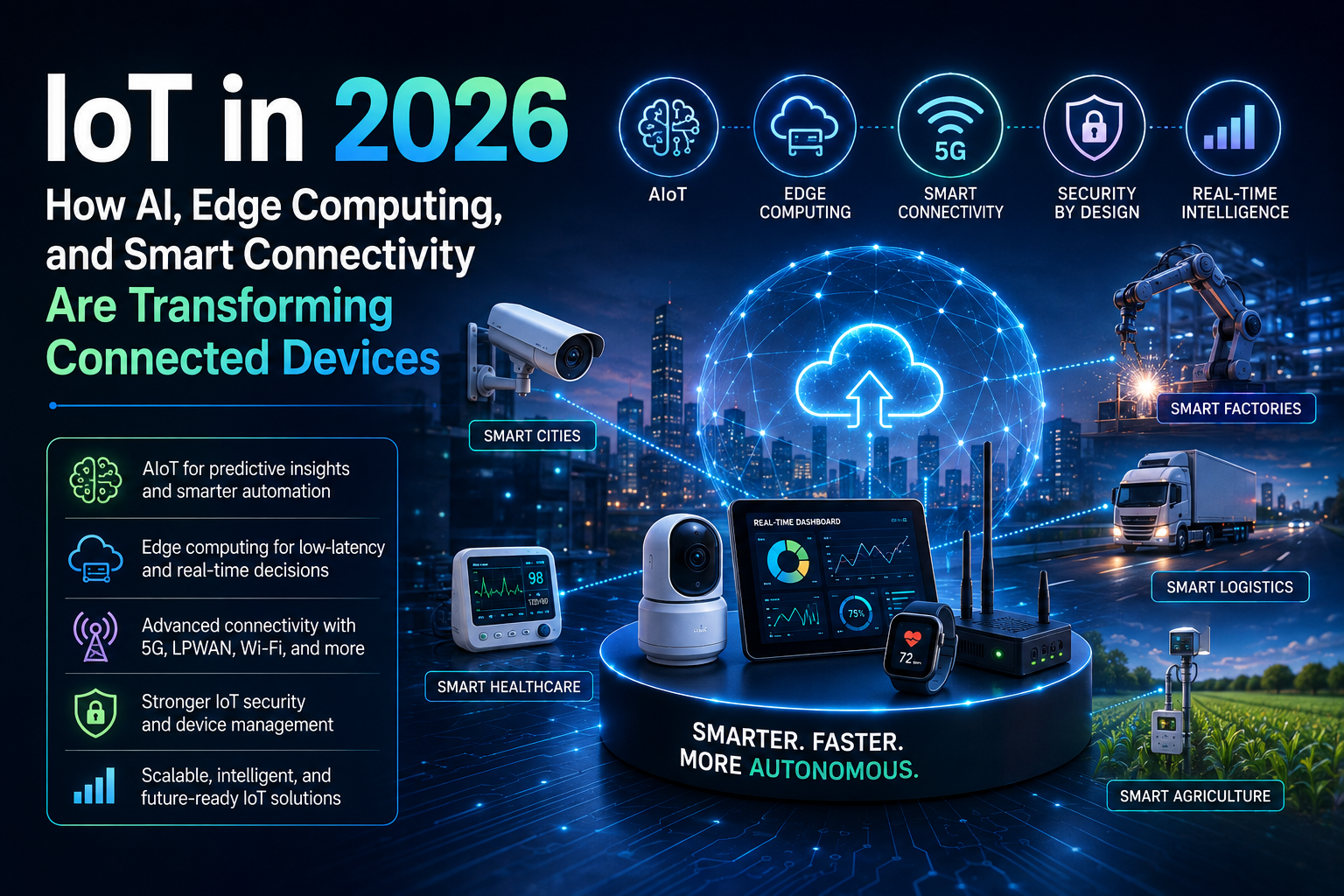
  • IoT in 2026: How AI, Edge Computing, and Smart Connectivity Are Transforming Connected Devices

    IoT in 2026: How AI, Edge Computing, and Smart Connectivity Are Transforming Connected Devices

    The Internet of Things (IoT) is entering a new phase in 2026. Connected devices are no longer limited to collecting data and sending it to the cloud. With AI, edge computing, advanced connectivity, and stronger cybersecurity, IoT systems are becoming smarter, faster, and more autonomous.

    For businesses, this means IoT is shifting from simple monitoring to real-time decision-making, predictive maintenance, automation, and intelligent operations.

    What Is IoT?

    The Internet of Things connects physical devices such as sensors, machines, wearables, vehicles, appliances, and industrial equipment to software platforms and networks.

    These devices can collect information, communicate with other systems, and trigger actions automatically.

    A modern IoT ecosystem typically includes:

    • Smart sensors and connected devices
    • Embedded software and firmware
    • Bluetooth, Wi-Fi, 5G, LPWAN, or other connectivity
    • Edge computing infrastructure
    • Cloud platforms
    • Mobile and web applications
    • AI and machine learning
    • IoT security and device management

    The real value comes from connecting these components into a system that can turn raw device data into useful business decisions.

    1. AIoT Is Making IoT More Intelligent

    One of the biggest developments in 2026 is the convergence of Artificial Intelligence and IoT, often called AIoT.

    Traditional IoT answers questions such as:

    What is happening?

    AI-powered IoT can go further:

    Why is it happening, what is likely to happen next, and what should the system do?

    For example, an industrial sensor may detect unusual vibration in a machine. Instead of simply sending an alert, an AI-powered system can analyze the pattern and identify a potential equipment failure before it happens.

    This enables:

    • Predictive maintenance
    • Anomaly detection
    • Intelligent automation
    • Energy optimization
    • Demand forecasting
    • Real-time decision-making

    AIoT is therefore transforming connected devices from passive data collectors into intelligent systems.

    2. Edge Computing Brings Intelligence Closer to Devices

    Cloud computing remains important, but businesses increasingly need IoT systems that can make decisions without sending every piece of data to a remote server.

    That’s where edge computing comes in.

    Instead of this:

    Device → Cloud → Decision

    modern IoT architectures can use:

    Device → Edge → Decision → Cloud

    Processing data closer to the source can reduce latency, lower unnecessary data transfers, and allow systems to continue operating when internet connectivity is unreliable. This is especially valuable for manufacturing, healthcare, energy, transportation, and other time-sensitive applications.

    3. IoT Security Is Becoming a Core Requirement

    More connected devices also mean a larger attack surface.

    An IoT ecosystem can include thousands of devices, gateways, applications, APIs, and cloud services. A weakness in one component can potentially create security risks across the wider system.

    Modern IoT development therefore needs security throughout the device lifecycle, including:

    • Secure device authentication
    • Encrypted communication
    • Secure firmware
    • Access control
    • Device monitoring
    • Regular software updates
    • Data privacy
    • Network segmentation
    • Vulnerability management

    NIST’s 2026 IoT cybersecurity work highlights the continuing need to develop security requirements and risk-management approaches as IoT technology evolves.

    The ITU has also outlined AIoT threats across hardware, system, data, network, and application layers, showing why security needs to be considered across the entire architecture rather than added at the end.

    4. 5G and Advanced Connectivity Are Expanding IoT

    Connectivity is the foundation of every IoT system.

    Different applications require different communication technologies. Depending on the use case, developers may combine:

    • Bluetooth Low Energy
    • Wi-Fi
    • 5G
    • NB-IoT
    • LTE-M
    • LoRaWAN
    • Private cellular networks

    5G is particularly useful for applications requiring reliable connectivity, higher bandwidth, and low latency.

    This can support use cases such as connected vehicles, smart factories, industrial automation, remote monitoring, and large-scale infrastructure.

    5. Smart Devices Are Becoming More Autonomous

    The next generation of IoT devices will increasingly be capable of making decisions locally.

    Consider a smart security camera.

    A traditional camera might continuously send video to the cloud.

    A smarter edge-enabled camera could identify an unusual event locally and send only relevant information to the central platform.

    This approach can reduce unnecessary data transmission while improving response times and privacy.

    The same concept can be applied to:

    • Industrial cameras
    • Smart wearables
    • Agricultural sensors
    • Fleet tracking devices
    • Healthcare monitoring systems
    • Smart home equipment
    • Retail systems

    6. IoT Is Transforming Industries

    IoT is no longer limited to smart homes.

    Manufacturing

    Connected machines can monitor temperature, vibration, pressure, and performance to support predictive maintenance and reduce unexpected downtime.

    Healthcare

    Connected medical devices and wearables can support continuous monitoring and generate alerts when abnormal patterns are detected.

    Agriculture

    IoT sensors can monitor soil moisture, temperature, humidity, and environmental conditions to help optimize irrigation and resource usage.

    Logistics

    Connected tracking devices can provide visibility into vehicles, shipments, temperature-sensitive products, and supply chains.

    Smart Cities

    IoT can support intelligent traffic systems, smart lighting, environmental monitoring, waste management, and infrastructure monitoring.

    Energy

    Connected meters and sensors can help organizations monitor consumption, detect abnormalities, and optimize energy usage.

    7. The Future of IoT Is Not Just More Devices

    The biggest change in IoT isn’t simply the number of connected devices.

    It’s what those devices can understand and do.

    A sensor that only reports temperature provides information.

    A sensor combined with edge computing and AI can identify an abnormal temperature pattern, predict a potential problem, and trigger an automated response.

    That is the transition from connected IoT to intelligent IoT.

    What Businesses Should Consider Before Building an IoT Solution

    Companies planning an IoT project should think beyond hardware.

    A successful IoT solution requires a complete technology strategy covering:

    1. Device and sensor selection
    2. Embedded software
    3. Connectivity
    4. Mobile or web applications
    5. Cloud and edge architecture
    6. Data processing
    7. AI and analytics
    8. Security
    9. Device management
    10. Scalability

    Choosing the right architecture at the beginning can make it much easier to scale an IoT product from a prototype into a production-ready solution.

    Conclusion

    IoT in 2026 is becoming smarter, more distributed, and more autonomous.

    AI is turning device data into actionable intelligence. Edge computing is moving processing closer to the source. Advanced connectivity is supporting increasingly distributed deployments, while cybersecurity is becoming a fundamental part of IoT architecture.

    For businesses, the opportunity is no longer simply to connect a device.

    The opportunity is to build an intelligent ecosystem where devices sense, software understands, AI predicts, and systems act.

    That is what will define the next generation of IoT.

    SEO Keywords

    Primary keywords: IoT development, IoT solutions, IoT development company, Internet of Things, IoT technology 2026

    Secondary keywords: AIoT, AI-powered IoT, edge computing, IoT security, smart devices, IoT applications, industrial IoT, IoT software development, IoT solutions for business, connected devices, IoT application development

    Long-tail keywords: custom IoT development services, AI-powered IoT solutions, IoT development for businesses, edge AI IoT solutions, secure IoT application development, industrial IoT development services
  • BLE Mesh Networking in 2026: Building Scalable, Intelligent IoT Ecosystems

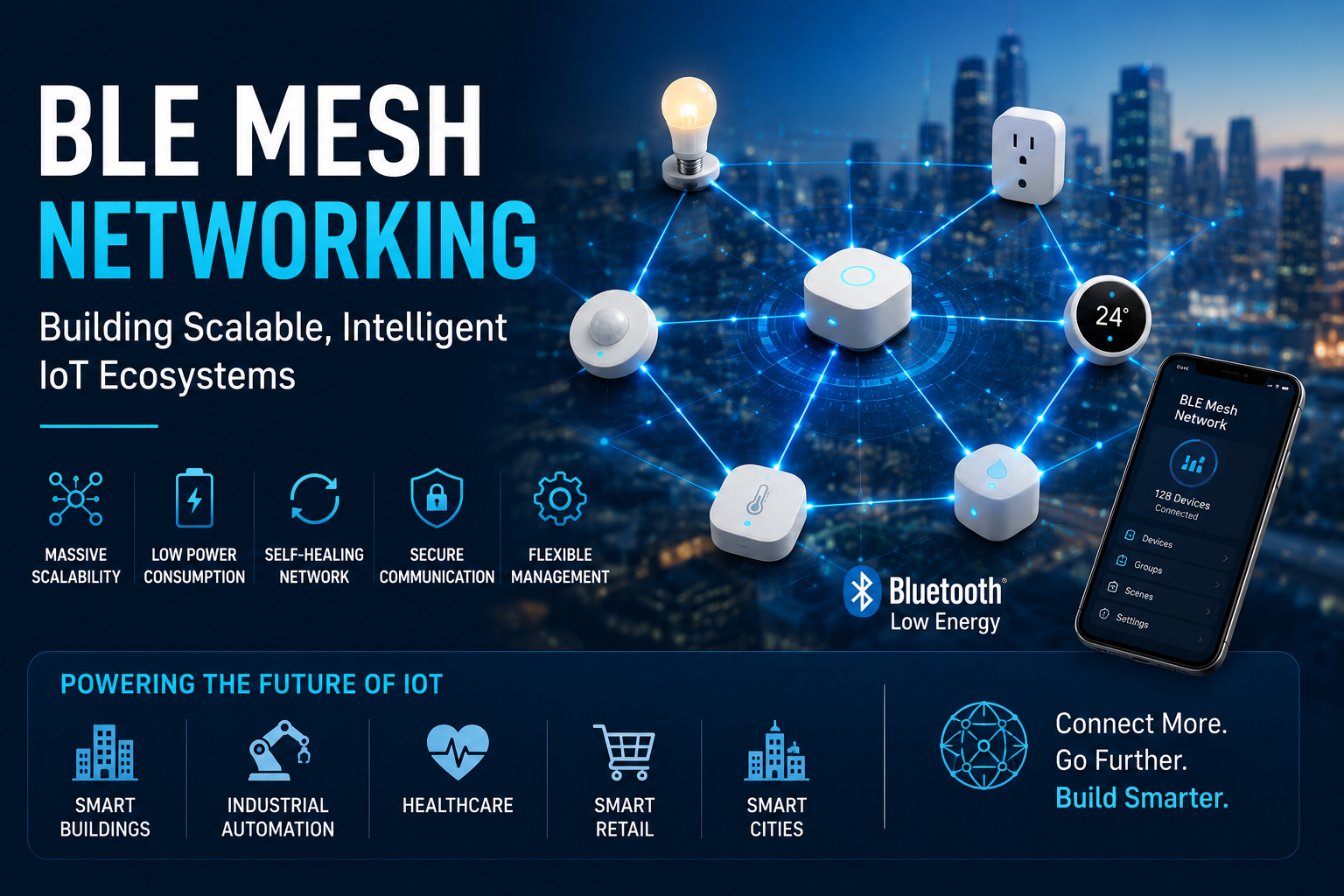
    BLE Mesh Networking in 2026: Building Scalable, Intelligent IoT Ecosystems

    The Internet of Things (IoT) is growing faster than ever, connecting billions of smart devices across industries. As businesses expand their IoT deployments, they need communication technologies that are scalable, energy-efficient, secure, and reliable. Traditional point-to-point Bluetooth connections often struggle to support large networks of connected devices.

    This is where Bluetooth Low Energy (BLE) Mesh Networking stands out. BLE Mesh enables thousands of devices to communicate across a decentralized network, making it ideal for smart buildings, industrial automation, healthcare, retail, and smart cities.

    At IoTBLE, we develop advanced BLE Mesh solutions that help businesses build intelligent, future-ready IoT ecosystems.


    What Is BLE Mesh Networking?

    BLE Mesh is a many-to-many communication protocol built on Bluetooth Low Energy technology. Instead of relying on direct connections between devices, each node can relay messages throughout the network, allowing information to travel across multiple devices.

    This architecture creates a highly scalable and resilient communication system capable of supporting large IoT deployments.


    How BLE Mesh Works

    A BLE Mesh network consists of different node types working together to deliver reliable communication.

    Key components include:

    • Relay Nodes – Forward messages throughout the network.
    • Low Power Nodes (LPNs) – Battery-operated devices that conserve energy.
    • Friend Nodes – Store messages for low-power devices until they wake up.
    • Proxy Nodes – Allow smartphones and legacy Bluetooth devices to communicate with the mesh network.

    This distributed approach eliminates single points of failure and improves network reliability.


    Key Benefits of BLE Mesh Networking

    Massive Scalability

    BLE Mesh can support thousands of connected devices within a single network, making it suitable for enterprise-scale IoT deployments.


    Low Power Consumption

    Battery-powered sensors and devices can operate for years without frequent battery replacements, significantly reducing maintenance costs.


    Self-Healing Network

    If one communication path becomes unavailable, messages automatically find alternative routes through other nodes, improving reliability.


    Secure Communication

    BLE Mesh incorporates multiple layers of security, including:

    • AES-128 encryption
    • Secure key management
    • Authentication
    • Device provisioning
    • Network isolation

    These features help protect IoT environments from unauthorized access.


    Flexible Device Management

    Administrators can remotely:

    • Add devices
    • Remove devices
    • Update firmware
    • Configure settings
    • Monitor device status

    without disrupting the entire network.


    Applications of BLE Mesh in IoT

    Smart Buildings

    BLE Mesh enables centralized control of:

    • Smart lighting
    • HVAC systems
    • Occupancy sensors
    • Energy management
    • Access control

    Industrial Automation

    Manufacturers use BLE Mesh to monitor:

    • Machinery
    • Environmental conditions
    • Predictive maintenance
    • Equipment health
    • Worker safety

    Healthcare

    Hospitals deploy BLE Mesh for:

    • Patient monitoring
    • Medical asset tracking
    • Smart hospital rooms
    • Environmental monitoring
    • Emergency alerts

    Smart Retail

    Retail businesses leverage BLE Mesh for:

    • Indoor navigation
    • Smart shelves
    • Digital signage
    • Inventory tracking
    • Personalized customer experiences

    Smart Cities

    Municipalities implement BLE Mesh for:

    • Street lighting
    • Environmental monitoring
    • Parking management
    • Traffic control
    • Public safety systems

    Why Businesses Are Choosing BLE Mesh Over Traditional Bluetooth

    Traditional Bluetooth works well for direct device-to-device communication but has limitations in larger deployments.

    BLE Mesh offers significant advantages:

    • Larger coverage area
    • Multi-hop communication
    • Better reliability
    • Lower maintenance
    • Greater scalability
    • Reduced infrastructure costs
    • Improved network resilience

    These capabilities make BLE Mesh a preferred solution for enterprise IoT.


    Technologies Used in BLE Mesh Solutions

    Modern BLE Mesh platforms integrate:

    • Bluetooth 5.4
    • IoT Sensors
    • Edge Computing
    • Cloud Platforms
    • Artificial Intelligence (AI)
    • Machine Learning
    • Mobile Applications
    • Secure APIs
    • Firmware Over-the-Air (FOTA) Updates
    • Real-Time Analytics Dashboards

    Together, these technologies create intelligent, connected environments capable of adapting to changing business needs.


    Why Choose IoTBLE?

    At IoTBLE, we specialize in designing and developing scalable Bluetooth Low Energy solutions tailored to diverse industries.

    Our expertise includes:

    • BLE Mesh Development
    • Custom IoT Application Development
    • Bluetooth Firmware Development
    • Mobile App Integration
    • IoT Device Connectivity
    • BLE Gateway Solutions
    • Sensor Network Development
    • Cloud Integration
    • Remote Device Management
    • Ongoing Maintenance and Support

    We build secure, energy-efficient, and scalable BLE ecosystems that empower businesses to innovate with confidence.


    The Future of BLE Mesh Networking

    As IoT adoption continues to grow, BLE Mesh will play a critical role in enabling intelligent connected ecosystems.

    Emerging trends include:

    • AI-driven device management
    • Digital twins for IoT infrastructure
    • Predictive maintenance
    • Edge AI processing
    • Smart energy optimization
    • Autonomous building management
    • Real-time location services (RTLS)
    • Integration with Matter and next-generation smart home standards

    Businesses investing in BLE Mesh today will be well-positioned to support tomorrow’s connected world.


    Conclusion

    BLE Mesh networking is transforming the way connected devices communicate. Its ability to deliver scalable, secure, low-power, and resilient communication makes it a foundational technology for modern IoT ecosystems.

    Whether you’re developing a smart building, connected healthcare platform, industrial monitoring system, or smart retail solution, BLE Mesh provides the flexibility and performance needed for long-term success.

    Ready to build a scalable BLE Mesh solution?
    Partner with IoTBLE to develop secure, intelligent, and future-ready Bluetooth Low Energy solutions that power the next generation of IoT innovation.


    Frequently Asked Questions (FAQs)

    What is BLE Mesh Networking?

    BLE Mesh is a Bluetooth Low Energy networking protocol that allows thousands of devices to communicate using a many-to-many architecture.

    How is BLE Mesh different from traditional Bluetooth?

    Traditional Bluetooth primarily supports direct device-to-device communication, while BLE Mesh enables multi-hop communication across large networks of connected devices.

    Which industries benefit from BLE Mesh?

    Smart buildings, healthcare, manufacturing, retail, logistics, hospitality, and smart city projects all benefit from BLE Mesh technology.

    Is BLE Mesh secure?

    Yes. BLE Mesh includes strong security features such as AES-128 encryption, secure provisioning, authentication, and key management to protect connected devices and data.

    Can BLE Mesh integrate with cloud platforms?

    Yes. BLE Mesh solutions can integrate with cloud platforms, mobile applications, analytics dashboards, and enterprise IoT systems for centralized monitoring and management.

  • IoT BLE Solutions: Connecting the Physical World with Intelligent Digital Experiences

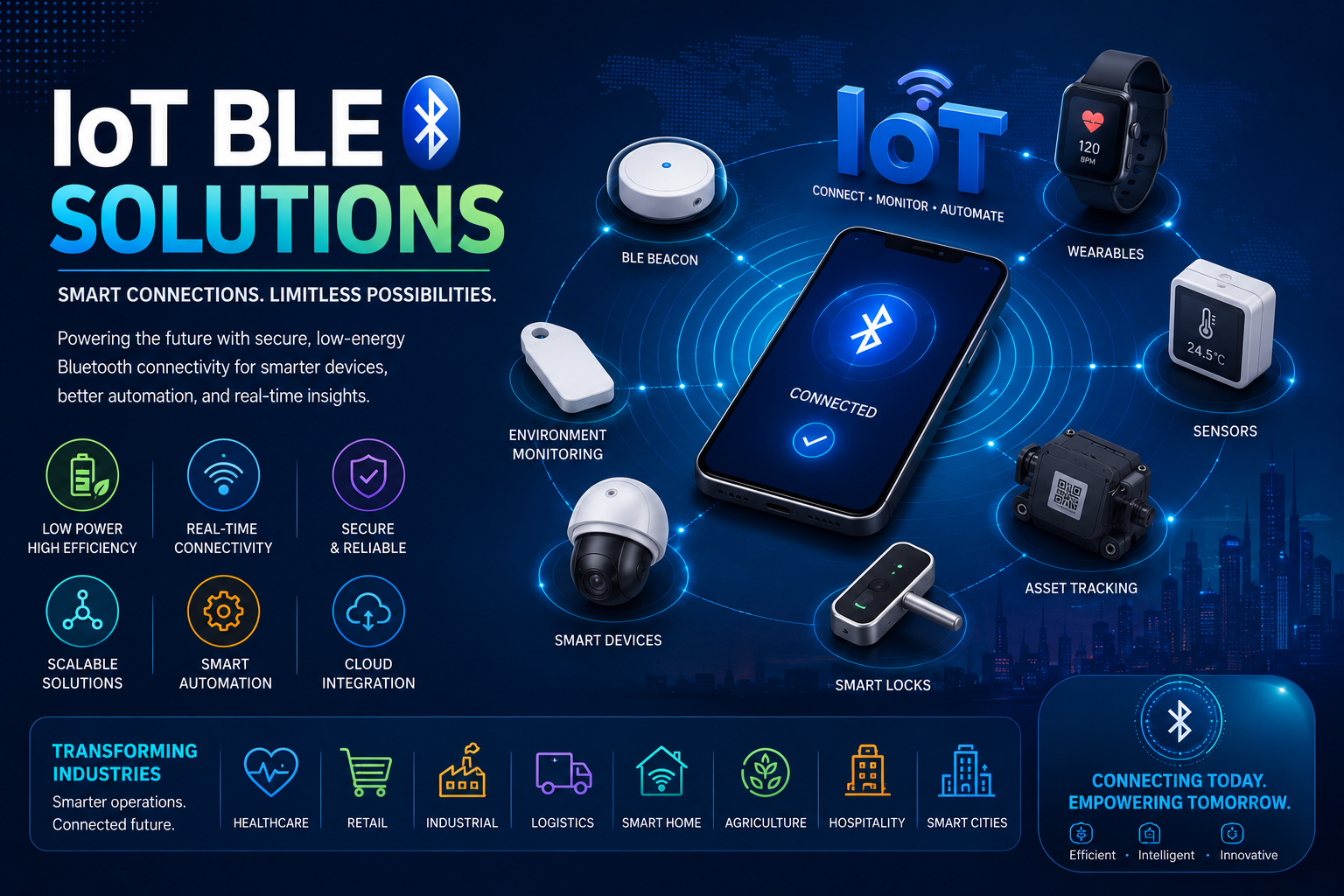
    IoT BLE Solutions: Connecting the Physical World with Intelligent Digital Experiences

    Imagine walking into a retail store where your phone instantly receives personalized offers, a hospital where patient vitals are monitored continuously through wearable devices, or a factory where machines automatically report maintenance issues before they fail.

    This isn’t the future—it’s happening today through IoT (Internet of Things) combined with Bluetooth Low Energy (BLE) technology.

    BLE has become one of the most reliable communication technologies for smart devices because it consumes extremely low power while delivering secure, fast, and accurate wireless communication.

    As businesses accelerate digital transformation, IoT BLE solutions are becoming the backbone of intelligent automation, real-time monitoring, asset tracking, predictive maintenance, and connected customer experiences.

    In this guide, we’ll explore everything about IoT BLE development and how it is reshaping industries worldwide.


    What is IoT BLE?

    IoT BLE (Internet of Things with Bluetooth Low Energy) refers to smart devices that communicate wirelessly using Bluetooth Low Energy technology.

    Unlike traditional Bluetooth, BLE is designed for devices that must operate for months—or even years—on a single battery.

    These devices continuously exchange data while consuming minimal power.

    Examples include:

    • Smart Watches
    • Medical Devices
    • Fitness Bands
    • BLE Beacons
    • Smart Locks
    • Temperature Sensors
    • Asset Tracking Tags
    • Industrial Equipment
    • Smart Lighting
    • Environmental Monitoring Systems

    Why BLE is Powering the Next Generation of IoT

    Businesses need devices that are:

    • Always connected
    • Battery efficient
    • Secure
    • Affordable
    • Fast
    • Scalable

    BLE meets all these requirements.

    Compared to Wi-Fi or traditional Bluetooth, BLE offers:

    • Extremely low power consumption
    • Faster device discovery
    • Reliable short-range communication
    • Cost-effective hardware
    • Secure encrypted communication
    • Easy smartphone integration

    This makes BLE ideal for modern IoT ecosystems.


    The Smart Business Revolution

    Modern businesses no longer rely on manual monitoring.

    Instead, connected devices continuously collect valuable information and instantly communicate with mobile applications and cloud platforms.

    Imagine a warehouse where every product automatically updates its location.

    Imagine a hospital where patient monitoring never stops.

    Imagine retail stores that understand customer movement in real time.

    This is the power of IoT BLE.


    Key Benefits of IoT BLE Solutions

    1. Ultra-Low Power Consumption

    Battery-powered devices can operate for years without replacement.

    Perfect for:

    • Sensors
    • Wearables
    • Asset trackers
    • Medical equipment
    • Smart meters

    2. Real-Time Data Collection

    BLE devices continuously send data to mobile apps or cloud dashboards.

    Businesses gain insights into:

    • Equipment performance
    • Customer behavior
    • Inventory movement
    • Environmental conditions
    • Employee safety

    3. Instant Device Communication

    BLE provides near real-time communication between:

    • Smartphones
    • Tablets
    • Sensors
    • Smart machines
    • Industrial equipment
    • Gateways

    4. Lower Operational Costs

    Automation reduces:

    • Manual inspections
    • Human errors
    • Maintenance costs
    • Downtime
    • Energy consumption

    5. Better Customer Experiences

    BLE enables:

    • Indoor navigation
    • Personalized promotions
    • Contactless interactions
    • Smart payments
    • Interactive shopping experiences

    Innovative Use Cases of IoT BLE

    Smart Hospitals

    Healthcare providers use BLE to:

    • Monitor patient vitals
    • Track medical equipment
    • Improve emergency response
    • Manage hospital assets
    • Reduce operational costs

    Retail Intelligence

    BLE transforms shopping through:

    • Smart shelves
    • Digital coupons
    • Customer journey analytics
    • Indoor positioning
    • Contactless checkout

    Industrial IoT

    Factories use BLE for:

    • Predictive maintenance
    • Equipment diagnostics
    • Worker safety
    • Machine monitoring
    • Production analytics

    Smart Agriculture

    Farmers monitor:

    • Soil moisture
    • Temperature
    • Livestock movement
    • Water usage
    • Crop conditions

    Smart Buildings

    BLE powers:

    • Smart lighting
    • Occupancy monitoring
    • Energy optimization
    • Security systems
    • HVAC automation

    Connected Logistics

    Track shipments using:

    • BLE Beacons
    • GPS Integration
    • Temperature Sensors
    • Warehouse Automation
    • Fleet Monitoring

    Must-Have Features in an IoT BLE Solution

    BLE Device Pairing

    Simple and secure device onboarding.


    Real-Time Dashboard

    Monitor all connected devices from one screen.


    Remote Monitoring

    View sensor data from anywhere.


    OTA Firmware Updates

    Update device software without physical access.


    Smart Alerts

    Receive notifications for:

    • Low battery
    • Device disconnect
    • Temperature changes
    • Motion detection
    • Security events

    Data Analytics

    Analyze:

    • Device health
    • Usage trends
    • Sensor history
    • Predictive insights

    Cloud Synchronization

    Synchronize data securely across multiple devices and locations.


    Industries Benefiting from IoT BLE

    • Healthcare
    • Manufacturing
    • Retail
    • Logistics
    • Hospitality
    • Automotive
    • Smart Cities
    • Agriculture
    • Education
    • Warehousing
    • Energy
    • Real Estate
    • Sports & Fitness

    Technologies Behind IoT BLE Development

    Mobile

    • Flutter
    • React Native
    • Kotlin
    • Swift

    Backend

    • Node.js
    • Python
    • Java
    • .NET

    Cloud

    • AWS IoT
    • Microsoft Azure IoT
    • Google Cloud IoT

    BLE Protocols

    • GATT
    • GAP
    • Beacon Protocols
    • Mesh Networking

    Databases

    • PostgreSQL
    • MongoDB
    • Firebase

    AI + IoT BLE = Intelligent Automation

    Artificial Intelligence is making BLE devices smarter.

    AI can:

    • Predict equipment failures
    • Detect unusual patterns
    • Optimize battery usage
    • Analyze sensor behavior
    • Recommend preventive maintenance
    • Automate business decisions

    This combination creates self-learning IoT ecosystems.


    Security in IoT BLE

    Modern BLE applications implement:

    • End-to-end encryption
    • Secure pairing
    • Device authentication
    • Role-based access
    • Secure firmware updates
    • Cloud security
    • API protection
    • Data encryption at rest

    Security is built into every layer.


    Future of IoT BLE

    The next generation of BLE technology will enable:

    • AI-powered smart sensors
    • Digital twins
    • Edge AI computing
    • Smart factories
    • Autonomous warehouses
    • Connected healthcare
    • Smart transportation
    • Predictive maintenance
    • Energy-efficient cities
    • Intelligent retail ecosystems

    IoT BLE is rapidly evolving from simple connectivity to autonomous, intelligent systems.


    Why Choose QuartusTech for IoT BLE Development?

    At QuartusTech, we build next-generation IoT BLE solutions that bridge the gap between hardware and intelligent software.

    Our expertise includes:

    • Custom BLE Mobile Apps
    • IoT Device Integration
    • BLE Beacon Solutions
    • Smart Wearable Applications
    • Industrial IoT Platforms
    • Cloud IoT Dashboards
    • AI-Powered Analytics
    • Firmware Integration
    • Cross-Platform Mobile Development
    • End-to-End IoT Product Development

    We help startups and enterprises transform innovative ideas into secure, scalable, and connected IoT ecosystems.


    Final Thoughts

    IoT BLE is no longer just a wireless communication technology—it’s the foundation of intelligent, connected experiences. From healthcare and logistics to retail and industrial automation, BLE enables businesses to build smarter products, reduce costs, and unlock real-time insights.

    If you’re planning to develop a smart device, wearable, beacon solution, or connected IoT platform, investing in custom IoT BLE development can help future-proof your business and deliver meaningful value to your customers.


    Frequently Asked Questions (FAQs)

    What is IoT BLE?

    IoT BLE combines Internet of Things devices with Bluetooth Low Energy technology to enable secure, low-power wireless communication.

    Why is BLE better than traditional Bluetooth for IoT?

    BLE uses significantly less power, supports fast device discovery, and is ideal for battery-powered devices that need long operating life.

    Which industries use IoT BLE?

    Healthcare, retail, manufacturing, logistics, agriculture, hospitality, automotive, smart cities, fitness, and many other industries use IoT BLE solutions.

    Can BLE devices connect to cloud platforms?

    Yes. BLE devices typically communicate with mobile apps or gateways, which then securely synchronize data with cloud platforms for monitoring and analytics.

    Why choose QuartusTech for IoT BLE development?

    QuartusTech delivers end-to-end IoT BLE solutions, including hardware integration, mobile apps, cloud platforms, AI-powered analytics, and scalable architectures tailored to your business needs.