PCI Developers Navbar

Tag: services

  • Smart Asset Tracking with BLE and IoT: The Future of Real-Time Business Visibility

    Smart Asset Tracking with BLE and IoT: The Future of Real-Time Business Visibility

    Introduction

    Imagine knowing the exact location of your equipment, inventory, medical devices, or company assets at any moment—without expensive GPS hardware or manual tracking.

    This is becoming a reality through Bluetooth Low Energy (BLE) and the Internet of Things (IoT).

    Modern businesses lose valuable time and money because of misplaced assets, inventory inaccuracies, delayed maintenance, and inefficient operations. Traditional tracking methods often rely on manual updates, which can lead to errors and outdated information.

    BLE-powered IoT solutions provide a smarter approach by enabling real-time asset visibility, automated monitoring, and data-driven decision-making.

    At IoTBLE, we help organizations build intelligent BLE and IoT solutions that improve efficiency, reduce operational costs, and create smarter connected environments.

    What Is BLE-Based Asset Tracking?

    BLE asset tracking uses small Bluetooth Low Energy tags attached to physical assets.

    These tags communicate with:

    • Smartphones
    • BLE Gateways
    • IoT Sensors
    • Cloud Platforms

    The collected data is processed and displayed on dashboards, allowing businesses to monitor the movement and status of valuable assets in real time.

    Unlike GPS, BLE is designed for indoor environments where satellite signals are weak or unavailable.

    Why Businesses Need Real-Time Asset Visibility

    Many organizations still depend on spreadsheets, barcode scans, or manual inventory checks.

    These methods create several challenges:

    • Lost equipment
    • Inventory inaccuracies
    • Time-consuming searches
    • Delayed maintenance
    • Increased operational costs
    • Poor resource utilization

    A BLE IoT solution automates asset tracking, helping businesses make faster and more informed decisions.

    How BLE IoT Asset Tracking Works

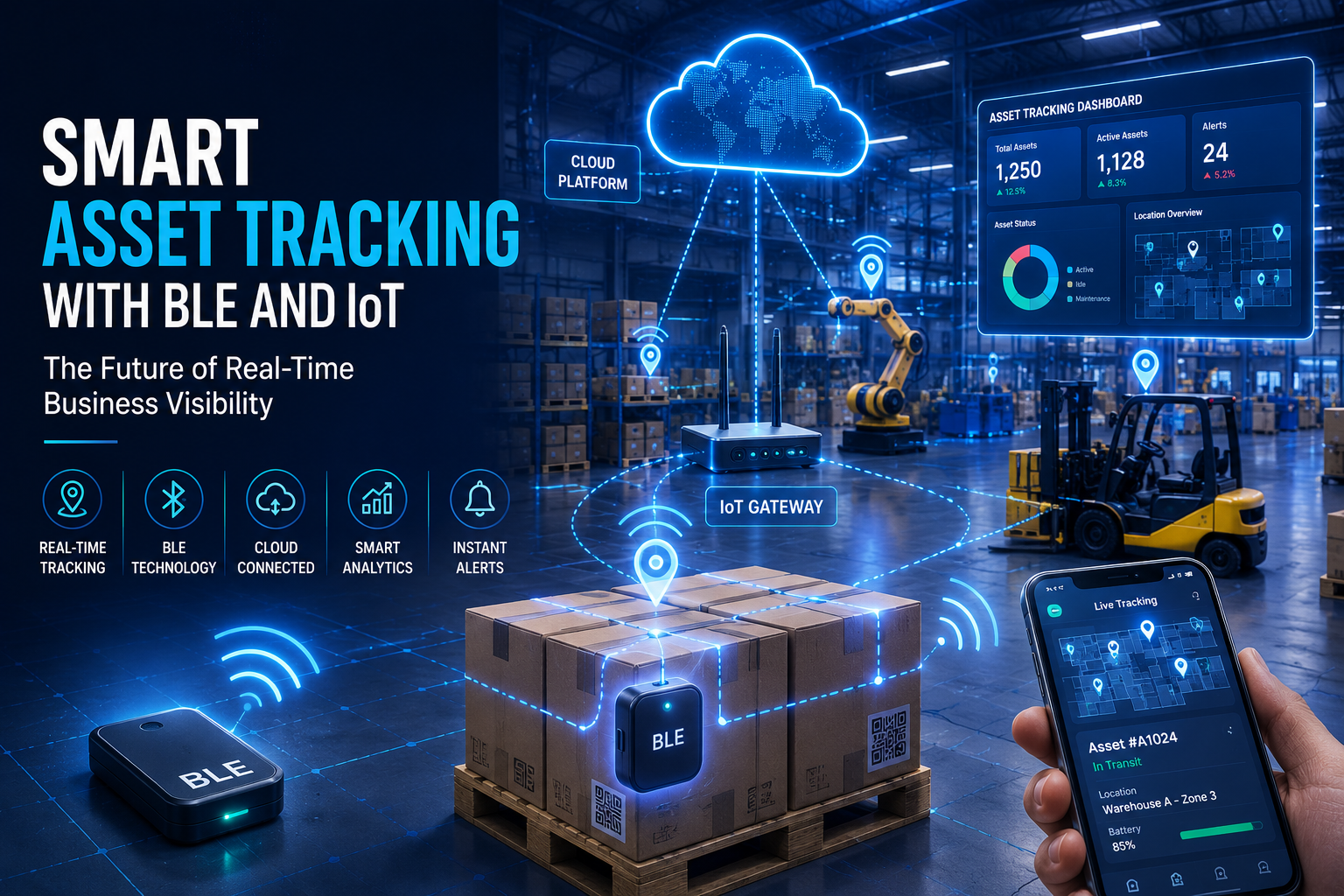
    A typical asset tracking system includes four main components:

    1. BLE Tags

    Compact Bluetooth tags are attached to equipment, tools, inventory, or valuable assets.

    These tags periodically broadcast their identity and status.

    2. BLE Gateways

    Gateways detect nearby BLE tags and securely transmit the collected information to cloud servers.

    3. Cloud Platform

    The cloud stores location history, device status, battery information, and other operational data.

    4. Dashboard & Mobile App

    Managers can view:

    • Live asset locations
    • Usage history
    • Battery status
    • Alerts
    • Reports
    • Maintenance schedules

    The result is complete visibility across the organization.

    Industries Benefiting from BLE IoT Tracking

    Healthcare

    Hospitals use BLE tracking for:

    • Wheelchairs
    • Medical equipment
    • Infusion pumps
    • Patient monitoring devices
    • Emergency equipment

    Staff spend less time searching for equipment and more time caring for patients.

    Manufacturing

    Factories monitor:

    • Production equipment
    • Tools
    • Machinery
    • Spare parts
    • Safety equipment

    This improves productivity while reducing equipment downtime.

    Warehousing & Logistics

    BLE helps warehouses manage:

    • Inventory movement
    • Storage locations
    • Forklifts
    • Shipping containers
    • High-value goods

    Real-time visibility improves inventory accuracy and order fulfillment.

    Retail

    Retailers use BLE technology for:

    • Smart inventory management
    • Product tracking
    • Customer engagement
    • In-store navigation
    • Theft prevention

    Hospitality

    Hotels can track:

    • Housekeeping equipment
    • Luggage carts
    • Maintenance tools
    • Conference equipment

    This improves operational efficiency and customer service.

    Key Features of BLE IoT Asset Tracking

    Modern asset tracking platforms include:

    • Real-time monitoring
    • Indoor positioning
    • Automated alerts
    • Battery monitoring
    • Geofencing
    • Historical reports
    • Analytics dashboards
    • Cloud synchronization
    • Mobile applications
    • Multi-location management

    These features provide businesses with greater operational control.

    Why BLE Is Better Than Traditional Tracking

    BLE offers several advantages:

    Low Power Consumption

    BLE tags can operate for months or even years on a single battery, depending on configuration.

    Affordable Hardware

    BLE tags are typically less expensive than GPS tracking devices.

    Indoor Accuracy

    BLE performs well inside buildings where GPS signals may be unreliable.

    Easy Smartphone Integration

    Most smartphones support Bluetooth Low Energy, making deployment simpler.

    Scalable Infrastructure

    Organizations can expand from a few devices to thousands without redesigning the entire system.

    AI and BLE IoT

    Artificial Intelligence adds another layer of intelligence to asset tracking.

    AI can:

    • Predict maintenance schedules
    • Detect unusual movement
    • Identify underutilized assets
    • Forecast inventory requirements
    • Generate automated insights

    Instead of simply showing where an asset is, AI helps explain what actions businesses should take next.

    Security Considerations

    Every IoT deployment should prioritize security.

    Best practices include:

    • Secure BLE pairing
    • Data encryption
    • Device authentication
    • Role-based access
    • Secure APIs
    • Firmware updates
    • Activity logging

    Security should be part of the architecture—not an afterthought.

    IoTBLE Development Services

    IoTBLE provides end-to-end BLE and IoT development services, including:

    • BLE Mobile App Development
    • Custom IoT Software Development
    • Asset Tracking Solutions
    • BLE Beacon Development
    • IoT Dashboard Development
    • Embedded Software Integration
    • Cloud IoT Platforms
    • AI-Powered Analytics
    • API Integration
    • Device Management Systems

    Our solutions are designed to scale with your business while maintaining performance and reliability.

    Why Choose IoTBLE?

    At IoTBLE, we combine expertise in:

    • Bluetooth Low Energy
    • IoT Architecture
    • Mobile Applications
    • Cloud Platforms
    • AI Integration
    • Embedded Systems
    • UX/UI Design
    • Enterprise Software Development

    We don’t just connect devices—we create intelligent ecosystems that help businesses operate more efficiently.

    Conclusion

    Asset visibility is becoming a competitive advantage.

    BLE and IoT technologies enable businesses to monitor equipment, improve inventory management, reduce operational costs, and make smarter decisions based on real-time data.

    As organizations continue their digital transformation journey, BLE-powered asset tracking will play an increasingly important role across industries.

    Whether you’re building a smart warehouse, a connected hospital, or an intelligent manufacturing facility, IoTBLE can help you create secure, scalable, and future-ready BLE IoT solutions.

    Ready to transform your business with BLE-powered asset tracking? Partner with IoTBLE and build smarter connected solutions today.
  • When IoT Meets Bluetooth Low Energy: Building Smarter, Connected Products for 2026

    When IoT Meets Bluetooth Low Energy: Building Smarter, Connected Products for 2026

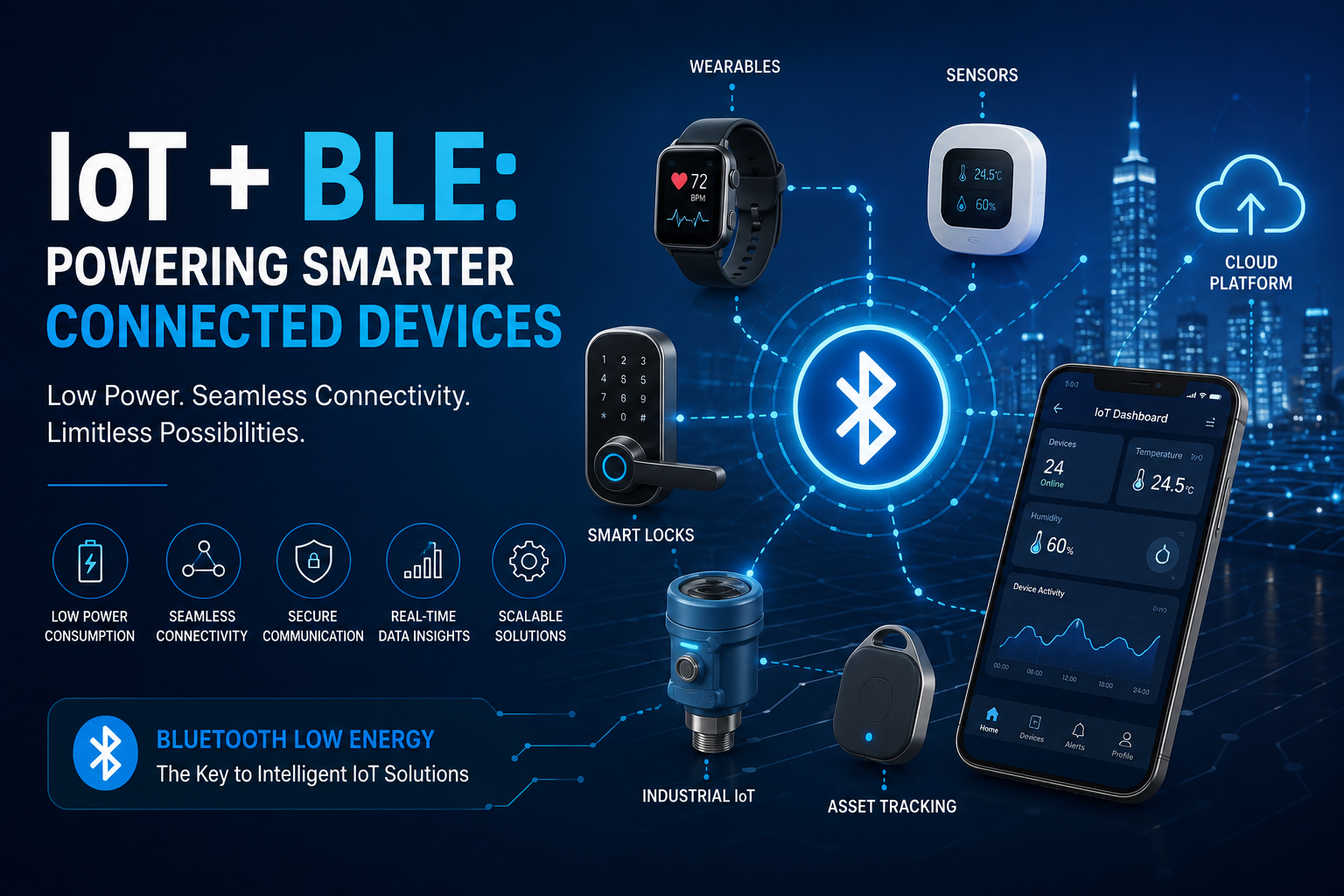
    The Internet of Things is no longer limited to smart speakers, fitness bands, or connected home devices. Today, IoT technology is helping businesses monitor equipment, automate operations, collect real-time data, improve customer experiences, and build intelligent products.

    However, an IoT solution is only as effective as the technology that connects its devices.

    This is where Bluetooth Low Energy (BLE) plays an important role.

    BLE enables devices to communicate wirelessly while using very little power. When combined with IoT, it creates connected solutions that are efficient, scalable, responsive, and suitable for many industries.

    At IoTBLE, we help businesses transform ideas into intelligent IoT and BLE-powered applications designed for real-world use.

    What Is Bluetooth Low Energy?

    Bluetooth Low Energy, commonly called BLE, is a wireless communication technology designed to transfer small amounts of data while consuming significantly less power than traditional Bluetooth connections.

    BLE is ideal for devices that need to operate for months or even years using small batteries.

    Common BLE-enabled devices include:

    • Smartwatches
    • Fitness trackers
    • Medical monitoring devices
    • Smart locks
    • Wireless sensors
    • Asset-tracking devices
    • Smart home products
    • Industrial monitoring equipment
    • Connected retail devices

    BLE allows these devices to exchange information with smartphones, tablets, gateways, and cloud platforms without requiring continuous high-power connectivity.

    Why BLE Is Important for IoT Development

    IoT devices often need to remain connected for long periods while operating with limited battery capacity.

    Traditional wireless technologies may consume more power than necessary for simple sensor data, device status updates, or short communication events.

    BLE provides an efficient alternative.

    Its key advantages include:

    Low Power Consumption

    BLE is designed to reduce energy usage. Devices can remain in low-power modes and communicate only when required.

    This makes BLE suitable for battery-powered sensors, wearables, healthcare devices, and smart products.

    Fast Device Connectivity

    BLE devices can quickly discover and connect with nearby smartphones, tablets, and gateways.

    This supports responsive user experiences and real-time data exchange.

    Wide Device Compatibility

    BLE is supported by modern Android and iOS devices, making it easier to develop connected mobile applications without requiring additional hardware.

    Cost-Effective Hardware

    BLE modules are widely available and can be integrated into many types of connected products.

    Secure Communication

    BLE supports security features such as authentication, encryption, and secure pairing. However, security must be correctly implemented during hardware, firmware, and application development.

    How IoT and BLE Work Together

    A typical BLE-powered IoT ecosystem may include four main components:

    1. BLE Device

    The physical device collects information or performs an action.

    Examples include:

    • Temperature sensors
    • Smart locks
    • Heart-rate monitors
    • Fitness devices
    • Industrial equipment sensors

    2. Mobile Application or Gateway

    A smartphone, tablet, or dedicated gateway communicates with the BLE device.

    The application may display device information, send commands, configure settings, or transfer data.

    3. Cloud Platform

    The cloud stores data and makes it available for analysis, reporting, and remote monitoring.

    4. Business Dashboard

    A web-based dashboard allows administrators to monitor devices, review data, manage users, and make informed decisions.

    Together, these components create a connected ecosystem.

    For example, a temperature sensor can collect environmental data, send it through BLE to a mobile gateway, upload it to the cloud, and display real-time information on a business dashboard.

    Real-World Applications of IoT BLE Technology

    Smart Healthcare

    BLE-enabled healthcare devices can collect and transmit information from wearable monitors and connected medical equipment.

    Possible applications include:

    • Remote patient monitoring
    • Activity tracking
    • Medication reminders
    • Connected health devices
    • Wellness monitoring

    These solutions can help healthcare teams access information more efficiently while improving patient engagement.

    Smart Homes

    BLE technology can support connected home experiences through:

    • Smart locks
    • Smart lighting
    • Connected thermostats
    • Security sensors
    • Home automation devices

    Users can control compatible devices through mobile applications and automated workflows.

    Industrial IoT

    Industrial businesses use IoT and BLE to monitor equipment, track assets, and improve operational visibility.

    Examples include:

    • Machine condition monitoring
    • Equipment tracking
    • Environmental sensors
    • Predictive maintenance systems
    • Worker safety solutions

    Real-time data can help businesses identify potential issues before they become major operational problems.

    Retail and Customer Engagement

    BLE beacons can provide location-aware experiences inside stores, events, and large facilities.

    Businesses can use BLE for:

    • Proximity-based notifications
    • Indoor navigation
    • Customer engagement
    • Smart inventory tracking
    • Personalized experiences

    Logistics and Asset Tracking

    BLE tags can help organizations monitor the location and movement of important assets.

    Applications include:

    • Warehouse asset tracking
    • Equipment management
    • Inventory monitoring
    • Supply-chain visibility
    • Facility management

    Fitness and Wearable Technology

    Wearable devices use BLE to communicate with smartphones while maintaining efficient battery performance.

    Common examples include:

    • Fitness trackers
    • Smartwatches
    • Sleep-monitoring devices
    • Sports performance sensors

    Key Challenges in BLE IoT Development

    Building a connected product involves more than connecting a device to a mobile application.

    Developers must consider several technical factors.

    Device Compatibility

    Different smartphones, operating systems, and BLE chipsets may behave differently.

    A reliable solution should be tested across multiple devices and operating-system versions.

    Connection Stability

    BLE connections can be affected by distance, physical barriers, radio interference, and device behavior.

    The application should handle disconnections and reconnect devices smoothly.

    Battery Optimization

    Low energy consumption depends on proper configuration.

    Connection intervals, data-transfer frequency, advertising settings, and device behavior should be optimized according to the product’s requirements.

    Data Security

    Connected devices may collect sensitive or business-critical information.

    Security should be considered across:

    • Device firmware
    • BLE communication
    • Mobile applications
    • Cloud platforms
    • APIs
    • User authentication

    Scalability

    A prototype may work with one device but face challenges when thousands of devices are deployed.

    A scalable architecture should support future growth from the beginning.

    How IoTBLE Builds Connected Solutions

    At IoTBLE, we provide end-to-end development services for businesses creating connected products and intelligent IoT ecosystems.

    Our development process includes:

    Product Discovery

    We understand the product idea, target users, device requirements, business goals, and technical challenges.

    BLE Architecture Planning

    Our team defines how devices, mobile applications, cloud services, and dashboards will communicate.

    Mobile App Development

    We develop Android and iOS applications that connect with BLE-enabled devices and provide intuitive user experiences.

    IoT Platform Development

    We build cloud-connected platforms for device management, data storage, monitoring, and analytics.

    Device Integration

    We integrate BLE devices with mobile applications, gateways, APIs, and cloud platforms.

    Testing and Optimization

    We test device discovery, pairing, connectivity, data transfer, battery performance, security, and application behavior.

    Deployment and Support

    We help businesses launch, maintain, and improve their connected products.

    Why Choose IoTBLE?

    IoTBLE combines expertise in:

    • Bluetooth Low Energy application development
    • IoT software development
    • Android and iOS applications
    • Custom web platforms
    • Cloud integration
    • IoT dashboards
    • Device connectivity
    • API development
    • Real-time data solutions
    • Connected product development

    We focus on building solutions that are practical, secure, scalable, and designed around real business requirements.

    The Future of IoT and BLE

    The future of connected technology will involve more intelligent devices working together.

    As businesses adopt smart sensors, connected products, edge computing, AI-powered analytics, and automated systems, efficient communication technologies will become increasingly important.

    BLE will continue to support many IoT applications because it offers:

    • Low power consumption
    • Broad mobile compatibility
    • Affordable hardware integration
    • Reliable short-range communication
    • Flexible use across industries

    The next generation of connected products will not simply collect information. They will analyze data, respond to changing conditions, automate actions, and provide useful insights.

    Final Thoughts

    IoT and Bluetooth Low Energy are helping businesses create smarter products and more connected experiences.

    From healthcare and fitness to industrial automation, retail, logistics, and smart homes, BLE-powered IoT solutions can improve visibility, efficiency, automation, and customer engagement.

    Building a successful connected product requires the right combination of hardware, firmware, mobile applications, cloud technology, security, and user experience.

    At IoTBLE, we help businesses bring these technologies together and turn innovative ideas into reliable, scalable, and future-ready connected solutions.

    Ready to build your next IoT or BLE-powered product?

    Connect with IoTBLE to create intelligent devices, connected applications, and scalable IoT solutions.

  • Edge AI and BLE: How Smarter Connected Devices Are Transforming Industries in 2026

    Edge AI and BLE: How Smarter Connected Devices Are Transforming Industries in 2026

    The Internet of Things is entering a more intelligent era.

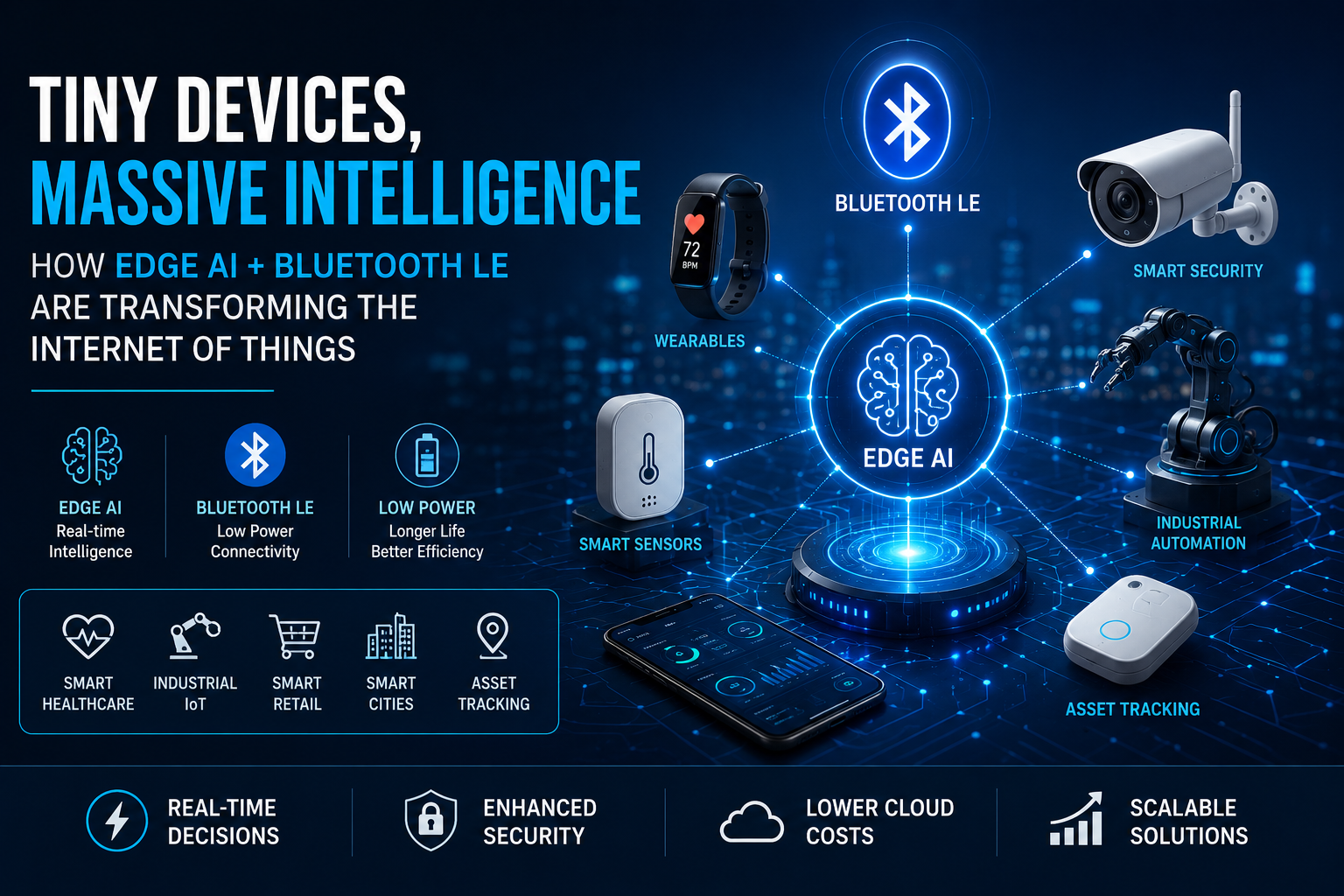
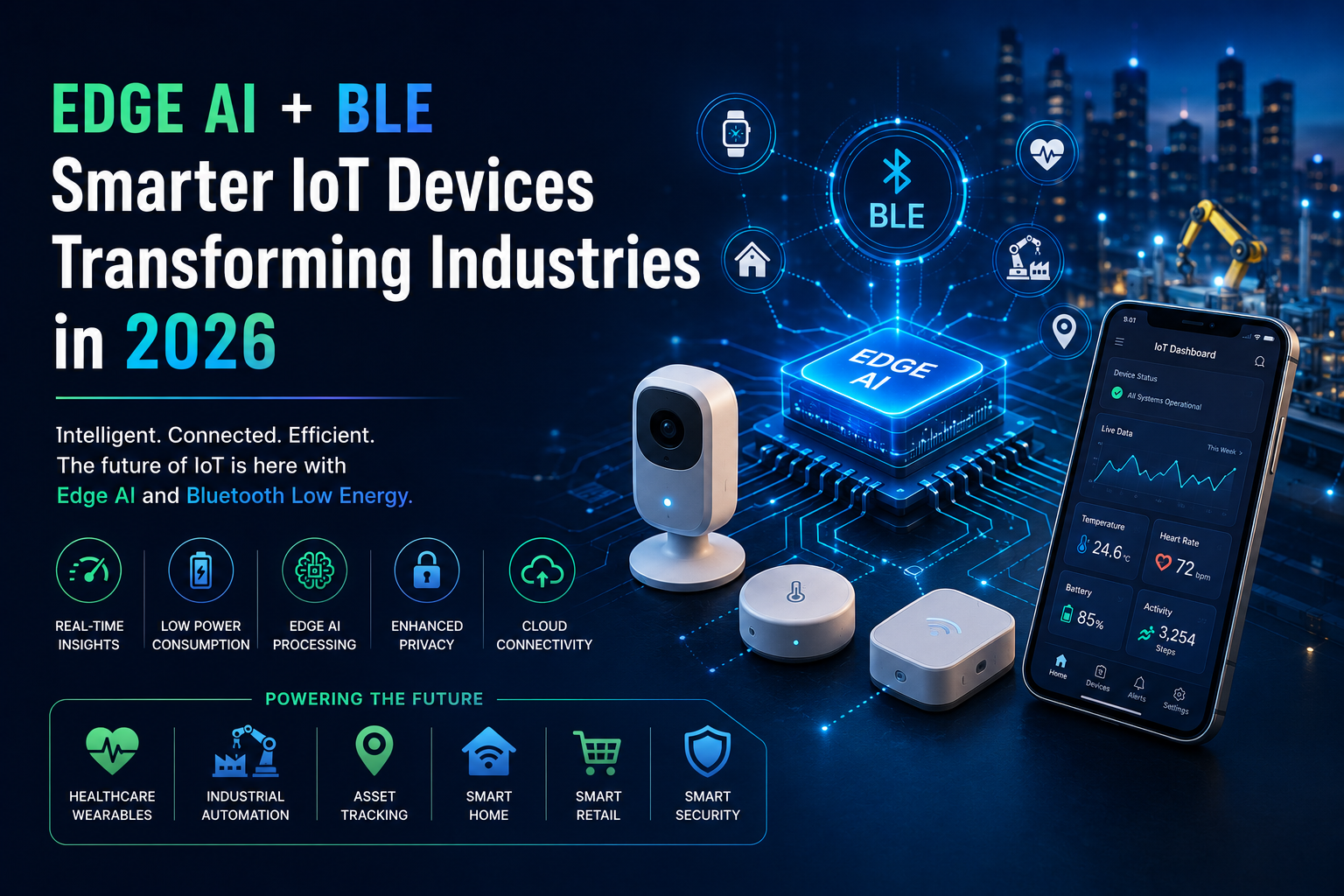
    Connected devices are no longer designed only to collect information and send it to the cloud. In 2026, many IoT solutions are becoming faster, smarter, and more responsive by combining Edge AI with Bluetooth Low Energy (BLE).

    This combination allows devices to collect data, process important information closer to where it is generated, and communicate efficiently with mobile applications, gateways, and connected systems.

    From healthcare wearables and smart homes to industrial monitoring and asset tracking, Edge AI and BLE are helping businesses build intelligent solutions with lower power consumption, faster responses, and improved real-time capabilities.

    What Is Edge AI?

    Edge AI refers to running artificial intelligence models directly on or near a device instead of sending all information to a remote cloud server.

    For example, a smart sensor may analyze data locally and send only important results to the cloud.

    This can provide several benefits:

    • Faster decision-making
    • Lower latency
    • Reduced cloud data usage
    • Improved privacy
    • Better offline functionality
    • More reliable real-time performance

    Edge AI is especially useful when a device must respond quickly or operate in environments with limited internet connectivity.

    What Is Bluetooth Low Energy?

    Bluetooth Low Energy, commonly known as BLE, is a wireless communication technology designed for low-power devices.

    BLE allows connected products to exchange small amounts of information while using less energy than traditional Bluetooth communication.

    BLE is commonly used in:

    • Fitness trackers
    • Smartwatches
    • Healthcare devices
    • Smart locks
    • Asset tracking systems
    • Industrial sensors
    • Smart home products
    • Connected retail devices

    Its low energy consumption makes BLE useful for battery-powered devices that need to operate for long periods.

    Why Combine Edge AI and BLE?

    Edge AI and BLE support different parts of an intelligent IoT solution.

    BLE provides efficient communication between devices, mobile applications, sensors, and gateways. Edge AI helps devices analyze information and make intelligent decisions closer to the source.

    Together, they can support connected solutions that are:

    • Fast
    • Energy-efficient
    • Intelligent
    • Responsive
    • Scalable
    • Privacy-focused

    For example, a wearable health device can collect sensor information, use Edge AI to identify unusual patterns, and send an important alert to a mobile application through BLE.

    The device does not always need to send every piece of raw information to the cloud.

    Top Edge AI and BLE Trends in 2026

    1. Smarter Healthcare Wearables

    Healthcare wearables are becoming more advanced.

    Modern connected devices can support:

    • Heart-rate monitoring
    • Activity tracking
    • Sleep analysis
    • Remote patient monitoring
    • Medication reminders
    • Health alerts

    Edge AI can help analyze sensor information locally, while BLE can connect the device to a smartphone or healthcare platform.

    This can support faster notifications and reduce unnecessary data transmission.

    Healthcare applications should be developed with strong privacy, security, and appropriate professional oversight.

    2. Predictive Maintenance in Industry

    Industrial equipment can generate large amounts of sensor information.

    Edge AI can analyze data from:

    • Motors
    • Pumps
    • Machines
    • Temperature sensors
    • Vibration sensors
    • Production equipment

    The system can identify unusual patterns that may indicate a potential equipment issue.

    BLE sensors can communicate with nearby gateways or mobile devices, helping businesses monitor equipment without relying on complex wired infrastructure.

    Predictive maintenance may help reduce unexpected downtime and improve operational planning.

    3. Intelligent Asset Tracking

    Businesses need to know where important assets are located.

    BLE beacons and connected tags can support:

    • Equipment tracking
    • Warehouse monitoring
    • Inventory visibility
    • Staff and asset location
    • Hospital equipment management

    Edge intelligence can help process location information locally and identify relevant movement patterns.

    This can improve operational visibility while reducing unnecessary cloud processing.

    4. Smart Home Automation

    Smart home technology is becoming more connected and context-aware.

    BLE-enabled devices can support:

    • Smart locks
    • Lighting systems
    • Thermostats
    • Security sensors
    • Home appliances
    • Energy monitoring

    Edge AI can help devices respond to local conditions.

    For example, a smart home system may identify normal activity patterns and automatically adjust lighting or temperature based on user preferences.

    5. Connected Retail Experiences

    Retail businesses are using BLE and IoT technology to improve customer experiences and store operations.

    Possible applications include:

    • Smart inventory tracking
    • Location-based customer experiences
    • Connected POS systems
    • Digital shelf monitoring
    • Asset management

    Edge AI can help analyze store activity and identify useful operational insights in real time.

    6. Low-Power AI Devices

    Energy efficiency is becoming an important part of IoT product development.

    Developers are building smaller AI models that can operate on devices with limited processing power and battery capacity.

    These models can support:

    • Sensor analysis
    • Activity recognition
    • Anomaly detection
    • Voice commands
    • Device monitoring

    BLE complements these devices by providing efficient wireless communication.

    Key Benefits for Businesses

    Faster Responses

    Local AI processing can reduce the time required to send information to a cloud server and receive a result.

    This is useful for:

    • Safety systems
    • Healthcare alerts
    • Industrial monitoring
    • Real-time automation

    Lower Cloud Costs

    Processing selected information at the edge can reduce the amount of data sent to cloud platforms.

    This may lower data transfer and cloud processing requirements.

    Improved Privacy

    Keeping some information closer to the device can reduce unnecessary data transmission.

    However, edge processing does not automatically make a solution secure. Businesses still need encryption, access controls, secure updates, and appropriate data management.

    Better Offline Performance

    Edge AI can allow some device features to continue working when internet access is unavailable or unreliable.

    Longer Battery Life

    BLE is designed for low-power communication, making it useful for battery-operated sensors and connected products.

    Building an Edge AI and BLE Solution

    Developing an intelligent connected product requires both software and hardware planning.

    Step 1: Define the Business Use Case

    Start with a clear question:

    What problem will the connected device solve?

    The team should identify:

    • Target users
    • Device requirements
    • Sensor requirements
    • AI capabilities
    • BLE communication needs
    • Expected outcomes

    Step 2: Select the Right Hardware

    Hardware selection may include:

    • Microcontrollers
    • BLE chipsets
    • Sensors
    • Batteries
    • Edge AI processors
    • Gateways

    The hardware should support the application’s performance, power, size, and cost requirements.

    Step 3: Design the BLE Architecture

    The BLE architecture may include:

    • Device discovery
    • Secure pairing
    • Data services
    • Device communication
    • Mobile app integration
    • Firmware updates

    Step 4: Develop the Edge AI Model

    The AI model should be optimized for the available device resources.

    Developers may consider:

    • Model size
    • Processing requirements
    • Memory usage
    • Accuracy
    • Power consumption

    Step 5: Build the Mobile or Web Application

    The connected application may provide:

    • Device setup
    • Real-time monitoring
    • Alerts
    • Data visualization
    • User controls
    • Device management

    Step 6: Add Security

    Security should be included throughout the solution.

    Important measures may include:

    • Encrypted BLE communication
    • Secure authentication
    • Device identity management
    • Secure firmware updates
    • Access controls
    • Cloud security

    Step 7: Test in Real-World Conditions

    IoT devices should be tested for:

    • BLE connection reliability
    • Battery performance
    • Communication range
    • Device compatibility
    • AI model accuracy
    • Environmental conditions
    • Security

    Challenges to Consider

    Edge AI and BLE offer many benefits, but development can involve challenges.

    Common considerations include:

    • Limited device memory
    • Battery constraints
    • BLE range limitations
    • Hardware compatibility
    • AI model optimization
    • Secure device management
    • Firmware updates
    • Cloud integration

    A successful solution requires careful planning across hardware, firmware, mobile applications, cloud services, and AI systems.

    Build Intelligent IoT and BLE Solutions with IoTBLE

    At IoTBLE, we help businesses turn connected product ideas into scalable and intelligent solutions.

    Our services include:

    • BLE application development
    • IoT software development
    • Edge AI integration
    • Connected device development
    • BLE firmware development
    • Mobile app development
    • IoT cloud platforms
    • Smart healthcare solutions
    • Industrial IoT development
    • Asset tracking applications
    • Smart home applications
    • IoT security and testing

    Whether you are building a wearable device, industrial monitoring platform, smart home product, or connected business solution, our team can help design and develop technology around your requirements.

    Conclusion

    The combination of Edge AI and BLE is helping IoT devices become faster, smarter, and more efficient.

    By processing important information closer to the device and using low-power wireless communication, businesses can build connected products with better responsiveness, lower data usage, improved privacy, and longer battery life.

    In 2026, the future of IoT is not only about connecting devices. It is about creating intelligent systems that can understand data, respond in real time, and deliver practical value.

    Ready to build an intelligent connected product? Connect with IoTBLE and transform your idea into a secure, scalable, and future-ready IoT solution.

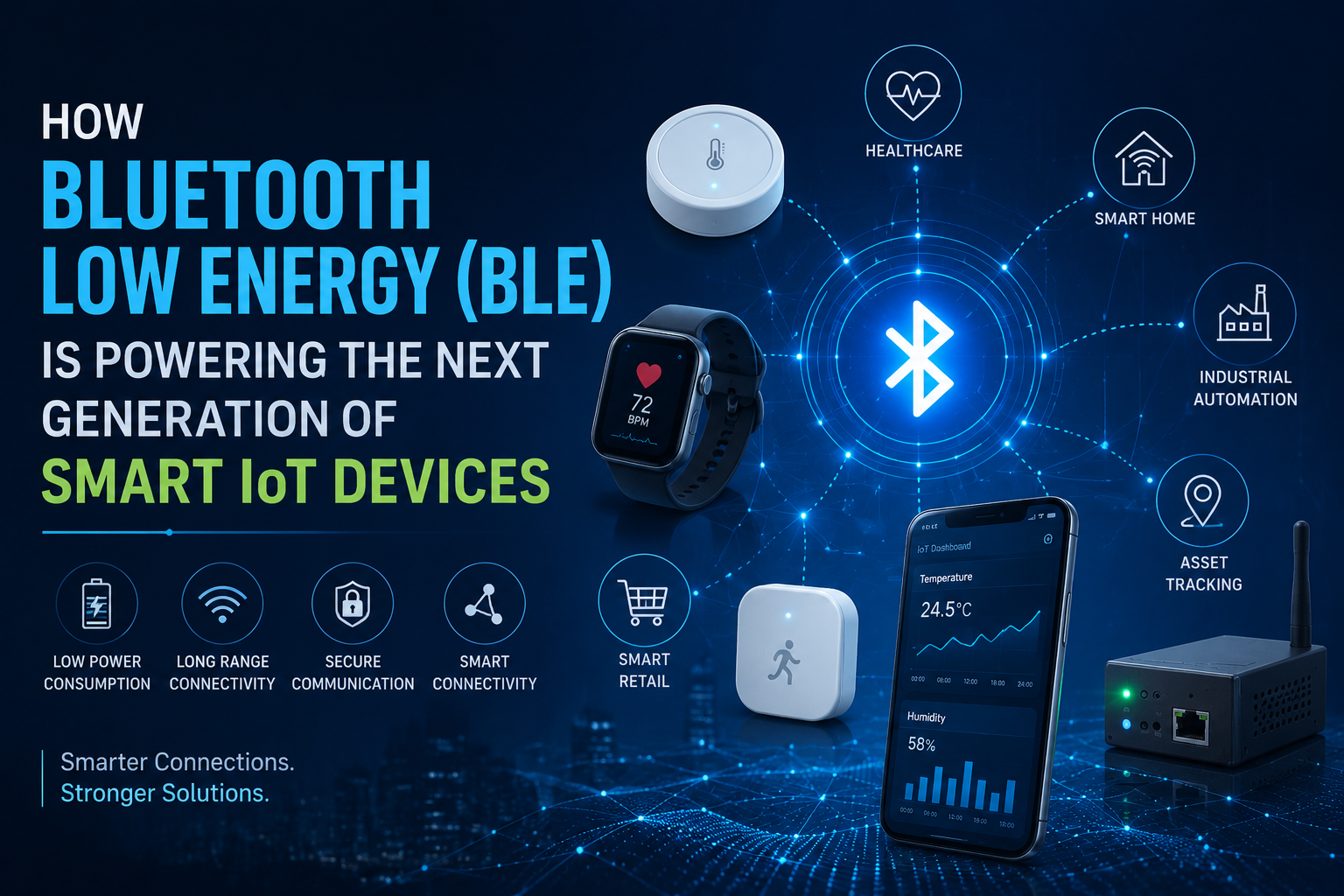
  • How Bluetooth Low Energy Is Powering the Next Generation of Smart IoT Devices

    How Bluetooth Low Energy Is Powering the Next Generation of Smart IoT Devices

    The Internet of Things is changing how people interact with technology.

    From smartwatches and fitness trackers to connected healthcare devices, smart homes, industrial sensors, and asset-tracking systems, IoT technology is helping devices collect data, communicate, and respond in real time.

    However, every connected device needs a reliable way to communicate.

    For many IoT applications, traditional Bluetooth or Wi-Fi may consume more power than necessary. This is where Bluetooth Low Energy (BLE) plays an important role.

    BLE allows devices to exchange information while using very little power. This makes it an ideal wireless technology for IoT products that need long battery life, reliable connectivity, and efficient data communication.

    At IoTBLE, we develop intelligent BLE and IoT solutions that help businesses turn connected-device ideas into practical, scalable products.

    What Is Bluetooth Low Energy?

    Bluetooth Low Energy, commonly known as BLE, is a wireless communication technology designed to use significantly less power than traditional Bluetooth.

    BLE is especially useful for devices that:

    • Run on small batteries
    • Need to operate for months or years
    • Send small amounts of data
    • Communicate with smartphones or gateways
    • Require fast and efficient connections
    • Need low-cost wireless connectivity

    BLE does not mean “low performance.”

    Instead, it is designed to use energy efficiently. A BLE device can remain in a low-power state for most of the time and become active only when it needs to send or receive information.

    This helps extend battery life without sacrificing essential connectivity.

    Why BLE Is Important for IoT

    IoT devices are often expected to work continuously with minimal maintenance.

    Imagine a temperature sensor installed inside a warehouse. Replacing its battery every few weeks would be inconvenient and expensive. A low-power communication technology can help the device operate for much longer.

    BLE supports this requirement by reducing unnecessary energy consumption.

    Some of the main benefits include:

    1. Low Power Consumption

    BLE is designed for energy-efficient communication.

    Many BLE devices can operate for long periods using small batteries, depending on factors such as connection frequency, data size, transmission power, and device configuration.

    This makes BLE useful for wearables, sensors, medical devices, smart tags, and battery-powered IoT products.

    2. Fast Connections

    BLE devices can establish connections quickly.

    Fast communication is valuable when devices need to exchange small pieces of information without remaining connected continuously.

    For example, a fitness tracker may periodically send activity data to a mobile application without using unnecessary battery power.

    3. Smartphone Compatibility

    Most modern smartphones support Bluetooth Low Energy.

    This allows businesses to create IoT solutions where a mobile application acts as a control panel, data viewer, or gateway.

    Users can connect to compatible BLE devices without purchasing additional hardware in many use cases.

    4. Cost-Effective Connectivity

    BLE hardware can be integrated into many types of connected products.

    Its energy efficiency and broad device support can help businesses develop practical IoT solutions without depending on high-power communication technologies for every use case.

    5. Flexible IoT Applications

    BLE can support many industries and product categories.

    It is commonly used in:

    • Healthcare
    • Fitness
    • Smart homes
    • Retail
    • Manufacturing
    • Logistics
    • Hospitality
    • Asset tracking
    • Industrial monitoring

    How BLE Works in an IoT System

    A typical BLE IoT solution includes several components.

    The BLE Device

    The device may contain sensors, a microcontroller, a BLE chip, and a power source.

    It collects information such as:

    • Temperature
    • Motion
    • Heart rate
    • Location data
    • Humidity
    • Equipment status
    • Battery level

    The Mobile App or Gateway

    A smartphone, tablet, gateway, or other connected system receives information from the BLE device.

    The application may display data, send commands, or transfer information to a cloud platform.

    The Cloud Platform

    Cloud infrastructure can store device information and support analytics, alerts, reporting, and remote monitoring.

    The Business Dashboard

    A web dashboard may allow administrators to view device activity, monitor performance, manage users, and analyze trends.

    Together, these components create a connected IoT ecosystem.

    Real-World BLE IoT Use Cases

    Smart Healthcare Devices

    BLE is used in connected healthcare products such as:

    • Heart-rate monitors
    • Blood pressure devices
    • Glucose monitoring systems
    • Wearable health trackers
    • Remote patient monitoring solutions

    A BLE-enabled device can send health information to a mobile application, where users or healthcare professionals can review the data.

    Security and privacy should be considered carefully when developing healthcare solutions.

    Fitness and Wearable Technology

    Fitness bands and smartwatches often use BLE to communicate with mobile applications.

    The devices can track:

    • Steps
    • Exercise activity
    • Sleep patterns
    • Heart rate
    • Calories
    • Movement

    BLE helps these products maintain wireless connectivity while supporting long battery life.

    Smart Home Systems

    BLE can connect smartphones with smart locks, lighting systems, sensors, appliances, and other home devices.

    A user may unlock a door, control a light, or receive an alert through a mobile application.

    Industrial IoT

    Manufacturing and industrial organizations can use BLE sensors to monitor equipment and operating conditions.

    Connected systems may track:

    • Machine temperature
    • Vibration
    • Equipment activity
    • Environmental conditions
    • Maintenance requirements

    This information can support predictive maintenance and help reduce unexpected equipment downtime.

    Asset Tracking

    BLE beacons and tags can help organizations monitor the movement and location of equipment.

    Possible applications include:

    • Warehouse inventory
    • Hospital equipment
    • Retail assets
    • Tools and machinery
    • Office equipment

    Smart Retail

    Retail businesses can use BLE technology for:

    • Proximity-based customer experiences
    • Digital promotions
    • Indoor navigation
    • Smart inventory systems
    • Connected point-of-sale solutions

    BLE vs. Wi-Fi: Which Is Better for IoT?

    BLE and Wi-Fi are designed for different requirements.

    BLE is often a strong choice when a device needs:

    • Low power consumption
    • Small data transfers
    • Long battery life
    • Smartphone connectivity
    • Short-range communication

    Wi-Fi may be more suitable when an application needs:

    • Higher data transfer speeds
    • Continuous internet connectivity
    • Large data transfers
    • Longer-range network access through existing infrastructure

    The right technology depends on the product’s requirements.

    Some IoT solutions may use both BLE and Wi-Fi. For example, a sensor may communicate through BLE to a local gateway, while the gateway uses Wi-Fi or cellular connectivity to send information to the cloud.

    Key Challenges in BLE IoT Development

    Although BLE offers many advantages, developing a reliable connected product requires careful planning.

    Device Compatibility

    Different smartphones, operating systems, and hardware versions may behave differently.

    BLE applications should be tested across relevant devices.

    Connection Stability

    The system should handle disconnections, reconnections, background activity, and changes in signal strength.

    Battery Optimization

    Poor device configuration can reduce battery life.

    Developers must optimize advertising intervals, connection settings, data transmission, and device activity.

    Security

    IoT devices can collect sensitive information or control physical systems.

    Security may include:

    • Secure pairing
    • Authentication
    • Data encryption
    • Access controls
    • Secure firmware updates

    Scalability

    A prototype may work with a few devices but require additional planning to support thousands of connected products.

    Cloud architecture, device management, data storage, and monitoring should be designed for future growth.

    How IoTBLE Builds Connected Solutions

    At IoTBLE, we help businesses develop BLE-powered products from concept to deployment.

    Our development process includes:

    1. IoT Product Discovery

    We understand the product idea, target users, device requirements, business goals, and technical challenges.

    2. BLE Architecture Planning

    We define how devices, mobile applications, gateways, cloud platforms, and dashboards will communicate.

    3. Mobile App Development

    We create Android and iOS applications that can connect with BLE devices and provide clear, user-friendly experiences.

    4. Device Integration

    Our team works with BLE hardware, sensors, embedded systems, and connected devices.

    5. Cloud and Dashboard Development

    We build cloud-connected systems for data storage, analytics, device management, reporting, and remote monitoring.

    6. Testing and Optimization

    We test connectivity, battery performance, device compatibility, security, and real-world behavior.

    7. Ongoing Support

    Connected products may require updates, monitoring, new features, and long-term maintenance.

    The Future of BLE and IoT

    BLE technology continues to evolve as connected products become more intelligent.

    Future BLE IoT solutions may include:

    • More advanced sensor networks
    • Improved indoor positioning
    • Smarter healthcare monitoring
    • AI-powered device analytics
    • More connected industrial systems
    • Energy-efficient smart buildings
    • Large-scale asset tracking
    • Better interoperability between devices

    As AI and IoT become more closely connected, devices will do more than collect information.

    They will help identify patterns, predict issues, automate actions, and support faster decision-making.

    Build Your BLE IoT Solution with IoTBLE

    Bluetooth Low Energy is helping businesses create connected products that are efficient, practical, and designed for long-term use.

    Whether you are building a wearable device, smart healthcare product, industrial monitoring platform, connected sensor, asset-tracking system, or custom IoT application, the right technology architecture can make a major difference.

    At IoTBLE, we combine BLE development, IoT engineering, mobile applications, cloud technology, and intelligent software to build scalable connected solutions.

    Have an IoT idea? Let’s connect it to the future.

    Contact IoTBLE to discuss your BLE and IoT development requirements.

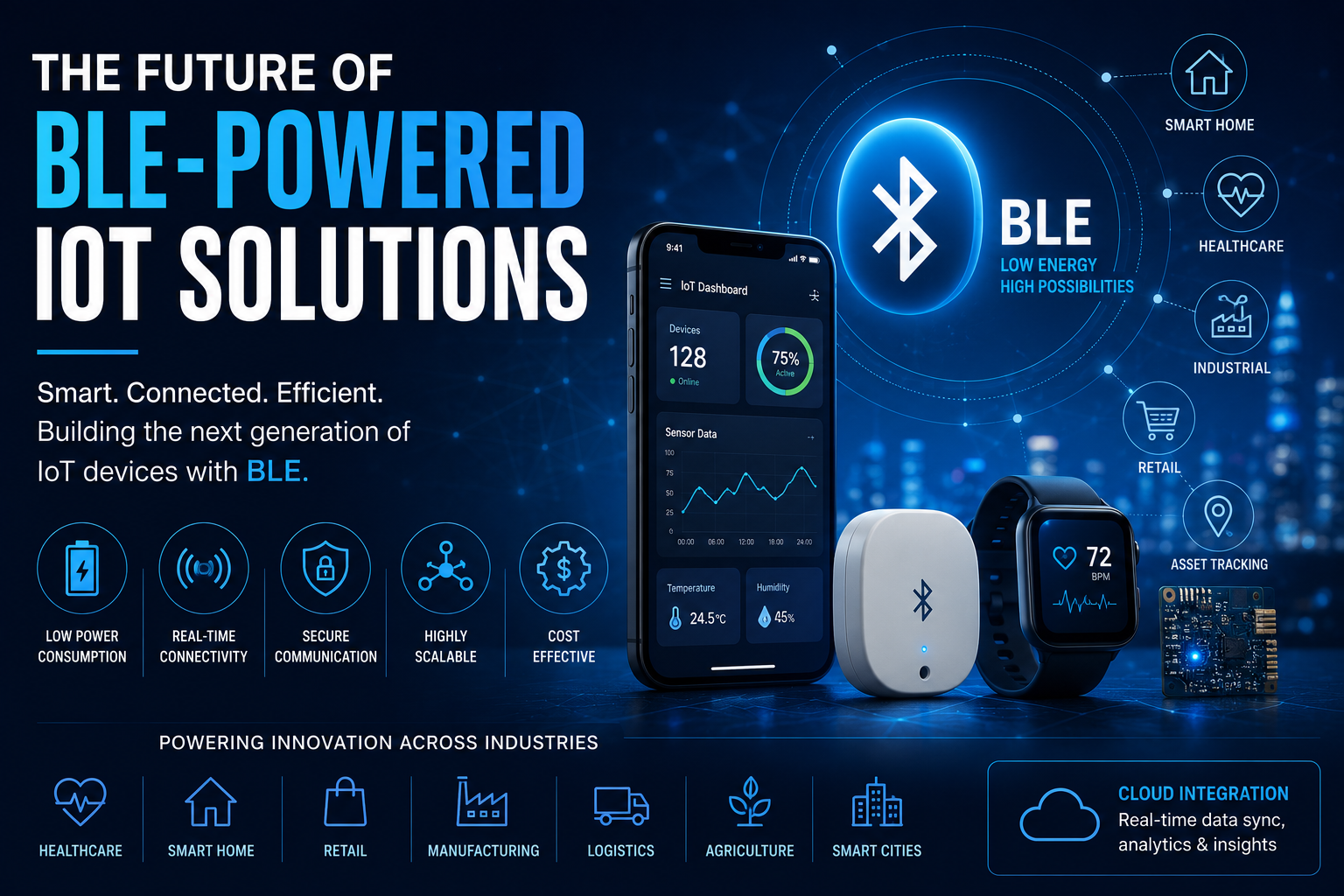
  • The Future of BLE-Powered IoT Solutions: Transforming Connected Devices in 2026

    The Future of BLE-Powered IoT Solutions: Transforming Connected Devices in 2026

    The Internet of Things (IoT) is rapidly transforming industries by connecting devices, collecting real-time data, and enabling intelligent automation. At the heart of many successful IoT ecosystems is Bluetooth Low Energy (BLE)—a wireless technology that delivers reliable, energy-efficient communication for connected devices.

    From smart homes and healthcare wearables to industrial automation and asset tracking, BLE has become the preferred connectivity solution for businesses building scalable IoT products.

    At IoTBLE, we specialize in developing custom BLE-enabled IoT solutions that help businesses innovate faster, improve operational efficiency, and deliver seamless connected experiences.


    What Is Bluetooth Low Energy (BLE)?

    Bluetooth Low Energy (BLE) is a wireless communication technology designed for devices that require low power consumption while maintaining reliable data transmission.

    Unlike traditional Bluetooth, BLE is optimized for:

    • Minimal battery usage
    • Fast device discovery
    • Secure communication
    • Long battery life
    • Low-cost hardware implementation

    These capabilities make BLE ideal for IoT applications where devices operate continuously for months or even years on a single battery.


    Why BLE Is Essential for IoT

    Modern IoT devices need reliable connectivity without draining battery power.

    BLE provides:

    • Ultra-low energy consumption
    • Fast pairing and communication
    • Secure encrypted connections
    • Cross-platform compatibility
    • Cost-effective deployment
    • Scalable device networks

    As businesses continue adopting connected technologies, BLE remains one of the most efficient wireless standards available.


    Key Benefits of BLE IoT Solutions

    1. Low Power Consumption

    BLE devices consume significantly less energy than traditional wireless technologies, allowing sensors and wearable devices to operate for extended periods without frequent battery replacements.


    2. Real-Time Connectivity

    BLE enables instant communication between smartphones, gateways, sensors, and embedded devices, making real-time monitoring possible across industries.


    3. High Scalability

    Whether connecting a few smart devices or thousands of IoT sensors, BLE supports scalable deployments that grow with business needs.


    4. Enhanced Security

    Modern BLE protocols include:

    • AES encryption
    • Secure pairing
    • Authentication
    • Privacy protection
    • Secure key exchange

    These features help safeguard sensitive business and customer data.


    5. Cost-Effective Development

    BLE modules are affordable, widely available, and supported by major hardware manufacturers, reducing overall development costs.


    Industries Using BLE IoT Solutions

    Healthcare

    Healthcare organizations use BLE for:

    • Patient monitoring
    • Wearable medical devices
    • Smart insulin pens
    • Connected blood pressure monitors
    • Hospital asset tracking

    Smart Homes

    BLE powers:

    • Smart lighting
    • Door locks
    • Thermostats
    • Motion sensors
    • Security systems
    • Home automation hubs

    Retail

    Retail businesses use BLE for:

    • Indoor navigation
    • Customer engagement
    • Proximity marketing
    • Smart shelves
    • Inventory tracking
    • Digital coupons

    Manufacturing

    Industrial BLE applications include:

    • Predictive maintenance
    • Equipment monitoring
    • Worker safety
    • Factory automation
    • Environmental sensors

    Logistics & Supply Chain

    BLE improves supply chain visibility through:

    • Asset tracking
    • Warehouse automation
    • Cold chain monitoring
    • Fleet management
    • Inventory optimization

    Essential Features of a BLE IoT Platform

    A modern BLE IoT solution should include:

    • Device provisioning
    • Secure BLE communication
    • Cloud synchronization
    • Mobile applications
    • OTA (Over-the-Air) firmware updates
    • Device monitoring
    • Real-time alerts
    • Analytics dashboards
    • API integrations
    • Multi-device management

    BLE vs Wi-Fi for IoT

    FeatureBLEWi-Fi
    Power ConsumptionVery LowHigh
    Battery LifeExcellentModerate
    RangeShort to MediumLong
    CostLowModerate
    Data TransferSmall PacketsHigh Bandwidth
    IoT SuitabilityExcellentGood

    BLE is the preferred choice for battery-powered IoT devices, while Wi-Fi is better suited for applications requiring high-speed data transfer.


    AI Meets BLE IoT

    Artificial Intelligence is making BLE-powered IoT systems more intelligent by enabling:

    • Predictive maintenance
    • Smart anomaly detection
    • Energy optimization
    • Behavior analysis
    • Automated alerts
    • Predictive analytics
    • Personalized user experiences

    The combination of AI and BLE creates connected systems that not only collect data but also generate actionable insights.


    Security Best Practices for BLE IoT

    To ensure secure IoT deployments:

    • Enable BLE encryption
    • Use secure pairing methods
    • Implement device authentication
    • Protect firmware updates
    • Monitor connected devices
    • Rotate encryption keys
    • Secure cloud APIs
    • Perform regular security testing

    Security should be integrated throughout the entire product lifecycle.


    Why Choose IoTBLE?

    At IoTBLE, we build intelligent Bluetooth Low Energy solutions tailored to modern business needs.

    Our expertise includes:

    • BLE Firmware Development
    • IoT Mobile App Development
    • Custom Embedded Software
    • Smart Device Development
    • BLE Sensor Integration
    • Wearable Device Solutions
    • Industrial IoT Platforms
    • Cloud IoT Integration
    • OTA Firmware Update Systems
    • BLE Gateway Development

    We help startups and enterprises create secure, scalable, and future-ready IoT products that deliver real business value.


    The Future of BLE in IoT

    As connected devices become more intelligent, BLE will continue playing a critical role in powering next-generation IoT ecosystems.

    Emerging innovations include:

    • AI-powered edge devices
    • Smart healthcare ecosystems
    • Connected factories
    • Digital twins
    • Smart cities
    • Autonomous logistics
    • Energy-efficient wearable technology
    • Intelligent environmental monitoring

    Businesses investing in BLE today are preparing for a more connected, automated, and data-driven future.


    Conclusion

    Bluetooth Low Energy has become the foundation of modern IoT innovation. Its low power consumption, secure communication, and flexibility make it ideal for building scalable connected products across industries.

    Whether you’re developing a wearable device, smart home product, industrial sensor network, or enterprise IoT platform, BLE offers the performance and efficiency needed to succeed.

    Ready to build your next BLE-powered IoT solution? Partner with IoTBLE to develop secure, scalable, and intelligent connected products that accelerate digital transformation.


    FAQs

    Q1. What is BLE in IoT?
    BLE (Bluetooth Low Energy) is a wireless communication technology designed for low-power IoT devices that require efficient, secure, and reliable connectivity.

    Q2. Why is BLE preferred for IoT devices?
    BLE offers low power consumption, long battery life, secure communication, and cost-effective implementation, making it ideal for connected devices.

    Q3. Which industries use BLE IoT solutions?
    Healthcare, retail, manufacturing, logistics, smart homes, hospitality, agriculture, and industrial automation all benefit from BLE-powered IoT solutions.

    Q4. Can BLE integrate with cloud platforms?
    Yes. BLE devices can connect to cloud services through mobile apps, gateways, or edge devices for real-time monitoring and analytics.

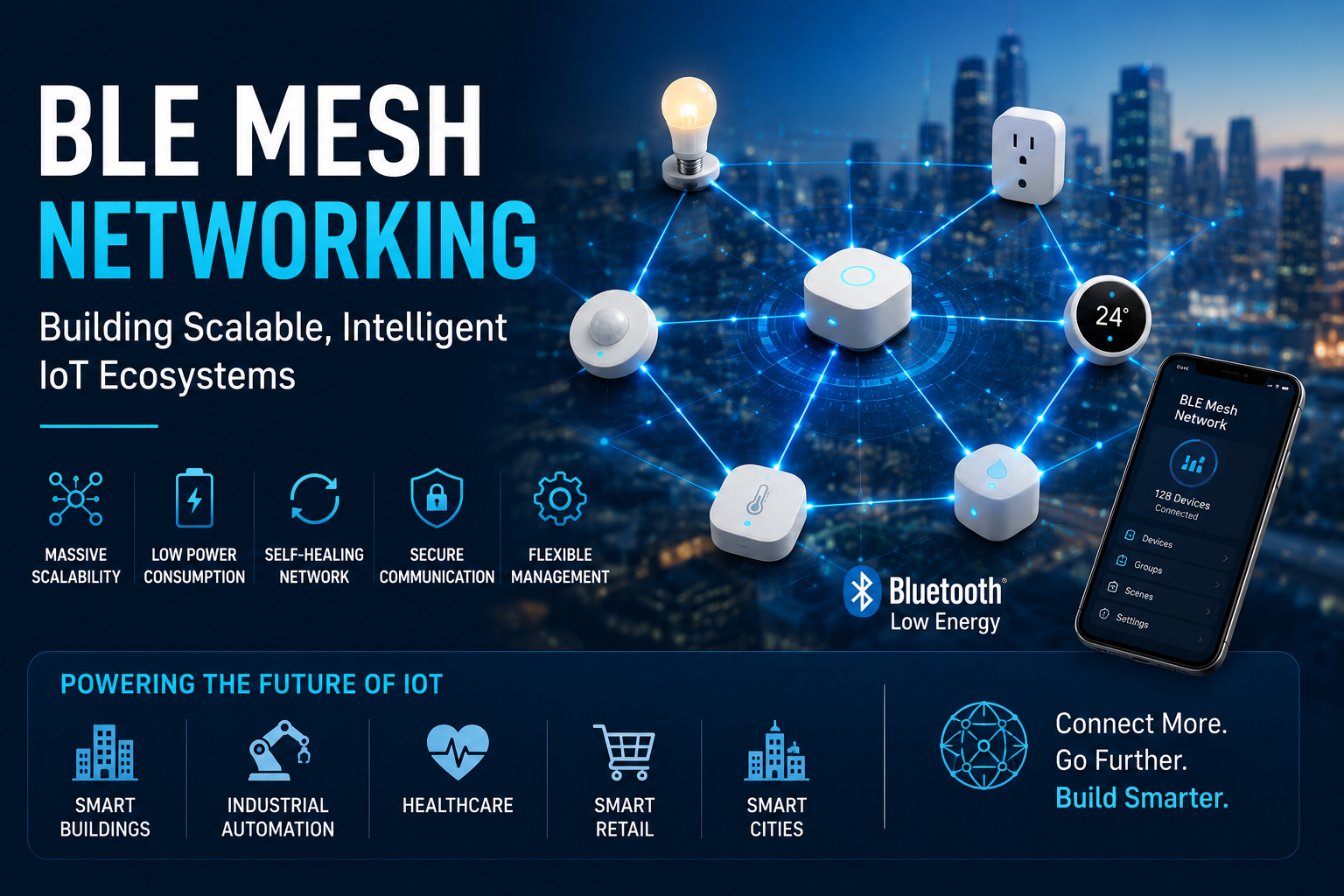
  • BLE Mesh Networking in 2026: Building Scalable, Intelligent IoT Ecosystems

    BLE Mesh Networking in 2026: Building Scalable, Intelligent IoT Ecosystems

    The Internet of Things (IoT) is growing faster than ever, connecting billions of smart devices across industries. As businesses expand their IoT deployments, they need communication technologies that are scalable, energy-efficient, secure, and reliable. Traditional point-to-point Bluetooth connections often struggle to support large networks of connected devices.

    This is where Bluetooth Low Energy (BLE) Mesh Networking stands out. BLE Mesh enables thousands of devices to communicate across a decentralized network, making it ideal for smart buildings, industrial automation, healthcare, retail, and smart cities.

    At IoTBLE, we develop advanced BLE Mesh solutions that help businesses build intelligent, future-ready IoT ecosystems.


    What Is BLE Mesh Networking?

    BLE Mesh is a many-to-many communication protocol built on Bluetooth Low Energy technology. Instead of relying on direct connections between devices, each node can relay messages throughout the network, allowing information to travel across multiple devices.

    This architecture creates a highly scalable and resilient communication system capable of supporting large IoT deployments.


    How BLE Mesh Works

    A BLE Mesh network consists of different node types working together to deliver reliable communication.

    Key components include:

    • Relay Nodes – Forward messages throughout the network.
    • Low Power Nodes (LPNs) – Battery-operated devices that conserve energy.
    • Friend Nodes – Store messages for low-power devices until they wake up.
    • Proxy Nodes – Allow smartphones and legacy Bluetooth devices to communicate with the mesh network.

    This distributed approach eliminates single points of failure and improves network reliability.


    Key Benefits of BLE Mesh Networking

    Massive Scalability

    BLE Mesh can support thousands of connected devices within a single network, making it suitable for enterprise-scale IoT deployments.


    Low Power Consumption

    Battery-powered sensors and devices can operate for years without frequent battery replacements, significantly reducing maintenance costs.


    Self-Healing Network

    If one communication path becomes unavailable, messages automatically find alternative routes through other nodes, improving reliability.


    Secure Communication

    BLE Mesh incorporates multiple layers of security, including:

    • AES-128 encryption
    • Secure key management
    • Authentication
    • Device provisioning
    • Network isolation

    These features help protect IoT environments from unauthorized access.


    Flexible Device Management

    Administrators can remotely:

    • Add devices
    • Remove devices
    • Update firmware
    • Configure settings
    • Monitor device status

    without disrupting the entire network.


    Applications of BLE Mesh in IoT

    Smart Buildings

    BLE Mesh enables centralized control of:

    • Smart lighting
    • HVAC systems
    • Occupancy sensors
    • Energy management
    • Access control

    Industrial Automation

    Manufacturers use BLE Mesh to monitor:

    • Machinery
    • Environmental conditions
    • Predictive maintenance
    • Equipment health
    • Worker safety

    Healthcare

    Hospitals deploy BLE Mesh for:

    • Patient monitoring
    • Medical asset tracking
    • Smart hospital rooms
    • Environmental monitoring
    • Emergency alerts

    Smart Retail

    Retail businesses leverage BLE Mesh for:

    • Indoor navigation
    • Smart shelves
    • Digital signage
    • Inventory tracking
    • Personalized customer experiences

    Smart Cities

    Municipalities implement BLE Mesh for:

    • Street lighting
    • Environmental monitoring
    • Parking management
    • Traffic control
    • Public safety systems

    Why Businesses Are Choosing BLE Mesh Over Traditional Bluetooth

    Traditional Bluetooth works well for direct device-to-device communication but has limitations in larger deployments.

    BLE Mesh offers significant advantages:

    • Larger coverage area
    • Multi-hop communication
    • Better reliability
    • Lower maintenance
    • Greater scalability
    • Reduced infrastructure costs
    • Improved network resilience

    These capabilities make BLE Mesh a preferred solution for enterprise IoT.


    Technologies Used in BLE Mesh Solutions

    Modern BLE Mesh platforms integrate:

    • Bluetooth 5.4
    • IoT Sensors
    • Edge Computing
    • Cloud Platforms
    • Artificial Intelligence (AI)
    • Machine Learning
    • Mobile Applications
    • Secure APIs
    • Firmware Over-the-Air (FOTA) Updates
    • Real-Time Analytics Dashboards

    Together, these technologies create intelligent, connected environments capable of adapting to changing business needs.


    Why Choose IoTBLE?

    At IoTBLE, we specialize in designing and developing scalable Bluetooth Low Energy solutions tailored to diverse industries.

    Our expertise includes:

    • BLE Mesh Development
    • Custom IoT Application Development
    • Bluetooth Firmware Development
    • Mobile App Integration
    • IoT Device Connectivity
    • BLE Gateway Solutions
    • Sensor Network Development
    • Cloud Integration
    • Remote Device Management
    • Ongoing Maintenance and Support

    We build secure, energy-efficient, and scalable BLE ecosystems that empower businesses to innovate with confidence.


    The Future of BLE Mesh Networking

    As IoT adoption continues to grow, BLE Mesh will play a critical role in enabling intelligent connected ecosystems.

    Emerging trends include:

    • AI-driven device management
    • Digital twins for IoT infrastructure
    • Predictive maintenance
    • Edge AI processing
    • Smart energy optimization
    • Autonomous building management
    • Real-time location services (RTLS)
    • Integration with Matter and next-generation smart home standards

    Businesses investing in BLE Mesh today will be well-positioned to support tomorrow’s connected world.


    Conclusion

    BLE Mesh networking is transforming the way connected devices communicate. Its ability to deliver scalable, secure, low-power, and resilient communication makes it a foundational technology for modern IoT ecosystems.

    Whether you’re developing a smart building, connected healthcare platform, industrial monitoring system, or smart retail solution, BLE Mesh provides the flexibility and performance needed for long-term success.

    Ready to build a scalable BLE Mesh solution?
    Partner with IoTBLE to develop secure, intelligent, and future-ready Bluetooth Low Energy solutions that power the next generation of IoT innovation.


    Frequently Asked Questions (FAQs)

    What is BLE Mesh Networking?

    BLE Mesh is a Bluetooth Low Energy networking protocol that allows thousands of devices to communicate using a many-to-many architecture.

    How is BLE Mesh different from traditional Bluetooth?

    Traditional Bluetooth primarily supports direct device-to-device communication, while BLE Mesh enables multi-hop communication across large networks of connected devices.

    Which industries benefit from BLE Mesh?

    Smart buildings, healthcare, manufacturing, retail, logistics, hospitality, and smart city projects all benefit from BLE Mesh technology.

    Is BLE Mesh secure?

    Yes. BLE Mesh includes strong security features such as AES-128 encryption, secure provisioning, authentication, and key management to protect connected devices and data.

    Can BLE Mesh integrate with cloud platforms?

    Yes. BLE Mesh solutions can integrate with cloud platforms, mobile applications, analytics dashboards, and enterprise IoT systems for centralized monitoring and management.

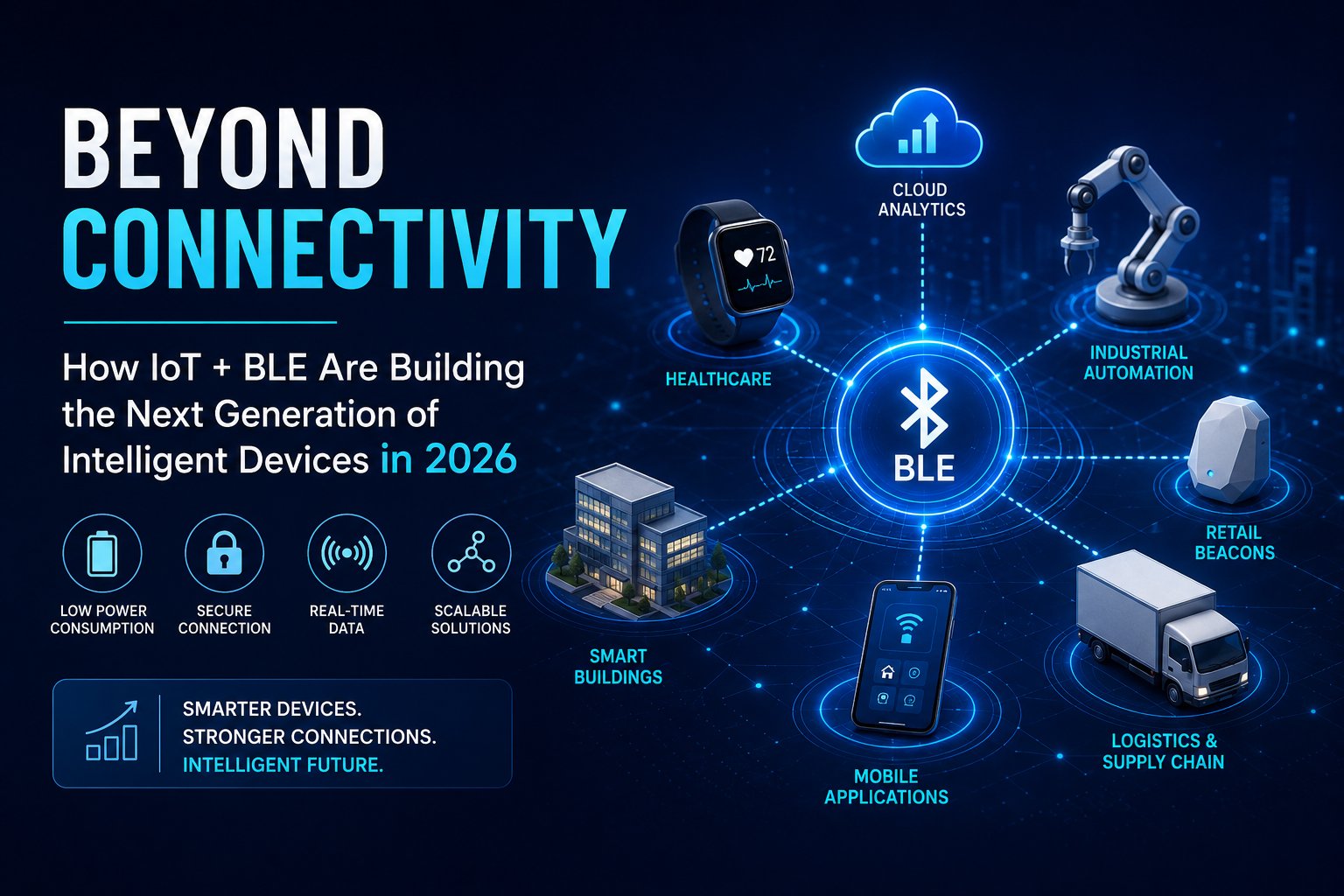
  • Beyond Connectivity: How IoT + BLE Are Building the Next Generation of Intelligent Devices in 2026

    Beyond Connectivity: How IoT + BLE Are Building the Next Generation of Intelligent Devices in 2026

    The Internet of Things (IoT) is no longer just about connecting devices—it’s about creating intelligent ecosystems that collect, analyze, and act on data in real time. At the heart of many of these ecosystems is Bluetooth Low Energy (BLE), the wireless technology enabling fast, secure, and energy-efficient communication between smart devices.

    From wearable health monitors and smart factories to retail beacons and industrial sensors, IoT + BLE has become the preferred combination for businesses looking to build scalable, low-power connected solutions.

    As organizations accelerate digital transformation in 2026, investing in custom IoT BLE development is becoming a competitive necessity rather than an experimental technology.


    Why BLE Is Essential for Modern IoT

    Unlike traditional Bluetooth, Bluetooth Low Energy is specifically designed for devices that need to transmit small amounts of data while consuming minimal power.

    Its advantages include:

    • Ultra-low energy consumption
    • Fast device discovery
    • Secure encrypted communication
    • Cost-effective hardware
    • Excellent mobile compatibility
    • Reliable indoor positioning
    • Easy integration with cloud platforms

    These features make BLE the ideal wireless protocol for IoT products that must operate continuously for months—or even years—without frequent battery replacement.


    Industries Being Transformed by IoT + BLE

    Healthcare

    Healthcare providers are adopting BLE-powered medical devices to improve patient monitoring while reducing hospital workloads.

    Examples include:

    • Remote patient monitoring
    • Smart insulin pens
    • Heart-rate monitoring wearables
    • Connected blood pressure devices
    • Oxygen saturation sensors
    • Hospital asset tracking

    Doctors receive real-time health information while patients gain continuous care outside hospitals.


    Retail

    Retailers use BLE beacons to deliver highly personalized customer experiences.

    Applications include:

    • Indoor navigation
    • Personalized promotions
    • Contactless checkout
    • Inventory tracking
    • Smart shelves
    • Customer behavior analytics

    BLE enables physical stores to provide digital shopping experiences comparable to eCommerce platforms.


    Manufacturing

    Industrial IoT relies heavily on BLE sensors for predictive maintenance and operational efficiency.

    Use cases:

    • Machine health monitoring
    • Temperature sensing
    • Equipment diagnostics
    • Predictive maintenance
    • Worker safety monitoring
    • Asset utilization tracking

    Manufacturers reduce downtime while improving production efficiency.


    Smart Buildings

    Modern commercial buildings integrate BLE with IoT systems to automate energy management.

    Examples:

    • Smart lighting
    • HVAC automation
    • Occupancy detection
    • Digital access control
    • Conference room management
    • Indoor positioning

    This results in lower operational costs and improved occupant experiences.


    Logistics & Supply Chain

    BLE-enabled IoT solutions provide real-time visibility into goods throughout the supply chain.

    Applications include:

    • Fleet monitoring
    • Cold chain monitoring
    • Warehouse automation
    • Shipment tracking
    • Smart pallets
    • Delivery verification

    Organizations gain accurate inventory visibility while reducing losses.


    Emerging IoT + BLE Trends for 2026

    AI-Powered Edge Computing

    BLE devices increasingly process data locally before sending insights to the cloud.

    Benefits include:

    • Faster decisions
    • Reduced latency
    • Lower bandwidth costs
    • Improved privacy
    • Better battery efficiency

    Digital Twins

    IoT devices continuously feed data into digital replicas of physical assets.

    Businesses use digital twins to:

    • Predict failures
    • Optimize maintenance
    • Simulate operations
    • Improve efficiency

    BLE Mesh Networks

    BLE Mesh enables thousands of connected devices to communicate simultaneously.

    Ideal applications include:

    • Smart cities
    • Industrial automation
    • Large commercial buildings
    • Smart lighting systems

    Indoor Location Intelligence

    BLE is becoming the standard for indoor positioning systems.

    Applications include:

    • Hospital navigation
    • Airport guidance
    • Warehouse tracking
    • Museum experiences
    • Retail analytics

    Sustainable IoT

    Energy-efficient BLE devices help organizations meet ESG and sustainability goals through:

    • Reduced battery waste
    • Lower energy consumption
    • Longer device lifespan
    • Lower maintenance costs

    Security Challenges and Best Practices

    As connected devices increase, cybersecurity becomes even more critical.

    Organizations should implement:

    • End-to-end encryption
    • Secure device authentication
    • Firmware updates over-the-air (OTA)
    • Identity management
    • Certificate-based security
    • Zero Trust architecture
    • Continuous vulnerability monitoring

    Security should be integrated into every stage of IoT product development—not added later.


    Why Businesses Choose Custom IoT BLE Development

    Off-the-shelf solutions often fail to meet complex business requirements.

    Custom development offers:

    • Tailored hardware integration
    • Cross-platform mobile applications
    • Cloud connectivity
    • Real-time analytics dashboards
    • Enterprise API integration
    • Scalable architecture
    • Advanced security implementation

    Whether developing healthcare wearables, industrial sensors, retail beacons, or smart consumer products, custom IoT BLE solutions provide greater flexibility and long-term scalability.


    The Future of Connected Intelligence

    The next generation of connected devices will not simply transmit data—they will analyze it, learn from it, and automate decisions.

    IoT combined with Bluetooth Low Energy forms the foundation of:

    • AI-driven automation
    • Predictive maintenance
    • Smart healthcare
    • Autonomous logistics
    • Intelligent manufacturing
    • Connected workplaces

    Businesses investing today in scalable IoT BLE ecosystems will be better positioned to innovate, reduce operational costs, and deliver exceptional customer experiences in the years ahead.


    Conclusion

    IoT and Bluetooth Low Energy are reshaping how businesses interact with devices, customers, and data. Their combination offers the perfect balance of low power consumption, secure communication, real-time connectivity, and scalability.

    As digital transformation accelerates, organizations that embrace custom IoT BLE solutions will unlock new efficiencies, smarter operations, and future-ready products. The connected future is no longer on the horizon—it is already here.

  • The Future Isn’t More Devices-It’s Devices That Disappear

    The Future Isn’t More Devices-It’s Devices That Disappear

    Technology has evolved dramatically over the past decade.

    First came smartphones.

    Then wearable devices.

    Now smart homes, connected factories, intelligent hospitals, and autonomous retail stores are becoming common.

    But the next revolution isn’t about adding more screens or gadgets.

    It’s about making technology disappear into the environment.

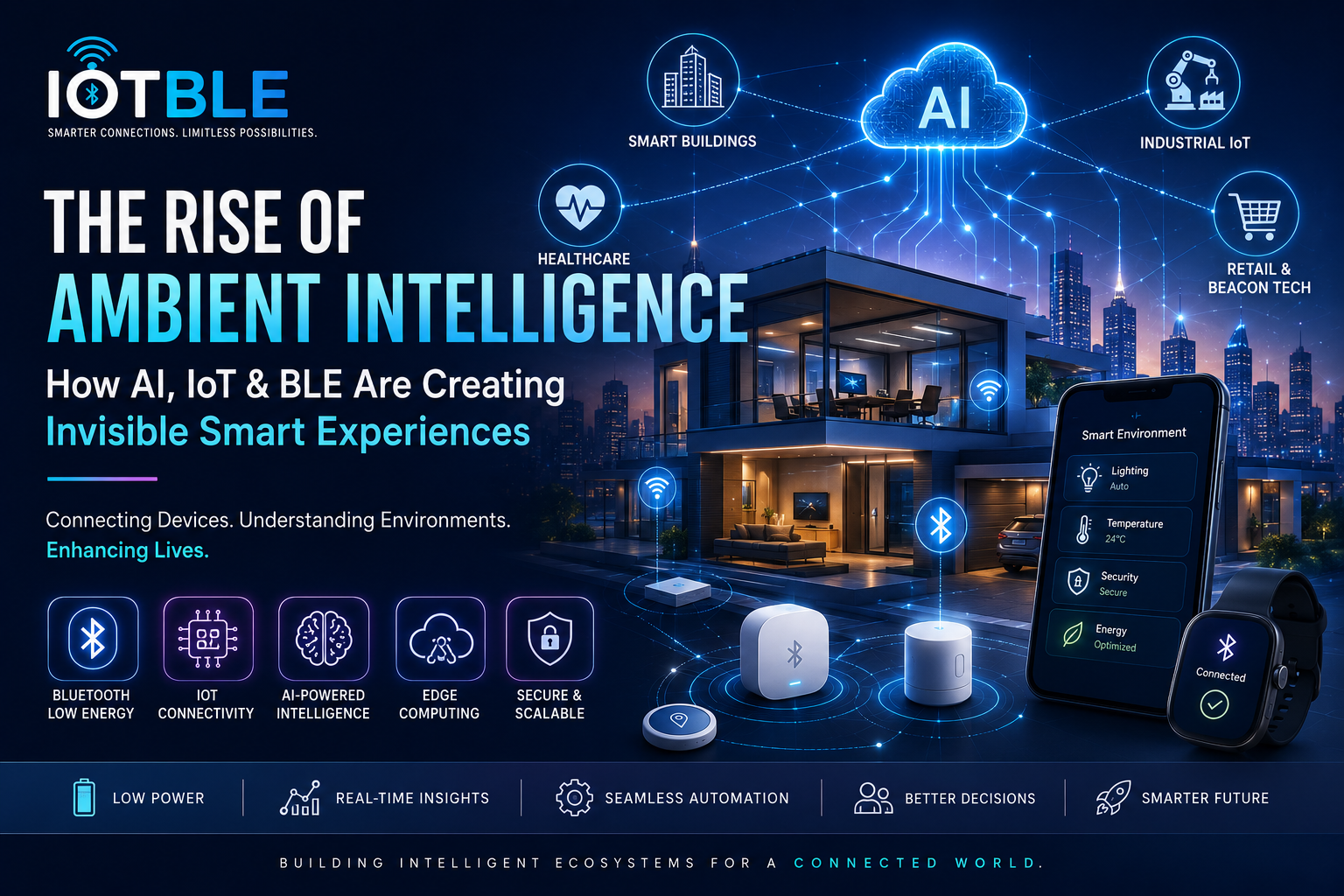
    This concept is known as Ambient Intelligence (AmI)—where AI, IoT, Bluetooth Low Energy (BLE), cloud computing, and edge intelligence work together to understand users, predict needs, and automate actions without requiring constant human interaction.

    Businesses adopting Ambient Intelligence today are building experiences that are faster, safer, more efficient, and virtually invisible to the end user.


    What Is Ambient Intelligence?

    Ambient Intelligence is an environment where connected devices continuously sense, analyze, and respond to people and surroundings.

    Instead of waiting for user commands, systems become proactive.

    Imagine walking into an office where:

    • Doors unlock automatically.
    • Lighting adjusts to your preferences.
    • Meeting rooms are prepared before you arrive.
    • Indoor navigation guides visitors.
    • Air conditioning adapts to occupancy.
    • Digital signage changes based on real-time traffic.

    No buttons.

    No manual configuration.

    Everything happens intelligently in the background.


    Why BLE Is the Foundation of Ambient Intelligence

    Bluetooth Low Energy is one of the most important technologies powering Ambient Intelligence.

    Unlike traditional Bluetooth, BLE offers:

    • Extremely low power consumption
    • Fast device discovery
    • Reliable indoor positioning
    • Secure wireless communication
    • Long battery life
    • Affordable deployment

    BLE enables thousands of smart devices to communicate continuously while consuming minimal energy.


    The Role of IoT in Smart Environments

    IoT devices provide the real-world data needed for intelligent decision-making.

    Connected sensors collect information such as:

    • Temperature
    • Motion
    • Humidity
    • Occupancy
    • Asset location
    • Equipment status
    • Air quality
    • Energy usage

    Without IoT, Ambient Intelligence cannot understand its environment.


    AI Makes Connected Devices Truly Intelligent

    Collecting data alone isn’t enough.

    Artificial Intelligence transforms sensor data into meaningful actions.

    AI can:

    • Predict equipment failures
    • Detect unusual behavior
    • Optimize energy consumption
    • Personalize user experiences
    • Improve workplace safety
    • Automate business workflows

    The combination of AI + IoT + BLE creates systems that continuously learn and improve over time.


    Edge Computing: Real-Time Intelligence

    Many smart devices cannot wait for cloud processing.

    Edge computing processes information directly on local devices.

    Benefits include:

    • Faster response times
    • Lower latency
    • Improved privacy
    • Reduced cloud costs
    • Better reliability
    • Offline functionality

    This is especially important for healthcare, manufacturing, and industrial automation.


    Real-World Applications of Ambient Intelligence

    Smart Healthcare

    Hospitals use BLE-enabled medical devices and AI to:

    • Monitor patients remotely
    • Track medical equipment
    • Detect emergencies
    • Improve patient safety
    • Reduce response times

    Intelligent Retail

    Retailers deploy BLE beacons and AI to:

    • Deliver personalized promotions
    • Track customer movement
    • Optimize store layouts
    • Reduce checkout times
    • Manage inventory automatically

    Smart Manufacturing

    Factories use connected sensors to:

    • Monitor machinery
    • Predict maintenance
    • Prevent downtime
    • Improve quality control
    • Reduce operational costs

    Smart Offices

    Modern workplaces automate:

    • Employee access
    • Meeting room booking
    • Climate control
    • Lighting
    • Visitor management
    • Occupancy monitoring

    Hospitality

    Hotels improve guest experiences through:

    • Mobile room access
    • Smart room automation
    • Personalized services
    • Indoor navigation
    • Energy-efficient operations

    Security Matters More Than Ever

    Connected environments introduce new cybersecurity challenges.

    Businesses should implement:

    • Device authentication
    • End-to-end encryption
    • Secure BLE pairing
    • Firmware updates
    • Zero Trust architecture
    • Continuous monitoring
    • Identity management

    Security must be integrated from the beginning—not added later.


    Challenges Businesses Must Solve

    Successful Ambient Intelligence projects require careful planning.

    Common challenges include:

    • Device interoperability
    • Battery optimization
    • Data privacy
    • Scalability
    • Network reliability
    • Legacy system integration
    • Cloud synchronization
    • Regulatory compliance

    Choosing the right technology architecture is essential for long-term success.


    Why Businesses Need Specialized IoT & BLE Development

    Building Ambient Intelligence solutions requires expertise across multiple domains.

    This includes:

    • BLE firmware development
    • Mobile application development
    • Embedded systems
    • IoT cloud platforms
    • AI model integration
    • API development
    • Security engineering
    • Edge computing
    • UX design
    • Data analytics

    An experienced technology partner can significantly reduce development time and deployment risks.


    How IoTBLE Helps Businesses Build Smarter Connected Solutions

    At IoTBLE, we specialize in designing and developing next-generation connected solutions that combine AI, IoT, and Bluetooth Low Energy technologies.

    Our services include:

    • BLE Application Development
    • IoT Product Development
    • Embedded Software Development
    • AI-Powered IoT Solutions
    • Beacon-Based Applications
    • Asset Tracking Systems
    • Smart Healthcare Solutions
    • Industrial IoT Platforms
    • Wearable Device Integration
    • Edge Computing Solutions
    • Cloud IoT Integration
    • Custom Connected Device Development

    Our goal is to create scalable, secure, and intelligent ecosystems that help businesses innovate faster and operate more efficiently.


    The Future Is Invisible

    The best technology is no longer the one people notice.

    It’s the one they never have to think about.

    Ambient Intelligence represents the next evolution of digital transformation—where AI, IoT, BLE, cloud platforms, and edge computing work together seamlessly to create intelligent environments that anticipate needs and simplify everyday experiences.

    Businesses investing today will gain a competitive advantage through automation, efficiency, personalization, and real-time intelligence.


    Conclusion

    Ambient Intelligence is transforming industries by connecting devices, data, and intelligence into a unified ecosystem. AI, IoT, and Bluetooth Low Energy are enabling businesses to build environments that are responsive, adaptive, and efficient.

    Whether it’s a smart hospital, connected factory, intelligent retail store, or automated workplace, the future belongs to organizations that embrace intelligent connected technologies today.

    At IoTBLE, we help businesses turn innovative ideas into secure, scalable, and future-ready IoT and BLE solutions.


    Frequently Asked Questions (FAQ)

    What is Ambient Intelligence?

    Ambient Intelligence (AmI) is an environment where AI, IoT devices, sensors, and BLE technology work together to automate processes and respond intelligently to users without requiring manual interaction.

    Why is BLE important for IoT?

    Bluetooth Low Energy enables secure, low-power communication between connected devices, making it ideal for wearables, asset tracking, healthcare, retail, and smart buildings.

    Which industries benefit from Ambient Intelligence?

    Healthcare, manufacturing, retail, logistics, hospitality, smart cities, offices, and industrial automation are among the biggest beneficiaries.

    How does AI improve IoT systems?

    AI analyzes sensor data, predicts outcomes, automates decisions, detects anomalies, and continuously optimizes connected environments.

    Why choose IoTBLE?

    IoTBLE provides end-to-end expertise in BLE application development, IoT product engineering, embedded systems, cloud integration, AI-powered automation, and secure connected-device solutions, helping businesses build reliable and scalable smart ecosystems.

  • Tiny Signals, Massive Impact: How Bluetooth Low Energy Is Quietly Transforming Every Industry

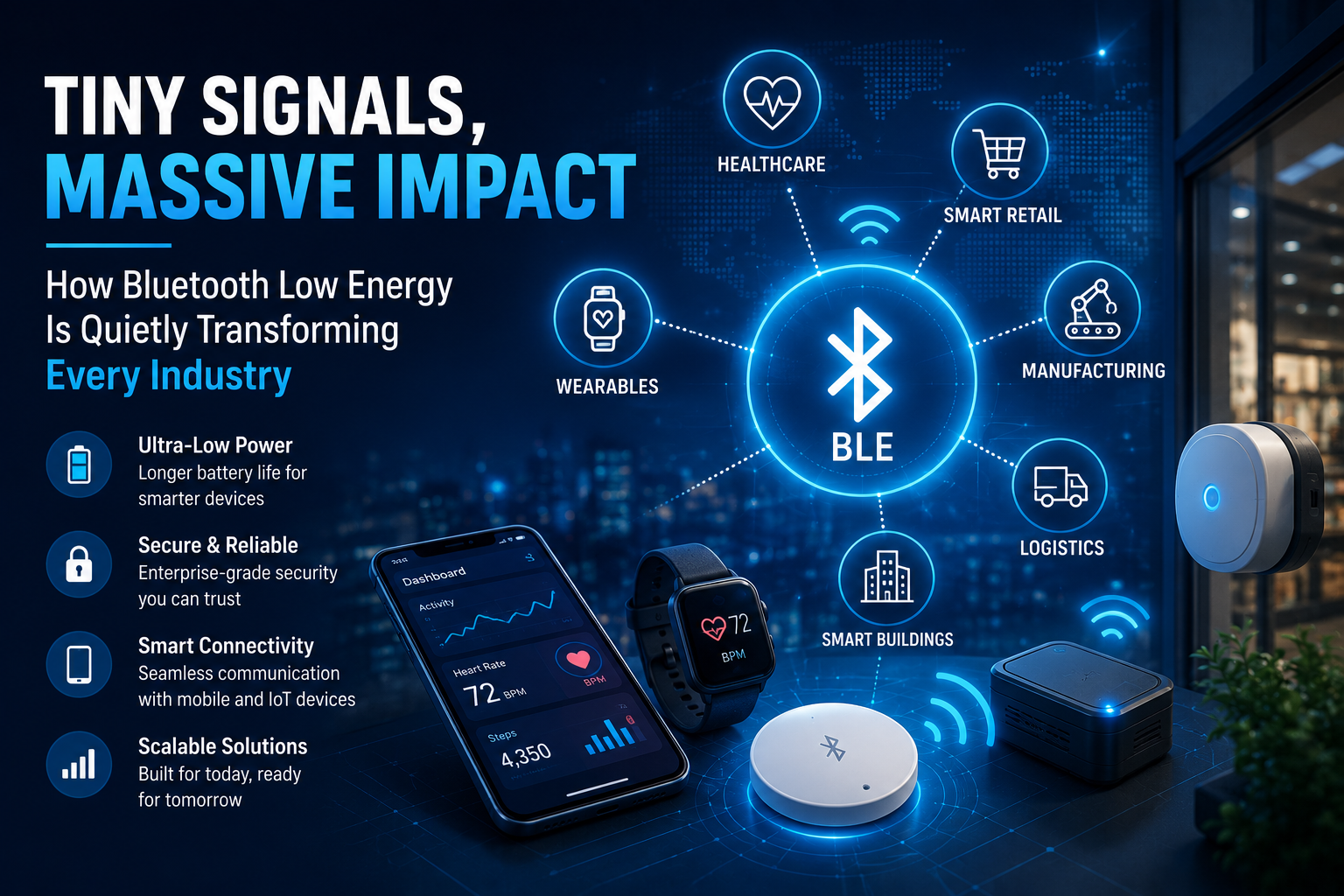
    Tiny Signals, Massive Impact: How Bluetooth Low Energy Is Quietly Transforming Every Industry

    When people think about the Internet of Things (IoT), they often imagine smart homes, wearable devices, or connected factories. But behind many of these innovations is a technology that rarely gets the spotlight—Bluetooth Low Energy (BLE).

    BLE has become the invisible communication layer connecting billions of devices while consuming only a fraction of the power required by traditional wireless technologies.

    From healthcare and retail to industrial automation and smart cities, BLE is enabling businesses to build faster, smarter, and more energy-efficient IoT ecosystems.

    In this article, we’ll explore why Bluetooth Low Energy is becoming the preferred connectivity solution for modern IoT applications and how it’s shaping the future of connected technology.


    What Is Bluetooth Low Energy (BLE)?

    Bluetooth Low Energy is a wireless communication technology designed for devices that need to transmit small amounts of data while consuming minimal power.

    Unlike classic Bluetooth, BLE focuses on:

    • Ultra-low power consumption
    • Fast device discovery
    • Secure communication
    • Reliable short-range connectivity
    • Low implementation cost
    • Long battery life

    This makes BLE perfect for battery-powered devices that need to operate continuously for months—or even years—without frequent charging.


    Why BLE Matters in IoT

    Every connected device has one common challenge:

    Power efficiency.

    IoT devices often operate in environments where charging or replacing batteries regularly isn’t practical.

    BLE solves this problem by offering:

    • Extremely low energy consumption
    • Fast communication
    • Stable connections
    • Low hardware costs
    • Broad compatibility with smartphones and tablets

    This combination has made BLE one of the most widely adopted IoT communication technologies worldwide.


    Industries Being Transformed by BLE

    Healthcare

    Healthcare organizations increasingly rely on BLE-enabled devices for real-time patient monitoring.

    Applications include:

    • Heart rate monitors
    • Glucose sensors
    • Blood pressure devices
    • Smart inhalers
    • Remote patient monitoring
    • Medical asset tracking

    BLE allows medical professionals to receive accurate patient data while ensuring long battery life for wearable devices.


    Smart Retail

    Retail businesses are using BLE Beacons to create personalized shopping experiences.

    Examples include:

    • Indoor navigation
    • Product recommendations
    • Digital coupons
    • Customer engagement
    • Contactless checkout
    • Smart inventory tracking

    Customers receive relevant information based on their location inside the store.


    Manufacturing

    Factories are becoming smarter with BLE-powered industrial solutions.

    Use cases include:

    • Equipment monitoring
    • Worker safety
    • Predictive maintenance
    • Machine diagnostics
    • Tool tracking
    • Production optimization

    BLE sensors continuously collect operational data without consuming excessive power.


    Logistics & Supply Chain

    BLE enables complete visibility across logistics operations.

    Applications include:

    • Asset tracking
    • Warehouse automation
    • Cold chain monitoring
    • Fleet equipment tracking
    • Package location
    • Inventory management

    Businesses gain real-time insights while reducing operational costs.


    Smart Buildings

    Modern commercial buildings use BLE for:

    • Smart lighting
    • Access control
    • Energy management
    • Occupancy detection
    • Indoor positioning
    • Meeting room automation

    These systems improve both security and operational efficiency.


    BLE vs Wi-Fi vs Zigbee

    FeatureBLEWi-FiZigbee
    Battery LifeExcellentModerateExcellent
    Power ConsumptionVery LowHighLow
    RangeShort-MediumLongMedium
    Data SpeedModerateHighLow
    Smartphone SupportNativeNativeLimited
    IoT SuitabilityExcellentGoodExcellent

    BLE strikes the perfect balance between power efficiency, affordability, and ease of deployment.


    Why Businesses Prefer BLE

    Organizations choose Bluetooth Low Energy because it offers:

    • Lower infrastructure costs
    • Longer battery life
    • Easy mobile integration
    • Strong security features
    • Faster deployment
    • Reliable communication
    • Scalable device management

    These benefits make BLE ideal for startups as well as large enterprises.


    Emerging BLE Trends

    The future of BLE extends far beyond wearable devices.

    Emerging innovations include:

    BLE Mesh Networks

    Thousands of connected devices communicate seamlessly across large facilities.

    Smart Cities

    BLE sensors improve:

    • Parking management
    • Public transportation
    • Street lighting
    • Environmental monitoring
    • Waste management

    Digital Healthcare

    Continuous patient monitoring is becoming standard through BLE-enabled medical devices.

    AI + BLE

    Artificial Intelligence analyzes data collected from BLE devices to predict failures, optimize operations, and automate business decisions.

    Precision Indoor Positioning

    BLE-based positioning systems provide highly accurate indoor navigation for hospitals, airports, shopping malls, and warehouses.


    Security in BLE Applications

    Security is essential for connected devices.

    Modern BLE implementations support:

    • Device authentication
    • Data encryption
    • Secure pairing
    • Privacy protection
    • Access control
    • Firmware updates

    Following security best practices ensures connected systems remain reliable and protected.


    Choosing the Right BLE Development Partner

    Successful BLE projects require expertise in:

    • Embedded firmware
    • Mobile application development
    • Cloud integration
    • IoT architecture
    • Security implementation
    • Device testing
    • Performance optimization

    A skilled development team ensures reliable communication, scalability, and long-term success.


    Why IoTBLE?

    At IoTBLE, we specialize in building intelligent Bluetooth Low Energy solutions for businesses across industries.

    Our services include:

    • Custom BLE Application Development
    • IoT Device Integration
    • BLE Firmware Development
    • Beacon Solutions
    • Wearable Device Connectivity
    • Smart Healthcare Applications
    • Industrial IoT Development
    • BLE Mobile Apps (Android & iOS)
    • Cloud Integration
    • End-to-End IoT Consulting

    Whether you’re developing a smart medical device, industrial sensor, retail beacon system, or connected consumer product, our experts help transform your ideas into scalable IoT solutions.


    Final Thoughts

    Bluetooth Low Energy is no longer just another wireless technology.

    It has become the backbone of modern IoT innovation—connecting billions of devices while delivering exceptional battery efficiency, security, and performance.

    As businesses continue embracing digital transformation, BLE will remain a critical technology powering smart industries, connected healthcare, intelligent retail, logistics automation, and future-ready cities.

    The smallest wireless signals are creating the biggest technological revolution.


    Frequently Asked Questions (FAQ)

    What is Bluetooth Low Energy (BLE)?

    Bluetooth Low Energy (BLE) is a wireless communication technology designed for low-power devices, enabling efficient data exchange while maximizing battery life.

    Why is BLE ideal for IoT?

    BLE provides low energy consumption, secure communication, native smartphone compatibility, and reliable connectivity, making it ideal for IoT devices.

    Which industries use BLE technology?

    Healthcare, retail, manufacturing, logistics, smart buildings, fitness, automotive, and smart city projects all rely on BLE solutions.

    Does BLE support secure communication?

    Yes. BLE supports encryption, secure pairing, authentication, and privacy features to protect connected devices and user data.

  • Tiny Devices, Massive Intelligence: How Edge AI + Bluetooth LE Are Transforming the Internet of Things

    Tiny Devices, Massive Intelligence: How Edge AI + Bluetooth LE Are Transforming the Internet of Things

    The Internet of Things (IoT) is entering a new era. Connected devices are no longer just collecting information—they’re becoming intelligent enough to process data, make decisions, and respond instantly without relying on cloud servers.

    This transformation is powered by two groundbreaking technologies: Edge Artificial Intelligence (Edge AI) and Bluetooth Low Energy (BLE).

    Together, they are creating a new generation of smart devices that are faster, more secure, energy-efficient, and capable of operating even without continuous internet connectivity.

    Whether it’s wearable healthcare devices, industrial sensors, smart retail systems, or connected homes, Edge AI and BLE are redefining what modern IoT solutions can achieve.


    What Is Edge AI?

    Edge AI refers to running artificial intelligence algorithms directly on the device rather than sending all data to the cloud for processing.

    Instead of waiting for cloud servers to analyze information, the device itself can:

    • Detect patterns instantly
    • Make decisions in milliseconds
    • Reduce internet dependency
    • Protect sensitive user data
    • Lower cloud computing costs

    This creates real-time intelligence where it matters most—at the edge of the network.


    Why Bluetooth Low Energy Is the Perfect Connectivity Technology

    Bluetooth Low Energy was designed specifically for IoT devices.

    Unlike traditional Bluetooth, BLE focuses on:

    • Ultra-low power consumption
    • Fast device discovery
    • Reliable short-range communication
    • High scalability
    • Secure encrypted connections

    Many BLE devices can operate for months or even years using a single battery.

    This makes BLE the preferred technology for wearable devices, smart sensors, medical equipment, asset tracking systems, and industrial monitoring.


    Why Edge AI and BLE Work Better Together

    BLE efficiently transfers data between nearby devices while Edge AI processes that information locally.

    Together they enable:

    Instant Decision Making

    Instead of sending every sensor reading to cloud servers, devices can detect anomalies immediately.

    Example:
    A wearable health monitor can detect abnormal heart rhythms and alert medical staff within seconds.


    Lower Latency

    Cloud communication introduces delays.

    Edge AI eliminates those delays by processing information directly on the device.

    Applications such as industrial automation and autonomous robotics greatly benefit from real-time responses.


    Better Battery Life

    Since only important information is transmitted to the cloud, BLE devices consume far less energy.

    This extends battery life while reducing operating costs.


    Enhanced Security

    Sensitive information stays on the device.

    Only processed insights are transmitted, reducing exposure to cyber threats and improving compliance with privacy regulations.


    Real-World Applications

    Smart Healthcare

    Hospitals increasingly use BLE-enabled medical devices to monitor patients remotely.

    Edge AI analyzes vital signs locally and sends alerts only when abnormalities are detected.

    Benefits include:

    • Faster emergency response
    • Lower network usage
    • Improved patient monitoring
    • Longer battery life for wearable devices

    Smart Manufacturing

    Factories deploy BLE sensors throughout production lines.

    Edge AI predicts equipment failures before they occur, reducing downtime and maintenance costs.

    Applications include:

    • Predictive maintenance
    • Machine monitoring
    • Worker safety
    • Energy optimization

    Smart Retail

    Retailers use BLE beacons and Edge AI to create personalized shopping experiences.

    Customers receive relevant promotions based on their location, while inventory systems automatically monitor stock levels.

    Benefits include:

    • Personalized customer engagement
    • Improved inventory management
    • Reduced operational costs
    • Faster checkout experiences

    Smart Buildings

    Modern commercial buildings use BLE-enabled sensors to optimize lighting, air conditioning, and security systems.

    Edge AI adjusts operations automatically based on occupancy and environmental conditions, improving energy efficiency and occupant comfort.


    Asset Tracking

    BLE tags combined with Edge AI help organizations track valuable equipment in warehouses, hospitals, airports, and manufacturing facilities.

    Businesses gain:

    • Real-time visibility
    • Reduced asset loss
    • Faster inventory audits
    • Improved operational efficiency

    Emerging Trends in BLE IoT

    The future of BLE-powered IoT continues to evolve rapidly.

    Key trends include:

    • Bluetooth Mesh networking
    • AI-powered predictive analytics
    • TinyML for ultra-small devices
    • Digital Twins
    • Smart cities
    • Intelligent logistics
    • Autonomous industrial systems

    These innovations will make connected devices even smarter while reducing energy consumption.


    Why Businesses Should Invest Now

    Organizations adopting Edge AI and BLE today gain several competitive advantages:

    • Faster automation
    • Lower cloud infrastructure costs
    • Better customer experiences
    • Improved operational efficiency
    • Stronger cybersecurity
    • Scalable IoT ecosystems
    • Future-ready digital infrastructure

    Early adopters are positioning themselves for long-term growth as intelligent IoT becomes a standard across industries.


    How IoTBLE Delivers Intelligent Connected Solutions

    At IoTBLE, we specialize in designing and developing advanced Bluetooth Low Energy and IoT solutions tailored to business needs.

    Our expertise includes:

    • BLE Mobile App Development
    • Embedded Firmware Development
    • Bluetooth Mesh Solutions
    • Smart Wearables
    • Healthcare IoT Applications
    • Industrial IoT Systems
    • Asset Tracking Solutions
    • Beacon Technology
    • Smart Home Automation
    • Edge AI Integration
    • Cloud IoT Platforms
    • Custom IoT Product Development

    We build secure, scalable, and energy-efficient solutions that empower businesses to innovate with confidence.


    Conclusion

    The future of IoT isn’t just about connecting devices—it’s about making those devices intelligent.

    By combining the power of Edge AI with Bluetooth Low Energy, organizations can build systems that respond instantly, consume less power, protect sensitive data, and deliver exceptional user experiences.

    As industries continue embracing digital transformation, businesses that invest in intelligent BLE-powered IoT solutions today will lead the connected world of tomorrow.

    If you’re planning your next IoT innovation, IoTBLE can help you transform your vision into a secure, scalable, and intelligent connected solution.