PCI Developers Navbar

Tag: developement

  • BLE IoT App Development in 2026: Building Smarter Connected Device Applications

    BLE IoT App Development in 2026: Building Smarter Connected Device Applications

    The Internet of Things is transforming how businesses build, monitor, and manage connected products. From smart wearables and healthcare devices to industrial sensors, asset trackers, smart home products, and connected equipment, organizations are increasingly looking for reliable ways to connect physical devices with mobile and cloud applications.

    Bluetooth Low Energy (BLE) has become an important connectivity technology for many of these applications because it supports short-range wireless communication with relatively low power consumption.

    When BLE is combined with IoT platforms and mobile applications, businesses can create connected experiences that allow users to monitor devices, collect data, configure hardware, and interact with physical products through smartphones and tablets.

    This is where BLE IoT app development becomes valuable.

    What Is BLE IoT App Development?

    BLE IoT app development involves creating mobile or web applications that communicate with Bluetooth Low Energy devices and connect them to broader IoT systems.

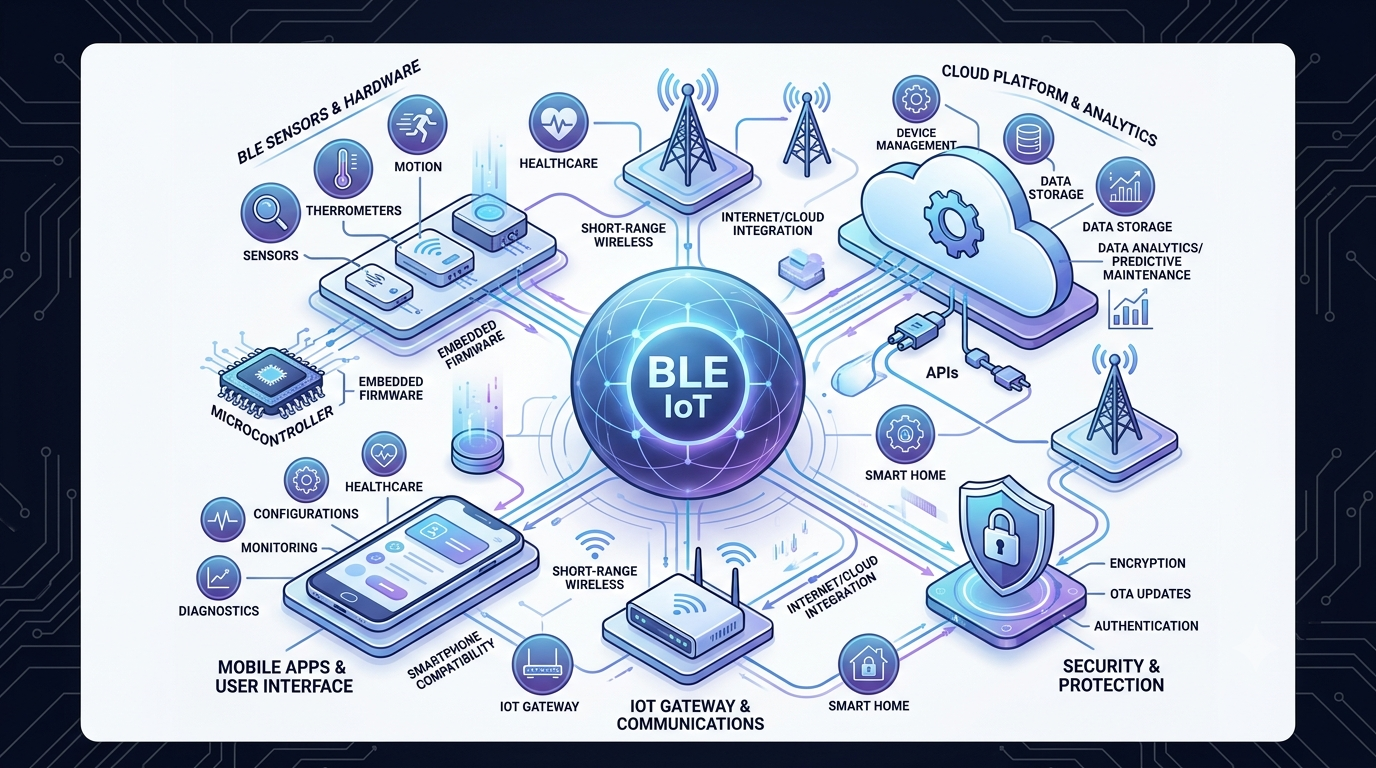
    A typical architecture can look like:

    BLE Device → Mobile App → IoT Backend → Cloud → Analytics Dashboard

    Depending on the product, the architecture may also include a dedicated gateway.

    For example, a smart sensor could collect temperature information and transmit it through BLE to a mobile application. The application can then send that information to a cloud platform where businesses can store, analyze, and visualize the data.

    This creates a complete connected-device ecosystem.

    Why BLE Is Important for IoT Applications

    Many IoT devices need to operate for long periods on batteries.

    BLE can be useful for these products because it is designed for low-power wireless communication.

    Common BLE IoT applications include:

    • Wearable devices
    • Fitness trackers
    • Smart sensors
    • Healthcare devices
    • Industrial monitoring
    • Asset tracking
    • Smart locks
    • Retail technology
    • Smart home products
    • Connected equipment

    The right connectivity technology depends on the product’s range, power, bandwidth, environment, and business requirements.

    How a BLE IoT App Works

    A BLE IoT application usually has several layers.

    1. Connected BLE Device

    The physical device contains a BLE-enabled chipset and may include sensors, actuators, or other hardware.

    2. BLE Communication

    The mobile application discovers and communicates with the device through Bluetooth Low Energy.

    3. Mobile Application

    The application can provide features such as:

    • Device discovery
    • Pairing
    • Configuration
    • Data visualization
    • Device control
    • Notifications
    • Firmware management

    4. IoT Backend

    The backend can store device information, user accounts, telemetry, and application data.

    5. Cloud Platform

    Cloud infrastructure can provide scalability, APIs, storage, analytics, and device management.

    Key Features of a BLE IoT Application

    A modern BLE IoT app can include a wide range of features depending on the product.

    BLE Device Discovery

    The application can scan for nearby compatible BLE devices and identify available devices.

    Secure Device Pairing

    Secure pairing and authentication help prevent unauthorized access to connected devices.

    Real-Time Device Data

    Applications can display sensor information and device status in near real time where appropriate.

    Remote Device Control

    For compatible hardware, users can send commands from the mobile application to the connected device.

    Push Notifications

    The application can notify users when certain device events or conditions occur.

    Device Configuration

    Users can configure device settings through the mobile application.

    Data Synchronization

    Device data can be synchronized between the mobile application and cloud backend.

    Firmware Updates

    Connected products may require firmware updates throughout their lifecycle. A properly designed application can support appropriate firmware-update workflows.

    BLE IoT App Development for Different Industries

    Healthcare

    BLE-connected applications can support certain healthcare and wellness devices.

    Potential use cases include:

    • Wearable monitoring
    • Fitness tracking
    • Temperature monitoring
    • Rehabilitation devices
    • Connected medical equipment

    Healthcare applications require careful consideration of security, privacy, reliability, and applicable regulatory requirements.

    Fitness and Wearables

    BLE is widely suited to short-range communication between wearable devices and smartphones.

    Apps can collect information such as:

    • Activity data
    • Device status
    • Exercise metrics
    • Sensor readings

    The information can then be presented through mobile dashboards.

    Industrial IoT

    Industrial companies can use BLE applications for connected sensors and equipment.

    Potential applications include:

    • Equipment monitoring
    • Maintenance
    • Asset tracking
    • Environmental sensing
    • Worker safety
    • Inventory monitoring

    A BLE mobile application can act as a convenient interface between field workers and connected industrial devices.

    Smart Home

    BLE IoT apps can provide interfaces for connected home products such as:

    • Smart locks
    • Sensors
    • Lighting controllers
    • Access systems
    • Connected appliances

    BLE can provide local device communication, while cloud services can enable broader application functionality where appropriate.

    Retail

    BLE applications can support connected retail environments through:

    • Asset tracking
    • Proximity experiences
    • Smart shelves
    • Inventory monitoring
    • Indoor navigation

    Retail applications can combine BLE data with analytics to create more intelligent customer and operational experiences.

    BLE + Cloud: Creating Connected Applications

    BLE provides local connectivity, while cloud infrastructure can provide centralized data management.

    A typical system may work like this:

    BLE Sensor → Mobile App → API → Cloud Database → Web Dashboard

    This architecture allows businesses to separate local device communication from centralized data management.

    Cloud infrastructure can support:

    • Device data storage
    • User management
    • APIs
    • Analytics
    • Notifications
    • Device management
    • Reporting

    BLE + AI for Intelligent IoT Applications

    AI is creating new possibilities for connected-device applications.

    BLE devices can collect sensor data, while AI can analyze that information to identify patterns and potential anomalies.

    For example:

    BLE Sensor → Data Collection → AI Analysis → Insight → Action

    Possible applications include:

    • Predictive maintenance
    • Anomaly detection
    • Usage analysis
    • Personalized recommendations
    • Equipment monitoring
    • Intelligent alerts

    AI should be applied where it solves a meaningful business or product problem rather than simply being added as a marketing feature.

    BLE App Development for Android and iOS

    Businesses developing BLE IoT products often need applications for both major mobile platforms.

    Android BLE Development

    Android applications can communicate with compatible BLE devices using the platform’s Bluetooth APIs.

    Developers need to consider device compatibility, permissions, connection behavior, background operation, and different Android versions.

    iOS BLE Development

    iOS applications can use Apple’s Core Bluetooth framework to communicate with BLE peripherals.

    Developers need to consider Apple’s permission requirements, background behavior, connection management, and device compatibility.

    A well-designed cross-platform strategy can help businesses maintain a consistent user experience while accounting for platform-specific BLE behavior.

    Challenges in BLE IoT App Development

    Building a BLE application is more complex than simply connecting a phone to a Bluetooth device.

    Connection Reliability

    Wireless connections can be affected by distance, interference, device behavior, and environmental conditions.

    Battery Consumption

    Poorly designed communication patterns can increase battery consumption.

    Platform Differences

    Android and iOS handle Bluetooth functionality differently.

    Device Compatibility

    Applications may need to support multiple hardware versions and firmware configurations.

    Security

    Connected devices can create additional attack surfaces, making authentication and secure communication important.

    Scalability

    An application that works well with a few devices must be designed differently when a business plans to support thousands or millions of devices.

    How to Build a BLE IoT Application

    A successful BLE IoT project should start with the product requirements.

    Step 1: Define the Product

    Determine what the device does and what users need to accomplish through the application.

    Step 2: Select BLE Hardware

    Choose the appropriate BLE chipset, sensors, power architecture, and hardware components.

    Step 3: Define the BLE Protocol

    Design services, characteristics, commands, data formats, and communication behavior.

    Step 4: Develop the Mobile Application

    Build the Android and/or iOS application for device discovery, communication, configuration, and data visualization.

    Step 5: Build the IoT Backend

    Develop APIs, databases, authentication, device management, and cloud infrastructure.

    Step 6: Add Analytics

    Use dashboards and analytics to convert raw device data into useful information.

    Step 7: Test the Complete System

    Testing should include:

    • BLE connectivity
    • Device compatibility
    • Battery performance
    • Security
    • Firmware compatibility
    • Mobile application behavior
    • Cloud communication
    • Real-world wireless environments

    Why Choose Custom BLE IoT App Development?

    Off-the-shelf applications may work for simple devices, but businesses developing unique connected products often require custom functionality.

    Custom BLE IoT application development can provide control over:

    • BLE communication
    • Mobile UX
    • Device configuration
    • Firmware workflows
    • Cloud architecture
    • APIs
    • Data analytics
    • Security
    • User management
    • Device lifecycle management

    This allows the application to be designed around the actual product instead of forcing the product to fit a generic application.

    The Future of BLE IoT Applications

    Connected applications are becoming more intelligent and integrated.

    The future of BLE IoT app development is likely to involve a combination of:

    BLE + IoT + Cloud + Edge Computing + AI + Mobile Applications

    BLE can provide efficient local connectivity, while cloud platforms can manage large-scale data and AI can help transform that data into useful insights.

    For businesses developing connected products, this combination can create new opportunities across healthcare, fitness, industrial IoT, retail, smart homes, logistics, and consumer technology.

    Final Thoughts

    BLE IoT app development is becoming an important part of connected-product development.

    A successful application requires much more than Bluetooth connectivity. It requires a carefully designed combination of hardware, BLE protocols, firmware, mobile development, cloud infrastructure, APIs, security, and data analytics.

    Businesses planning connected products in 2026 should consider the complete ecosystem from the beginning.

    With the right architecture, a BLE-enabled mobile application can become the bridge between physical devices and intelligent digital experiences.

    Looking to build a BLE IoT application?

    IoTBLEAppDeveloper can help businesses develop connected-device applications combining Bluetooth Low Energy, mobile apps, IoT platforms, cloud services, and intelligent data solutions.
  • BLE and IoT Product Development in 2026: Trends, Technologies & Future of Connected Devices

    BLE and IoT Product Development in 2026: Trends, Technologies & Future of Connected Devices

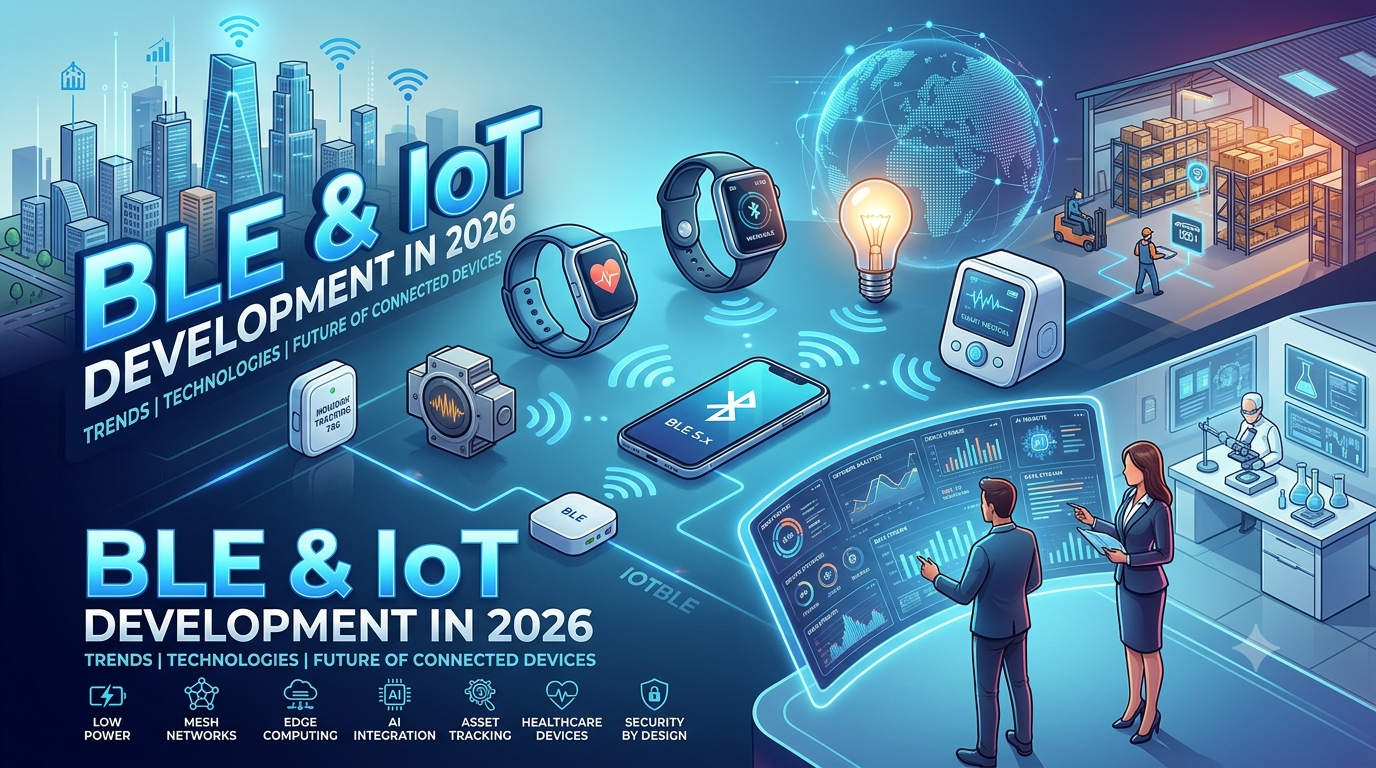
    The Internet of Things is moving toward smaller, smarter, and more energy-efficient connected devices. From wearable technology and healthcare devices to industrial sensors, smart buildings, asset tracking, and connected products, businesses are looking for reliable technologies that can connect devices without consuming excessive power.

    Bluetooth Low Energy (BLE) has become an important technology in this ecosystem.

    In 2026, the combination of BLE and IoT is creating new opportunities for businesses developing connected products. Improvements in Bluetooth technology, edge computing, AI, cloud platforms, device security, and interoperability are making BLE-based IoT solutions more capable than ever.

    For companies planning a connected product, understanding the latest BLE IoT development trends can help create solutions that are scalable, secure, and ready for future growth.

    What Is BLE IoT Development?

    BLE IoT development involves using Bluetooth Low Energy to connect devices, sensors, smartphones, gateways, and cloud platforms.

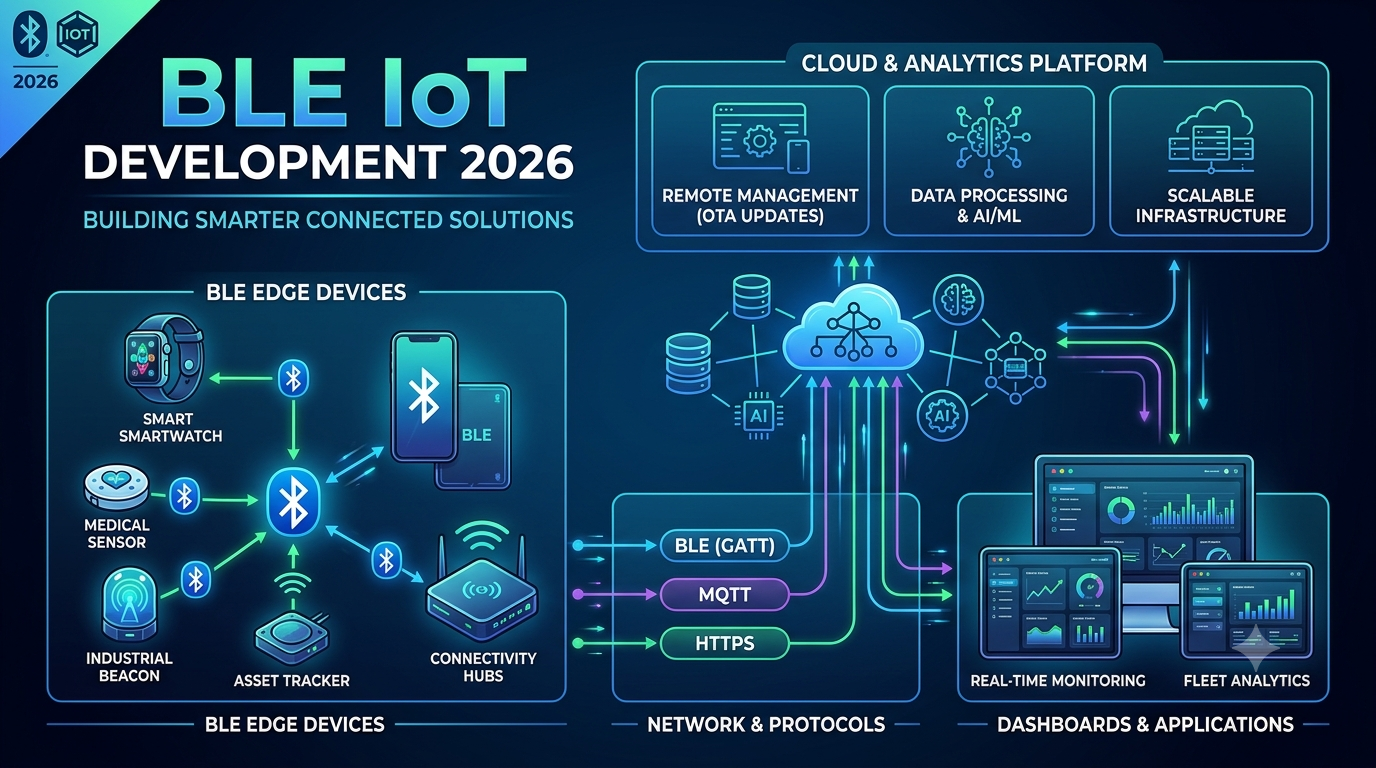
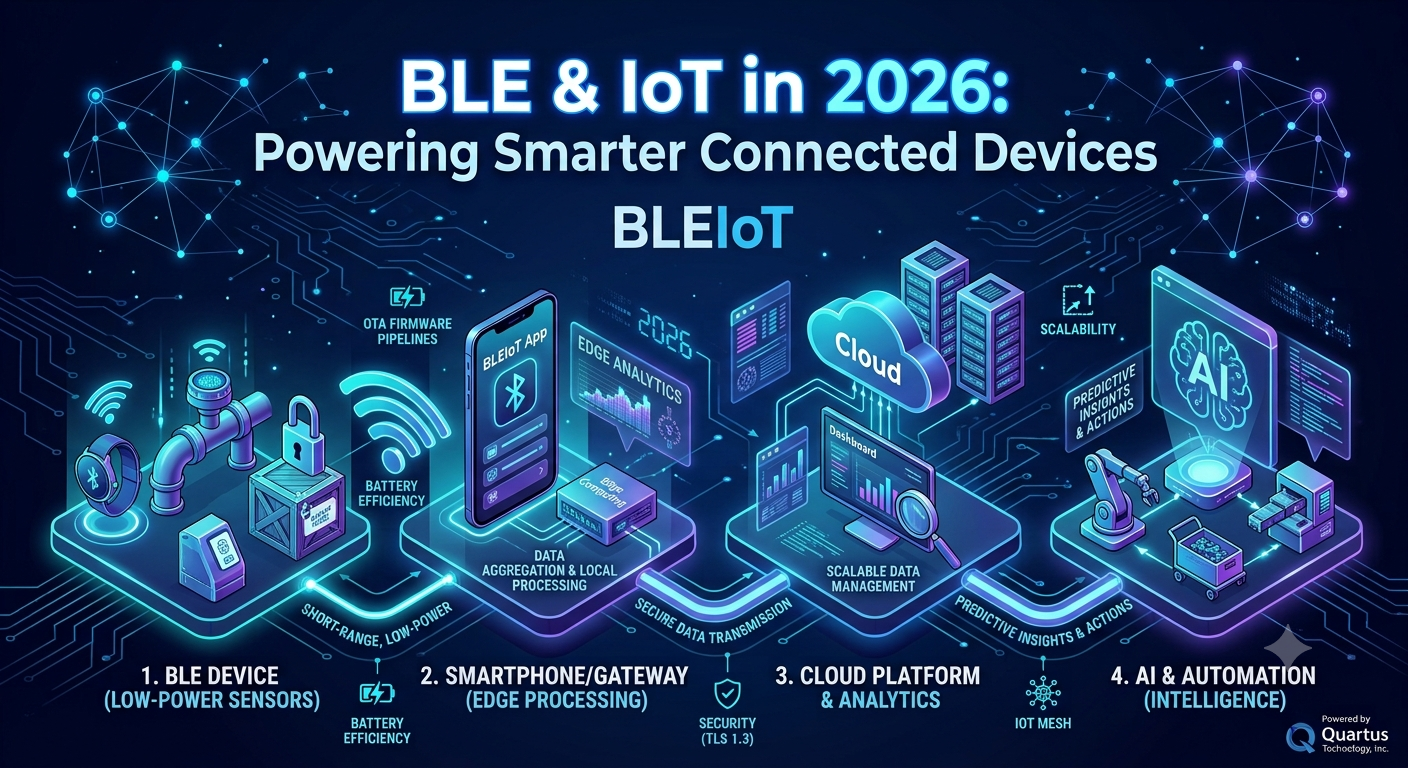
    A typical BLE IoT ecosystem can look like:

    BLE Device → Smartphone/Gateway → Internet → Cloud → Analytics/AI → Business Application

    BLE is particularly useful for IoT applications where devices need:

    • Low power consumption
    • Wireless connectivity
    • Small hardware footprints
    • Smartphone compatibility
    • Sensor communication
    • Periodic data transmission
    • Secure device communication

    This makes BLE suitable for everything from consumer products to industrial IoT systems.

    Why BLE Is Important for IoT in 2026

    Traditional wireless technologies are not always ideal for battery-powered devices.

    Many IoT products need to operate for months or even years while collecting and transmitting sensor information.

    BLE addresses this requirement by providing wireless connectivity optimized for low-power applications.

    Businesses can use BLE for:

    • Smart sensors
    • Wearables
    • Healthcare devices
    • Asset tracking
    • Industrial monitoring
    • Smart home products
    • Fitness devices
    • Retail technology
    • Location-based services
    • Connected equipment

    The combination of low power consumption and broad smartphone support makes BLE an attractive technology for connected product development.

    Top BLE and IoT Trends in 2026

    1. Bluetooth Low Energy for Smart IoT Devices

    BLE continues to be an important connectivity option for smart devices.

    Developers can use BLE to connect sensors and embedded devices to smartphones, tablets, gateways, and other nearby devices.

    Common applications include:

    • Temperature sensors
    • Motion sensors
    • Fitness trackers
    • Medical devices
    • Smart locks
    • Asset tags
    • Industrial sensors
    • Smart appliances

    The trend is moving toward smaller devices that can collect more data while consuming less energy.

    2. BLE 5.x and Advanced Bluetooth Capabilities

    Modern BLE development can take advantage of features introduced across the Bluetooth 5.x family.

    Depending on the hardware and use case, developers can benefit from improvements related to:

    • Range
    • Data throughput
    • Broadcasting
    • Reliability
    • Device communication
    • Location services

    For IoT product developers, selecting the right Bluetooth specification and hardware architecture is an important part of product design.

    3. Bluetooth Mesh for Large-Scale IoT

    Bluetooth Mesh enables many devices to communicate within a network rather than relying on a simple one-to-one connection.

    This makes it useful for environments containing large numbers of connected devices.

    Potential applications include:

    • Smart lighting
    • Commercial buildings
    • Industrial facilities
    • Smart offices
    • Warehouse systems
    • Building automation

    Instead of connecting every device directly to a central controller, mesh networking can create a distributed communication architecture.

    4. BLE + Edge Computing

    Edge computing is becoming increasingly important for IoT.

    Instead of sending every piece of sensor data to the cloud, an edge device can process information locally.

    For example:

    BLE Sensor → Edge Gateway → Local Processing → Cloud

    This can reduce:

    • Latency
    • Bandwidth requirements
    • Cloud processing costs
    • Dependence on constant connectivity

    Edge computing is particularly useful for industrial IoT and applications where rapid responses are important.

    5. AI + BLE IoT

    One of the biggest opportunities in 2026 is combining AI with connected IoT devices.

    BLE sensors can continuously collect information, while AI systems can analyze the data and identify patterns.

    For example:

    Sensor Data → BLE → Gateway → AI Model → Action

    AI-powered IoT solutions can support:

    • Predictive maintenance
    • Anomaly detection
    • Equipment monitoring
    • Energy optimization
    • Predictive analytics
    • Health and fitness insights
    • Smart automation

    The value of IoT is increasingly moving from simply collecting data to understanding what the data means.

    6. Matter and Connected Home Ecosystems

    Interoperability has become an important issue in smart-home development.

    Matter is designed to improve interoperability between supported smart-home devices and ecosystems.

    BLE can also play a role in device setup and commissioning workflows within connected-device ecosystems.

    For developers building smart-home products, understanding how BLE interacts with technologies such as Wi-Fi, Thread, and Matter can be important when designing the overall connectivity architecture.

    7. BLE Asset Tracking

    Asset tracking is another major application for BLE IoT.

    BLE tags can be attached to:

    • Equipment
    • Tools
    • Inventory
    • Medical assets
    • Vehicles
    • Warehouse products
    • Employee devices

    A BLE tracking system can combine tags, gateways, mobile applications, cloud infrastructure, and analytics.

    This can help businesses understand where assets are located and how they move through a facility.

    8. Indoor Positioning and Location Services

    GPS does not work efficiently for many indoor applications.

    BLE-based technologies can help businesses develop indoor location and proximity solutions.

    Applications include:

    • Indoor navigation
    • Retail proximity
    • Warehouse tracking
    • Hospital asset tracking
    • Employee location
    • Smart building applications
    • Beacon-based marketing

    BLE beacons and Bluetooth-based positioning can therefore become an important component of location-aware IoT systems.

    9. BLE Healthcare and Wearable Devices

    Healthcare and wearable technology continue to be important BLE applications.

    BLE can connect devices such as:

    • Fitness trackers
    • Smartwatches
    • Health monitors
    • Blood pressure devices
    • Glucose-related devices
    • Medical sensors
    • Rehabilitation equipment

    The device can collect measurements and securely transmit information to a smartphone or gateway.

    For healthcare applications, however, developers must pay particular attention to security, privacy, reliability, regulatory requirements, and the intended medical use of the product.

    10. Low-Power Industrial IoT

    Industrial environments contain thousands of sensors and connected devices.

    BLE can be useful for monitoring:

    • Temperature
    • Humidity
    • Vibration
    • Equipment status
    • Machine conditions
    • Environmental conditions

    When combined with gateways and cloud platforms, BLE sensors can become part of a larger Industrial IoT (IIoT) architecture.

    Key Components of a BLE IoT Solution

    A successful BLE IoT product usually contains multiple layers.

    1. BLE Hardware

    This is the physical device containing the Bluetooth chipset, sensors, battery, and other electronics.

    2. Firmware

    Firmware controls device behavior, Bluetooth communication, sensors, power management, and data collection.

    3. Mobile Application

    A smartphone application can communicate with BLE devices, configure them, display data, and send information to the cloud.

    4. Gateway

    A gateway can collect data from multiple BLE devices and forward it to the internet.

    5. Cloud Platform

    The cloud layer can store device information, sensor data, user information, and analytics.

    6. Dashboard

    A web or mobile dashboard can allow businesses to monitor connected devices and analyze their data.

    7. AI and Analytics

    AI and analytics can transform raw IoT data into useful insights and automated actions.

    BLE IoT Development Architecture

    A modern architecture may look like:

    BLE Sensors

    ↓

    BLE Gateway / Smartphone

    ↓

    Internet Connectivity

    ↓

    Cloud Platform

    ↓

    Data Processing & Analytics

    ↓

    AI / Automation

    ↓

    Web or Mobile Dashboard

    This architecture can be customized depending on the product requirements.

    BLE IoT Security Considerations

    Security should be considered from the beginning of product development.

    Important areas include:

    • Secure pairing
    • Authentication
    • Encryption
    • Device identity
    • Secure firmware updates
    • Access control
    • Cloud security
    • API security
    • Data protection
    • Device lifecycle management

    IoT security cannot be treated as an afterthought because compromised connected devices can potentially expose both device and user data.

    How to Develop a BLE IoT Product

    A structured development process can reduce technical risks.

    Step 1: Define the Product

    Identify the device’s purpose, users, sensors, connectivity requirements, and business objectives.

    Step 2: Select Hardware

    Choose an appropriate BLE chipset, sensors, battery, antenna, and supporting components.

    Step 3: Develop Firmware

    Build firmware for Bluetooth communication, sensor data collection, power management, and device configuration.

    Step 4: Develop the Mobile App

    Create Android and/or iOS applications for device discovery, pairing, configuration, and data visualization.

    Step 5: Build the Cloud Backend

    Develop APIs, databases, authentication, device management, and data processing systems.

    Step 6: Add Analytics and AI

    Use analytics or AI models to identify patterns, anomalies, and opportunities for automation.

    Step 7: Test the Product

    Test:

    • Connectivity
    • Range
    • Battery performance
    • Security
    • Firmware stability
    • Mobile compatibility
    • Network conditions
    • Device scalability

    Step 8: Deploy and Monitor

    After launch, monitor device performance and continuously improve firmware, applications, APIs, and cloud infrastructure.

    Industries Using BLE IoT Technology

    BLE IoT development can support a wide range of industries.

    Healthcare

    Connected medical and wellness devices.

    Retail

    Beacons, proximity experiences, inventory tracking, and smart retail systems.

    Manufacturing

    Machine monitoring, sensors, and predictive maintenance.

    Logistics

    Asset tracking and warehouse monitoring.

    Smart Buildings

    Lighting, occupancy, environmental monitoring, and automation.

    Automotive

    Connected accessories, vehicle-related devices, and proximity applications.

    Fitness

    Wearables, fitness sensors, and activity monitoring.

    Consumer Electronics

    Smart appliances, accessories, and connected products.

    Why Businesses Choose Custom BLE IoT Development

    Every connected product has different requirements.

    A custom BLE IoT solution allows businesses to design the technology around their specific product rather than relying entirely on generic platforms.

    Benefits can include:

    • Custom hardware integration
    • Custom BLE firmware
    • Android and iOS applications
    • Cloud integration
    • API development
    • IoT dashboards
    • Device management
    • AI integration
    • Scalable architecture
    • Custom security implementation

    This approach can be especially valuable for businesses developing their own connected products.

    The Future of BLE and IoT

    The future of connected devices will increasingly combine BLE, AI, edge computing, cloud platforms, advanced sensors, and intelligent automation.

    The next generation of IoT products will not simply connect devices. They will collect data, understand patterns, predict problems, and automatically respond to changing conditions.

    BLE is well positioned for this evolution because it provides a practical connectivity layer for many low-power devices.

    From smart wearables and healthcare devices to industrial sensors and asset tracking, BLE IoT development can help businesses transform physical products into intelligent connected solutions.

    Build Your BLE IoT Solution With IoTBLE

    Developing a successful connected product requires more than simply adding Bluetooth connectivity.

    It requires the right combination of BLE hardware, firmware, mobile applications, cloud infrastructure, APIs, security, analytics, and IoT architecture.

    Whether you are building a wearable, smart sensor, industrial IoT product, asset tracking solution, healthcare device, or connected consumer product, a well-planned BLE architecture can provide the foundation for long-term scalability.

    IoTBLE helps businesses explore and develop BLE-powered IoT solutions designed around their specific product and connectivity requirements.

    Target SEO Keywords

    • BLE IoT development
    • BLE IoT solutions
    • Bluetooth IoT development
    • BLE product development
    • Bluetooth Low Energy development
    • BLE application development
    • BLE software development
    • BLE firmware development
    • IoT product development
    • IoT development company
    • Bluetooth IoT solutions
    • BLE device development
    • BLE mobile app development
    • BLE gateway development
    • BLE sensor development
    • Bluetooth Mesh development
    • BLE asset tracking
    • BLE indoor positioning
    • BLE healthcare devices
    • BLE wearable development
    • industrial BLE IoT
    • AI IoT development
    • edge IoT development
    • connected device development
    • IoT product development 2026
    • BLE IoT trends 2026
  • IoT Product Development in 2026: How BLE Connectivity Is Powering Smarter Connected Devices

    IoT Product Development in 2026: How BLE Connectivity Is Powering Smarter Connected Devices

    From wearable healthcare devices to industrial monitoring systems, connected technology is changing how businesses interact with physical products.

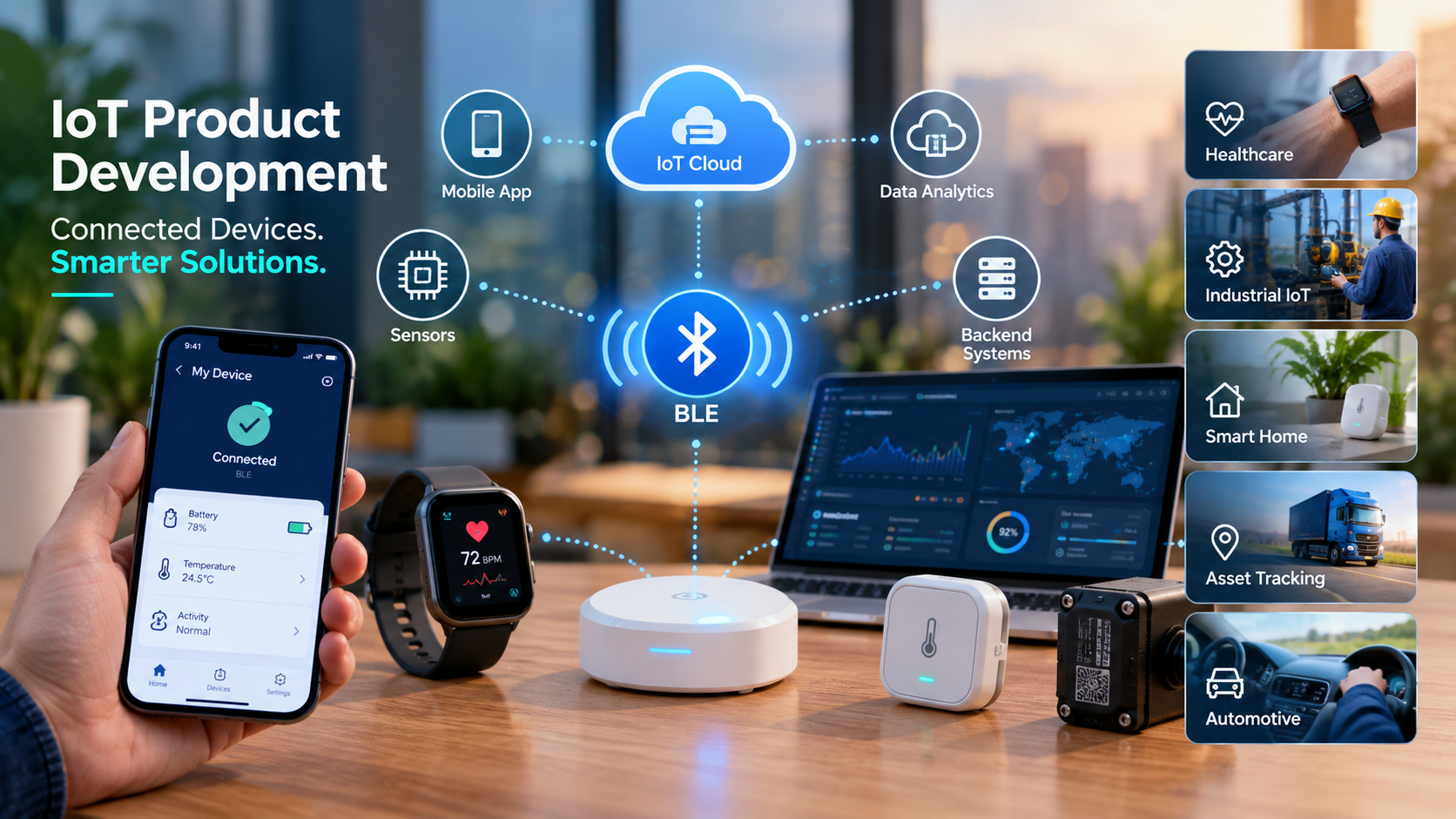
    In 2026, IoT product development is moving beyond basic device connectivity. Businesses are increasingly combining Bluetooth Low Energy (BLE), cloud platforms, mobile applications, and artificial intelligence to create intelligent connected ecosystems.

    Imagine a wearable device that continuously monitors activity, a smart sensor that sends real-time equipment data, or an industrial asset tracker that communicates with a mobile application.

    These solutions rely on seamless communication between hardware, firmware, software, and connected platforms.

    Bluetooth Low Energy plays an important role in this transformation by enabling energy-efficient wireless communication for a wide range of IoT applications.

    What Is IoT Product Development?

    IoT product development is the process of designing and building connected products that collect, exchange, and process information through networks and software systems.

    A typical IoT solution consists of:

    • Hardware components and sensors
    • Embedded firmware
    • Wireless connectivity such as BLE or Wi-Fi
    • Mobile or web applications
    • Cloud infrastructure
    • Data analytics and device management

    The objective is to develop products that deliver useful functionality while maintaining reliability, security, and scalability.

    Why Bluetooth Low Energy Is Important for IoT Development

    Bluetooth Low Energy is designed for wireless communication with low energy consumption.

    It is particularly useful for devices that operate on batteries and need to communicate periodically with smartphones, gateways, or other connected systems.

    Key Benefits of BLE Connectivity

    1. Low Power Consumption

    BLE enables battery-powered devices to communicate efficiently, making it suitable for wearables, sensors, and portable equipment.

    2. Smartphone Compatibility

    BLE allows IoT products to connect with compatible smartphones and tablets without requiring additional dedicated hardware in many use cases.

    3. Compact Device Design

    Its communication model supports compact connected products where power and physical size are important considerations.

    4. Cost-Effective Connectivity

    BLE can reduce connectivity complexity for short-range wireless applications.

    5. Flexible Integration

    BLE can be integrated with mobile applications, gateways, cloud platforms, and other IoT technologies.

    6 Industries Transforming Through IoT and BLE Solutions

    1. Healthcare and Medical Devices

    Connected healthcare products are enabling remote monitoring and improved access to health-related information.

    Examples include:

    • Wearable monitoring devices
    • Smart thermometers
    • Connected medical accessories
    • Patient monitoring systems
    • Fitness and wellness trackers

    BLE enables compatible devices to transfer readings to mobile applications for visualization and further processing.

    2. Industrial IoT and Predictive Maintenance

    Manufacturing facilities use connected sensors to monitor equipment and operational conditions.

    IoT product development supports:

    • Equipment condition monitoring
    • Temperature and vibration sensing
    • Asset tracking
    • Maintenance notifications
    • Industrial data collection

    When combined with analytics, these systems can help maintenance teams identify abnormal patterns before equipment failures occur.

    3. Smart Home Automation

    Smart home products use wireless connectivity to improve convenience and energy management.

    Examples include:

    • Smart locks
    • Lighting systems
    • Temperature sensors
    • Smart switches
    • Home security devices

    BLE can support device provisioning, configuration, and local communication within connected home ecosystems.

    4. Asset Tracking and Logistics

    Businesses need visibility into the location and condition of valuable assets.

    BLE beacons and connected tags can support:

    • Warehouse asset tracking
    • Equipment identification
    • Inventory visibility
    • Proximity-based notifications
    • Indoor location systems

    These solutions can be integrated with mobile applications and backend platforms.

    5. Automotive and Mobility

    Connected automotive accessories and mobility products increasingly rely on wireless communication.

    BLE can support digital access, device pairing, vehicle accessories, and connected user experiences.

    6. Consumer Electronics and Wearables

    Wearables and consumer products depend on seamless communication between hardware and mobile applications.

    Examples include:

    • Smartwatches
    • Fitness bands
    • Wireless accessories
    • Smart sensors
    • Connected personal devices

    Reliable BLE application development is essential for pairing, data synchronization, and device management.

    The Role of AI in Modern IoT Product Development

    The combination of AI and IoT is creating opportunities for intelligent connected products.

    Traditional IoT systems collect and transmit data. AI-powered systems can analyze that information to identify patterns, detect anomalies, and generate predictions.

    For example, an industrial sensor may continuously collect equipment readings. An AI-powered platform can analyze historical information and identify conditions that may require inspection.

    Potential applications include:

    • Predictive maintenance
    • Smart energy management
    • Intelligent healthcare monitoring
    • Automated alerts
    • Equipment performance analysis

    The integration of AI should be based on the product’s actual requirements, available data, and processing capabilities.

    Challenges in Developing BLE-Enabled IoT Products

    Despite its advantages, developing connected devices involves several engineering considerations.

    Connectivity Reliability

    Developers must account for wireless interference, connection stability, pairing behavior, and communication range.

    Battery Optimization

    Power consumption needs to be considered throughout hardware design, firmware development, and communication scheduling.

    Device Security

    Secure pairing, authentication, encryption, and firmware update mechanisms are essential for protecting connected products.

    Hardware and Software Compatibility

    Firmware, mobile applications, sensors, and backend services must work together consistently.

    Scalability

    A product that works with a few devices should also be designed with future deployment and device management requirements in mind.

    IoT Product Development Lifecycle

    A structured development process helps businesses move from concept to a market-ready connected product.

    Step 1: Product Concept and Requirements

    Define the device’s purpose, users, functionality, connectivity, and operating environment.

    Step 2: Hardware and Sensor Selection

    Choose appropriate components based on power requirements, performance, cost, and product size.

    Step 3: Embedded Firmware Development

    Develop firmware for device control, communication, sensor integration, and power management.

    Step 4: BLE Connectivity Integration

    Implement pairing, data exchange, device discovery, and connection management.

    Step 5: Mobile App and Cloud Development

    Build the application and backend systems required for monitoring, configuration, and data management.

    Step 6: Testing and Optimization

    Validate connectivity, security, battery performance, reliability, and user experience.

    Why Choose IoTBLE for Connected Product Development?

    Building an IoT product requires coordinated engineering across hardware, firmware, wireless communication, and software platforms.

    IoTBLE focuses on connected technology and BLE-enabled product development, helping businesses explore solutions for smart devices and connected applications.

    From Bluetooth Low Energy integration to IoT application development, the right engineering approach can help turn a product concept into a functional connected solution.

    Frequently Asked Questions

    What is BLE in IoT?

    Bluetooth Low Energy is a wireless communication technology designed for low-power data exchange between compatible devices, smartphones, and connected systems.

    What is the difference between BLE and traditional Bluetooth?

    BLE is optimized for low-energy communication, while Bluetooth Classic is commonly used for applications requiring continuous data streams, such as audio.

    What products use BLE connectivity?

    Wearables, healthcare accessories, smart home devices, asset trackers, industrial sensors, and consumer electronics commonly use BLE.

    Can BLE devices connect to mobile applications?

    Yes. Compatible BLE devices can communicate with Android and iOS applications for pairing, configuration, data transfer, and device management.

    How long does IoT product development take?

    The timeline depends on product complexity, hardware availability, firmware requirements, application features, testing, and certification needs.

    Conclusion

    IoT product development is creating new opportunities for businesses to build smarter, more connected products.

    With Bluetooth Low Energy, embedded engineering, mobile applications, and intelligent data processing, organizations can develop connected solutions for healthcare, manufacturing, logistics, consumer electronics, and more.

    The foundation of a successful IoT product is reliable connectivity, thoughtful engineering, security, and a scalable architecture.

    Have an IoT product idea?

    Explore BLE and IoT development possibilities with IoTBLE and take your connected product from concept to implementation.

    CTA: Build Smarter. Connect Better. Innovate with IoTBLE.

  • BLE IoT Gateways in 2026: Connecting Bluetooth Devices to the Cloud

    BLE IoT Gateways in 2026: Connecting Bluetooth Devices to the Cloud

    Bluetooth Low Energy (BLE) has become an important connectivity technology for smart devices, sensors, wearables, industrial equipment, healthcare devices, and asset monitoring systems.

    But a BLE device does not always need to communicate directly with the cloud.

    In many IoT applications, a BLE IoT gateway acts as the bridge between nearby Bluetooth devices and a remote cloud platform. This architecture can make it possible to collect information from multiple BLE devices, process data locally, and send relevant information to centralized applications.

    As businesses move from individual connected devices toward larger IoT ecosystems, understanding the role of BLE gateways is becoming increasingly important.

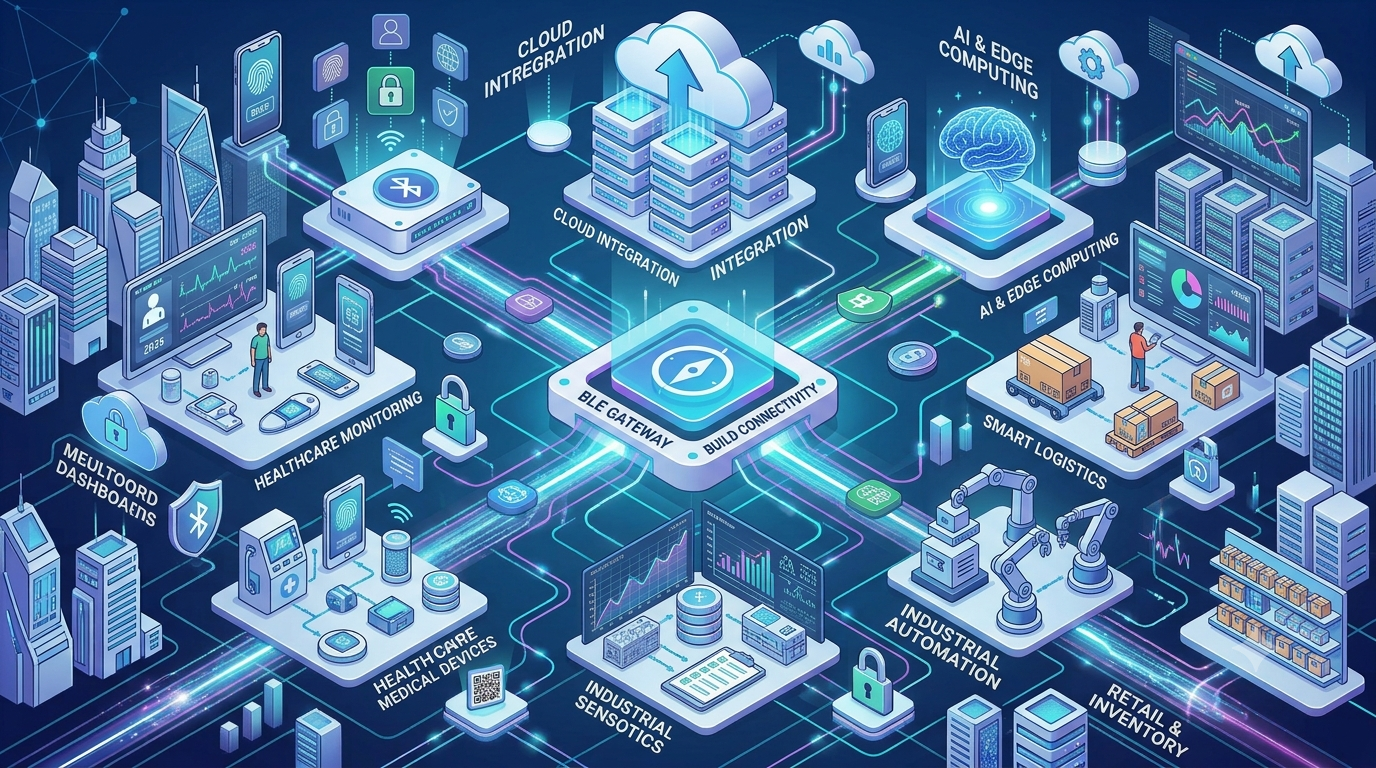
    What Is a BLE IoT Gateway?

    A BLE IoT gateway is a hardware or software-enabled system that receives data from BLE devices and forwards it to another network or platform.

    A basic architecture can look like:

    BLE Sensor → BLE Gateway → Internet → Cloud Platform → Dashboard

    The gateway can communicate with multiple BLE devices within its coverage area while using technologies such as Wi-Fi, Ethernet, cellular connectivity, or other networking methods to communicate with backend systems.

    This makes the gateway an important link between short-range Bluetooth communication and wider IoT infrastructure.

    Why Do IoT Systems Need BLE Gateways?

    BLE is designed primarily for short-range wireless communication.

    Cloud platforms, on the other hand, generally require an internet or network connection.

    A gateway can connect these two environments.

    For example:

    Temperature Sensor

    ↓ BLE

    Gateway

    ↓ Wi-Fi / Ethernet / Cellular

    Cloud Platform

    ↓

    Web Dashboard

    This allows businesses to collect information from devices without requiring every BLE sensor to have its own internet connection.

    How Does a BLE Gateway Work?

    A typical BLE gateway performs several functions.

    1. Device Discovery

    The gateway scans for nearby BLE devices and identifies available signals.

    2. Data Collection

    It receives information from sensors, beacons, tags, or other Bluetooth-enabled products.

    3. Data Processing

    Depending on the architecture, the gateway may filter, transform, aggregate, or validate information locally.

    4. Network Communication

    The gateway sends relevant data to the cloud or another backend system.

    5. Device Management

    Advanced gateways can support remote configuration, diagnostics, software updates, and device monitoring.

    This creates a complete communication pathway between physical devices and business applications.

    BLE Gateway vs Direct-to-Cloud Devices

    Not every IoT product needs a gateway.

    Some devices can connect directly to Wi-Fi or cellular networks.

    However, BLE gateway architecture can be useful when many low-power Bluetooth devices operate within the same physical environment.

    BLE Gateway ArchitectureDirect Internet Connectivity
    Multiple BLE devices can share a gatewayDevices generally need their own network connection
    Can support low-power BLE sensorsMay require higher device power consumption
    Centralized local communicationEach device communicates independently
    Useful for indoor environmentsUseful where direct connectivity is practical
    Gateway infrastructure is requiredGateway may not be required

    The right architecture depends on device requirements, deployment environment, power constraints, connectivity availability, and business objectives.

    Where Are BLE IoT Gateways Used?

    BLE gateway technology can support many industries.

    Healthcare

    Hospitals can use BLE-enabled devices and gateways to collect information from connected equipment.

    Potential applications include:

    • Medical equipment monitoring
    • Asset visibility
    • Temperature monitoring
    • Patient-related devices
    • Environmental sensors

    Healthcare deployments require particularly careful consideration of privacy, security, and regulatory requirements.

    Warehousing

    BLE gateways can receive signals from tagged assets, equipment, pallets, or containers.

    The collected data can then be integrated with warehouse management platforms.

    Manufacturing

    Factories can use BLE sensors to monitor equipment, environmental conditions, and operational assets.

    Gateways can collect data from multiple devices and forward it to industrial or cloud platforms.

    Retail

    Retail environments can use BLE devices for inventory visibility, equipment monitoring, and other proximity-based applications.

    Smart Buildings

    BLE sensors can monitor environmental conditions such as:

    • Temperature
    • Humidity
    • Occupancy-related signals
    • Equipment status
    • Room conditions

    The gateway can collect information from different areas of a building and send it to a centralized management platform.

    BLE Gateways and Edge Computing

    One of the important developments in IoT architecture is the growing use of edge computing.

    Instead of sending every piece of sensor data directly to the cloud, a gateway can perform selected processing locally.

    For example:

    BLE Sensors → Gateway → Local Processing → Cloud

    The gateway could potentially:

    • Filter unnecessary data
    • Detect predefined events
    • Aggregate sensor readings
    • Trigger local alerts
    • Buffer information during connectivity interruptions
    • Forward only relevant information

    This can reduce unnecessary network traffic and support applications where immediate local processing is useful.

    BLE Gateway Connectivity Options

    A gateway may use different technologies to communicate with backend systems.

    Wi-Fi

    Suitable for environments with reliable wireless network coverage.

    Ethernet

    Useful for fixed installations where wired network connectivity is available.

    Cellular

    Can be useful for remote or mobile deployments where wired or Wi-Fi infrastructure is unavailable.

    Ethernet + Cellular Backup

    Some commercial IoT deployments can use multiple network options for improved connectivity resilience.

    The choice depends on deployment conditions and reliability requirements.

    MQTT and BLE IoT

    MQTT is commonly used in IoT architectures because it follows a lightweight publish-and-subscribe communication model.

    A simplified architecture could look like:

    BLE Device → Gateway → MQTT Broker → Cloud Application

    The gateway publishes device information, while authorized applications can subscribe to relevant data streams.

    MQTT can be useful for applications involving large numbers of connected devices, but the appropriate communication protocol depends on the overall system architecture.

    Designing a Scalable BLE Gateway

    A gateway that supports ten devices may have very different requirements from one expected to support thousands.

    During development, businesses should consider:

    • Number of BLE devices
    • Scanning frequency
    • Data volume
    • Network availability
    • Processing requirements
    • Memory
    • Storage
    • Power requirements
    • Security
    • Remote management
    • Firmware updates

    Planning for future device growth can help prevent architectural limitations later.

    Security Considerations for BLE Gateways

    A gateway sits between connected devices and backend infrastructure, making security particularly important.

    A secure BLE IoT architecture can include:

    Device Authentication

    Verify that connected devices are authorized.

    Secure Communication

    Protect information exchanged between devices, gateways, and backend systems.

    API Security

    Use appropriate authentication and authorization for cloud communication.

    Secure Gateway Access

    Restrict administrative access to authorized users.

    Firmware Protection

    Implement secure mechanisms for gateway software and firmware updates.

    Network Segmentation

    Where appropriate, isolate IoT infrastructure from other business systems.

    Security requirements should be evaluated according to the device, industry, data, and deployment environment.

    Remote Gateway Management

    Large IoT deployments may involve hundreds or thousands of gateways.

    Physically accessing every gateway for configuration or maintenance can be difficult.

    A remote management platform can potentially support:

    • Gateway health monitoring
    • Configuration management
    • Software updates
    • Device status
    • Error reporting
    • Connectivity monitoring
    • Remote diagnostics

    This can significantly simplify the management of distributed IoT infrastructure.

    What Happens When Internet Connectivity Is Lost?

    IoT systems should account for network interruptions.

    A well-designed gateway may temporarily store data locally and forward it when connectivity is restored.

    This can be useful for applications where temporary internet outages should not result in complete data loss.

    The appropriate buffering strategy depends on:

    • Data importance
    • Available storage
    • Network reliability
    • Required data freshness
    • Application requirements

    AI and BLE Gateway Architecture

    AI can add another layer of intelligence to BLE IoT systems.

    For example, a gateway or cloud platform could analyze sensor information to identify patterns or unusual behavior.

    Potential applications include:

    • Equipment anomaly detection
    • Predictive maintenance
    • Energy optimization
    • Environmental monitoring
    • Asset utilization analysis
    • Automated alerts

    A practical architecture might look like:

    BLE Sensors → Gateway → IoT Platform → AI Analytics → Business Dashboard

    AI should be introduced where it addresses a specific business requirement rather than simply being added as a technology feature.

    Steps to Develop a Custom BLE IoT Gateway

    Businesses planning a custom gateway can follow a structured development process.

    Step 1: Define the Use Case

    Identify the devices, environment, data, and business objective.

    Step 2: Select BLE Hardware

    Choose the appropriate Bluetooth chipset, module, antenna, and supporting components.

    Step 3: Develop Gateway Firmware

    Implement BLE scanning, device communication, processing, storage, and networking functionality.

    Step 4: Add Cloud Connectivity

    Connect the gateway with the required IoT platform using suitable protocols and APIs.

    Step 5: Build Device Management

    Create tools for configuration, monitoring, diagnostics, and updates.

    Step 6: Implement Security

    Secure device communication, authentication, access, firmware, and cloud connectivity.

    Step 7: Test in Real Environments

    Test range, interference, network interruptions, device density, power consumption, and reliability.

    Step 8: Prepare for Deployment

    Optimize the solution for manufacturing, installation, monitoring, and long-term maintenance.

    Why Businesses Choose Custom BLE IoT Development

    Off-the-shelf gateways can be useful for standard applications, but some businesses require specialized functionality.

    Custom BLE gateway development can provide greater control over:

    • Hardware configuration
    • BLE device compatibility
    • Data processing
    • Cloud integration
    • Security
    • User management
    • Remote updates
    • Industry-specific workflows

    For a company developing its own connected product ecosystem, a custom gateway can become an important part of the overall product architecture.

    How BLEIoT Can Help

    BLEIoT focuses on Bluetooth Low Energy and IoT development for businesses building connected products and wireless ecosystems.

    Depending on project requirements, development can cover:

    • BLE IoT development
    • BLE gateway development
    • Bluetooth device integration
    • BLE firmware development
    • IoT application development
    • Mobile BLE applications
    • Cloud IoT integration
    • Sensor connectivity
    • Smart device development
    • Connected product engineering
    • Custom Bluetooth solutions

    The development approach can be adapted to the product’s hardware, connectivity, software, and business requirements.

    Final Thoughts

    BLE IoT gateways provide an important connection between low-power Bluetooth devices and larger digital platforms.

    They can collect data from multiple BLE devices, perform local processing, connect to cloud systems, and support remote device management.

    For businesses developing smart buildings, healthcare solutions, industrial systems, warehouse technology, asset monitoring platforms, or connected consumer products, gateway architecture can provide a practical way to build a scalable IoT ecosystem.

    The future of IoT is not simply about connecting more devices.

    It is about creating reliable connections between devices, data, software, and business operations.

    SEO Keywords

    • BLE IoT gateway
    • BLE gateway development
    • Bluetooth IoT gateway
    • BLE IoT development
    • Bluetooth Low Energy IoT
    • custom BLE gateway
    • IoT gateway development
    • BLE device integration
    • Bluetooth gateway development
    • BLE firmware development
    • IoT device connectivity
    • Bluetooth IoT solutions
    • smart device development
    • connected product development
    • BLE development company

    Meta Title

    BLE IoT Gateways in 2026: Development & Connectivity Guide | BLEIoT

    Meta Description

    Learn how BLE IoT gateways connect Bluetooth devices to cloud platforms and explore gateway architecture, edge computing, security, AI, and custom BLE development.

    Suggested URL Slug

    /blogs/ble-iot-gateway-development-connect-bluetooth-devices-cloud/

  • IoT BLE Development in 2026: Building Smarter, Low-Power Connected Devices

    IoT BLE Development in 2026: Building Smarter, Low-Power Connected Devices

    The Internet of Things is moving beyond simple device connectivity. In 2026, businesses are building connected products that can sense, communicate, analyze, automate, and respond in real time.

    From industrial sensors and wearables to smart locks, medical devices, fitness trackers, EV chargers, and smart-building systems, Bluetooth Low Energy (BLE) has become an important connectivity technology for battery-powered IoT products.

    The latest Bluetooth ecosystem is also expanding into areas such as precise ranging, higher data throughput, edge AI, ultra-low-power devices, and Ambient IoT applications. Bluetooth SIG’s 2026 updates highlight developments including Channel Sounding, Bluetooth Core 6.3 enhancements, and work toward higher-throughput Bluetooth LE.

    What Is IoT BLE Development?

    IoT BLE development combines Bluetooth Low Energy connectivity with sensors, embedded firmware, mobile applications, gateways, cloud platforms, and data analytics.

    A typical architecture can look like:

    BLE Device → Mobile App / Gateway → Cloud Platform → Data Processing → Dashboard → Automation

    This architecture allows physical devices to communicate with software systems while maintaining the low-power characteristics required by many IoT applications.

    Why BLE Is Important for IoT

    BLE is particularly useful for IoT products that need wireless communication while operating with limited battery capacity.

    Common advantages include:

    • Low power consumption
    • Wireless device connectivity
    • Smartphone compatibility
    • Compact hardware designs
    • Secure communication capabilities
    • Support for sensors and peripherals
    • Proximity and location-aware applications
    • Flexible device-to-app communication

    Bluetooth SIG describes Bluetooth LE as a low-power technology suited to Ambient IoT applications, including energy-constrained connected devices.

    IoT BLE Architecture: From Device to Cloud

    Building a successful connected product requires more than adding a BLE module.

    The complete technology stack can include several layers.

    1. BLE Hardware

    The hardware layer may include:

    • Sensors
    • BLE SoCs
    • Microcontrollers
    • Battery systems
    • Actuators
    • Displays
    • Industrial equipment
    • Medical components

    Hardware selection affects power consumption, performance, connectivity, security, and overall product cost.

    2. Embedded Firmware

    Firmware controls how the device communicates and behaves.

    A BLE IoT product may require firmware for:

    • Advertising
    • Scanning
    • Connections
    • GATT services
    • Sensor data collection
    • Power management
    • Device configuration
    • Security
    • OTA updates

    Firmware and mobile applications should be designed together so that communication remains reliable throughout the product lifecycle.

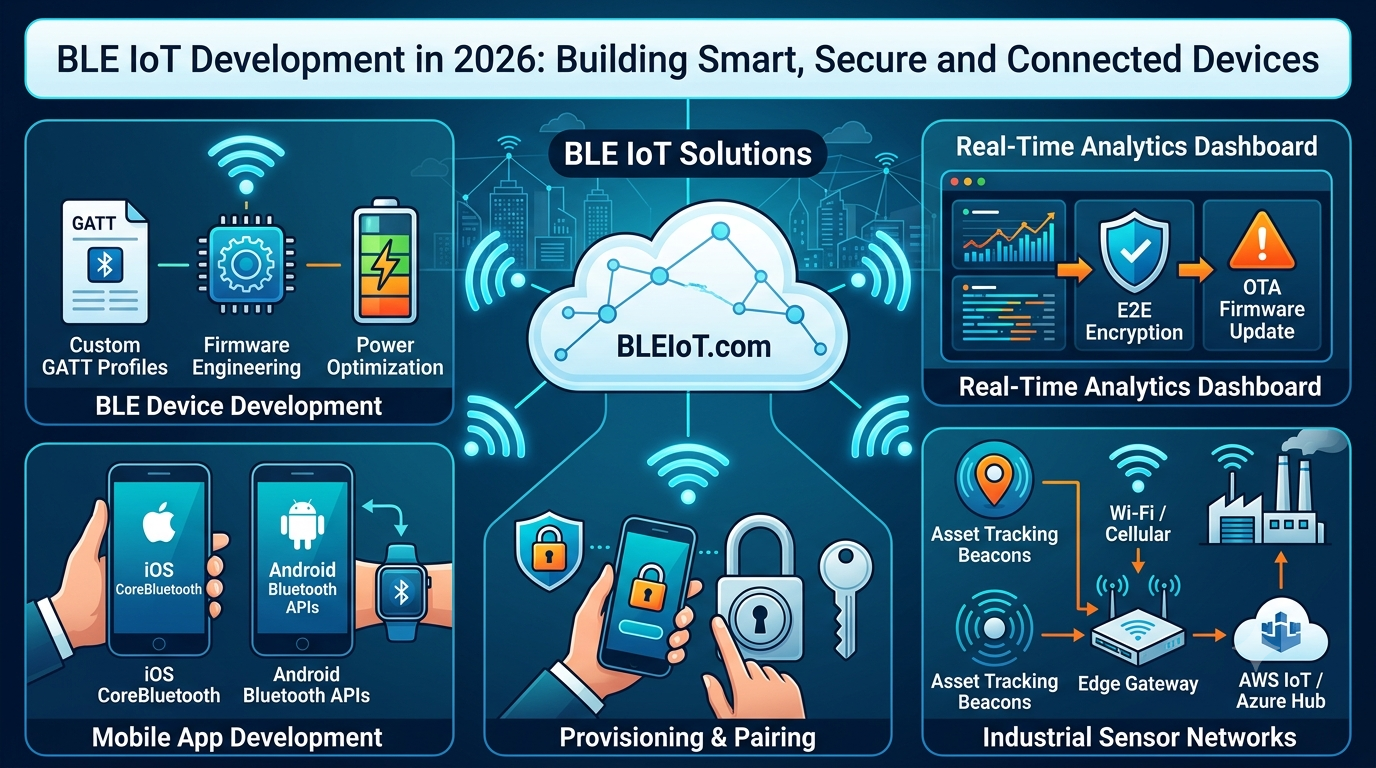
    3. Mobile Application

    Many BLE products use smartphones as a bridge between the physical device and cloud services.

    Native iOS and Android development can provide access to platform-specific Bluetooth APIs, including CoreBluetooth on iOS and Android Bluetooth APIs.

    A mobile application can handle:

    • Device discovery
    • Pairing
    • Provisioning
    • Configuration
    • Data visualization
    • User authentication
    • Device control
    • Cloud synchronization

    4. Gateway Connectivity

    Some IoT deployments cannot rely on smartphones as the communication bridge.

    A dedicated gateway can collect information from multiple BLE devices and transmit it to a cloud platform.

    This architecture can be useful for:

    • Industrial facilities
    • Smart buildings
    • Retail environments
    • Warehouses
    • Healthcare environments
    • Large sensor networks

    5. Cloud Infrastructure

    Cloud systems can store, process, visualize, and analyze data collected from connected devices.

    Common cloud platforms for IoT development include:

    • AWS IoT
    • Microsoft Azure IoT
    • Google Cloud

    A secure edge-to-cloud architecture can provide centralized monitoring and device management.

    Custom GATT Services for IoT Products

    The Generic Attribute Profile (GATT) defines how BLE devices organize and exchange data.

    Custom GATT services can be designed around the specific requirements of an IoT product.

    For example, an industrial sensor could have characteristics for:

    • Temperature
    • Pressure
    • Vibration
    • Battery level
    • Device status
    • Error conditions

    A custom GATT architecture can make communication between the embedded device and application more structured and predictable.

    Secure BLE Pairing and Device Provisioning

    Security should be considered from the beginning of IoT BLE development.

    Connected devices may exchange sensitive business, operational, or personal information.

    A secure implementation can include:

    • Authentication
    • Secure pairing
    • Encryption
    • Key management
    • Device identity
    • Access control
    • Secure provisioning
    • Protected firmware updates

    Device provisioning is especially important when hundreds or thousands of devices need to be deployed.

    The objective is to make first-time setup secure while keeping the user experience simple.

    OTA Firmware Updates

    IoT products often remain in the field for years.

    Requiring technicians to physically update every device can become expensive and impractical.

    Over-the-air firmware updates can allow manufacturers to distribute firmware improvements remotely.

    OTA updates can be used for:

    • Security patches
    • Bug fixes
    • Performance improvements
    • New functionality
    • Device optimization

    A production-grade OTA system should consider authentication, integrity verification, recovery mechanisms, interrupted transfers, and device compatibility.

    BLE and Edge AI

    One of the emerging directions in 2026 is the combination of BLE connectivity and edge AI.

    Bluetooth SIG highlights the growing relationship between Bluetooth connectivity and edge AI, particularly for wearables, industrial applications, smart buildings, and other intelligent connected products.

    Instead of sending every piece of raw data to the cloud, an IoT device or edge gateway can potentially process information locally.

    For example:

    Sensor → BLE → Edge Processing → AI Model → Decision → Action

    This can help applications that require faster responses, lower latency, or reduced cloud communication.

    Bluetooth Channel Sounding and IoT

    Bluetooth Channel Sounding is another important development for location-aware IoT applications.

    The technology is designed to enable more accurate distance measurement between Bluetooth devices. Bluetooth SIG identifies applications such as asset tracking, location awareness, and other proximity-based experiences.

    Potential IoT use cases include:

    • Asset tracking
    • Indoor positioning
    • Smart access systems
    • Location-aware automation
    • Proximity-based experiences
    • Industrial monitoring

    As the technology develops, developers can explore new IoT applications that require greater awareness of device distance.

    Higher Data Throughput for BLE

    Bluetooth technology is also evolving toward higher data throughput.

    Bluetooth SIG’s High Data Throughput work is targeting speeds of up to 7.5 Mbps compared with today’s 2 Mbps maximum for Bluetooth LE, while retaining the technology’s low-power focus.

    Higher throughput could expand the types of applications that can use Bluetooth LE, particularly where connected devices need to transfer larger amounts of data.

    IoT BLE Use Cases

    Smart Wearables

    BLE can connect smartwatches, fitness trackers, smart rings, and other wearable devices with smartphones and cloud platforms.

    Healthcare Devices

    Connected medical and wellness devices can collect measurements and securely transmit data to applications and backend systems.

    For regulated medical products, development also requires appropriate regulatory and quality considerations.

    Industrial IoT

    BLE sensor networks can monitor:

    • Temperature
    • Pressure
    • Vibration
    • Equipment status
    • Asset location
    • Environmental conditions

    Smart Buildings

    BLE-enabled sensors can support:

    • Occupancy monitoring
    • Smart access
    • Environmental monitoring
    • Energy management
    • Building automation

    Retail and Electronic Shelf Labels

    Bluetooth connectivity can support connected retail devices such as electronic shelf labels, asset tags, and other smart-store technologies.

    Smart Locks

    BLE enables smartphones and other authorized devices to communicate with connected locks for access-control applications.

    EV and Charging Infrastructure

    Connected charging systems can use BLE alongside other communication technologies for configuration, monitoring, and user interaction.

    Challenges in IoT BLE Development

    Building a reliable BLE IoT product requires careful engineering.

    Battery Life

    More sensors, wireless communication, and processing can increase power consumption.

    Developers need to optimize:

    • Advertising intervals
    • Connection intervals
    • Sleep modes
    • Sensor sampling
    • Data transmission
    • Firmware processing

    Device Compatibility

    iOS and Android handle Bluetooth differently, and Android devices can vary by manufacturer and operating-system version.

    Testing across real devices is therefore important.

    Connectivity Reliability

    BLE communication can be affected by:

    • Physical obstacles
    • Radio interference
    • Distance
    • Device density
    • Antenna design
    • Environmental conditions

    Security

    Connected devices can become entry points into larger systems if security is poorly designed.

    Security should therefore be integrated across firmware, BLE communication, mobile applications, APIs, cloud infrastructure, and device management.

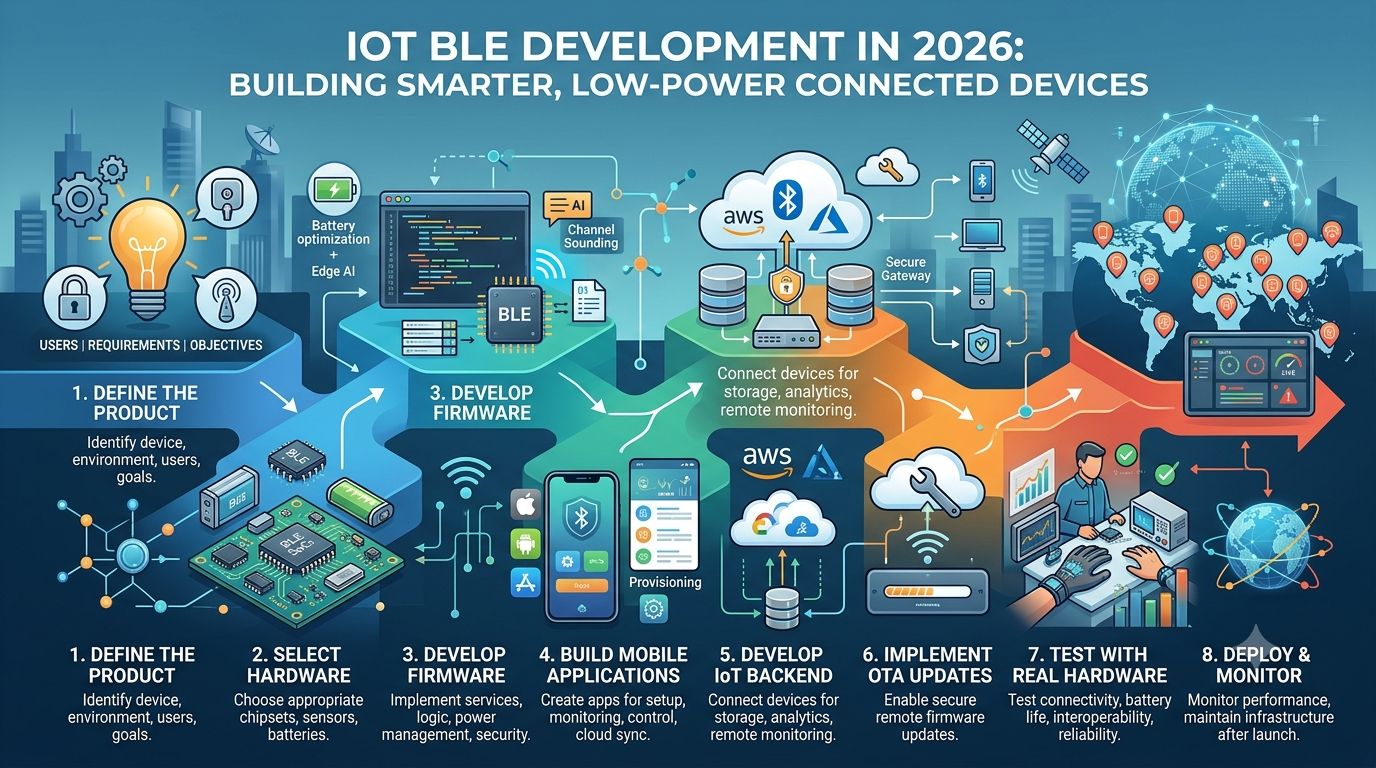
    How to Build an IoT BLE Product

    A structured development process can include:

    Step 1: Define the Product

    Identify the device, users, sensors, environment, connectivity requirements, and business objectives.

    Step 2: Select Hardware

    Choose appropriate BLE chipsets, sensors, microcontrollers, batteries, and communication components.

    Step 3: Develop Firmware

    Implement BLE services, device logic, power management, security, and sensor communication.

    Step 4: Build Mobile Applications

    Develop iOS and Android applications for provisioning, configuration, monitoring, and control.

    Step 5: Develop the IoT Backend

    Connect devices to cloud services for data storage, analytics, remote monitoring, and device management.

    Step 6: Implement OTA Updates

    Create a secure mechanism for remotely updating deployed devices.

    Step 7: Test With Real Hardware

    Test connectivity, battery life, device interoperability, firmware reliability, mobile compatibility, and real-world operating conditions.

    Step 8: Deploy and Monitor

    After launch, continue monitoring device performance and maintaining firmware, applications, APIs, and cloud infrastructure.

    Why Choose an IoT BLE Development Partner?

    IoT product development crosses several technical disciplines.

    A capable development team may need expertise in:

    • BLE protocol development
    • Embedded firmware
    • Custom GATT services
    • iOS CoreBluetooth
    • Android Bluetooth APIs
    • BLE hardware integration
    • IoT gateways
    • Cloud infrastructure
    • OTA firmware updates
    • Security
    • QA with physical devices
    • Production support

    IoT BLE Services highlights these areas as part of its end-to-end BLE and IoT development capabilities, including BLE device development, IoT system integration, sensor networks, gateway and cloud connectivity, provisioning, OTA updates, and embedded firmware integration.

    The Future of IoT BLE Development

    BLE is moving beyond simple device-to-phone connectivity.

    The combination of BLE + sensors + edge computing + AI + cloud platforms is creating new possibilities for intelligent connected products.

    Current Bluetooth developments point toward:

    • More accurate ranging
    • Higher data throughput
    • Lower-power IoT
    • Edge AI
    • Ambient IoT
    • Smarter sensor networks
    • Location-aware devices
    • More intelligent connected products

    Bluetooth SIG’s current development roadmap also includes work aimed at IP-based communication and other capabilities that could support evolving IoT architectures.

    Conclusion

    IoT BLE development in 2026 is becoming more sophisticated as businesses demand connected products that are secure, power-efficient, scalable, and intelligent.

    A successful IoT product requires more than Bluetooth connectivity. It needs coordinated hardware, embedded firmware, BLE protocols, mobile applications, gateways, cloud infrastructure, security, analytics, and ongoing device management.

    Whether you’re developing a wearable, industrial sensor, smart lock, healthcare device, fitness tracker, EV charger, or enterprise IoT platform, a well-designed BLE architecture can provide the foundation for reliable connected experiences.

    Build Your Connected IoT Product

    Looking for IoT BLE development services for your next connected product?

    IoT BLE Services can help with BLE device development, custom GATT services, embedded firmware, mobile BLE applications, IoT system integration, gateways, cloud connectivity, secure provisioning, OTA updates, and real-time device monitoring.

  • BLE IoT Development in 2026: Building Smarter Connected Devices and IoT Solutions

    BLE IoT Development in 2026: Building Smarter Connected Devices and IoT Solutions

    The Internet of Things is moving beyond simple device connectivity.

    Businesses today are building connected products that can collect sensor data, communicate with smartphones and gateways, automate processes, monitor assets, and generate real-time insights.

    One technology playing an important role in these solutions is Bluetooth Low Energy (BLE).

    BLE provides low-power wireless communication that can connect sensors, wearables, medical devices, industrial equipment, smart products, and other connected devices.

    When combined with IoT platforms, cloud services, mobile applications, and analytics, BLE can become an important component of modern connected-device ecosystems.

    What Is BLE IoT?

    BLE IoT refers to IoT solutions that use Bluetooth Low Energy to connect devices, sensors, smartphones, gateways, and other components within a connected ecosystem.

    A typical BLE IoT architecture can look like:

    BLE Device → Smartphone/Gateway → Internet → Cloud Platform → Dashboard/Application

    The BLE device collects or exchanges data locally, while a smartphone or gateway can forward relevant information to an internet-connected platform.

    This architecture can be useful where devices need low-power communication and do not necessari

  • IoT and BLE Development in 2026: Connecting Devices, Data, and Intelligent Applications

    IoT and BLE Development in 2026: Connecting Devices, Data, and Intelligent Applications

    The Internet of Things is moving beyond simple connected devices. In 2026, businesses are building intelligent ecosystems where sensors, Bluetooth devices, mobile applications, gateways, cloud platforms, and analytics systems work together.

    For many of these products, Bluetooth Low Energy (BLE) provides an efficient way to connect nearby devices while IoT technology enables data to move beyond the local environment.

    This combination is helping businesses develop smarter wearables, industrial sensors, healthcare devices, asset-tracking systems, smart-home products, and connected consumer applications.

    What Is IoT BLE Development?

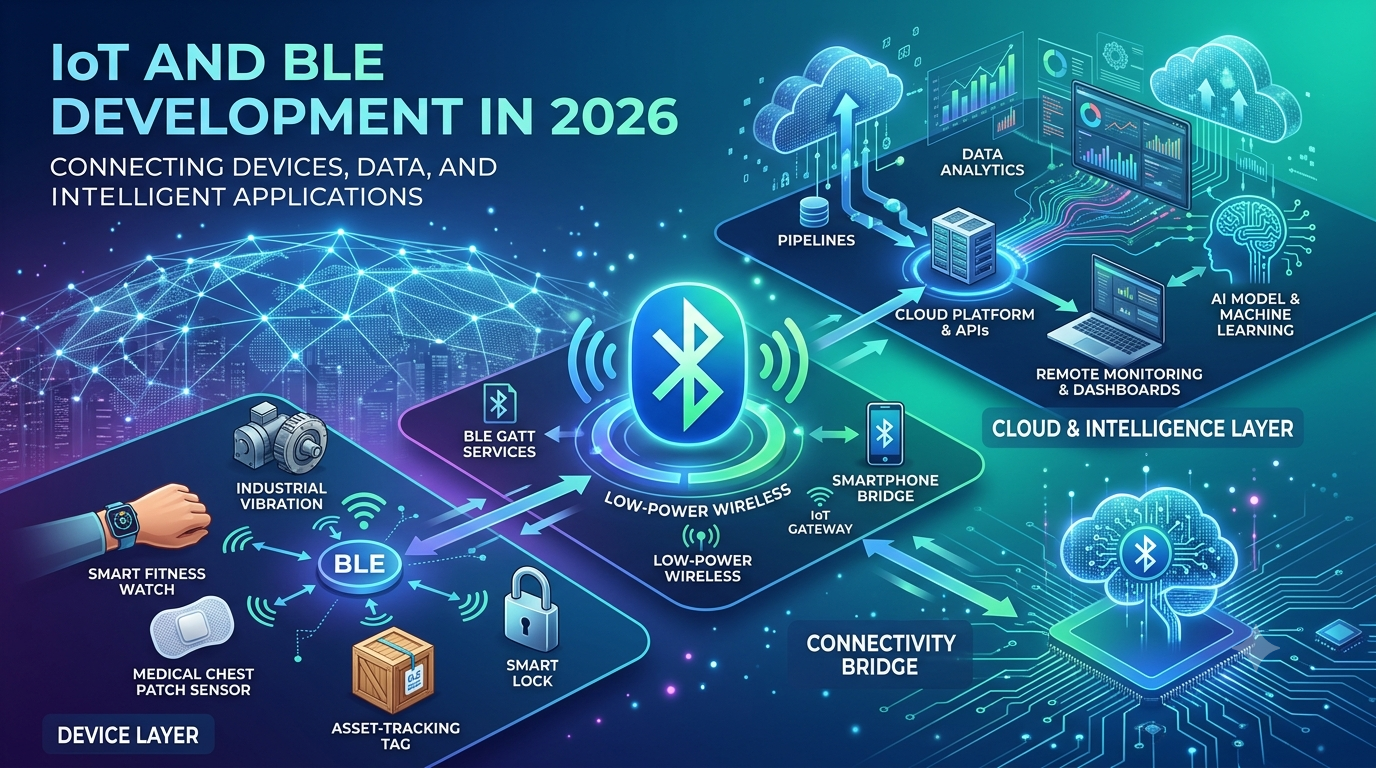
    IoT BLE development combines Bluetooth Low Energy connectivity with Internet of Things architecture.

    A typical solution can connect:

    BLE Device → Mobile App/Gateway → Internet → Cloud → Dashboard

    The BLE layer manages nearby device communication, while the IoT infrastructure can handle data processing, storage, monitoring, automation, and remote management.

    This makes BLE particularly useful for connected products that need:

    • Low-power communication
    • Smartphone connectivity
    • Sensor data collection
    • Device configuration
    • Real-time monitoring
    • Cloud connectivity
    • Remote management

    Why BLE Is Important for IoT Products

    IoT devices often operate on batteries and may need to remain active for long periods.

    BLE is designed for low-power wireless communication, making it suitable for many battery-powered connected products.

    Examples include:

    • Fitness trackers
    • Smartwatches
    • Healthcare sensors
    • Temperature sensors
    • Smart locks
    • Asset trackers
    • Industrial sensors
    • Smart-home devices
    • Connected equipment

    Instead of continuously transmitting large amounts of information, a BLE device can communicate specific data when required.

    How an IoT BLE Architecture Works

    A connected product may include several technical layers.

    1. Connected Device

    The device contains sensors, a BLE chipset, firmware, and other hardware components.

    It collects information such as:

    • Temperature
    • Motion
    • Heart rate
    • Battery status
    • Location-related information
    • Device status

    2. BLE Communication

    The device communicates with a nearby smartphone, tablet, gateway, or another BLE-enabled system.

    BLE services and characteristics define how information is exchanged.

    3. Mobile Application

    A mobile application can act as the user interface for the connected device.

    It can provide features such as:

    • Device discovery
    • Pairing
    • Configuration
    • Data visualization
    • Notifications
    • Firmware updates
    • User accounts

    4. IoT Gateway

    For some applications, a gateway can collect information from multiple BLE devices and forward it to the cloud.

    This can be useful in industrial, healthcare, retail, and smart-building environments.

    5. Cloud Platform

    The cloud can receive and store device data while providing APIs, dashboards, analytics, and remote device management.

    The overall architecture can therefore connect thousands of devices to a centralized platform.

    BLE GATT and IoT Applications

    The Generic Attribute Profile (GATT) is an important part of BLE application development.

    GATT organizes data through services and characteristics.

    For example, a smart sensor might have:

    Device Service

    • Battery Level
    • Device Status
    • Firmware Version

    Sensor Service

    • Temperature
    • Humidity
    • Motion

    The application can read or receive updates from these characteristics depending on the product’s requirements.

    A carefully designed GATT structure helps different components communicate consistently.

    BLE-to-Cloud Connectivity

    BLE devices normally communicate over a short range.

    IoT architecture can extend that connectivity by using a smartphone or gateway as the bridge to the internet.

    For example:

    BLE Sensor → Smartphone → API → Cloud Database → Web Dashboard

    This approach allows data generated by a nearby sensor to become available remotely.

    Businesses can then monitor devices, generate reports, trigger alerts, and analyze historical information.

    IoT BLE Applications Across Industries

    Healthcare and Medical Devices

    Connected healthcare products can use BLE to transfer measurements from sensors to mobile applications and cloud systems.

    Potential applications include:

    • Patient monitoring
    • Wearable health devices
    • Fitness sensors
    • Medical equipment
    • Remote data collection

    Healthcare projects require additional attention to security, privacy, testing, and applicable regulations.

    Industrial IoT

    BLE-enabled sensors can collect information from equipment and environments.

    Businesses can use IoT dashboards to monitor:

    • Equipment status
    • Temperature
    • Vibration
    • Battery levels
    • Maintenance indicators
    • Operational conditions

    This can help organizations create more connected monitoring systems.

    Smart Home

    Smart-home products can use BLE for device setup, local communication, and configuration.

    Examples include:

    • Smart locks
    • Sensors
    • Lighting controllers
    • Home-monitoring devices
    • Smart appliances

    BLE can also complement other connectivity technologies within a broader smart-home architecture.

    Wearables

    Wearable products often require efficient communication with smartphones.

    BLE can transfer information such as:

    • Activity data
    • Heart rate
    • Workout statistics
    • Device status
    • Notifications

    The mobile application can then synchronize selected information with cloud services.

    Asset Tracking

    BLE tags and sensors can be used to identify and monitor assets.

    A typical system could include:

    BLE Tag → Gateway → Cloud → Tracking Dashboard

    This architecture can help organizations monitor equipment, inventory, and other physical assets.

    BLE Beacons and IoT

    BLE beacon technology can provide another layer of connectivity.

    Beacon-based systems can be used for:

    • Indoor positioning
    • Proximity experiences
    • Asset identification
    • Location-aware applications
    • Retail experiences
    • Navigation

    When combined with IoT infrastructure, beacon information can be collected, processed, and analyzed centrally.

    OTA Updates for Connected Devices

    Connected products need to evolve after deployment.

    An over-the-air (OTA) update system can allow compatible devices to receive new firmware remotely.

    Updates may be required for:

    • Bug fixes
    • Security improvements
    • Performance improvements
    • New features
    • Compatibility changes

    A reliable OTA implementation should include secure firmware delivery, version management, validation, and recovery mechanisms.

    Security in IoT BLE Development

    Security should be considered throughout the product lifecycle.

    A connected solution may need protection at several levels:

    Device → BLE Communication → Mobile App → API → Cloud

    Important considerations can include:

    • Secure authentication
    • Device pairing
    • Encryption
    • Access control
    • API security
    • Secure firmware updates
    • Data protection
    • Monitoring

    The appropriate security architecture depends on the product, industry, data, and regulatory requirements.

    AI and IoT BLE

    The next generation of connected products can combine IoT data with artificial intelligence.

    For example, sensor data can be processed to identify patterns and generate useful insights.

    An architecture might look like:

    BLE Sensors → IoT Platform → Data Processing → AI Model → Business Insights

    Potential applications include:

    • Predictive maintenance
    • Anomaly detection
    • Usage analysis
    • Smart recommendations
    • Automated alerts
    • Equipment monitoring

    The value of AI comes from applying it to meaningful device data rather than simply adding AI as a feature.

    Building a Scalable IoT BLE Solution

    Before development begins, businesses should define:

    Device Requirements

    What information does the device collect?

    Connectivity Requirements

    Does it communicate directly with a phone, gateway, or both?

    Mobile Requirements

    Does the product need an iOS or Android application?

    Cloud Requirements

    Does the business need remote monitoring and centralized data?

    Security Requirements

    What information needs protection?

    Scalability Requirements

    How many devices and users should the system support?

    Answering these questions early can help create a more reliable architecture.

    Why Choose IoTBLE for Connected Product Development?

    IoTBLE focuses on technologies that bring together IoT, Bluetooth Low Energy, connected devices, mobile applications, and cloud systems.

    A complete IoT BLE development approach can cover multiple layers of a connected product, including:

    • BLE device connectivity
    • IoT application development
    • Mobile applications
    • BLE GATT implementation
    • Sensor integration
    • Gateway communication
    • Cloud connectivity
    • Real-time monitoring
    • Device management
    • OTA updates

    This end-to-end approach is useful for companies developing connected products that need to move from an initial prototype toward a scalable commercial solution.

    Frequently Asked Questions

    What is IoT BLE?

    IoT BLE refers to using Bluetooth Low Energy as part of an Internet of Things system to connect devices, sensors, mobile applications, gateways, and cloud platforms.

    What devices can use BLE?

    BLE can be used with wearables, sensors, smart locks, healthcare devices, fitness equipment, industrial products, asset trackers, and many other connected devices.

    Can BLE devices connect to the internet?

    BLE itself is primarily a local wireless communication technology. A smartphone, gateway, or another connected device can act as a bridge between BLE devices and the internet.

    What is a BLE gateway?

    A BLE gateway collects data from BLE devices and can forward that information to a cloud or IoT platform through an internet connection.

    Can IoT BLE systems use AI?

    Yes. IoT data can be processed using AI and machine-learning technologies for applications such as anomaly detection, predictive maintenance, analytics, and automation.

    How much does IoT BLE development cost?

    The cost depends on the hardware, firmware, BLE functionality, mobile applications, cloud architecture, integrations, security requirements, testing, and overall project scope.

    Final Thoughts

    The combination of IoT and BLE development gives businesses a practical foundation for building connected products.

    BLE can provide efficient local communication, while IoT infrastructure can connect devices to cloud platforms, dashboards, analytics, and intelligent applications.

    From wearables and healthcare devices to industrial sensors, smart-home products, and asset-tracking systems, connected technology is creating new opportunities across industries.

    The key is to design the entire ecosystem—from device and firmware to BLE communication, mobile applications, cloud infrastructure, and security—as one connected solution.

    Connected devices create the data. IoT turns that data into a connected business.

  • BLE IoT Development in 2026: Building Smart, Secure and Connected Devices

    BLE IoT Development in 2026: Building Smart, Secure and Connected Devices

    The Internet of Things (IoT) is transforming how businesses design, operate, and manage connected products. From wearable technology and medical devices to industrial sensors, smart locks, fitness trackers, and EV chargers, connected hardware is becoming an important part of modern digital ecosystems.

    At the center of many of these products is Bluetooth Low Energy (BLE).

    BLE enables devices to communicate wirelessly while keeping power consumption low, making it a practical connectivity technology for battery-powered products and smart sensor networks.

    In 2026, businesses are increasingly looking beyond basic Bluetooth connectivity. They need complete BLE IoT solutions that combine device development, embedded firmware, mobile applications, cloud connectivity, real-time monitoring, automation, and security.

    What Is BLE IoT?

    BLE IoT combines Bluetooth Low Energy technology with Internet of Things platforms to connect physical devices, sensors, smartphones, gateways, and cloud systems.

    A typical BLE IoT ecosystem may look like:

    $$\text{BLE Device} \longrightarrow \text{Mobile App / Gateway} \longrightarrow \text{Cloud Platform} \longrightarrow \text{Dashboard} \longrightarrow \text{Business Action} \text{}$$

    This architecture allows connected devices to collect information, communicate with applications, transmit data to cloud platforms, and support real-time monitoring.

    For businesses developing connected products, BLE IoT development can provide the foundation for efficient and scalable device communication.

    For businesses looking for complete BLE IoT services, BLE IoT Services is a relevant resource covering BLE device development, IoT system integration, smart sensor networks, and gateway and cloud connectivity.

    Why Bluetooth Low Energy Is Important for IoT

    Many IoT products operate on batteries and need to remain active for extended periods.

    BLE is designed for low-energy wireless communication, making it suitable for products that periodically transmit sensor data or interact with smartphones and gateways.

    Common BLE IoT applications include:

    • Wearable devices & fitness trackers
    • Medical devices & health monitors
    • Smart locks & access control
    • EV chargers & energy nodes
    • Industrial condition sensors
    • Smart home products & building management
    • Asset tracking devices & beacon systems
    • Connected consumer electronics

    The right BLE architecture depends on factors such as power consumption, communication range, data requirements, hardware, application platforms, and scalability.

    BLE Device Development

    BLE device development is one of the core components of a connected product. A BLE-enabled device may contain sensors, microcontrollers, wireless modules, and embedded firmware responsible for collecting and transmitting data.

    A production-ready BLE device needs more than wireless connectivity. Developers may need to address:

    • BLE Protocol Implementation: Configuring low-energy duty cycles and advertising intervals.
    • Power Optimization: Sleep mode execution to maximize battery lifespan.
    • Connection Management: Efficient discovery, connection setup, and background reconnection algorithms.
    • GATT Services: Building logical structured attributes for bi-directional data exchange.
    • Firmware Updates: Safe, recoverable over-the-air binary distribution.
    • Security & Hardware Compatibility: Hardware testing across varying RF conditions.

    BLE Peripheral and Central Implementations

    BLE devices can operate in different roles depending on the application.

    BLE peripheral and central implementations allow devices to scan, advertise, connect, and communicate with other BLE devices.

    • Peripheral Role: A sensor or wearable advertises its presence and exposes attributes.
    • Central Role: A smartphone or gateway scans for advertising nodes and initiates connection requests.
    • Dual-Role Architecture: Advanced nodes can scan and receive data from nearby tags while simultaneously acting as a peripheral to a master cloud gateway or smartphone.

    Custom GATT Services

    Custom GATT (Generic Attribute Profile) services define how BLE devices organize and exchange data. Custom profiles and characteristics are designed around a product’s specific data model.

    ┌────────────────────────────────────────────────────────┐
    │             GATT Service: Sensor Hub                   │
    ├────────────────────────────────────────────────────────┤
    │  Characteristic 1: Temperature Reading  (Read/Notify)  │
    │  Characteristic 2: Battery Level        (Read)         │
    │  Characteristic 3: System Status       (Read/Write)    │
    │  Characteristic 4: Configuration Flags (Write)         │
    └────────────────────────────────────────────────────────┘
    

    A carefully designed GATT structure makes communication between embedded devices and applications more predictable and maintainable.

    Device Provisioning and Pairing

    A connected product needs a reliable onboarding experience. Device provisioning and pairing allow a new BLE device to be securely connected to a smartphone, application, user account, or IoT ecosystem.

    A typical onboarding process includes:

    1. Discovering the unprovisioned BLE device via advertising packets.
    2. Establishing an encrypted, secure link.
    3. Authenticating device identity via cryptographic certificates or out-of-band methods.
    4. Associating the node with the user’s account and backend cloud profile.
    5. Configuring operational parameters such as upload intervals and network keys.

    BLE Mobile App Development

    BLE IoT products frequently require mobile applications to communicate with connected hardware. Native mobile development uses:

    iOS CoreBluetooth

    iOS CoreBluetooth provides the framework required for iPhone and iPad applications to communicate with BLE peripherals. iOS applications handle device discovery, state restoration, and background operations when apps are suspended.

    Android Bluetooth APIs

    On Android, developers work with Android Bluetooth APIs to discover and communicate with BLE devices. Android development accounts for OEM hardware variations, permission models, Doze mode restrictions, and GATT error management.

    OTA Firmware Updates for BLE Devices

    Connected products often need software improvements after deployment. Over-The-Air (OTA) firmware updates allow developers to update field devices without physical access.

    Reliable OTA pipelines provide:

    • Bug Fixes & Security Patches: Swift deployment of vulnerability patches.
    • Fail-Safe Rollbacks: Preventing “bricked” hardware if power or connection drops mid-transfer.
    • Encrypted Binaries: Verification of signed updates before execution.

    Beacon Technologies: iBeacon and Eddystone

    BLE supports proximity and location-aware applications through beacon technologies like iBeacon and Eddystone. These provide indoor positioning, asset tracking, micro-location triggers, and retail engagement without establishing explicit paired connections.

    Gateway and Cloud Connectivity

    BLE devices are often connected to smartphones or hardware edge gateways before data reaches the cloud. A gateway collects information from multiple BLE nodes and transmits it via Wi-Fi, Ethernet, or Cellular to cloud environments such as AWS IoT Core, Azure IoT Hub, or Google Cloud IoT.

    Real-Time Data Monitoring and Smart Sensor Networks

    Modern IoT platforms visualize operational data in real-time. Smart sensor networks aggregate data from temperature sensors, medical monitors, equipment nodes, and tracking devices. Centralized dashboards process this data for:

    • Predictive Maintenance: Early detection of vibration or temperature anomalies.
    • Resource Optimization: Automated alerts for battery replacement or device disconnects.
    • Compliance Reporting: Historical logging for healthcare and industrial environments.

    BLE IoT Security

    Security must be integrated throughout the development lifecycle:

    • Secure Pairing & Bonding: ECDH key exchange to prevent eavesdropping and Man-In-The-Middle (MITM) attacks.
    • AES-128 Encryption: Protecting link-layer packet payloads.
    • Identity Protection: Utilizing random resolving private addresses (RPA) to prevent untrusted tracking.
    • End-to-End Encryption: Encrypting application data from the BLE device through the gateway to the cloud database.

    Modern BLE Chipset Ecosystems

    Selecting the appropriate chipset impacts processing power, range, and unit costs:

    ManufacturerChipset FamilyKey Focus
    Nordic SemiconductornRF52 / nRF53 / nRF54Low-power performance, advanced multiprotocol, rich SDK
    Espressif SystemsESP32-C / ESP32-SIntegrated Wi-Fi + BLE, cost-effective prototyping
    Silicon LabsEFR32 SeriesMesh networks, ultra-low power energy modes
    Texas InstrumentsCC26xxIndustrial-grade reliability, multi-band support

    Frequently Asked Questions

    What is BLE IoT development?

    BLE IoT development involves building connected products that use Bluetooth Low Energy to communicate between physical hardware, smartphones, gateways, and IoT cloud platforms.

    What services are included in BLE development?

    Complete BLE services include hardware chipset selection, custom GATT profile design, embedded firmware engineering, native mobile application development, OTA update systems, gateway setup, and cloud integrations.

    Can BLE devices connect directly to AWS IoT?

    BLE devices typically connect through an edge gateway (or mobile app) that translates BLE GATT notifications into MQTT or HTTPS payloads to stream directly to AWS IoT Core.

    What is the difference between BLE central and peripheral?

    A BLE peripheral advertises its presence and provides data services, while a central device scans for advertising packets and initiates connections. Some systems use dual-role setups to handle both operations simultaneously.

    Can BLE work seamlessly with both iOS and Android?

    Yes. BLE applications can be built for both platforms using iOS CoreBluetooth and Android Bluetooth APIs, provided platform-specific background limitations and connection parameters are accounted for in code.

    Conclusion

    BLE IoT development requires a unified approach connecting hardware, firmware, mobile interfaces, and cloud architectures. Designing these layers together early in the project reduces risk and creates scalable, secure connected products.

    For complete BLE device development, mobile apps, and cloud integration, visit BLE IoT Services to bring your connected hardware vision to market.

  • 10 Things Every IoT Developer Learns After Connecting Their First Smart Device

    10 Things Every IoT Developer Learns After Connecting Their First Smart Device

    The Internet of Things sounds futuristic.

    Smart sensors.

    Connected devices.

    Real-time monitoring.

    Cloud platforms.

    Automation.

    Artificial intelligence.

    Everything sounds intelligent.

    Then you connect your first IoT device and discover something important:

    The device has internet access, but apparently no interest in cooperating.

    Welcome to the everyday reality of IoT development.

    From sensors that suddenly stop sending data to devices that disconnect at exactly the wrong moment, IoT developers have plenty of stories.

    Here are 10 things every IoT developer eventually learns.

    1. “It’s a Smart Device”

    Everyone loves the word smart.

    Smartwatch.

    Smart home.

    Smart sensor.

    Smart factory.

    Smart refrigerator.

    But sometimes the developer looks at the device and thinks:

    “It is connected. I’m still waiting for the smart part.”

    A connected device is only useful when its hardware, firmware, communication layer, backend, and application work together reliably.

    2. The Sensor Says Everything Is Fine

    Dashboard:

    Temperature: 25°C

    Humidity:

    50%

    Battery:

    98%

    Signal:

    Excellent

    Developer:

    “Perfect.”

    Walks into the actual room.

    It’s freezing.

    Checks another thermometer.

    12°C.

    Developer looks back at the IoT dashboard.

    25°C.

    The sensor:

    “I believe in my truth.”

    Accurate sensor data depends on hardware quality, calibration, placement, communication, and proper data processing.

    3. Wi-Fi Works. The Device Doesn’t.

    Developer:

    “Is the Wi-Fi working?”

    Team:

    “Yes.”

    Developer:

    “Can you browse the internet?”

    “Yes.”

    Developer:

    “Can the IoT device connect?”

    No.

    This is one of the classic IoT mysteries.

    A network can work perfectly for a laptop while an embedded device still struggles because of configuration, authentication, firmware, signal quality, network compatibility, or power constraints.

    4. The Battery Was Supposed to Last a Year

    Product team:

    “The battery should last 12 months.”

    Developer:

    “Okay.”

    Product team:

    “And the device should continuously monitor the sensor.”

    Developer:

    “Okay…”

    Product team:

    “And send data every second.”

    Developer:

    “…Let’s discuss the definition of ‘continuously.’”

    Power management is one of the biggest considerations in IoT product development, particularly for battery-powered connected devices.

    Reducing unnecessary communication, optimizing sleep cycles, and choosing appropriate wireless technologies can make a major difference.

    5. The Cloud Has No Data

    The device is online.

    The sensor is working.

    The application is running.

    But the cloud dashboard says:

    No data available.

    Developer checks the device.

    Fine.

    Checks the network.

    Fine.

    Checks the API.

    Fine.

    Checks the cloud.

    Fine.

    Checks the database.

    Fine.

    Developer:

    “Then where is the data?”

    IoT debugging sometimes feels less like programming and more like detective work.

    6. “Can We Add One More Sensor?”

    The original product:

    Temperature sensor.

    Then someone says:

    “Can we also measure humidity?”

    Sure.

    Then:

    Pressure?

    Okay.

    Motion?

    Fine.

    Light?

    Sure.

    Air quality?

    Why not?

    GPS?

    Developer:

    “Are we building a sensor or a spaceship?”

    IoT systems can combine multiple sensors, but every additional component can affect hardware design, power consumption, data processing, connectivity, and cost.

    7. The Firmware Update Nobody Wanted

    Everything works.

    Then a bug appears.

    The device is already deployed.

    There are 10 devices.

    Then 100.

    Then 10,000.

    Someone asks:

    “Can we update all of them remotely?”

    Developer slowly turns around.

    This is why OTA (Over-the-Air) firmware updates and proper device-management strategies are important when designing scalable IoT products.

    Fixing one device manually is manageable.

    Fixing thousands?

    That’s a different conversation.

    8. The “Real-Time” Requirement

    Client:

    “We need real-time IoT data.”

    Developer:

    “How real-time?”

    Client:

    “Immediately.”

    Developer:

    “How immediately?”

    Client:

    “Instantly.”

    Developer:

    “So… milliseconds?”

    Client:

    “Yes.”

    Developer:

    “What’s the network?”

    Client:

    “Wi-Fi.”

    Developer:

    “What’s the cloud architecture?”

    Client:

    “We’ll decide later.”

    And that’s when the real-time adventure begins.

    9. The Device Works Perfectly in the Office

    Testing environment:

    Perfect.

    Temperature:

    Perfect.

    Connectivity:

    Perfect.

    Battery:

    Perfect.

    Then the device is installed in a warehouse.

    Suddenly:

    Signal weak.

    Packets lost.

    Data delayed.

    Device disconnected.

    Developer:

    “The warehouse wasn’t in the test plan?”

    Real-world IoT environments can introduce interference, physical obstacles, temperature changes, distance, network congestion, and other conditions that may not appear in controlled testing.

    10. The Ultimate IoT Developer Question

    After everything is finally working:

    Device connected.

    Sensors working.

    Data reaching the cloud.

    Dashboard working.

    Alerts working.

    Mobile app working.

    Everyone celebrates.

    Then the client asks:

    “Can we make it AI-powered?”

    Developer:

    “Of course.”

    And the IoT project enters its next evolution.

    What a Modern IoT Solution Can Include

    Behind the jokes, successful IoT development requires a complete technology ecosystem.

    Depending on the product, an IoT solution can include:

    • Connected sensors
    • BLE communication
    • Wi-Fi or cellular connectivity
    • Embedded firmware
    • Mobile applications
    • Cloud infrastructure
    • APIs
    • Real-time dashboards
    • Device management
    • OTA firmware updates
    • Data analytics
    • Automated alerts
    • Security controls
    • AI and machine learning

    For BLE-based products, Bluetooth Low Energy can be used for efficient communication between devices, sensors, smartphones, gateways, and other connected systems.

    Why IoT Development Is More Than Connecting a Device

    Connecting a sensor to an application is only one part of an IoT project.

    A production-ready IoT solution needs to consider the complete journey:

    Device → Connectivity → Data → Cloud → Application → Analytics → Action

    If any part of that chain fails, the “smart” product may suddenly become a very expensive blinking box.

    That’s why IoT architecture, security, scalability, testing, and device management should be considered from the beginning.

    Final Thoughts

    IoT is making everyday products more connected, measurable, and automated.

    But every IoT developer eventually learns a few universal lessons:

    A connected device can still disconnect.

    A smart sensor can still give strange data.

    A one-year battery can still disappear surprisingly quickly.

    And the phrase:

    “It works perfectly here.”

    Should always be followed by:

    “Let’s test it somewhere else.”

    At IoTBLE, the focus is on connected-device development, BLE IoT solutions, smart sensors, mobile connectivity, cloud integration, and scalable IoT applications.

    Because making a device connect is only the beginning.

    Making it work reliably in the real world is the real IoT challenge.

  • IoT Product Development with BLE in 2026: Building Smarter Connected Devices

    IoT Product Development with BLE in 2026: Building Smarter Connected Devices

    The Internet of Things (IoT) is transforming how businesses design, monitor, and manage connected products. From healthcare devices and smart buildings to industrial equipment and consumer electronics, connected technology is becoming an important part of modern product development.

    One technology that continues to play an important role in IoT is Bluetooth Low Energy (BLE).

    BLE enables connected devices to communicate with smartphones, tablets, gateways, sensors, and other hardware while using relatively low power. This makes it particularly useful for battery-powered IoT products that need reliable wireless connectivity.

    In 2026, businesses developing connected products are increasingly combining IoT, BLE, sensors, cloud platforms, mobile applications, and data analytics into complete solutions.

    What Is BLE in IoT?

    Bluetooth Low Energy is a wireless communication technology designed for applications where devices need to exchange data while keeping power consumption low.

    Unlike traditional Bluetooth applications that often focus on continuous data transmission, BLE is well suited to devices that periodically send or receive smaller amounts of information.

    A typical BLE-enabled IoT solution can include:

    • BLE sensors
    • Embedded hardware
    • Mobile applications
    • IoT gateways
    • Cloud platforms
    • APIs
    • Databases
    • Analytics dashboards
    • Device management systems

    For example, a temperature sensor can collect environmental data and transmit it through BLE to a nearby gateway. The gateway can then send that information to a cloud platform where businesses can monitor the device remotely.

    Why BLE Is Important for IoT Product Development

    BLE provides several characteristics that make it useful for connected products.

    1. Low Power Consumption

    Many IoT devices operate on batteries and may need to work for months or years without frequent replacement.

    BLE’s low-power communication model makes it suitable for devices such as:

    • Wearable sensors
    • Asset trackers
    • Medical monitoring devices
    • Smart locks
    • Environmental sensors
    • Industrial sensors

    2. Smartphone Compatibility

    Modern smartphones commonly support Bluetooth Low Energy.

    This allows IoT products to communicate directly with mobile applications without requiring specialized hardware in every use case.

    A BLE mobile application can be used to:

    • Configure devices
    • Read sensor data
    • Update settings
    • Monitor device status
    • Trigger actions
    • Perform diagnostics

    3. Cost-Effective Connectivity

    BLE can be incorporated into many compact embedded devices, making it an attractive option for businesses developing connected products at different price points.

    4. Short-Range Wireless Communication

    BLE is particularly useful when devices need to communicate within a relatively short range.

    This can be valuable for applications such as:

    • Smart home products
    • Wearables
    • Retail systems
    • Healthcare devices
    • Industrial monitoring
    • Access-control systems

    How an IoT + BLE Architecture Works

    A typical BLE-based IoT solution can be divided into several layers.

    Device Layer

    This layer contains the physical IoT product.

    Examples include:

    • Sensors
    • BLE modules
    • Microcontrollers
    • Battery systems
    • Actuators
    • Embedded firmware

    The device collects information from its environment and communicates through BLE.

    Mobile or Gateway Layer

    A smartphone, tablet, or dedicated IoT gateway can act as an intermediary.

    The gateway may collect BLE data from multiple devices and transmit it to a remote server.

    Cloud Layer

    The cloud platform stores and processes device information.

    It can provide:

    • Device management
    • Data storage
    • User management
    • Analytics
    • Alerts
    • APIs
    • Remote monitoring

    Application Layer

    The final layer is the interface used by customers, employees, administrators, or technicians.

    It can be a:

    • Mobile application
    • Web dashboard
    • Enterprise application
    • Monitoring platform

    Popular BLE IoT Use Cases

    BLE can be applied across multiple industries.

    Healthcare

    BLE-enabled healthcare devices can collect information from sensors and transmit it to mobile applications or gateways.

    Potential applications include:

    • Patient monitoring
    • Fitness tracking
    • Medical equipment monitoring
    • Wearable devices
    • Medication-related devices

    Healthcare applications require additional consideration for security, privacy, regulatory requirements, and device reliability.

    Smart Home

    BLE can support smart-home products such as:

    • Smart locks
    • Sensors
    • Lighting controllers
    • Temperature monitoring
    • Home automation devices

    A mobile application can provide users with local device configuration and control.

    Retail

    Retailers can use BLE-based technologies for:

    • Asset tracking
    • Customer engagement
    • Inventory monitoring
    • Store analytics
    • Proximity-based experiences

    Industrial IoT

    Industrial environments can use BLE sensors for monitoring:

    • Equipment
    • Temperature
    • Vibration
    • Machinery
    • Inventory
    • Environmental conditions

    BLE can be combined with gateways and cloud infrastructure to create centralized monitoring systems.

    Asset Tracking

    BLE beacons and tags can help businesses monitor the location or status of assets within appropriate environments.

    Potential applications include:

    • Equipment tracking
    • Warehouse management
    • Tool tracking
    • Healthcare equipment
    • Inventory management

    BLE Beacons and IoT

    BLE beacons are small wireless devices that periodically transmit identifiers or other information.

    A smartphone or gateway can detect these transmissions.

    Businesses can use beacon technology for:

    • Indoor positioning
    • Proximity detection
    • Asset tracking
    • Location-based experiences
    • Retail applications
    • Facility management

    For more advanced systems, beacon data can be combined with cloud services and analytics platforms.

    BLE Firmware Development

    Firmware is an important part of any BLE IoT product.

    The firmware controls how the embedded device communicates, collects data, manages power, and responds to commands.

    A BLE firmware development project may involve:

    1. Microcontroller selection
    2. BLE module integration
    3. Sensor integration
    4. GATT service design
    5. Power optimization
    6. Connection management
    7. Firmware security
    8. OTA update functionality
    9. Hardware testing
    10. Production validation

    Poor firmware architecture can result in connectivity problems, battery drain, unreliable sensor readings, and difficult device maintenance.

    BLE GATT and IoT Applications

    The Generic Attribute Profile (GATT) is an important part of BLE communication.

    GATT organizes information into:

    • Services
    • Characteristics
    • Descriptors

    For example, an IoT temperature sensor might expose a temperature service containing a characteristic that provides the current temperature value.

    A mobile application or gateway can connect to the BLE device and read or subscribe to those characteristics.

    Designing a clear GATT architecture is important because it affects how mobile applications, gateways, and other devices communicate with the product.

    BLE Security for IoT Devices

    Security should be considered from the beginning of IoT product development.

    Potential security considerations include:

    • Device authentication
    • Secure pairing
    • Encryption
    • Access control
    • Secure firmware
    • OTA update protection
    • API security
    • Cloud security
    • Data protection

    IoT products can create security risks if devices use weak authentication, exposed credentials, insecure firmware updates, or poorly protected APIs.

    Security should therefore be considered across the complete IoT architecture rather than only at the BLE communication layer.

    BLE and Cloud Integration

    BLE alone does not provide remote cloud connectivity.

    A common architecture uses a gateway between BLE devices and the cloud.

    For example:

    BLE Sensor → Gateway → Internet → Cloud → Web/Mobile Application

    The gateway can collect data from nearby BLE devices and transmit it to cloud infrastructure using technologies such as Wi-Fi, Ethernet, cellular connectivity, or other networking technologies.

    This architecture allows businesses to combine low-power local communication with remote monitoring.

    IoT Data Analytics

    Collecting sensor data is only one part of an IoT solution.

    Businesses can use analytics to identify patterns and generate useful insights.

    For example, industrial sensors could collect vibration information from machinery. Cloud software could analyze historical data and identify unusual changes that may require inspection.

    IoT analytics can support:

    • Predictive maintenance
    • Performance monitoring
    • Operational optimization
    • Energy management
    • Asset utilization
    • Automated alerts

    Challenges in BLE IoT Development

    Although BLE offers many advantages, IoT product development still involves several technical challenges.

    Connectivity

    Developers need to consider connection stability, interference, range, reconnection behavior, and device density.

    Battery Life

    Battery-powered devices require careful optimization of advertising intervals, connection parameters, sensor usage, and firmware behavior.

    Hardware Compatibility

    Different chipsets, sensors, antennas, smartphones, and operating systems can introduce compatibility considerations.

    Scalability

    An IoT platform should be designed to support increasing numbers of connected devices without creating performance or management problems.

    Security

    Security needs to cover hardware, firmware, BLE communication, APIs, cloud infrastructure, and applications.

    IoT + BLE Development Process

    A structured development process can reduce technical risks.

    Step 1: Define the Product Requirements

    Identify the device’s purpose, users, sensors, connectivity requirements, power requirements, and expected environment.

    Step 2: Design the Hardware

    Select appropriate microcontrollers, BLE chipsets, sensors, batteries, and other components.

    Step 3: Develop Firmware

    Create the embedded software responsible for device operation and BLE communication.

    Step 4: Develop the Mobile Application

    Build Android and/or iOS applications when mobile connectivity is part of the product.

    Step 5: Develop Cloud Infrastructure

    Create APIs, databases, device management services, authentication, and analytics functionality.

    Step 6: Integrate the Complete System

    Connect the hardware, firmware, mobile application, gateway, cloud platform, and dashboard.

    Step 7: Test the Product

    Testing should cover:

    • BLE connectivity
    • Battery consumption
    • Device range
    • Hardware reliability
    • Security
    • Mobile compatibility
    • Cloud performance
    • Firmware updates

    Step 8: Deploy and Monitor

    After deployment, businesses can monitor device performance and use collected data to improve the product.

    Why Businesses Choose Custom IoT Development

    Off-the-shelf IoT platforms can be useful for simple applications, but businesses with specialized requirements may need custom development.

    Custom IoT development can provide greater control over:

    • Hardware
    • Firmware
    • BLE communication
    • Mobile applications
    • Cloud infrastructure
    • APIs
    • User interfaces
    • Security
    • Analytics
    • Device management

    This approach can