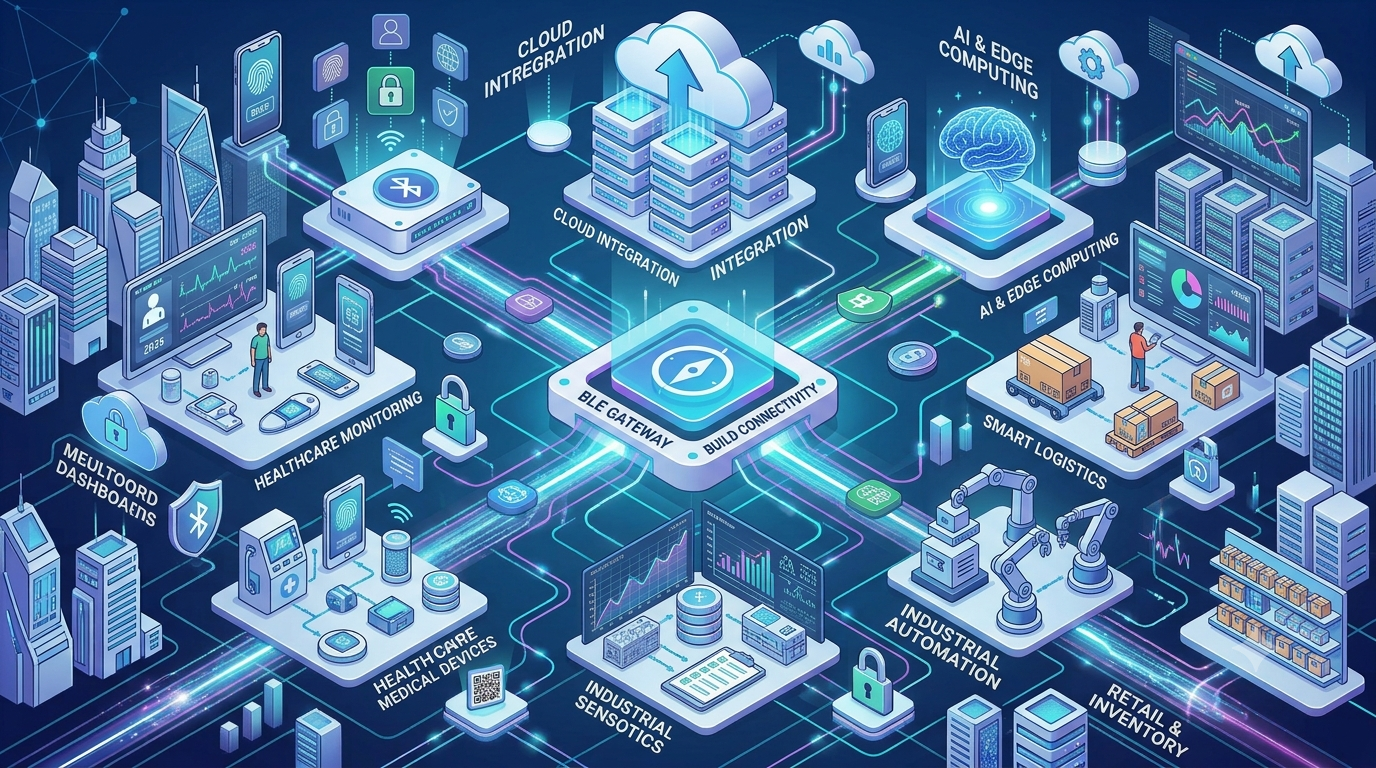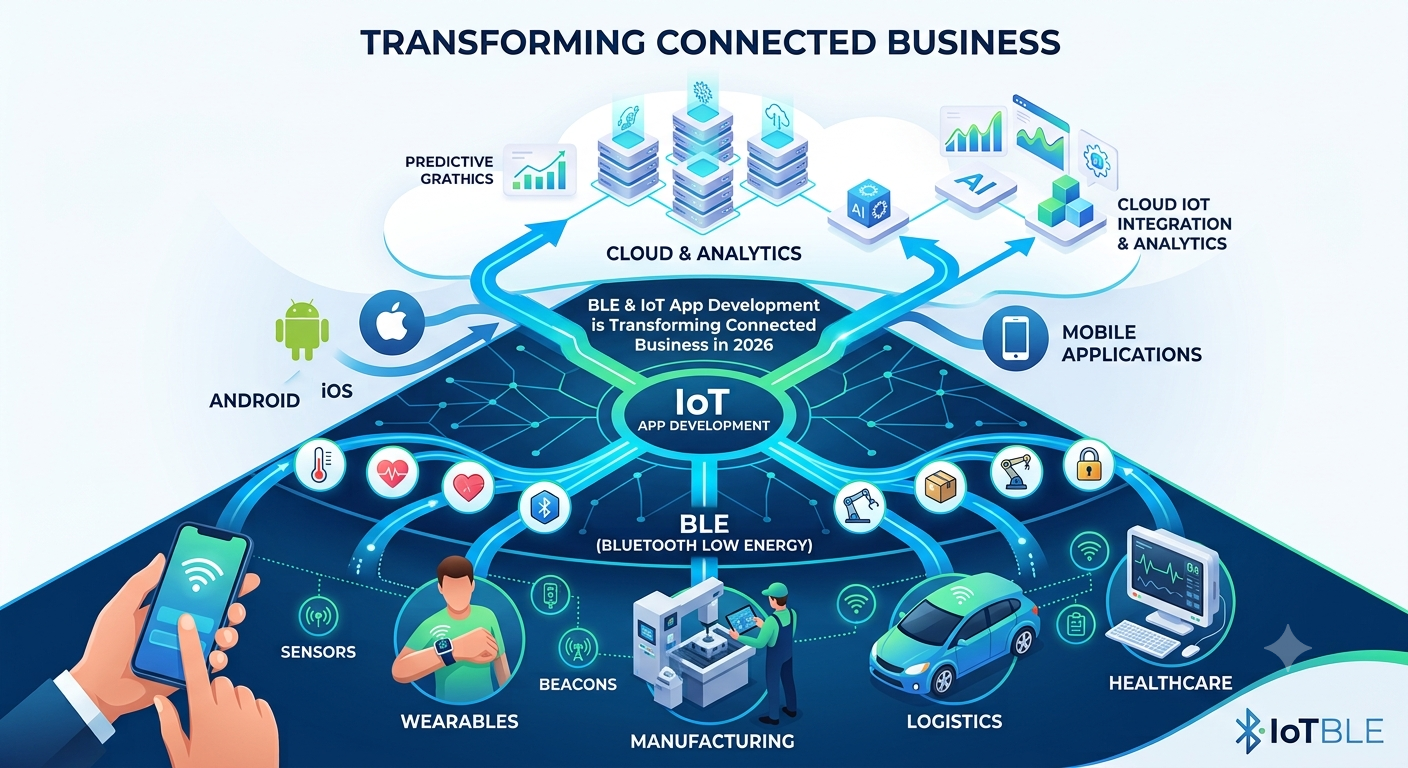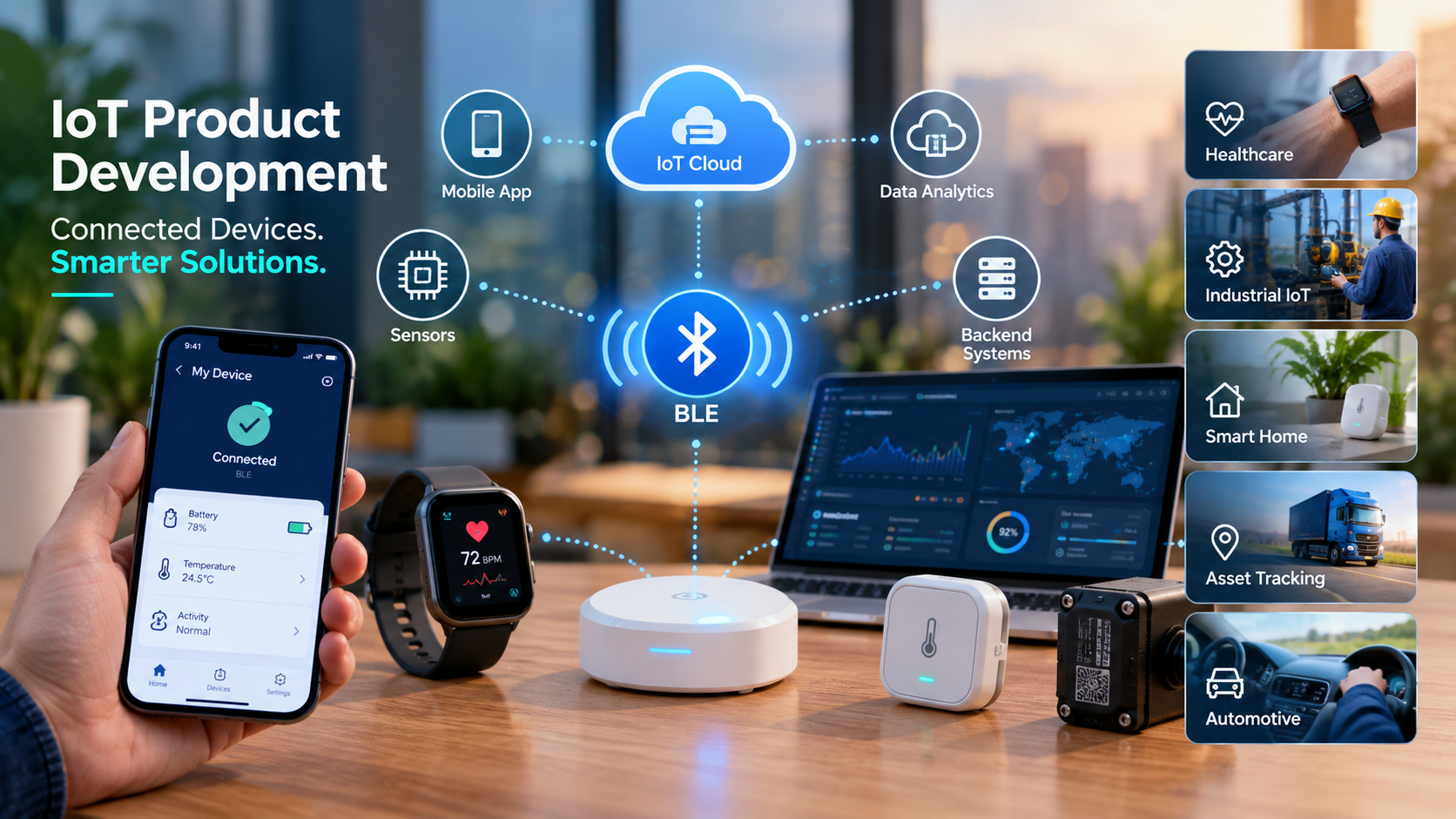
From wearable healthcare devices to industrial monitoring systems, connected technology is changing how businesses interact with physical products.
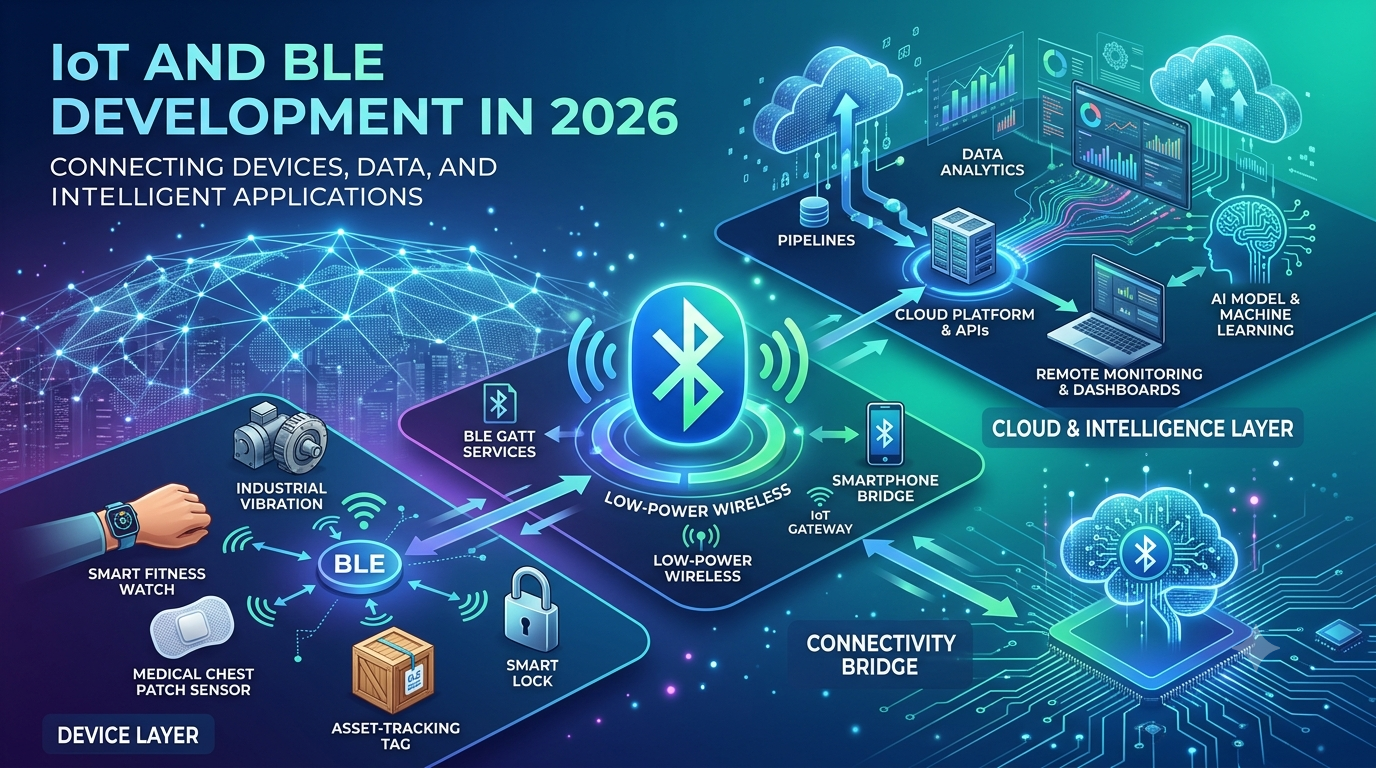
In 2026, IoT product development is moving beyond basic device connectivity. Businesses are increasingly combining Bluetooth Low Energy (BLE), cloud platforms, mobile applications, and artificial intelligence to create intelligent connected ecosystems.
Imagine a wearable device that continuously monitors activity, a smart sensor that sends real-time equipment data, or an industrial asset tracker that communicates with a mobile application.
These solutions rely on seamless communication between hardware, firmware, software, and connected platforms.
Bluetooth Low Energy plays an important role in this transformation by enabling energy-efficient wireless communication for a wide range of IoT applications.
What Is IoT Product Development?
IoT product development is the process of designing and building connected products that collect, exchange, and process information through networks and software systems.
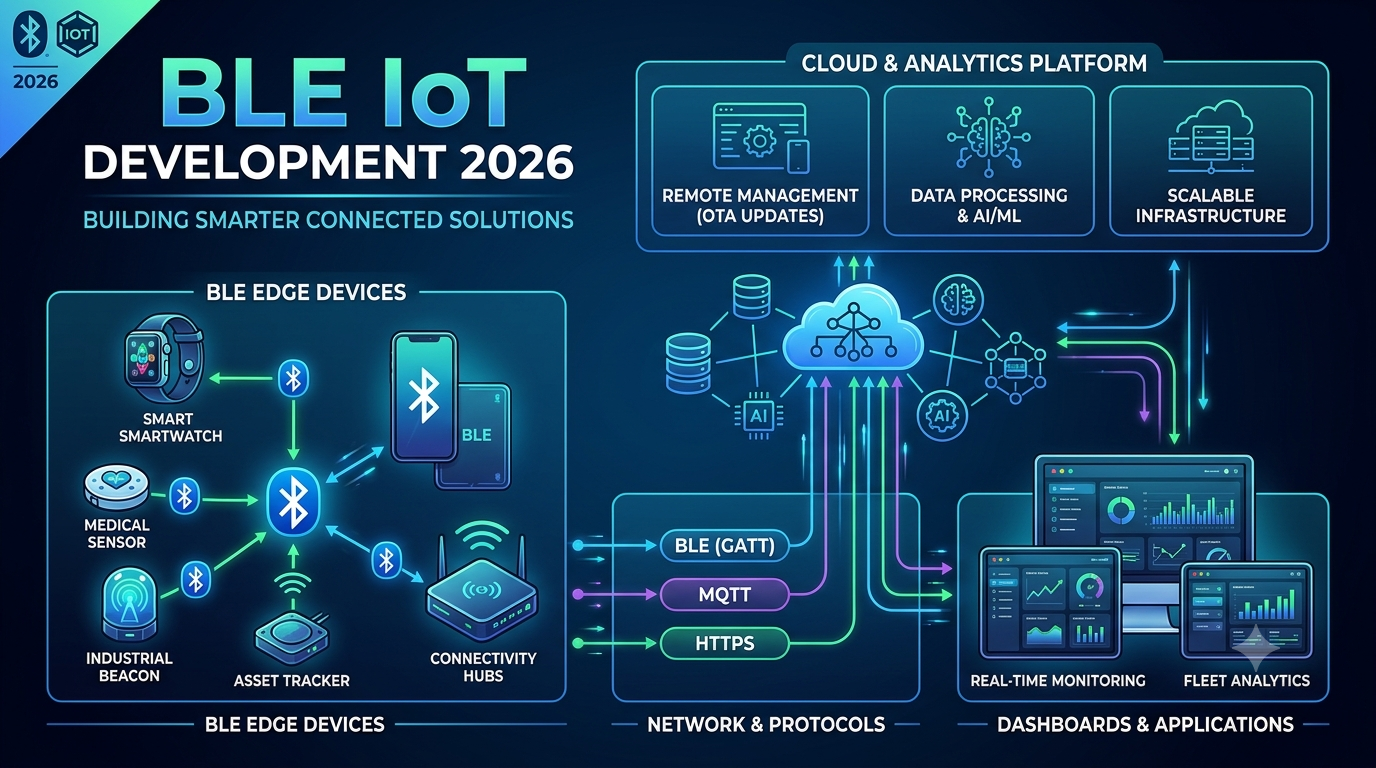
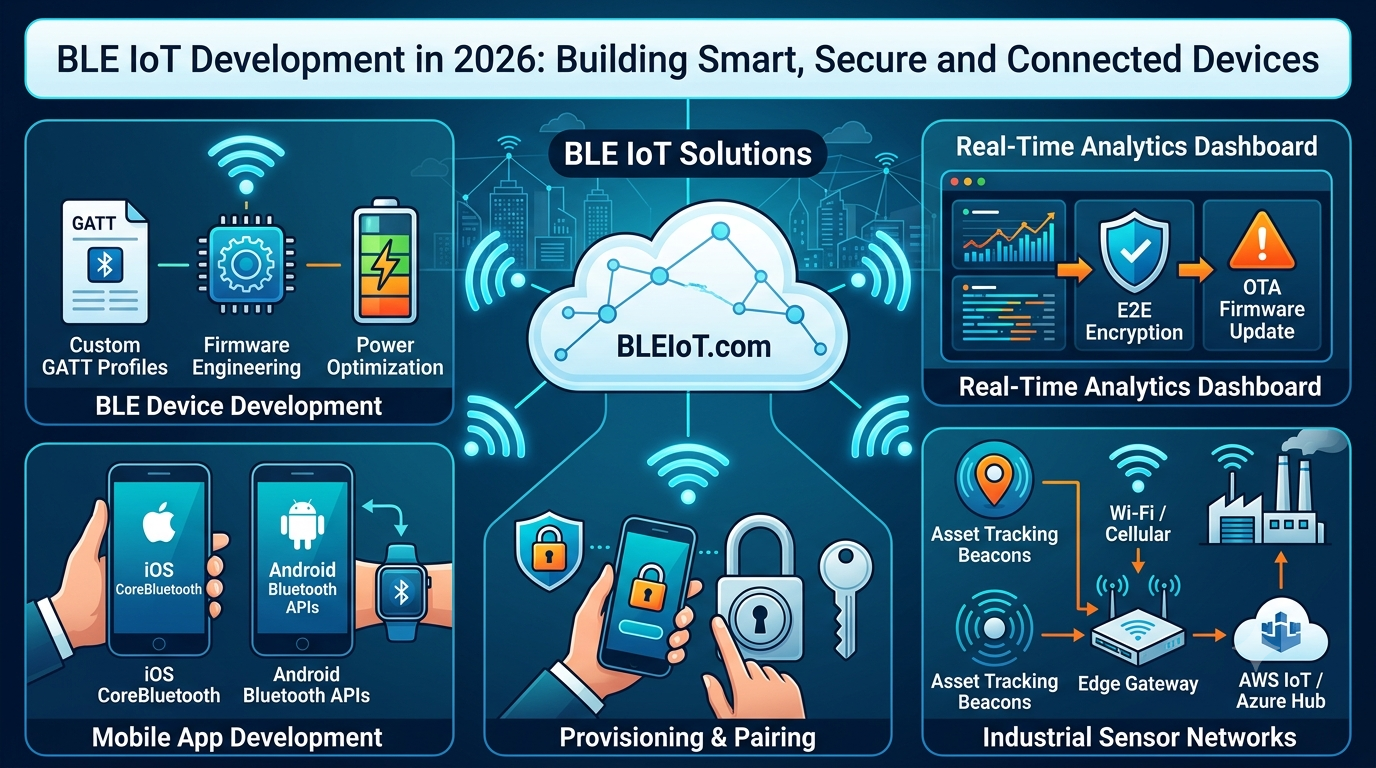
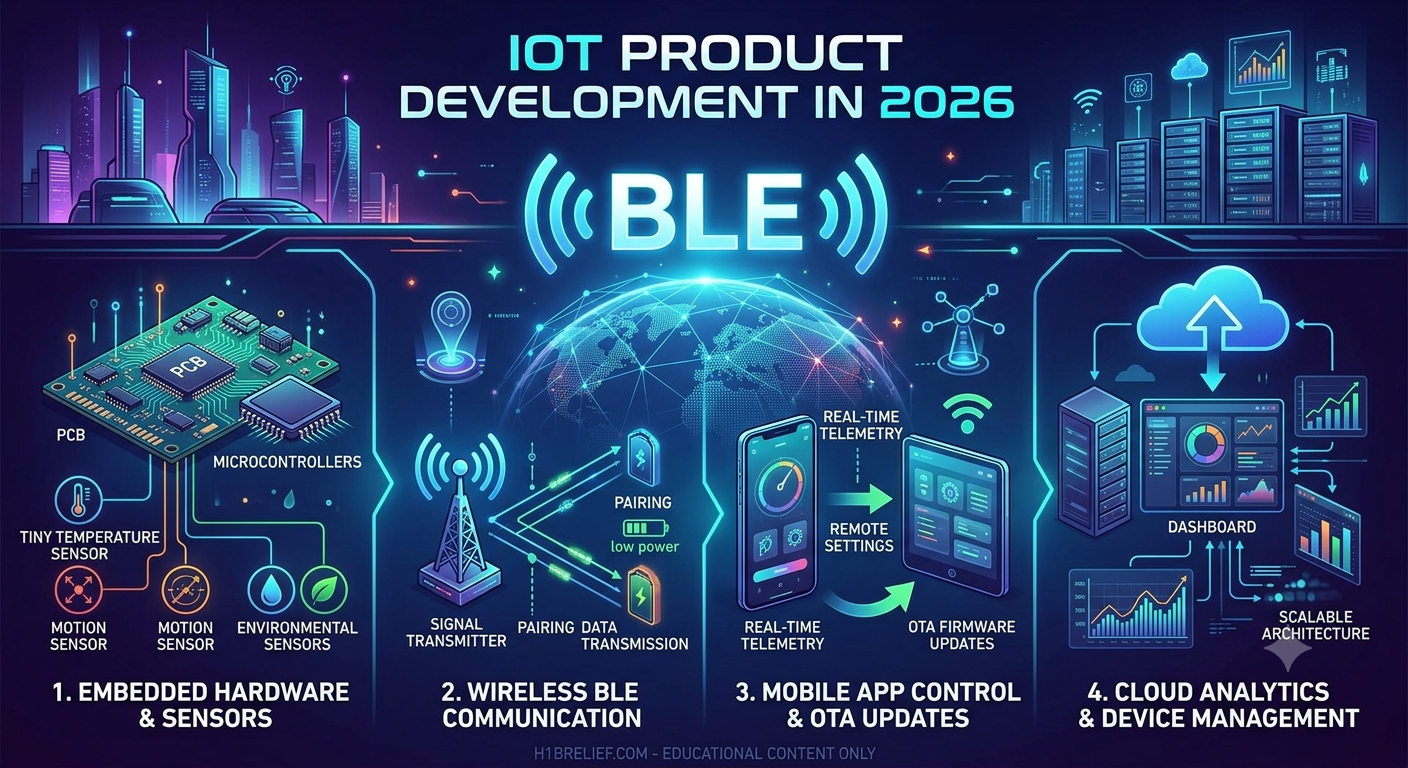
A typical IoT solution consists of:
- Hardware components and sensors
- Embedded firmware
- Wireless connectivity such as BLE or Wi-Fi
- Mobile or web applications
- Cloud infrastructure
- Data analytics and device management
The objective is to develop products that deliver useful functionality while maintaining reliability, security, and scalability.
Why Bluetooth Low Energy Is Important for IoT Development
Bluetooth Low Energy is designed for wireless communication with low energy consumption.
It is particularly useful for devices that operate on batteries and need to communicate periodically with smartphones, gateways, or other connected systems.
Key Benefits of BLE Connectivity
1. Low Power Consumption
BLE enables battery-powered devices to communicate efficiently, making it suitable for wearables, sensors, and portable equipment.
2. Smartphone Compatibility
BLE allows IoT products to connect with compatible smartphones and tablets without requiring additional dedicated hardware in many use cases.
3. Compact Device Design
Its communication model supports compact connected products where power and physical size are important considerations.
4. Cost-Effective Connectivity
BLE can reduce connectivity complexity for short-range wireless applications.
5. Flexible Integration
BLE can be integrated with mobile applications, gateways, cloud platforms, and other IoT technologies.
6 Industries Transforming Through IoT and BLE Solutions
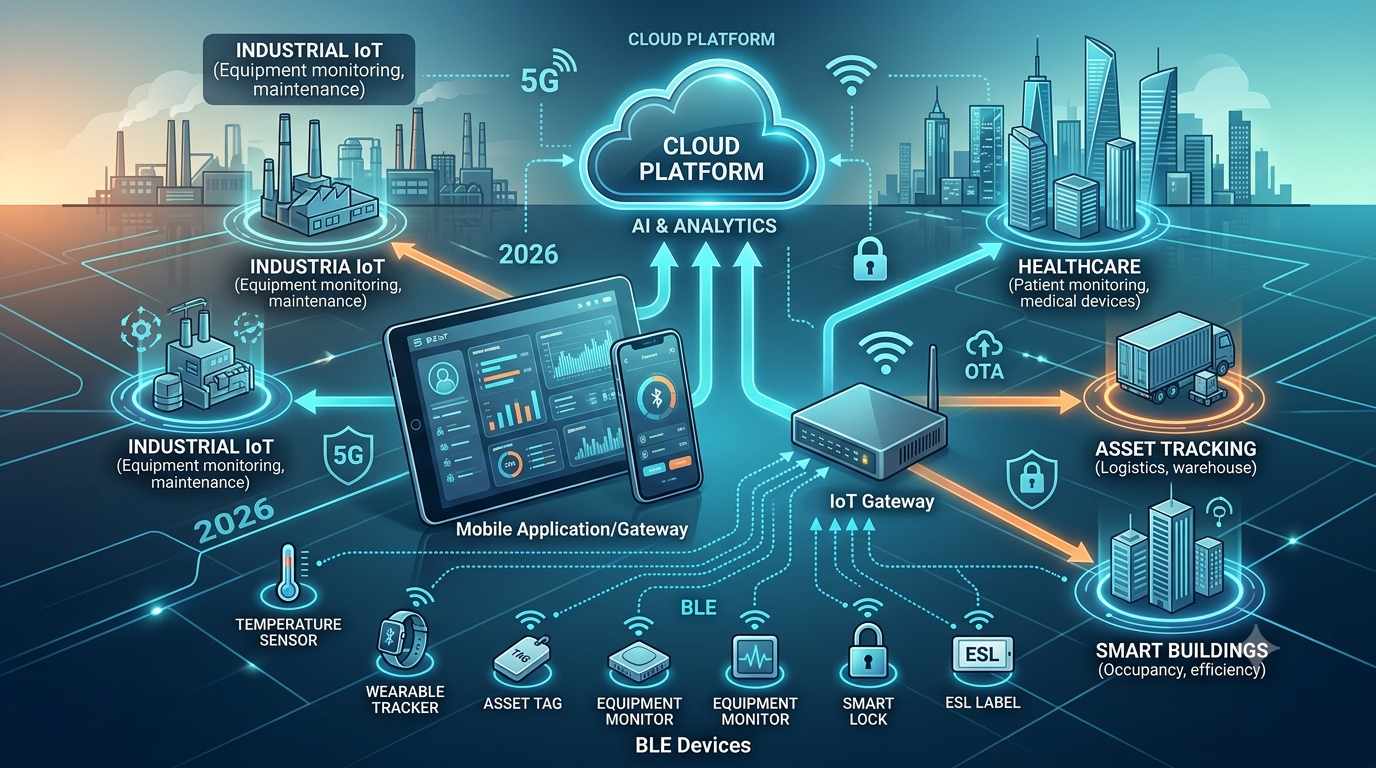
1. Healthcare and Medical Devices
Connected healthcare products are enabling remote monitoring and improved access to health-related information.
Examples include:
- Wearable monitoring devices
- Smart thermometers
- Connected medical accessories
- Patient monitoring systems
- Fitness and wellness trackers
BLE enables compatible devices to transfer readings to mobile applications for visualization and further processing.
2. Industrial IoT and Predictive Maintenance
Manufacturing facilities use connected sensors to monitor equipment and operational conditions.
IoT product development supports:
- Equipment condition monitoring
- Temperature and vibration sensing
- Asset tracking
- Maintenance notifications
- Industrial data collection
When combined with analytics, these systems can help maintenance teams identify abnormal patterns before equipment failures occur.
3. Smart Home Automation
Smart home products use wireless connectivity to improve convenience and energy management.
Examples include:
- Smart locks
- Lighting systems
- Temperature sensors
- Smart switches
- Home security devices
BLE can support device provisioning, configuration, and local communication within connected home ecosystems.
4. Asset Tracking and Logistics
Businesses need visibility into the location and condition of valuable assets.
BLE beacons and connected tags can support:
- Warehouse asset tracking
- Equipment identification
- Inventory visibility
- Proximity-based notifications
- Indoor location systems
These solutions can be integrated with mobile applications and backend platforms.
5. Automotive and Mobility
Connected automotive accessories and mobility products increasingly rely on wireless communication.
BLE can support digital access, device pairing, vehicle accessories, and connected user experiences.
6. Consumer Electronics and Wearables
Wearables and consumer products depend on seamless communication between hardware and mobile applications.
Examples include:
- Smartwatches
- Fitness bands
- Wireless accessories
- Smart sensors
- Connected personal devices
Reliable BLE application development is essential for pairing, data synchronization, and device management.
The Role of AI in Modern IoT Product Development
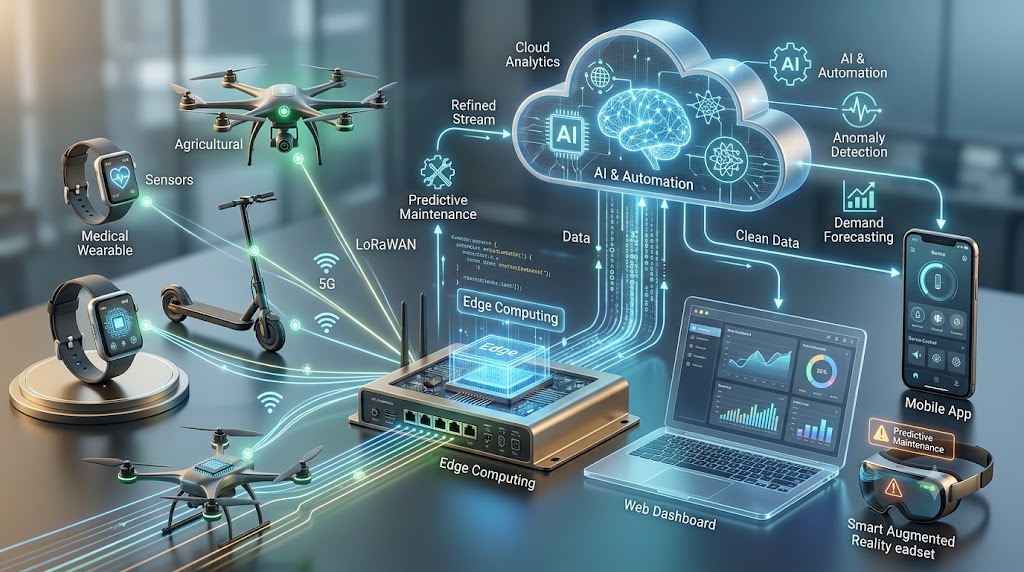
The combination of AI and IoT is creating opportunities for intelligent connected products.
Traditional IoT systems collect and transmit data. AI-powered systems can analyze that information to identify patterns, detect anomalies, and generate predictions.
For example, an industrial sensor may continuously collect equipment readings. An AI-powered platform can analyze historical information and identify conditions that may require inspection.
Potential applications include:
- Predictive maintenance
- Smart energy management
- Intelligent healthcare monitoring
- Automated alerts
- Equipment performance analysis
The integration of AI should be based on the product’s actual requirements, available data, and processing capabilities.
Challenges in Developing BLE-Enabled IoT Products
Despite its advantages, developing connected devices involves several engineering considerations.
Connectivity Reliability
Developers must account for wireless interference, connection stability, pairing behavior, and communication range.
Battery Optimization
Power consumption needs to be considered throughout hardware design, firmware development, and communication scheduling.
Device Security
Secure pairing, authentication, encryption, and firmware update mechanisms are essential for protecting connected products.
Hardware and Software Compatibility
Firmware, mobile applications, sensors, and backend services must work together consistently.
Scalability
A product that works with a few devices should also be designed with future deployment and device management requirements in mind.
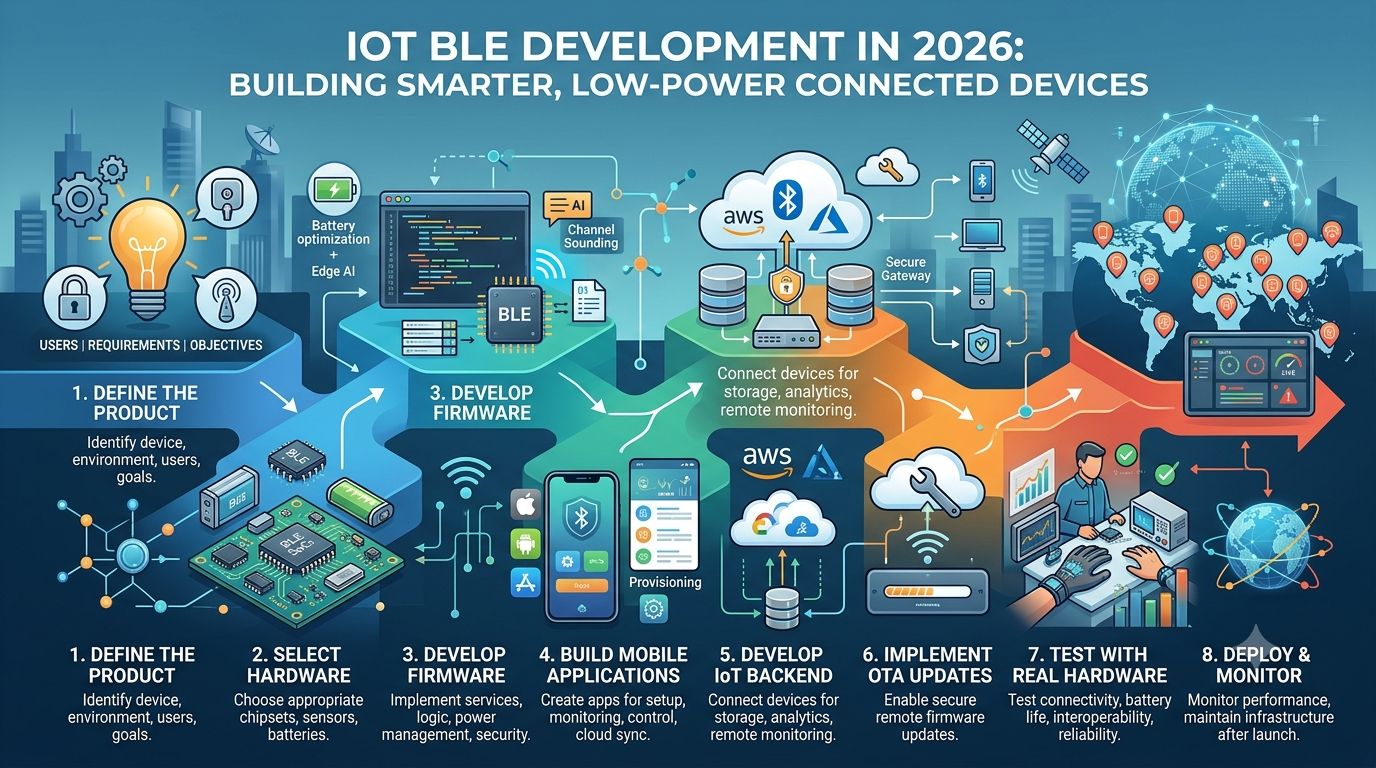
IoT Product Development Lifecycle
A structured development process helps businesses move from concept to a market-ready connected product.
Step 1: Product Concept and Requirements
Define the device’s purpose, users, functionality, connectivity, and operating environment.
Step 2: Hardware and Sensor Selection
Choose appropriate components based on power requirements, performance, cost, and product size.
Step 3: Embedded Firmware Development
Develop firmware for device control, communication, sensor integration, and power management.
Step 4: BLE Connectivity Integration
Implement pairing, data exchange, device discovery, and connection management.
Step 5: Mobile App and Cloud Development
Build the application and backend systems required for monitoring, configuration, and data management.
Step 6: Testing and Optimization
Validate connectivity, security, battery performance, reliability, and user experience.
Why Choose IoTBLE for Connected Product Development?
Building an IoT product requires coordinated engineering across hardware, firmware, wireless communication, and software platforms.
IoTBLE focuses on connected technology and BLE-enabled product development, helping businesses explore solutions for smart devices and connected applications.
From Bluetooth Low Energy integration to IoT application development, the right engineering approach can help turn a product concept into a functional connected solution.
Frequently Asked Questions
What is BLE in IoT?
Bluetooth Low Energy is a wireless communication technology designed for low-power data exchange between compatible devices, smartphones, and connected systems.
What is the difference between BLE and traditional Bluetooth?
BLE is optimized for low-energy communication, while Bluetooth Classic is commonly used for applications requiring continuous data streams, such as audio.
What products use BLE connectivity?
Wearables, healthcare accessories, smart home devices, asset trackers, industrial sensors, and consumer electronics commonly use BLE.
Can BLE devices connect to mobile applications?
Yes. Compatible BLE devices can communicate with Android and iOS applications for pairing, configuration, data transfer, and device management.
How long does IoT product development take?
The timeline depends on product complexity, hardware availability, firmware requirements, application features, testing, and certification needs.
Conclusion
IoT product development is creating new opportunities for businesses to build smarter, more connected products.
With Bluetooth Low Energy, embedded engineering, mobile applications, and intelligent data processing, organizations can develop connected solutions for healthcare, manufacturing, logistics, consumer electronics, and more.
The foundation of a successful IoT product is reliable connectivity, thoughtful engineering, security, and a scalable architecture.
Have an IoT product idea?
Explore BLE and IoT development possibilities with IoTBLE and take your connected product from concept to implementation.
CTA: Build Smarter. Connect Better. Innovate with IoTBLE.